Body mass index remains one of the most widely used health screening tools in the United Kingdom, and huge numbers of people look up how to calculate your body mass index every year before a GP appointment, at the start of a fitness programme, or simply out of curiosity about their own health. The appeal is easy to understand: two measurements you can take at home with basic equipment, one simple formula, and a single number that places you on a scale the NHS itself uses every day. Yet behind that apparent simplicity sit a surprising number of small decisions — metric or imperial units, how precisely to measure your height, which category ranges actually apply to you — that can quietly change how you should read the result.
Unlike the previous version of this article, which described BMI mostly in general terms, this updated guide is built around the practical skill itself: doing the calculation correctly, checking your working against fully worked examples, and understanding exactly what the resulting number does and does not tell you about your health. You will find the metric formula and the imperial formula presented side by side, two complete worked examples with every step of the arithmetic shown, the official NHS category ranges used across the UK, and an honest account of the situations where BMI can mislead. By the end, you will be able to work out your own figure confidently with nothing more than a tape measure, a set of bathroom scales, and the calculator on your phone.
What Your Body Mass Index Actually Measures
When you calculate your body mass index, the number you receive is not a direct measurement of your body fat, even though it is often described that way in casual conversation. It is better understood as an index of weight relative to height: a screening value, first devised by the Belgian statistician Adolphe Quetelet in the 1830s, that lets clinicians compare the builds of different people on a single standardised scale. Because it needs only height and weight, it can be used almost anywhere — in GP surgeries, workplace health checks, and large population studies — which is precisely why it has survived for nearly two centuries while more elaborate measurements have come and gone.
It is equally important to grasp what the figure is for, because that shapes how seriously you should take it. BMI was designed as a screening tool, not a diagnosis, which means its job is to flag who might benefit from a closer look rather than to declare anyone healthy or unhealthy on its own. At population level it tracks closely with the risk of conditions such as type 2 diabetes and heart disease, and that is why the NHS leans on it so heavily; at individual level, though, it is only the opening question in a longer conversation that may also involve waist measurement, blood pressure, family history, and how you actually live day to day.
The BMI Formula in Metric and Imperial Units
The metric version of the formula is the one the NHS uses, and it could hardly be simpler: divide your weight in kilograms by the square of your height in metres, written as BMI = kg ÷ m². The squaring step catches many people out the first time, but it exists for a sound reason — body weight naturally scales with the square of height in human populations, so dividing by height squared keeps the index fair for short and tall people alike. If you measure your height in centimetres, as most UK bathroom setups encourage, just divide by one hundred first: 175 cm becomes 1.75 m, and you are ready to calculate.
To calculate your body mass index in imperial units, the structure is identical but the arithmetic carries a conversion factor: BMI = (weight in pounds × 703) ÷ (height in inches)². The number 703 simply reconciles pounds and inches with the metric definition, so the result lands on exactly the same scale. Anyone who still thinks in stones and pounds should convert first — multiply the stones by fourteen and add the remaining pounds — and anyone working in feet and inches should convert the whole height to inches before squaring it. Done carefully, the imperial route gives precisely the same answer as the metric one.
How to Calculate Your Body Mass Index Step by Step
The most reliable way to calculate your body mass index at home is to treat it like a small experiment and control the variables. Weigh yourself first thing in the morning, after using the bathroom and before eating, wearing light clothing or none, and use the same scales each time. Measure your height standing straight against a wall without shoes, heels together, looking straight ahead, and have someone else mark the top of your head if you can — self-measured height is routinely overstated by a centimetre or two. Convert the height to metres, multiply it by itself, and divide your kilogram weight by that figure; the result, rounded to one decimal place, is your BMI.
A handful of common mistakes quietly corrupt results, so they are worth naming. Weighing yourself at different times of day can swing the scales by a kilogram or more because of food, water, and clothing, while guessing your height instead of measuring it introduces errors that get amplified when the figure is squared. Mixing units is the classic blunder — centimetres fed into a metres formula, or pounds divided without the 703 factor — and it produces nonsense numbers that still look plausible. If your answer seems surprising, recheck the units before you recheck your lifestyle, because the arithmetic is almost always where the fault lies.
Once you have a trustworthy baseline, the real value of the number emerges through repetition rather than through any single reading. Recalculating every few weeks, under the same conditions, turns BMI from a one-off curiosity into a trend line that shows whether gradual changes in diet and activity are moving you in the right direction. Keep a simple log with the date, your weight, your height, and the resulting figure; over months, that modest record becomes far more informative than any individual measurement, and it is exactly the kind of history a GP finds useful if you ever discuss your weight in an appointment.
Worked Examples With Real Numbers
Theory is reassuring, but nothing builds confidence like watching the arithmetic happen, so here is a complete metric example. Take a person who weighs 70 kg and stands 1.75 m tall — a very ordinary combination. First square the height: 1.75 × 1.75 = 3.0625. Then divide the weight by that figure: 70 ÷ 3.0625 = 22.857, which rounds to 22.9. That sits comfortably inside the 18.5–24.9 band, so when you calculate your body mass index for these measurements, the verdict is a healthy weight. Notice how each step is trivial on its own; the only skill involved is keeping the units consistent from start to finish.
Now the same exercise in imperial units, for a person weighing 154 lb at 5 ft 7 in tall. Convert the height entirely to inches: 5 × 12 + 7 = 67 inches, and square it: 67 × 67 = 4,489. Multiply the weight by 703: 154 × 703 = 108,262. Divide: 108,262 ÷ 4,489 = 24.119, which rounds to 24.1 — again inside the healthy range, just a little higher up the band than the previous example. These two demonstrations also reveal something useful: a few pounds or a single inch either way can shift the result by nearly a full point, which is why honest measuring matters far more than which unit system you prefer.

Reading Your Result Against the NHS Categories
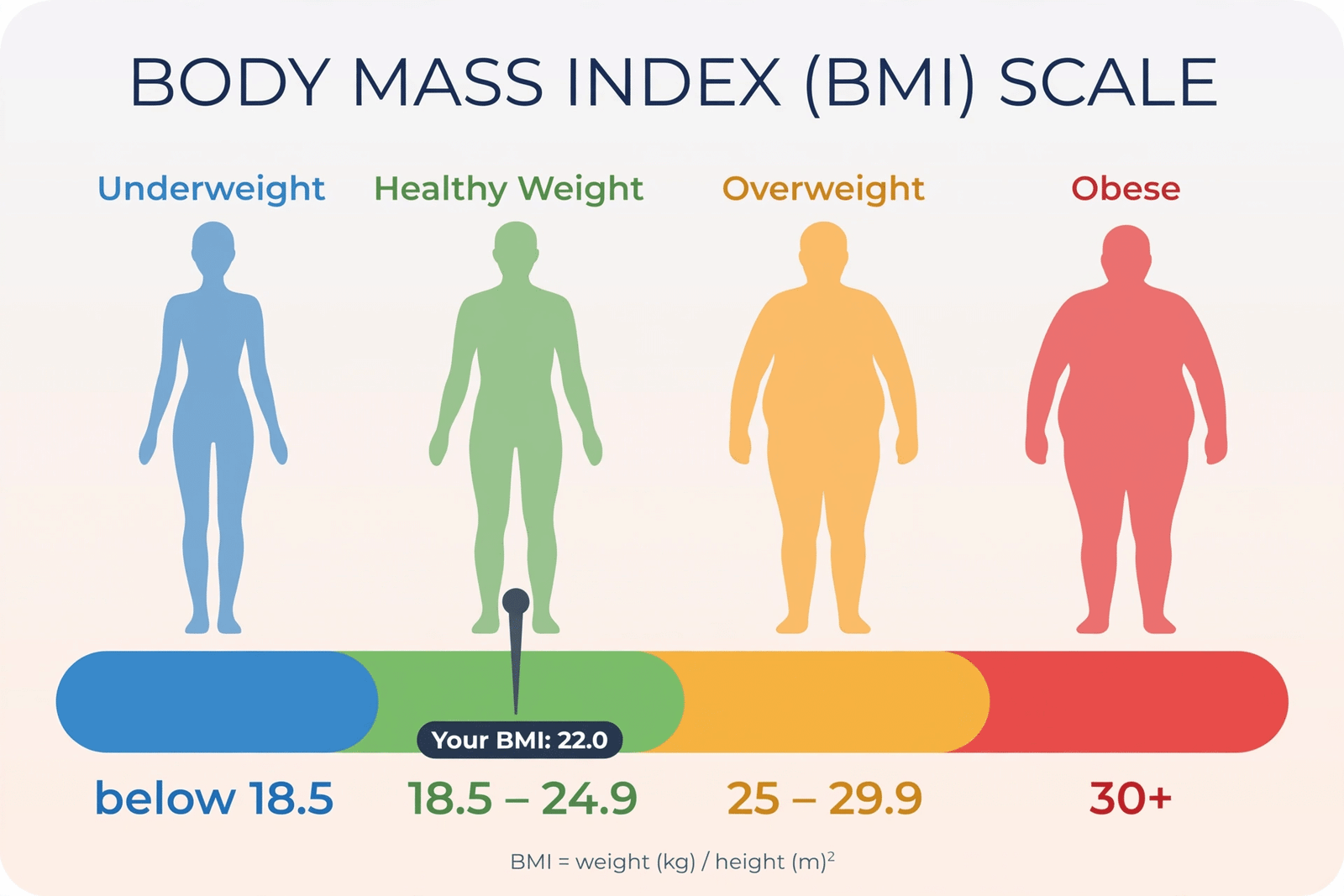
With your number in hand, the next step is to place it on the scale the NHS uses for adults: below 18.5 counts as underweight, 18.5 to 24.9 is the healthy weight range, 25 to 29.9 is overweight, and 30 or above is classed as obese, with higher bands at 35 and 40 marking more severe obesity. These cut-offs are not arbitrary lines drawn for convenience; they reflect the points at which large studies show the average risk of weight-related illness beginning to climb. Landing in the healthy band is associated with the lowest statistical risk, while each step upward corresponds to a higher likelihood of conditions such as type 2 diabetes, high blood pressure, and heart disease developing over time.
One refinement deserves attention, because it affects a large share of the UK population: the NHS recognises lower thresholds for people of South Asian, Chinese, Black African, Black Caribbean, or Middle Eastern family background, who tend to face higher health risks at lower BMIs. For these groups, the overweight range effectively begins at 23 rather than 25, and obesity at 27.5 rather than 30, in line with NICE guidance — a detail confirmed in the NHS guidance on body mass index. If that description fits you, compare your result against the adjusted bands rather than the standard ones, and mention it to your GP so your records reflect the correct thresholds.
The Honest Limitations of BMI
For all its usefulness, BMI has blind spots that you should know about before you let a single number shape your self-image. The most famous is muscle: because the formula cannot distinguish lean tissue from fat, a heavily muscled person — a rugby player, a weightlifter, anyone with years of resistance training — can score well into the overweight or even obese bands while carrying very little body fat. The same maths that makes BMI fair across heights makes it unfair across builds, which is why clinicians treat an athletic high reading very differently from a sedentary one and will usually reach for the tape measure around the waist before drawing conclusions.
There are also whole groups for whom the standard adult categories simply do not apply. Children and teenagers aged two to eighteen are assessed with BMI centiles that account for age and sex, because growing bodies change too fast for fixed cut-offs to make sense. Pregnancy renders the calculation meaningless as a weight guide, and in older adults the relationship between BMI and health risk shifts as muscle naturally declines. None of this makes the index useless — it remains the best cheap first screen medicine has — but it does mean the number deserves context, and anyone with an unusual build, a medical condition, or a result near a boundary should discuss it with a professional rather than acting on it alone.
Keeping Your BMI in the Healthy Range
If your result sits outside the healthy band, the encouraging news is that BMI responds to the least dramatic interventions, provided they are sustained. The behaviours that move the number are unglamorous but well proven: regular moderate activity such as brisk walking, a diet built around vegetables, whole grains, and sensible portions, adequate sleep, and keeping sugary drinks and alcohol within modest limits. Crash diets may shift the scales quickly, but they rarely shift them permanently, whereas small consistent changes — a daily walk, one fewer sugary drink — compound over months into movements of several BMI points, which is more than enough to cross from one category into a healthier one.
Just as important is knowing when the number on its own is not the right tool for the job. If your BMI is below 18.5 without intentional weight loss, or above 30, or moving steadily in the wrong direction despite your efforts, that is a sensible moment to book a GP appointment rather than to keep experimenting alone. The NHS offers structured support including its free twelve-week weight loss plan and local weight management services, and a clinician can check the things BMI cannot see — blood pressure, blood sugar, cholesterol — to build a fuller picture. Treat the index as what it is: a useful compass, not the destination itself.
Frequently Asked Questions
What is the simplest way to calculate BMI at home? The simplest reliable method needs only bathroom scales, a tape measure, and your phone’s calculator, and it takes about two minutes once you know the steps. Weigh yourself in the morning in light clothing, measure your height barefoot against a wall in centimetres and divide by one hundred to get metres, then multiply that height figure by itself and divide your kilogram weight by the result. That final number is your BMI, ready to compare against the NHS bands. The whole procedure rewards consistency more than precision equipment: same scales, same time of day, same conditions each time you repeat it, and your trend over weeks will be far more trustworthy than any single reading.
Do I need the metric system to calculate your body mass index accurately? No — the imperial formula gives exactly the same result on exactly the same scale, provided you include the 703 conversion factor and keep your units consistent throughout. Weigh yourself in pounds, measure your height entirely in inches, square the inches, then divide the weight multiplied by 703 by that squared figure. The classic error is mixing stones with the pounds formula or forgetting the 703, either of which produces a wildly wrong answer that still looks convincing. If you are comfortable in metric, though, the calculation is one step shorter, which is why the NHS presents the kilogram-and-metre version as its standard.
What BMI should I aim for? For most adults in the UK, the target is the 18.5 to 24.9 range that the NHS classes as a healthy weight, since large studies associate that band with the lowest average risk of weight-related disease. Where you sit inside the band matters less than staying inside it steadily over the years, and there is no prize for chasing the bottom of the range. If you are of South Asian, Chinese, Black African, Black Caribbean, or Middle Eastern background, use the adjusted thresholds — overweight from 23 and obese from 27.5 — because health risks in these groups tend to rise at lower BMIs. When in doubt, ask your GP which band applies to you.
Is BMI accurate for muscular people? It is often misleading for them, and this is the most widely acknowledged weakness of the index. Muscle is considerably denser than fat, so someone with substantial lean mass — from weight training, rugby, manual labour, or simply a naturally sturdy frame — can record a BMI in the overweight or obese range while being perfectly healthy by every other measure. Clinicians know this and will not judge a muscular patient by BMI alone; they look instead at waist circumference, fitness, blood pressure, and lifestyle. If you train seriously and your BMI surprises you, treat it as a prompt for a proper assessment, not as a verdict on your health.
How often should I recalculate my BMI? For most people, every four to eight weeks is plenty, always under the same conditions — same scales, same time of day, similar clothing — so that the readings are genuinely comparable. More frequent checking adds noise rather than insight, because normal daily fluctuations in food, water, and even posture can move the number by several tenths without anything meaningful changing. What matters is the slow trend across months: a line drifting steadily down toward the healthy band, or holding stable inside it, tells you far more than any individual figure. If you are actively working with a GP or a weight management programme, follow whatever schedule they suggest instead.
Conclusion
Knowing how to calculate your body mass index is a small skill with an outsized payoff: two home measurements and a minute of arithmetic give you the same screening number that GPs and the NHS use as their starting point. This guide has laid out both the metric and imperial formulas, walked through two fully worked examples so you can verify your own sums, set out the official category ranges including the adjusted thresholds for higher-risk ethnic backgrounds, and been frank about where the index falls short. Kept alongside sensible habits — regular movement, balanced food, enough sleep — the number becomes a genuinely useful compass for long-term health rather than a source of anxiety.
The wisest way to use your result is as the beginning of a conversation, not the end of one. If your BMI sits comfortably in the healthy range and stays there, you have a simple, free way to confirm that your lifestyle is working. If it sits outside that range, or behaves unexpectedly for your build, take the number to your GP along with a short log of your readings — that combination of your own careful measuring and professional context is exactly how a screening tool is meant to be used, and it puts you in the strongest position to protect your health for years to come.
If you found this hands-on approach to health maths useful, you may also enjoy our article on the best supplements for ADHD adults, which takes the same practical, no-nonsense approach to another widely searched health topic and breaks down what the evidence actually says in plain, jargon-free language. You can read the full guide here and keep exploring our health section for more straightforward explainers designed to help you make confident, well-informed decisions about your wellbeing.