Bringing More People Into Three-Dimensional Design
Three-dimensional design is no longer limited to professional studios or people who have spent years learning complex modeling software. Independent creators, small businesses, students, and hobbyists are increasingly interested in producing digital assets for personal projects, online content, product concepts, and physical objects. As these applications expand, accessible creation tools are becoming increasingly valuable.
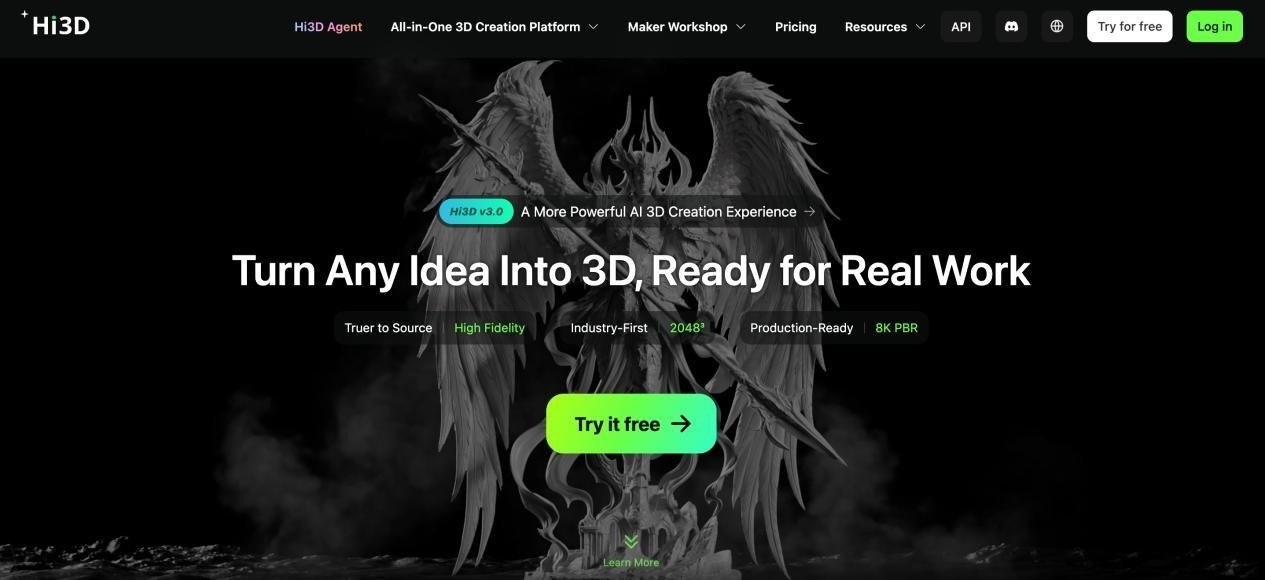
Hi3D is an AI-powered platform that helps users create three-dimensional models from visual references and creative ideas. By combining AI generation with tools for appearance development and model preparation, it provides an alternative to workflows that rely entirely on manual modeling. Users can start with an image or a text description, develop an initial asset, and continue working toward a model suited to their goals.
The platform addresses a common challenge in digital creation: having a clear idea of an object does not necessarily mean knowing how to build it in 3D software. Traditional modeling involves learning how to manipulate geometry, manage surfaces, and organize a scene. These skills remain valuable, but AI-assisted generation can provide an initial result that users can evaluate and refine.
For beginners, this creates an opportunity to experiment without first mastering every technical operation. For experienced designers, it offers another way to explore concepts and establish a starting point for more detailed work.
Reduce the Distance Between Imagination and Execution
Creative ideas often develop faster than they can be modeled. Someone might imagine a distinctive desk accessory, a fictional creature, or an unusual piece of home decor but struggle to translate that idea into precise three-dimensional geometry. The gap between imagination and execution can discourage experimentation, particularly when the project is personal rather than commercial.
Hi3D helps narrow this gap by allowing users to approach creation through familiar inputs. Text descriptions can communicate a concept, while images can provide more specific visual information. AI then assists in developing the idea into a digital asset.
This approach is useful for projects where visual exploration matters more than technical modeling from the beginning. A person designing a collectible might want to test several silhouettes before choosing one to refine. Someone planning a themed decoration could explore different shapes and proportions before committing to a final design.
The generated result may not reproduce every detail exactly as intended, but it can provide a concrete object to evaluate. Instead of considering an idea only in the abstract, users can inspect its volume, silhouette, and overall appearance.
This change in the starting point can make the creative process feel less intimidating. It also gives users a more immediate way to identify what works, what needs improvement, and which direction deserves further attention.
Give Personal Projects More Room to Experiment
Personalization is one of the appealing aspects of digital fabrication. People may want objects that reflect their interests, commemorate an occasion, or match a particular aesthetic. Standard products cannot always meet these preferences, and commissioning a custom design may be expensive or impractical for a small project.
AI-assisted modeling creates another possibility. With Hi3D, users can explore original concepts and generate models that serve as starting points for personalized creations. A tabletop ornament, a miniature character, a themed accessory, or a decorative keepsake can begin with an idea that is specific to the individual rather than selected from a standard catalog.
Text-to-image generation can help users explore a visual direction, while image-to-3D conversion can turn a suitable reference into a model. This combination supports a flexible approach to personal design because users can work from either a description or an existing visual concept.
Personalization still requires thoughtful choices. A model may need adjustments to proportions, dimensions, or small details before it is ready for its intended purpose. Nevertheless, AI generation can help users explore more possibilities before deciding which design to develop.
For hobbyists, the main benefit may be creative freedom. They can experiment with objects that reflect their own interests instead of limiting themselves to designs that are already available.
Support Faster Concept Development for Small Teams
Small design teams often work under practical constraints. They may have limited time, few dedicated modeling specialists, or several concepts that need to be evaluated before a project moves forward. Creating every preliminary asset manually can make early exploration unnecessarily expensive.
Hi3D can support concept development by helping teams produce initial models from reference images and written descriptions. These models can be used to communicate ideas, discuss visual direction, and identify potential changes before more detailed production work begins.
For example, a team exploring a new decorative product might want to compare different shapes or stylistic treatments. AI-assisted generation can provide preliminary versions for discussion, allowing team members to identify promising directions before investing in detailed modeling.
The same approach may be useful for independent product designers, creative agencies, and content teams developing visual assets. A generated model can help communicate a concept more clearly than a written description alone, especially when the design involves unusual forms or distinctive surface details.
It is important to distinguish concept development from engineering validation. An AI-generated model may communicate the intended appearance without meeting the dimensional, structural, or manufacturing requirements of a finished product. Teams should review the geometry and make appropriate adjustments before using the asset for functional testing or commercial production.
Used at the right stage, AI generation can help teams focus their effort on evaluating ideas instead of spending all their time constructing preliminary geometry.
Explore Visual Identity Through AI-Assisted Texturing
A recognizable visual style can make a digital asset more distinctive. The same underlying shape may communicate very different ideas depending on its colors, surface treatment, and material appearance. A smooth, brightly colored object may feel playful, while a darker surface with intricate detail may create a more dramatic impression.
Hi3D includes AI-assisted texturing capabilities that help users explore alternative appearances for generated models. As an ai 3d model texture generator, it allows creators to consider surface design alongside geometry instead of treating the two as entirely separate concerns.
For character artists, texture exploration can help establish a consistent visual identity. A model might be developed with a stylized finish for a collectible concept or a more natural appearance for a different presentation. Designers working on decorative objects can also use surface treatments to investigate how an idea might fit into a particular aesthetic.
These experiments can be useful before a creator settles on a final design direction. Comparing alternative appearances may reveal that a simpler texture communicates the idea more effectively than a highly detailed one, or that a different color treatment makes important features easier to recognize.
Digital appearance, however, should not be confused with physical material behavior. Textures applied to a model do not automatically reproduce the same finish on a printed object. Creators should consider the capabilities of the intended production method when deciding which details are worth preserving.
Connect Digital Creativity With Physical Making
For many users, the appeal of 3D creation comes from the possibility of turning a digital idea into something tangible.An ai 3d print generator can help bridge the gap between digital concepts and physical objects, allowing a model to become a decorative object, a miniature, a personalized gift, or a prototype that can be handled and examined. Moving from a digital file to a physical object, however, introduces requirements that do not always matter during visual design.
Hi3D includes tools intended to support parts of this transition. Its model-splitting capabilities can help divide larger or more complicated designs into sections that are easier to print. Where supported, connection structures can assist with assembling the resulting parts. Its multicolor processing tools can also help users prepare models with distinct color regions for compatible printing workflows.
These features are relevant because successful printing involves more than generating a visually appealing shape. The model must fit the available equipment, use appropriate geometry, and be processed in a way that matches the intended material and printer.
Consider a decorative sculpture that is too large for a particular printer. Dividing it into smaller sections may make production more practical, but the user still needs to check the dimensions, connection points, and assembly process. Likewise, a colorful figurine may require adjustments to small features so that its appearance remains clear after printing.
Hi3D can help establish a starting point for these tasks, while final preparation and quality checks remain important. Users without their own equipment may also explore the platform’s printing and delivery service where available, providing an alternative route to obtaining a physical version of a suitable model.
Develop Different Types of Three-Dimensional Content
The usefulness of AI-assisted modeling extends beyond a single creative discipline. Different users approach 3D content with different goals, and a flexible generation platform can provide value across several kinds of projects.
For hobbyists, the platform can support experimentation with miniature designs, decorative accessories, fictional characters, and objects inspired by personal interests. These projects often prioritize originality and visual appeal, making AI-generated starting points particularly useful.
For educators, accessible modeling tools can introduce students to the relationship between images, shapes, and physical objects. Learners can examine how a visual concept becomes a three-dimensional form and discuss the limitations of automated generation. This can provide a practical starting point for activities involving design, digital creativity, and fabrication.
Digital artists may use generated models as preliminary assets for illustration, visualization, or further development in dedicated 3D applications. Rather than expecting the initial output to be production-ready, they can treat it as a foundation for artistic refinement.
Small businesses may investigate AI-assisted modeling when exploring custom product concepts or developing early visual materials. The ability to produce preliminary assets can help teams communicate ideas and assess potential designs before deciding whether to invest in more detailed development.
These applications share a common principle: AI can make the first stage of creation more accessible, while the amount of additional work depends on the project’s purpose and quality requirements.
Work With Models Beyond a Single Platform
Creative workflows rarely end when a model is generated. Users may need to edit the geometry, prepare a file for printing, import an asset into another application, or share it with collaborators. Compatibility with downstream tools is therefore an important consideration when selecting an AI 3D platform.
Hi3D supports several export formats across its tools, with options that may include STL, OBJ, GLB, FBX, USDZ, and 3MF. The formats available depend on the specific workflow, so users should check the export options provided for their chosen feature.
Different formats serve different purposes. STL and 3MF are commonly used in 3D printing workflows, whereas OBJ, GLB, and FBX are often used to transfer assets between 3D applications and digital content pipelines. Selecting an appropriate format helps ensure that the generated asset can be used in the next stage of a project.
This approach allows Hi3D to fit into a broader creative process. Users can generate an initial model with AI, refine it in compatible software, and prepare it using tools suited to their particular requirements. The platform can therefore serve as an entry point rather than requiring every subsequent task to happen in the same environment.
For developers and businesses that want to integrate AI generation into their own applications, Hi3D also provides API services. Supported capabilities can include image-based generation, relief creation, model splitting, and multicolor processing. The exact implementation requirements depend on the API, and technical teams should review the relevant documentation before integrating these functions.
Approach AI Generation With Realistic Expectations
AI-assisted 3D creation can simplify parts of a workflow, but the quality of the output depends on several factors. The clarity of the input image, the complexity of the subject, the intended level of detail, and the requirements of the final application all influence whether a generated model is suitable for use.
A visually convincing result may still contain irregular geometry or details that do not translate well into physical production. A model intended for animation may need different refinements from one designed for 3D printing. Likewise, an object that looks appropriate in a preview may require dimensional adjustments before it can function as a real product.
Users can improve their results by starting with clear references, defining the intended purpose of the model, and checking the output carefully. Simple concepts are often easier to evaluate than designs with many overlapping parts or extremely fine details. When precision matters, additional editing and testing should be part of the workflow.
Hi3D is best understood as a tool for making selected stages of 3D creation more accessible, not as a guarantee that every generated asset will be ready for immediate production. This distinction helps users choose the right tasks for AI assistance and understand when conventional modeling or technical validation is still necessary.
Make More Ideas Worth Exploring
The growing role of AI in 3D design is changing how people approach the beginning of a creative project. Instead of building every preliminary shape manually, users can work from images and descriptions, evaluate generated assets, and decide which concepts deserve further development.
Hi3D brings together tools for visual exploration, model generation, texturing, relief creation, and print-oriented preparation. Its broader value lies in giving users more ways to begin a project and helping them move from an initial concept toward a model that can be refined for different purposes.
Whether someone is exploring a personal design, developing a preliminary product concept, or experimenting with physical fabrication, the platform provides an accessible starting point. With careful review and appropriate follow-up work, AI-assisted creation can make three-dimensional design easier to explore while leaving room for human creativity, technical judgment, and individual expression.