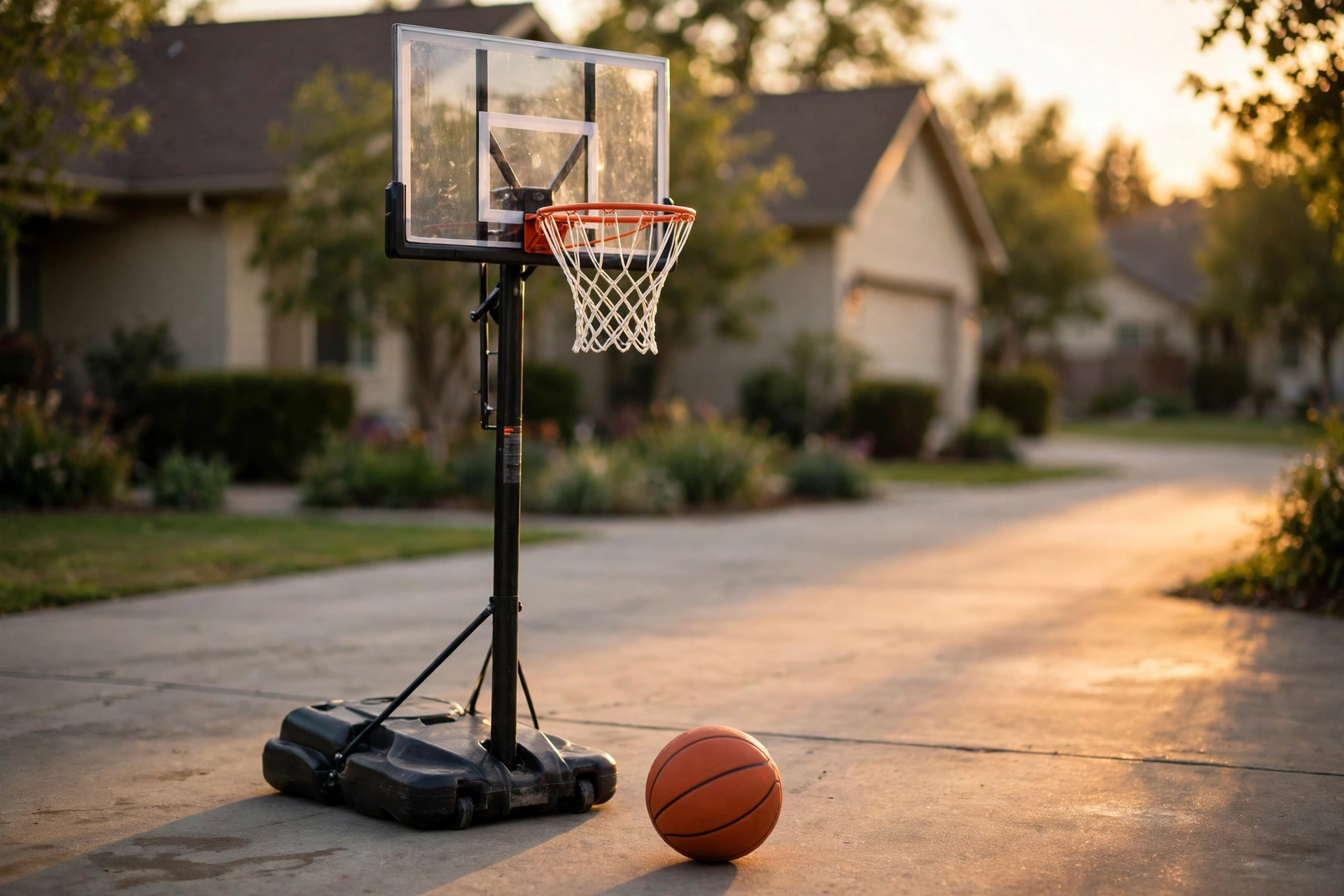
A basketball hoop is one of the simplest ways to bring the game home, whether you want a serious practice setup in the driveway, a fun hoop for the kids in the garden, or a permanent court for the whole family. But not all hoops are the same, and the difference between a hoop you use every day and one that gathers dust in the garage usually comes down to choosing the right type, the right size, and the right place to put it. This guide explains the main types of hoops, the backboard materials, the heights that suit different players, and the installation and safety basics you need to know before you buy.
Buying a hoop is a bigger decision than it first appears, because a good one is a long-term purchase. A cheap hoop with a flimsy pole and a thin backboard will wobble, rust, and frustrate anyone who tries to practise seriously on it. A well-chosen hoop, on the other hand, can last for years and become the centre of daily games, shooting practice, and family time. The aim of this guide is to help you spend your money wisely, avoid the common mistakes, and end up with a hoop that fits your space, your players, and your budget.
Types of Hoop
There are three main types of hoop, and the right one for you depends on how permanent you want the setup to be and how much space you have. Portable hoops are the most popular choice for home use. They have a wheeled base that you fill with water or sand for stability, and they can be moved around the driveway or garden when needed. Portable hoops are a good option if you rent your home, if you want to store the hoop away in winter, or if you are not sure where the best spot is yet. The trade-off is stability: even a well-filled portable base will move slightly on hard dunks and strong shots, and lighter models can tip over in strong wind if they are not anchored properly.
In-ground hoops are the most stable and the most professional option. The pole is set into a concrete footing in the ground, which makes the hoop rock solid and gives the most realistic playing experience. If you have a permanent driveway or court area and you play regularly, an in-ground hoop is the best long-term investment. The downside is that installation is a bigger job, involving digging, concrete, and curing time, and once it is in, it is not moving. Wall-mounted hoops are the third option: the backboard and rim attach directly to a wall or garage, which saves floor space and avoids the need for a pole at all. They work well in smaller gardens and on garage walls, but they need a strong, solid wall and they offer less flexibility on height adjustment than a freestanding system.
Basketball Hoop Heights and Sizes
The official height of a basketball hoop is 10 feet, or 3.05 metres, measured from the playing surface to the top of the rim. That is the regulation height used in professional and adult competitive basketball, and it is the height that most serious players should aim for. However, not every player needs a 10-foot hoop, and for children and beginners a lower height makes the game far more enjoyable. Many modern hoops are height-adjustable, typically from around 7.5 feet up to the full 10 feet, which means the hoop can grow with the player. For younger children, a height of around 8 feet is a good starting point, while teenagers can usually handle 9 to 10 feet.
Backboard size matters too. A larger backboard gives you a bigger target for bank shots and makes the hoop feel more like a real court setup. Regulation backboards measure 72 inches wide by 42 inches tall, and that is the size used in professional play. Home hoops commonly come in 44-inch, 48-inch, 54-inch, and 60-inch widths, and the right size depends on your space and your ambitions. A 54-inch or 60-inch backboard is a good choice for a dedicated home court, while a 44-inch or 48-inch board is fine for casual play in a smaller driveway. The rim itself is a standard 18 inches in diameter, and a good rim should have a breakaway spring mechanism that flexes under pressure, which protects both the backboard and the player during dunks and hard shots.
Backboard Materials Compared
The backboard is where you will notice the biggest difference between a cheap hoop and a good one, because the material determines how the ball bounces. Tempered glass is the best material and the one used in professional arenas: it gives a true, consistent rebound and looks the part, but it is also the heaviest and most expensive option, and it needs a strong pole and base to support it. If you play seriously and want the most realistic rebound, tempered glass is worth the investment, provided your hoop system is built to carry it.
Acrylic is the most common material for mid-range home hoops. It looks similar to glass, gives a good rebound, and is lighter and cheaper, which makes it a sensible choice for most families. Polycarbonate is the toughest and lightest option: it is virtually unbreakable and handles weather well, but the rebound is noticeably less lively than glass or acrylic, so it suits younger players and casual games more than serious practice. Steel and moulded plastic backboards are found on budget and junior hoops; they are durable and cheap, but the rebound is poor and they can look and feel basic. When choosing, think about who will use the hoop most: serious players will appreciate glass or acrylic, while younger children will be perfectly happy with polycarbonate.
How to Choose the Right Basketball Hoop
Choosing the right hoop starts with your space. Measure the area where you plan to play, and make sure there is enough clear room around the hoop for safe play, including space behind the backboard and room to run, shoot, and land without hitting walls, fences, or cars. A driveway is the most common home location, but a flat section of garden or a dedicated court area also works well. Check that the surface is level and solid, because an uneven surface will make the hoop unstable and the ball bounce unpredictably. Also think about the neighbours: a hoop near a shared boundary can send stray balls into the next garden, so position it with that in mind.
Next, think about who will play and how often. If the hoop is mainly for young children, a portable or junior hoop with an adjustable height is the practical choice, and you do not need to spend a fortune. If teenagers or adults will practise regularly, invest in a sturdier system with a larger backboard and a proper breakaway rim. Consider the weather in your area too: hoops left outside all year need rust-resistant poles, weatherproof backboards, and a base that will not crack in frost. Finally, check the warranty and the availability of spare parts, because a rim, net, or backboard that can be replaced is better than a hoop that becomes useless after one broken part.
Installation and Safety Basics
Installing a hoop is straightforward for portable models but needs care for in-ground systems. A portable hoop simply needs its base filled with water or sand according to the instructions, and many owners add extra weight or anchor straps for stability. For an in-ground hoop, you will need to dig a hole, pour concrete, and allow it to cure fully before attaching the pole and backboard, which usually takes at least 24 to 72 hours depending on the product and the weather. Always follow the manufacturer’s instructions exactly, because the concrete footing is what keeps the hoop upright and safe. If you are unsure about the digging or the concrete work, hiring a professional installer is money well spent. For more detail on backboard design and construction, the backboard overview on Wikipedia is a useful reference.
Safety deserves the same attention as installation. Check the hoop regularly for loose bolts, rust, cracks in the backboard, and wear on the rim and net, and tighten or replace parts as needed. Never let anyone hang from the rim unless the system is specifically rated for it, and never climb the pole. Keep the playing area clear of obstacles, and make sure children understand that the hoop is not a climbing frame. If your hoop is portable, check the base level regularly, because water can leak and sand can settle, reducing stability over time. A quick monthly check takes only a few minutes and can prevent an accident and extend the life of the hoop.
Maintaining Your Hoop
A hoop that is looked after will last far longer than one that is ignored. The net is the part that wears out first, so replace it when it frays or tears, and choose a heavy-duty net if the hoop is used daily. Keep the backboard clean with mild soap and water, and avoid abrasive cleaners that can scratch acrylic or polycarbonate. Check the pole and base for rust, especially at the joints and bolt holes, and touch up any scratches with rust-resistant paint before they spread. Lubricate the height-adjustment mechanism occasionally so it stays smooth, and store any removable parts, such as a portable base cover, properly when not in use.
If you live in an area with harsh winters, consider moving a portable hoop into a garage or shed during the coldest months, or at least covering it to protect it from frost and snow. For in-ground hoops, a cover over the backboard can reduce weather damage. At the end of each season, give the whole system a once-over: tighten every bolt, check the rim springs, inspect the backboard for cracks, and replace anything that is worn. These small jobs are easy to put off, but they are what separate a hoop that lasts five years from one that lasts fifteen.
What size basketball hoop do I need?
The size of hoop you need depends on your space and who will play. A 54-inch or 60-inch backboard suits a dedicated home court and serious players, while a 44-inch or 48-inch backboard is fine for casual play in a smaller driveway. The rim is a standard 18 inches across, and the official rim height is 10 feet. If children will use the hoop, choose an adjustable model that can be lowered to around 7.5 or 8 feet and raised as they grow.
Is a portable or in-ground basketball hoop better?
An in-ground hoop is better for stability and for serious play, because the pole is set in concrete and does not move. A portable hoop is better for flexibility, because it can be moved, stored away, and used without permanent installation. Choose an in-ground hoop if you have a permanent court area and play regularly; choose a portable hoop if you rent, want to move it, or are not ready to commit to a fixed location.
How much does a basketball hoop cost?
The cost of a hoop varies widely depending on the type, size, and materials. Budget portable hoops for children can be inexpensive, mid-range portable and wall-mounted hoops for family use sit in the middle, and high-end in-ground systems with tempered glass backboards cost considerably more, especially once installation is included. As a general rule, spending more on a sturdier pole, a larger backboard, and a better rim gives you a hoop that plays better and lasts longer.
Can you install a hoop yourself?
You can install a portable hoop yourself in under an hour, since it mainly involves assembling the pole and backboard and filling the base with water or sand. An in-ground hoop is a bigger job that involves digging, pouring concrete, and waiting for it to cure, and many people hire a professional for that part. A wall-mounted hoop can be a DIY job if you are confident fixing heavy brackets to a solid wall, but the wall must be strong enough to take the load.
How do I stop my portable hoop from tipping over?
To stop a portable hoop from tipping over, fill the base completely with sand rather than water, because sand is heavier and does not leak or freeze. Place the hoop on a flat, level surface, keep it out of strong wind where possible, and consider adding ground anchors or sandbags for extra stability. Check the base regularly, because a base that has lost weight is the most common cause of a hoop tipping over.
What is the best backboard material for a home hoop?
The best backboard material for a home hoop depends on how seriously you play. Tempered glass gives the most realistic rebound and is the professional choice, acrylic gives a good rebound at a lower price and weight, and polycarbonate is the toughest and most weather-resistant option but has a less lively bounce. For most families, acrylic offers the best balance of performance, weight, and price.
Conclusion
Choosing a basketball hoop is about matching the hoop to your space, your players, and how often you will play. A portable hoop is the flexible choice for families and renters, an in-ground hoop is the best option for a permanent court and serious practice, and a wall-mounted hoop is a smart solution for smaller spaces. Pay attention to the backboard size and material, choose a height-adjustable system if children will use it, and take installation and safety seriously, because a stable, well-maintained hoop is a safe hoop. Get those decisions right, and it will give you years of games, practice, and time outdoors.
For another straightforward sporting explainer, take a look at our guide to rugby positions, which explains every role on the field in simple terms.