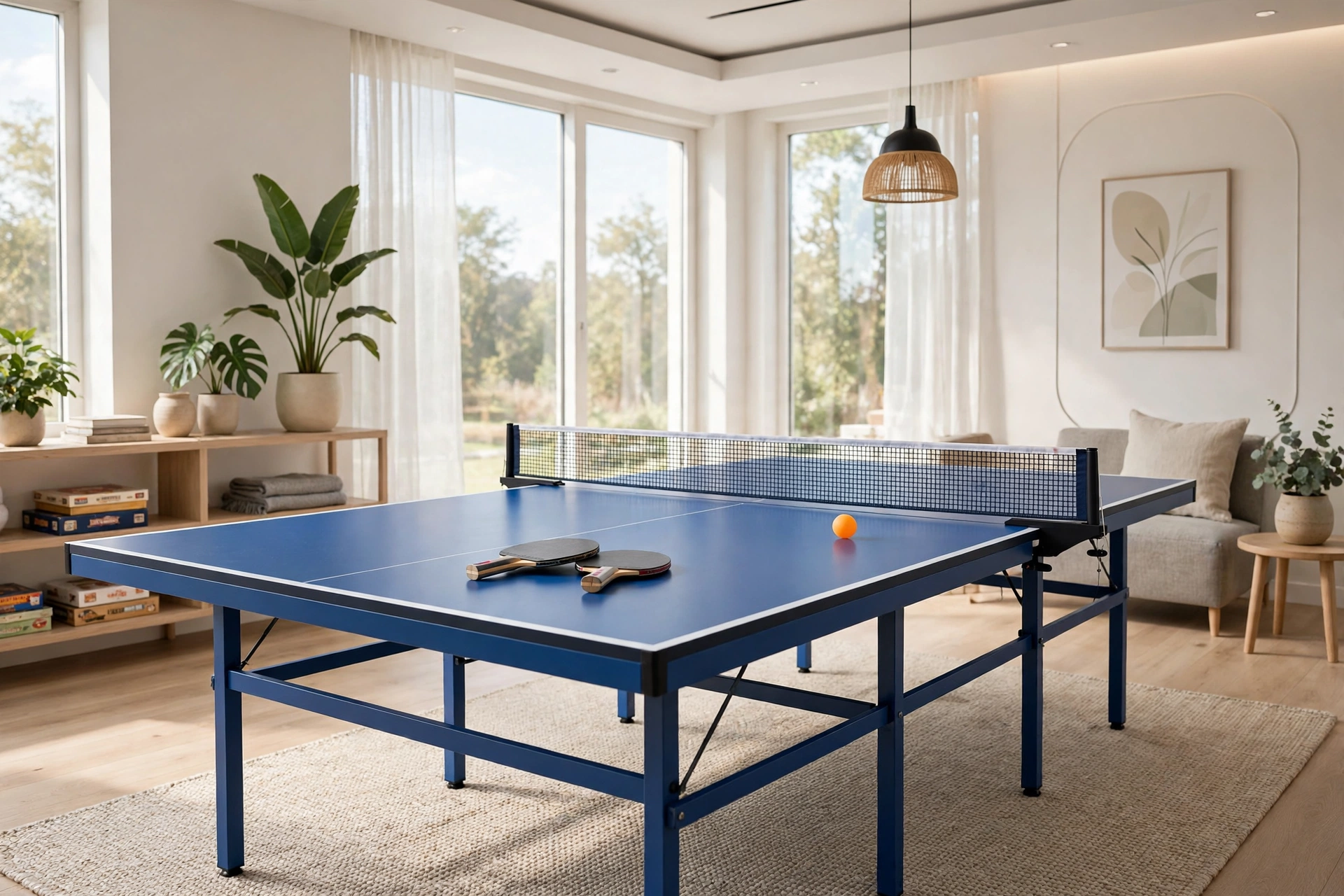
A table tennis table is one of the best value pieces of sports equipment you can buy for a home, a school or a club, because a single table can keep a whole family or a whole class busy for years. The problem is that not all tables are the same, and the differences that matter most are not obvious from a photograph. A table that is too thin will give a dead, uneven bounce, a table that is too big for the room will leave no space to play, and an indoor table left outside will warp within a season. This table tennis table buying guide explains the standard sizes, the types of table, the thickness that affects bounce, and the brands to look for, so you can choose a table that suits your space, your budget and the way you actually play.
The first thing to understand is that table tennis is a game of precise measurements, and the table you buy should match them if you want a proper game. The International Table Tennis Federation, the ITTF, sets the official dimensions used in Olympic and World Championship play, and most reputable manufacturers build their full-size tables to those dimensions. That does not mean every home needs a competition table, because smaller tables exist for children and for tight spaces, but it does mean you should know the standard before you decide to go smaller. A table tennis table is also a large piece of furniture, so measuring your room is just as important as choosing the table itself.
Standard Table Tennis Table Size
The official size of a full-size table tennis table is 274 centimetres long, 152.5 centimetres wide and 76 centimetres high, which works out at 9 feet by 5 feet by 2 feet 6 inches. The net sits across the middle of the table and stands 15.25 centimetres, or 6 inches, high, and the playing surface is usually dark green or dark blue with white boundary lines 2 centimetres wide. Those measurements are set by the ITTF and apply to every table used in sanctioned competition, so a table that claims to be full size but measures less than 274 by 152.5 centimetres is not a genuine full-size table, whatever the listing says.
Knowing the official size matters even if you never play competitively, because the size of the table determines the size of the room you need. A full-size table tennis table needs space around it for players to move, step back and swing, and a room that only just fits the table will make the game cramped and frustrating. As a rough guide, a comfortable casual playing area is around 5.8 metres long by 3.4 metres wide, while competitive play needs closer to 8.5 metres by 4 metres, and a ceiling height of around 3 metres is recommended so that high lobs do not hit the ceiling. If your room is smaller than that, a midi or mini table may be a better choice than squeezing a full-size table into a space that cannot hold it.
Table Tennis Table Types: Indoor, Outdoor and Foldable
Table tennis tables come in three broad types, and the type you choose depends on where the table will live. Indoor tables are designed for use inside a house, a hall or a club, and they usually have a wooden top made from medium-density fibreboard, or MDF, which gives a consistent bounce but must be kept dry. An indoor table left in a damp garage or outside in the rain will absorb moisture, warp and lose its playing quality, so indoor tables should be stored somewhere dry. Most indoor tables are also foldable, which means each half can be folded up vertically for storage or for solo practice against one half in playback mode.
Outdoor tables are built to survive the weather, and they use tops made from weatherproof materials such as aluminium composite, resin laminate or treated plywood, with frames and legs that resist rust. An outdoor table tennis table can live in a garden, a patio or a school playground all year round, although it is still sensible to use a cover in the worst of the winter. The bounce on an outdoor table is usually slightly different from an indoor table, and the top is often a little thicker and heavier, but for casual play the difference is small and the convenience of leaving the table outside is worth it for many families. If you are not sure whether your table will stay inside, an outdoor model is the safer choice.
Foldable tables are not a separate type so much as a feature that most modern tables share, and they come in two main styles. Rollaway tables have two separate halves, each on its own set of wheels, so the halves can be pushed apart for play and pushed together for storage. One-piece tables have a single frame with both halves hinged, which is more stable but heavier to move. Either way, look for lockable wheels, a safe folding mechanism that cannot drop suddenly, and a playback position that lets one half stand upright so a single player can practise against it. Some cheaper tables have no wheels at all, which makes them very awkward to move, so wheels are worth paying for.
Tabletop Thickness and Bounce Quality
Tabletop thickness is the single most important factor in how a table tennis table plays, and it is the detail that separates a good table from a disappointing one. Thicker tops give a more consistent, livelier bounce, because the playing surface is stiffer and less likely to flex or vibrate when the ball hits it. Thinner tops can feel hollow and dead, and the bounce can vary across the surface, which makes rallies unpredictable and makes it harder to learn proper strokes. The thickness is measured in millimetres, and the common options are 12 millimetres, 15 millimetres, 18 millimetres, 22 millimetres and 25 millimetres.
For occasional family play, a top of 12 to 15 millimetres is usually adequate, and it keeps the table light and affordable, although the bounce will be noticeably softer than on a thicker table. For regular home use, a top of 16 to 19 millimetres is a practical middle ground, offering a much better bounce without a big jump in price or weight. For clubs, schools and serious players, a top of 19 to 22 millimetres is the usual choice, and competition tables use a 25 millimetre top, which is the thickest commonly available and gives the most consistent rebound. The ITTF standard for approved competition tables is a minimum top thickness of 22 millimetres, with a ball dropped from 30 centimetres expected to bounce back to around 23 centimetres. If you can afford it, buying a thicker top is the single best upgrade you can make.
Table Tennis Table Brands and What They Offer
There are several well-established table tennis table brands, and knowing the main names helps you compare like with like. Stiga is one of the oldest names in the sport and makes tables for every level, from budget home tables to ITTF-approved competition models, and it is widely sold in the UK. Cornilleau, a French manufacturer, is best known for its outdoor tables, which are built to survive years outside and are popular with schools and leisure centres. Butterfly is the premium brand most associated with professional play, and its tables are used in major tournaments, while Killerspin is an American brand that combines playing quality with striking design.
Alongside those names, there are many own-brand and value tables sold by sports retailers and online marketplaces, and some of them offer good value for casual play. The key is to compare the specification rather than the brand name, because a 19 millimetre table from a lesser-known maker can play better than a 12 millimetre table from a famous one. Check the top thickness, the frame construction, the wheel quality and the warranty, and read customer reviews from people who have actually played on the table. If you plan to play competitively, look for the ITTF approval logo on the table or in the product specification, and check that the model appears in the ITTF approved equipment list, because terms such as regulation size and tournament ready have no official meaning on their own.
How to Choose the Right Table Tennis Table
Choosing the right table tennis table starts with your room, because the table has to fit with enough space to play around it. Measure the length and width of the room, then subtract at least 1.5 metres from each end and 1 metre from each side for movement, and see whether a full-size table still fits. If it does not, consider a midi table, which measures around 152 by 76 centimetres, or a mini table for children, which is around 90 by 45 centimetres, rather than buying a full-size table that leaves no room to swing a bat. Remember to check the ceiling height as well, because a low ceiling will spoil high shots, and check that you can get the table through the door when it arrives.
The next question is how often the table will be used and by whom. A family that plays once a week in the garden needs a weatherproof outdoor table with a 12 to 15 millimetre top, while a club that plays every night needs a 22 to 25 millimetre indoor table with a strong steel frame and lockable wheels. A school needs something in between, with a top thick enough to survive heavy use and a frame sturdy enough to be moved by staff. Budget matters too, but it is worth spending a little more on thickness and build quality, because a table is a long-term purchase and a cheap table that warps or wobbles will need replacing far sooner than a good one. Set your budget, then buy the thickest top and the strongest frame you can afford within it.
Table Tennis Table Accessories You Will Need
A table tennis table on its own is not enough to play, and the accessories you buy will affect how much you enjoy the game. At minimum you need two bats and a few balls, and it is worth buying more balls than you think you need, because table tennis balls are light, they roll under furniture, and they crack easily. Bats range from cheap pre-made bats that are fine for beginners to custom bats with separate rubbers for serious players, and for most families a pair of mid-priced bats is a good starting point. A table cover is also a sensible purchase, because it protects the top from dust, sunlight and spills, and it is essential if the table is stored in a garage.
Other useful accessories include a net and post set if your table does not come with one built in, a ball picker or a box to keep balls together, and a storage bag for bats. Some tables are sold as bundles that include bats, balls and a cover, which can be good value, although the bats in a bundle are often basic, so check what is included before you buy. If you play outdoors, a windproof net and a set of heavier outdoor balls can help, because standard balls are easily blown off course. None of these accessories is expensive, but buying them at the same time as the table means you can start playing straight away.
Setting Up and Looking After Your Table Tennis Table
Setting up a table tennis table is usually straightforward, but it is worth taking the time to do it properly. Assemble the table on a flat, level surface, following the instructions, and check that all bolts are tight before you play on it. Use a spirit level on the playing surface if you have one, because a table that is not level will give an uneven bounce and the ball will roll to one side. Adjustable feet are useful on uneven floors, so check whether your table has them and use them to get the surface level. Once the table is assembled, fit the net and check that it is 15.25 centimetres high and taut across the middle, because a sagging net changes the game.
Looking after the table is mostly a matter of keeping it clean, dry and covered when it is not in use. Wipe the top with a slightly damp cloth to remove dust, and avoid using harsh cleaning products that could damage the surface. Keep drinks and food away from the table, because spills can stain or warp the top, and never stand or sit on the table, because the top is not designed to take a person’s weight. If the table is foldable, make sure the folding mechanism is locked when the table is upright, and keep children away from the hinges. With basic care, a good table tennis table should last for many years, and the playing surface should stay true for as long as you own it.
Indoor Versus Outdoor: Which Table Tennis Table Is Better
The question of whether an indoor or an outdoor table tennis table is better has no single answer, because it depends entirely on where the table will be used. An indoor table gives the best playing experience, with a consistent bounce, a smooth surface and protection from wind and weather, and it is the right choice for a games room, a club or a school hall. The downside is that it must stay inside and dry, which means you need a suitable room and somewhere to store it when it is folded away. An indoor table is also usually lighter and easier to move, which matters if the room is used for other things.
An outdoor table gives a slightly less perfect bounce, but it can live outside all year and be used whenever the weather allows, which makes it the right choice for a garden, a patio or a playground. Outdoor tables are built with weatherproof tops and rust-resistant frames, and many of them have a cover included or available as an accessory. The best choice for most families is to decide honestly where the table will spend most of its time, and to buy the type that matches that location, rather than buying an indoor table and hoping it survives outside. If you have both a garden and a garage, an outdoor table is often the more flexible option, because it can be used in either place.
Common Mistakes When Buying a Table Tennis Table
One of the most common mistakes when buying a table tennis table is choosing on price alone and ending up with a very thin top that gives a poor bounce. A table with a 12 millimetre top may look like a bargain, but if the bounce is dead and inconsistent, nobody will enjoy playing on it and the table will end up folded away in a corner. Another common mistake is not measuring the room, and discovering too late that there is no space to step back from the table or to swing a bat properly. Always measure before you order, and remember to allow space for players as well as for the table itself.
A third mistake is buying an indoor table for outdoor use, which will warp the top and void the warranty, and a fourth is ignoring the weight and the wheels, which makes the table very hard to move. Check the weight in the specification and make sure the wheels are lockable and large enough to roll over the floor you have. Finally, many buyers forget to check what is included, and are surprised to find that the table comes without a net, without bats and without a cover. Read the full specification before you buy, and factor the cost of the accessories into your budget, so there are no surprises when the table arrives.
What Size Is a Table Tennis Table
What size is a table tennis table? A full-size table tennis table measures 274 centimetres long, 152.5 centimetres wide and 76 centimetres high, which is 9 feet by 5 feet by 2 feet 6 inches. The net is 15.25 centimetres, or 6 inches, high. Those are the official dimensions set by the International Table Tennis Federation, the ITTF, and they apply to every table used in sanctioned competition. Smaller midi tables measure around 152 by 76 centimetres and mini tables around 90 by 45 centimetres, but those are not full-size tables.
What Thickness Table Tennis Table Is Best
What thickness table tennis table is best? For occasional family play, a 12 to 15 millimetre top is adequate, and for regular home use a 16 to 19 millimetre top is a practical choice that gives a much better bounce. For clubs, schools and serious players, a 19 to 22 millimetre top is recommended, and competition tables use a 25 millimetre top. The ITTF minimum for approved competition tables is 22 millimetres, with a ball dropped from 30 centimetres expected to bounce to around 23 centimetres. As a general rule, buy the thickest top you can afford, because thickness is the main factor in bounce quality.
Are Outdoor Table Tennis Tables Any Good
Are outdoor table tennis tables any good? Yes, outdoor table tennis tables are good for casual and family play, and they are built with weatherproof tops and rust-resistant frames so they can live outside all year round. The bounce is usually slightly less consistent than on a top-quality indoor table, but for most players the difference is small and the convenience of leaving the table outside is worth it. If you want the best possible bounce and you have a suitable indoor room, an indoor table is the better choice, but if your table will live in the garden, an outdoor model is the right one to buy.
How Much Space Do You Need for a Table Tennis Table
How much space do you need for a table tennis table? A full-size table tennis table needs a playing area of around 5.8 metres by 3.4 metres for comfortable casual play, and around 8.5 metres by 4 metres for competitive play, with a ceiling height of around 3 metres for high shots. The table itself is 274 by 152.5 centimetres, so the extra space is for players to move, step back and swing. If your room is smaller than that, consider a midi or mini table, or an outdoor table for the garden, rather than squeezing a full-size table into a space that cannot hold it.
How Do You Store a Table Tennis Table
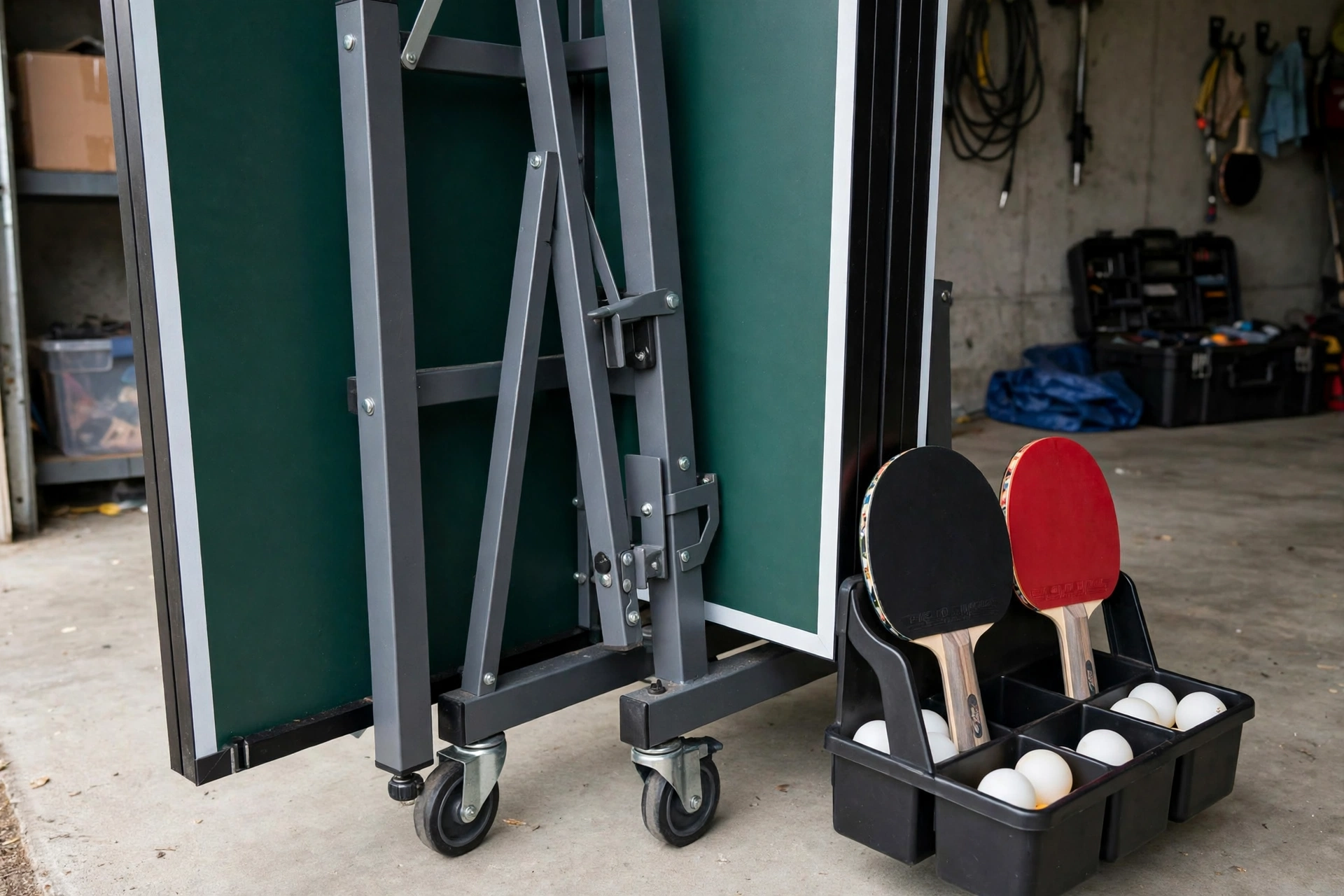
How do you store a table tennis table? Most modern table tennis tables fold up, with each half folding vertically so the table takes up far less floor space, and many have wheels so they can be rolled into a corner or a garage. Lock the folding mechanism and the wheels once the table is in its storage position, and use a cover to protect the top from dust and damage. Indoor tables should be stored somewhere dry, because damp can warp the top, while outdoor tables can stay outside under a cover. Never store heavy items on top of a folded table, and keep children away from the folding hinges.
Do Table Tennis Tables Need a Cover
Do table tennis tables need a cover? A cover is not essential, but it is a sensible purchase, because it protects the playing surface from dust, sunlight, spills and scratches when the table is not in use. It is especially important for outdoor tables, which face rain and sun all year, and for tables stored in a garage, where dust and damp can damage the top. A cover is inexpensive compared with the cost of the table, and it can extend the life of the playing surface by years, so it is worth buying one at the same time as the table.
Conclusion
A table tennis table is a simple purchase once you know what to look for, and the key points are easy to remember. Buy a full-size table if your room can hold one, and check the official dimensions of 274 by 152.5 by 76 centimetres before you order. Choose an indoor table for a games room or a club, and an outdoor table for a garden or a playground, and never leave an indoor table outside. Pay attention to tabletop thickness, because a 19 millimetre top will play far better than a 12 millimetre top, and buy the thickest top your budget allows. Check the wheels, the folding mechanism and what is included, and read reviews before you commit. If you get those decisions right, your table tennis table will give you years of rallies, and it will still be giving a true bounce long after cheaper tables have warped or been forgotten in the garage. To learn more about the sport itself, including clubs and competitions in England, visit Table Tennis England, the national governing body for the sport.
If you enjoy following team sports, you may also like our guide to rugby positions, which explains every role on the rugby pitch.