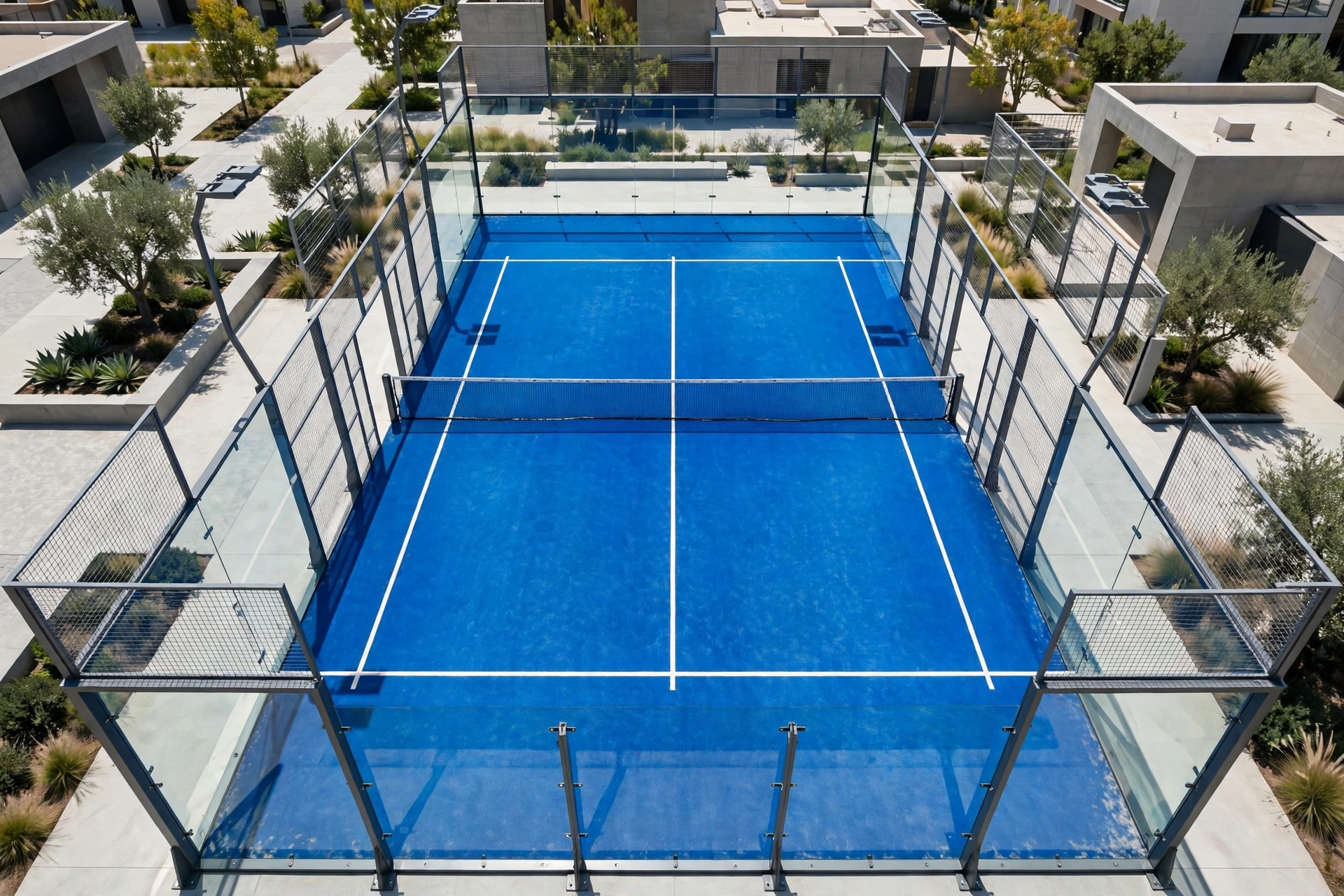
A padel court is one of the most distinctive sights in modern sport: a compact, glass-walled enclosure about the size of a small garden, where four players rally a ball off the walls as well as over the net. Padel has grown rapidly across the UK and Europe in recent years, and new courts are appearing in leisure centres, tennis clubs, parks and private developments. Yet while most people know how to play the game, far fewer know what a padel court actually is, how big it is, what it is made of, and what it takes to build or book one. This guide explains the padel court in full, from its official dimensions and glass walls to its surfaces, lighting and costs, so you know exactly what you are looking at the next time you step onto one.
The most important thing to understand about a padel court is that it is not a smaller tennis court. It is a fully enclosed structure, and the walls are part of the game, which means the dimensions, the materials and the height of the enclosure are all set by strict rules. The International Padel Federation, known as the FIP, publishes the official regulations, and any court built for competition has to follow them. Recreational courts should follow the same standards too, because a court that is the wrong size or has the wrong walls will not play properly and will not be accepted for official matches. A padel court is therefore a piece of sports engineering as much as a playing space.
Padel Court Dimensions: The Official Size
The official dimensions of a padel court are set by the International Padel Federation, and they are precise. A standard doubles padel court measures 20 metres long by 10 metres wide, giving a playing area of 200 square metres, and the court is divided in half by a net, so each side is a 10 metre by 10 metre square. The FIP allows a tolerance of just 0.5 per cent on those dimensions, which means a competition court has to be built to within a few centimetres of the official size. For comparison, a padel court is roughly a quarter smaller than a tennis doubles court, which is part of the reason the game feels fast and close.
The 20 by 10 metre figure is the playing area inside the walls, not the total footprint of the structure, and that distinction matters if you are planning a build. The walls themselves, the posts, the access gates and the space around the court for players and spectators all add to the footprint, so a realistic site allowance is around 21 metres by 11 metres for a single court, and more if you want circulation space, seating or a viewing area. There is also a singles version of the court, which measures 20 metres long by 6 metres wide, but singles courts are rare and most clubs build doubles courts, because doubles is the standard format of the game. If you are booking a court rather than building one, the dimensions matter less, but it is still useful to know that every proper padel court you play on should be the same size.
Padel Court Walls and Glass
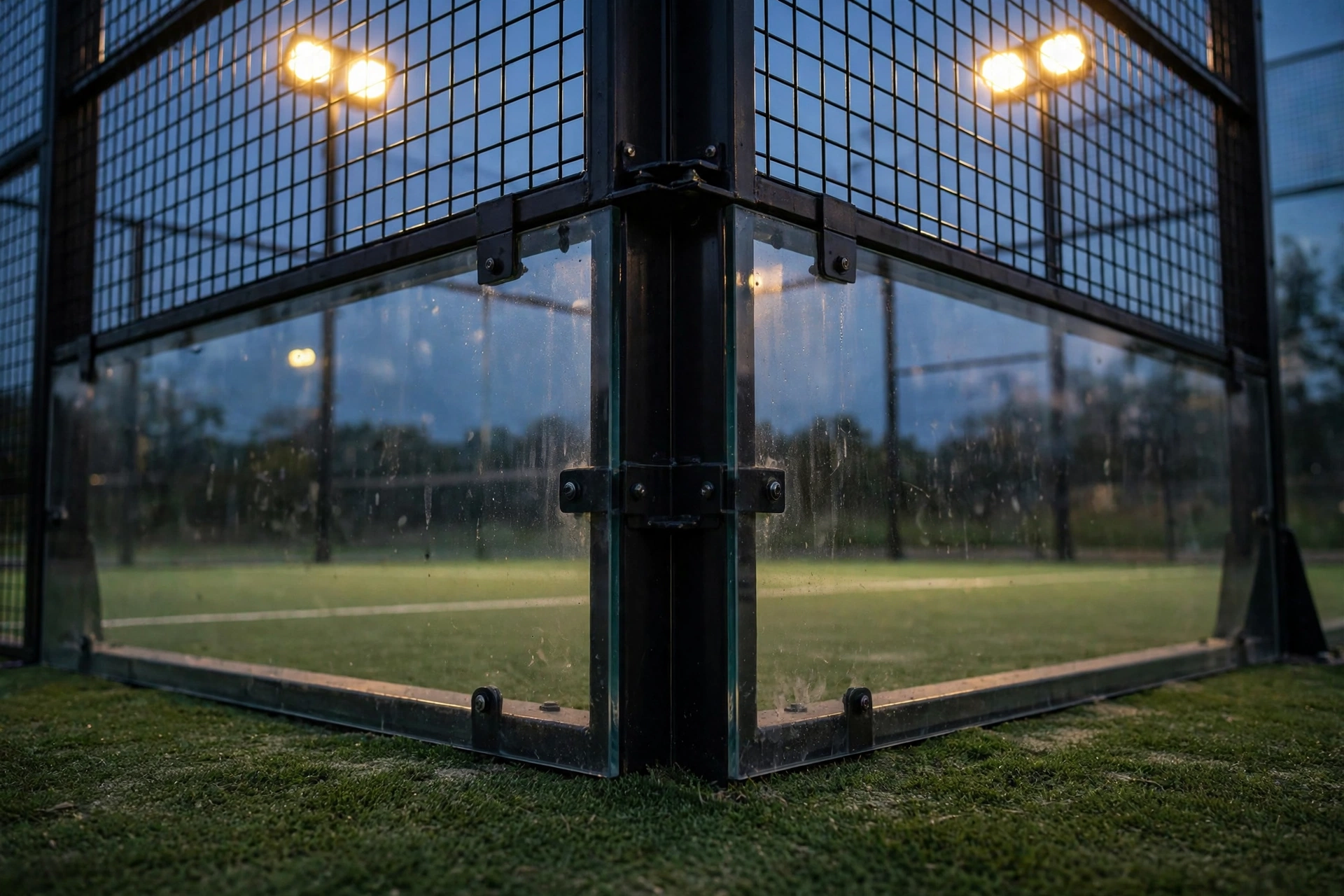
The walls are what make a padel court unique, and they are also the most technically demanding part of the structure. The back walls, which sit behind each baseline, are 4 metres high in total, made up of 3 metres of solid material and 1 metre of metal mesh on top. The solid part is usually tempered glass in a modern court, although concrete or brick can be used instead, and the mesh above it lets the ball pass through in the same way as a fence. The side walls have a stepped design, starting at 4 metres high near the back wall and stepping down to 3 metres, and then to 2 metres of glass as they run towards the net, with metal mesh filling the rest of the side.
The glass used in a padel court is tempered safety glass, usually 10 to 12 millimetres thick, and it is chosen because it gives a clean, predictable bounce and because it is strong enough to withstand repeated ball impacts and the occasional player collision. Twelve millimetre glass is regarded as the more robust standard for heavily used venues, while 10 millimetre glass is common on lighter-use courts. The glass also has to be fitted correctly, with the panels aligned so that the bounce is consistent across the whole wall, and the frames and fixings have to be strong enough to hold the panels in place. Modern panoramic courts use even more glass and less mesh, which gives spectators a better view and gives the court a more open feel, although the playing dimensions and wall heights stay the same.
The Net, Lines and Markings on a Padel Court
The net on a padel court is lower than a tennis net and it divides the 20 metre court into two equal halves. At the centre, the net is 88 centimetres high, and it rises slightly to 92 centimetres at the posts on each side, which is the same height as the net in the official FIP rules. The net is held taut by a cable and supported by posts that sit outside the playing area, and it should be checked regularly, because a sagging net changes the height of every shot that crosses it. The net is also the line that defines the two halves of the court, and the service lines, which sit 6.95 metres from the net on each side, mark the boxes into which the serve must land.
The court markings are painted or built into the surface, and they are simpler than the lines on a tennis court. The service lines run parallel to the net, 6.95 metres away from it, and the centre line divides each half into two service boxes. The lines themselves are usually white and clearly visible against the blue or green artificial turf, and they need to be kept clean and in good repair, because a faded line can cause arguments in a match. Unlike tennis, there is no doubles sideline or singles sideline on a padel court, because the walls define the width of the court, so the markings are limited to the service lines and the centre line. If you are new to the game, it is worth taking a moment to look at the lines before you play, because they tell you where the serve has to go and where you should be standing to receive it.
Padel Court Surfaces: Artificial Turf and Alternatives
The playing surface of a padel court is almost always artificial turf, and the type of turf affects how the ball bounces and how the players move. The most common surface is sand-filled artificial grass, which is a short-pile synthetic turf dressed with fine silica sand. The sand gives the surface grip, helps the ball bounce consistently, and protects the turf fibres from wear, but it needs to be topped up and brushed regularly, because the sand shifts with play and can build up in some areas and thin out in others. A well-maintained sand-filled turf gives a medium-paced game with a reliable bounce, which is why it is the standard choice for most clubs.
There are alternatives, including fibrillated turf, which has split fibres that hold the sand in place, and newer sand-free or low-sand surfaces, which are designed to need less maintenance and to play slightly faster. Some courts use a textured acrylic or resin surface instead of turf, although that is less common in the UK and it gives a different, faster game. The surface sits on a base that has to be flat, level and well drained, because water pooling on a padel court makes the surface slippery and can damage the turf. Underneath the turf there is usually a porous asphalt or concrete base with a drainage layer, and the whole construction has to be built to a tolerance of a few millimetres, because any unevenness will show up in the bounce of the ball. If you are choosing between courts to play on, the condition of the surface is one of the best indicators of how well a club looks after its facilities.
Indoor and Outdoor Padel Courts
Padel courts can be built indoors or outdoors, and each option has its own advantages. Outdoor courts are the most common in the UK, because they are cheaper to build and easier to fit into an existing site, and they can be used for most of the year, although rain and wind will affect play. An outdoor padel court needs good drainage, because standing water on the turf makes it slippery, and it needs lighting if it is to be used in the evenings, which is when many players want to play. A canopy or a roof over an outdoor court can extend its usable hours, and some clubs cover their courts with a simple steel and fabric structure to keep the rain off.
Indoor padel courts are more expensive to build, because they need a building with enough height and space, but they can be used in any weather and at any time of year. The FIP rules require a minimum clear height of 6 metres above the court for indoor play, and 8 metres is recommended for new venues, because a low ceiling interferes with high lobs, which are an important part of the game. Indoor courts also need good lighting and ventilation, because four players in an enclosed space generate a lot of heat, and they need a surface that works well in a controlled environment. Many of the best-known padel clubs in the UK have a mix of indoor and outdoor courts, so that players can book an indoor court in the winter and an outdoor court in the summer.
Padel Court Lighting and Facilities
Lighting is an essential part of a modern padel court, because most recreational play happens in the evenings after work, and a court without lights is effectively closed for half the day in winter. A padel court is usually lit by four floodlights, one at each corner, mounted on poles or on the structure of the court itself, and the lights are designed to give an even spread of light across the playing surface without dazzling the players. LED floodlights are now the standard choice, because they are brighter, cheaper to run and longer lasting than older halogen lights, and they reach full brightness instantly, which is useful when a court is booked at short notice.
Beyond lighting, a good padel venue needs facilities that make the experience enjoyable, including a booking system, changing rooms, a place to sit and watch, and somewhere to buy or hire rackets and balls. Many clubs have a cafe or a social area, because padel is a very social game and players often stay for a drink after a match. If you are choosing a club, it is worth looking at the facilities as well as the courts, because a club with good lighting, well-maintained surfaces and a friendly social scene will keep you coming back. If you are building a court, it is worth budgeting for the facilities as well as the court itself, because a court with no lights and no changing rooms will be much harder to fill.
How Much Does a Padel Court Cost to Build
The cost of building a padel court varies widely, and it depends on the type of court, the location, the groundwork, the surface, the lighting and whether the court is indoors or outdoors. A basic outdoor court with a standard glass and mesh enclosure, sand-filled artificial turf and LED lighting will cost significantly less than a panoramic court with a canopy, premium glass and full facilities, and an indoor court will cost more again because of the building. Groundwork is often the biggest variable, because a site that needs levelling, drainage or foundations will cost more than a flat site that is ready to build on, and planning permission and professional fees add to the total as well.
Because prices vary so much by location and specification, it is not possible to give a reliable UK figure for a padel court build, and any single number quoted online should be treated with caution. The honest answer is that a court is a five-figure investment, and that the only way to get an accurate figure is to obtain quotes from specialist padel court builders for your specific site. Prices quoted for other countries are not a reliable guide to UK costs, because labour, materials and regulations differ, so a figure from Spain or South Africa should not be used to budget a UK build. If you are considering building a court, get at least three quotes, check what is included in each one, and ask for references from previous installations before you commit.
How to Book a Padel Court and What to Expect
Booking a padel court is straightforward, and most clubs in the UK use an online booking system or an app, where you can see which courts are free and book a slot, usually for an hour or ninety minutes. Peak times are weekday evenings and weekend mornings, and popular clubs can be booked up days in advance, so it is worth booking early if you want a specific time. Prices vary by club, location and time of day, with peak slots costing more than off-peak slots, and many clubs offer membership schemes that reduce the cost per session for regular players. Some clubs also offer pay-as-you-go booking for non-members, which is a good way to try the game before committing to a membership.
When you arrive, you will need a padel racket, which is shorter and thicker than a tennis racket and has a solid face with holes rather than strings, and padel balls, which are similar to tennis balls but slightly less pressurised. Many clubs hire rackets and sell balls, so you do not need to buy your own equipment for a first session, although regular players usually buy their own racket quite quickly. Wear comfortable sports clothes and court shoes with good grip, because the artificial turf can be slippery, and bring water, because padel is a fast, physical game. Most clubs have a short induction or a beginner session for new players, which is worth taking, because the rules around the walls and the serve are different from tennis and squash.
Padel Court Maintenance and Lifespan
A padel court needs regular maintenance to stay in good condition, and the surface is the part that needs the most attention. Sand-filled artificial turf needs to be brushed regularly to redistribute the sand, and the sand needs to be topped up from time to time, because it is displaced by play and washed away by rain. The turf itself will wear over time, particularly in the areas where players move most, and a well-used court may need its turf replaced after several years, depending on how heavily it is used. The glass panels need to be cleaned regularly, because dirt and algae can build up on them, and the fixings and frames need to be checked for corrosion and damage.
The metal mesh and the structure of the court also need to be inspected, because the mesh can be damaged by ball impacts and the frame can be affected by weather. Floodlights need to be checked and replaced as they fail, and the drainage around the court needs to be kept clear so that water does not pool on the surface. A court that is well maintained will last for many years and will give a consistent game throughout its life, while a court that is neglected will deteriorate quickly and become unpleasant to play on. If you are choosing a club, the condition of the courts is a good guide to how seriously the club takes its facilities, and it is worth playing on a court that is clean, well lit and well maintained.
How Big Is a Padel Court?
How big is a padel court? A standard doubles padel court measures 20 metres long by 10 metres wide, giving a playing area of 200 square metres, with a tolerance of 0.5 per cent allowed by the International Padel Federation. Each half of the court is 10 metres by 10 metres, divided by a net that is 88 centimetres high at the centre and 92 centimetres high at the posts. A singles padel court measures 20 metres long by 6 metres wide, but singles courts are rare and most clubs build doubles courts.
How High Are the Walls on a Padel Court?
How high are the walls on a padel court? The back walls on a padel court are 4 metres high, made up of 3 metres of solid material, usually tempered glass, and 1 metre of metal mesh on top. The side walls are stepped, starting at 4 metres high near the back wall and stepping down to 3 metres and then to 2 metres of glass as they run towards the net, with metal mesh filling the rest of the side. The glass is tempered safety glass, usually 10 to 12 millimetres thick, and indoor courts need a minimum clear height of 6 metres above the playing surface.
What Surface Is a Padel Court?
What surface is a padel court? Most padel courts use sand-filled artificial turf, which is a short-pile synthetic grass dressed with fine silica sand to give grip and a consistent bounce. The turf sits on a flat, level and well-drained base, usually porous asphalt or concrete with a drainage layer, and it needs regular brushing and sand top-ups to stay in good condition. Some courts use fibrillated turf or low-sand surfaces, and a small number use acrylic or resin surfaces, but sand-filled artificial turf is the standard choice for most clubs in the UK.
How Much Does It Cost to Build a Padel Court in the UK?
How much does it cost to build a padel court in the UK? There is no single reliable UK figure, because the cost depends on the type of court, the site, the groundwork, the surface, the lighting and whether the court is indoors or outdoors, and a court is a five-figure investment in any case. Prices quoted for other countries are not a reliable guide to UK costs, so the only way to get an accurate figure is to obtain quotes from specialist padel court builders for your specific site. Get at least three quotes, check what is included, and ask for references before you commit.
Can You Play Padel on a Tennis Court?
Can you play padel on a tennis court? No, you cannot play padel properly on a tennis court, because padel is played in an enclosed court with glass walls and metal mesh that the ball is meant to rebound off, and a tennis court has no walls. A padel court measures 20 by 10 metres, which is smaller than a tennis court, and it uses a lower net, a different racket and a different ball. Some venues convert tennis courts into padel courts by building the enclosure inside the tennis court area, but the game itself needs a purpose-built padel court.
Where Can You Play Padel in the UK?
Where can you play padel in the UK? Padel courts are now available at leisure centres, tennis clubs, dedicated padel clubs and some parks across the UK, and the number of courts is growing rapidly. Most clubs use an online booking system or an app, where you can see availability and book a court, usually for an hour or ninety minutes, and many offer beginner sessions and racket hire for new players. You can find general information about the sport, its history and its rules on Wikipedia’s padel page, which gives a useful overview before your first game.
Conclusion
A padel court is a compact, precisely built enclosure, and every part of it has a purpose. The 20 by 10 metre playing area, the 4 metre back walls of glass and mesh, the 88 centimetre net, the service lines 6.95 metres from the net and the sand-filled artificial turf all work together to create a game that is fast, social and easy to pick up, and the standard dimensions mean that a court in London plays the same as a court in Madrid. Whether you are booking a court for a first game or considering building one, the details matter: check the condition of the surface, the quality of the lighting and the height of the walls, and remember that a well-maintained court is the difference between a good game and a frustrating one. Padel is growing quickly in the UK, and understanding the court itself is the best way to enjoy it.
If you enjoy following team sports, you may also like our guide to rugby positions, which explains every role on the rugby pitch.