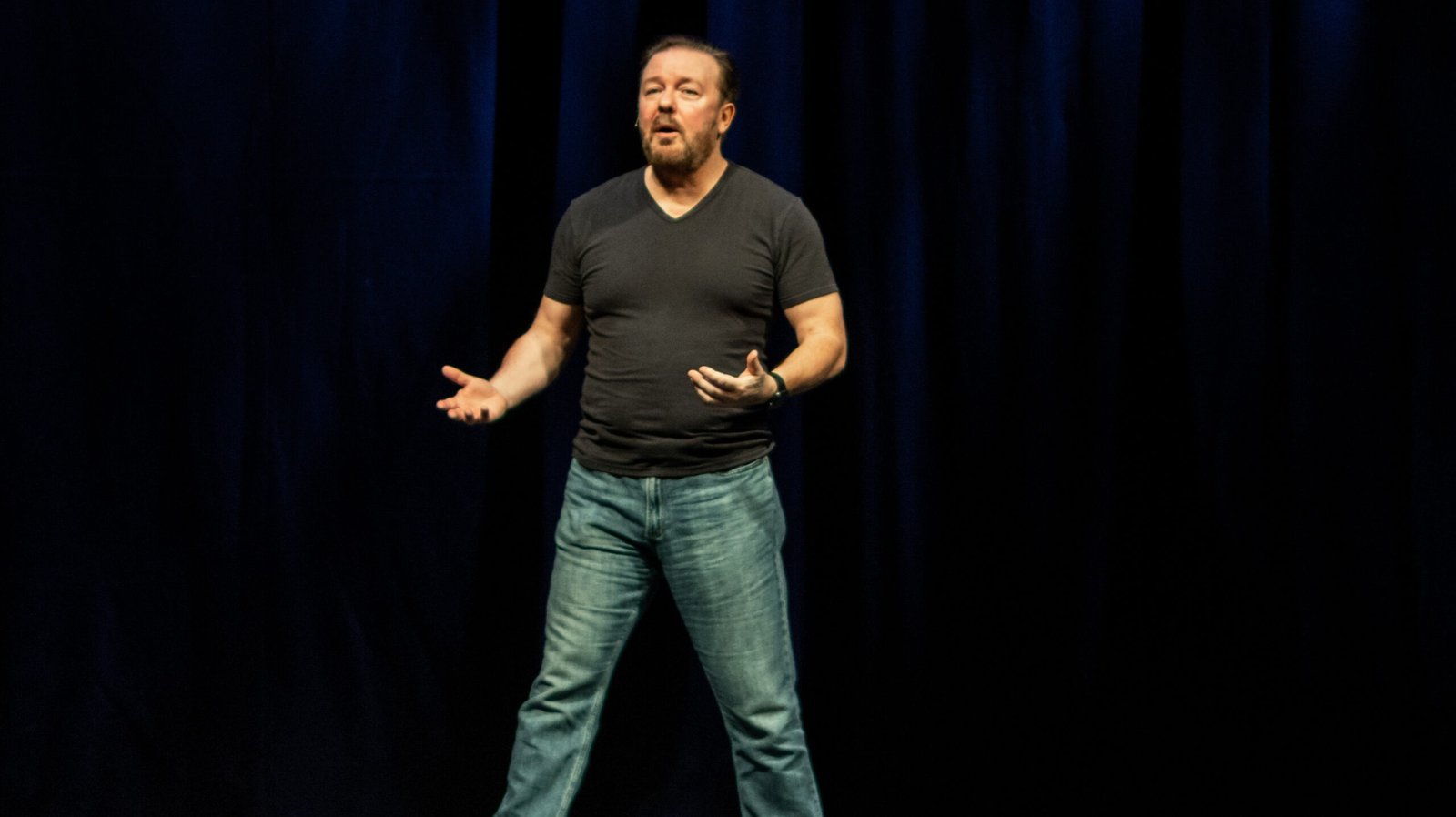
Before Ricky Gervais and Stephen Merchant changed British comedy, they were two men in a small London radio studio, filling dead air between records. Gervais was the boss, a former pop singer turned radio executive with strong opinions and no filter. Merchant was his assistant, a tall, gangly Bristol graduate who had talked his way into the job. Nobody listening to their Saturday afternoon show in 1998 could have guessed that within three years the pair would create the most influential British sitcom of its generation and launch an American remake that ran for nine seasons. They worked because they were opposites: Gervais the instinctive performer who loved the spotlight, Merchant the careful writer behind the scenes.
The story starts with two very different lives. Ricky Gervais was born on 25 June 1961 in Reading, Berkshire, and studied philosophy at the University of London. Before comedy, he tried pop stardom, fronting the band Seona Dancing, whose single “More to Lose” became a minor hit in the Philippines in 1985. Stephen Merchant was born thirteen years later, on 24 November 1974, in Hanham, a suburb of Bristol. He studied film and literature at the University of Warwick from 1993 to 1996, graduating with a BA, and began in broadcasting on student station Radio Warwick. When the two finally met, the age gap and the difference in temperament turned out to be the point.
An Unlikely Meeting at XFM
Gervais joined the London radio station XFM in 1996, and a year later, in 1997, he hired Merchant as his assistant. The two hosted a Saturday afternoon radio show together from January to August 1998, when both left as the station was bought by the Capital Radio Group. On air they were an odd pairing: Gervais loud and endlessly confident, Merchant dry and quick to puncture his boss’s ego. Listeners loved it.
Merchant then left radio to take a production course with the BBC, and it was there that the idea for The Office began to take shape. Gervais had been developing a mock-documentary about office life, and Merchant helped him turn a short sketch into a full series. In September 2001, they returned to XFM as co-hosts of The Ricky Gervais Show, alongside their television breakthrough. Radio had brought them together, and it kept bringing them back: the show later became a podcast, then an animated series.
The Office: Twelve Episodes That Changed Comedy
The Office debuted on BBC television in July 2001, created and written by Gervais and Merchant. Shot in the style of a fly-on-the-wall documentary, it followed the staff of Wernham Hogg, a fictional paper company in Slough, and Gervais starred as David Brent, the deluded manager who believed he was a philosopher, comedian and rock star all at once. There was no laugh track and no studio audience. The comedy came from long silences, awkward pauses and the slow realisation that Brent’s employees could see exactly what he could not see about himself.
The numbers tell you how small the show was, and how large its impact became. The Office ran for only 12 episodes across two series, followed by a two-part Christmas special in 2003. Yet it won numerous BAFTA and British Comedy awards, plus two Golden Globe Awards, an almost unheard-of achievement for a British sitcom. Gervais and Merchant served as executive producers on the American version of The Office, which ran from 2005 to 2013 and became a huge hit in its own right. A show about a dull paper company in Slough had become a global template.
Extras and the Podcast That Broke Records
Their next collaboration, Extras, ran on BBC Two from 2005 to 2007, and it was a different kind of show with the same DNA. Gervais played Andy Millman, a struggling actor reduced to background extra work, while Merchant played Darren Lamb, his spectacularly incompetent agent, whose advice was always wrong and whose confidence never wavered. Guest stars from Kate Winslet to Samuel L. Jackson queued up to send up their own celebrity. Gervais won an Emmy in 2007 for best actor in a comedy series, confirming that the success of The Office had not been a one-off.
Around the same time, the pair accidentally made podcasting history. The Ricky Gervais Show, a podcast recorded with Merchant and their producer Karl Pilkington, ran from 2005 to 2006 and was downloaded by more than 500,000 listeners per episode, making it at the time the most downloaded podcast ever. Its appeal was the opposite of polish: three men talking and arguing, with Pilkington’s bizarre worldview providing most of the material. It was later adapted into an animated series (2010–2012), and Pilkington went on to front An Idiot Abroad, the travel series Merchant co-developed (2010–2012).
Cemetery Junction and Life’s Too Short
In 2010, Gervais and Merchant made their first feature film together, Cemetery Junction, which they wrote and co-directed. Released in the United Kingdom on 14 April 2010, it was a coming-of-age comedy-drama set in Reading in 1973, following three young working-class friends trying to escape small-town life. Christian Cooke, Felicity Jones, Tom Hughes and Jack Doolan starred, alongside Ralph Fiennes and Emily Watson, with Gervais in a supporting role and Merchant as Dougie. It was gentler and more nostalgic than their television work: two writers interested in class, ambition and the places they came from.
Their next project together was Life’s Too Short, which debuted in 2011 and concluded with a special two years later. The series starred Warwick Davis as a fictionalised version of himself, a dwarf actor running a talent agency, and it returned to the mock-documentary style of The Office. It did not reach the heights of their earlier work, and it would turn out to be their last full series as a writing team. After more than a decade of working together almost constantly, they began to drift into separate careers, not with a falling-out, but because each wanted to try different things.
Two Very Different Solo Careers
Gervais stayed close to the formula that had made him famous, but kept pushing it into darker and more personal territory. He created Derek (2012–2014), playing a kind-hearted care-home worker, then After Life (Netflix, 2019–2022), in which he played a widower coping with grief through brutal honesty. His films included Night at the Museum (2006), Ghost Town (2008), his first leading film role, The Invention of Lying (2009) and Muppets Most Wanted (2014). He also hosted the Golden Globe Awards in 2010, 2011, 2012, 2016 and 2020, and in 2024 he won a Golden Globe himself for his Netflix special Ricky Gervais: Armageddon (2023).
Merchant, standing 6ft 7in and impossible to miss on screen, took a stranger and more varied path. He created and starred in Hello Ladies (HBO, 2013–2014), based on his stand-up material about an Englishman looking for love in Los Angeles. He wrote and directed Fighting with My Family (2019), about WWE wrestler Paige and her family, co-produced with Dwayne Johnson. As an actor, he stepped away from comedy: the mutant Caliban in Logan (2017), a Gestapo officer in Taika Waititi’s Jojo Rabbit (2019), and serial killer Stephen Port in the BBC drama Four Lives (2022), earning an RTS Best Supporting Actor nomination. He then created The Outlaws with Elgin James, the BBC crime comedy that ran for three series and eighteen episodes between 2021 and 2024, with Merchant starring alongside Christopher Walken. In September 2025 he guest-starred as Julian, the self-described last Englishman in England, in the third series of The Walking Dead: Daryl Dixon.
Why the Partnership Still Matters
Not every famous pairing is built on real shared work. Some actors are linked only because fans imagine them together, or because they were once considered for the same role. Gervais and Merchant are the opposite: a genuine creative partnership, forged in a radio studio, tested across two landmark sitcoms, a record-breaking podcast and a feature film. In that sense they have something in common with other British pairings whose shared history runs deep, including Benedict Cumberbatch and Martin Freeman, whose own long collaboration on Sherlock grew from a similarly unlikely meeting. The difference is that Gervais and Merchant did not just share a screen: they wrote the jokes, directed the cameras and changed what British television comedy was allowed to be.
Ricky Gervais and Stephen Merchant started as a boss and his assistant in a London radio station. They ended up as one of the most important partnerships in modern comedy, two men who proved the funniest thing on television could be an ordinary office, an incompetent agent, or a pause that lasted one second too long. The Office was only twelve episodes. A quarter of a century later, television is still catching up with it.