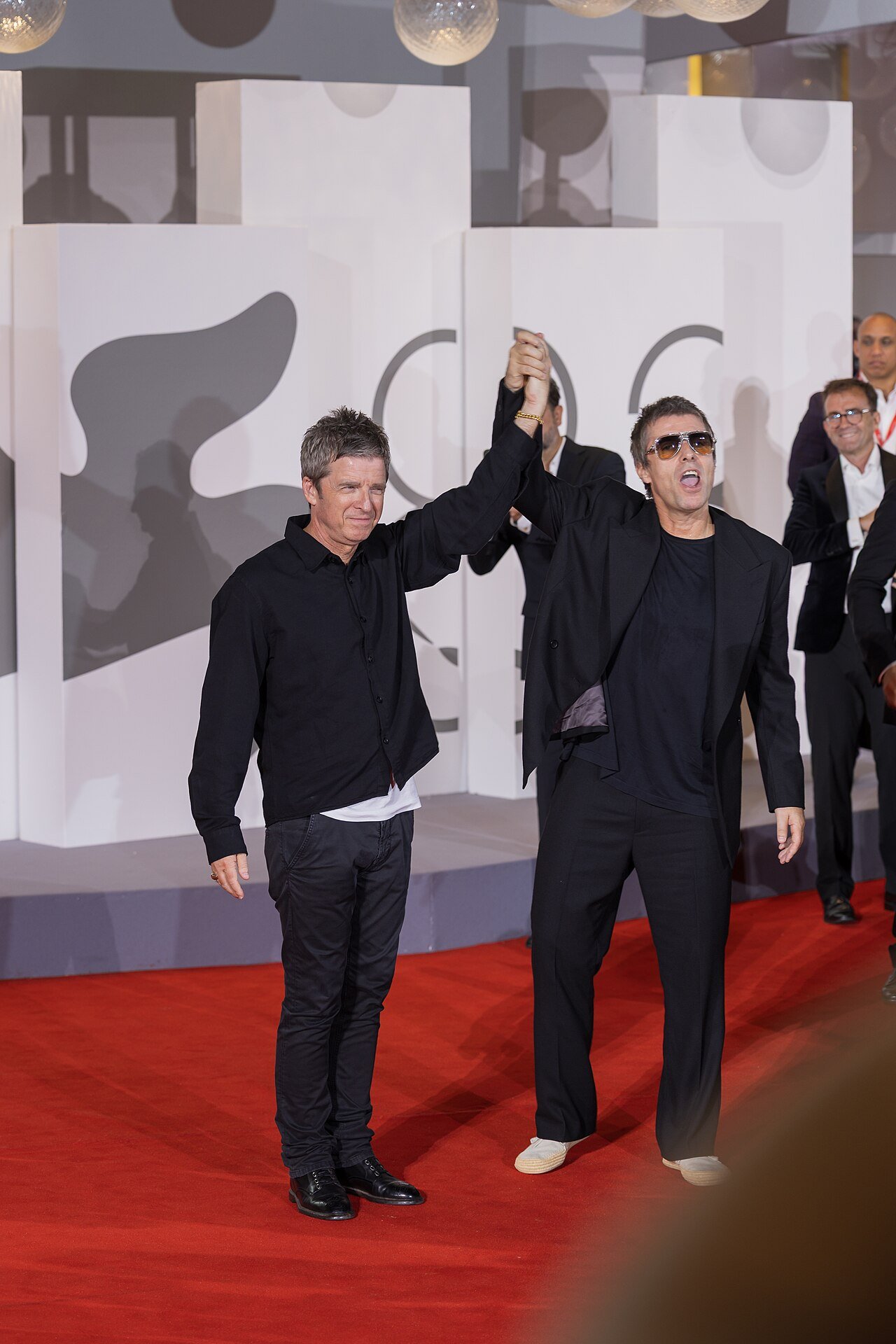
For almost sixteen years, British music fans had stopped asking the question out loud. Would Liam Gallagher and Noel Gallagher ever share a stage again? The brothers had built one of the biggest bands in the world, torn it apart in public, and spent fifteen years insisting the door was closed. Then, in the summer of 2025, the door opened. When the first chords rang out in Cardiff, the brothers stood side by side again.
That is why the story of Liam Gallagher and Noel Gallagher still matters. It is a story of family, ambition, rivalry and reconciliation, played out in front of millions. Oasis were never a quiet band, and the Gallaghers were never quiet brothers. Their music was loud, direct and full of confidence, and their arguments were just as loud. Underneath the noise were two brothers whose songs millions recognised as their own.
Two Brothers From Manchester
Noel Gallagher was born on 29 May 1967 in Longsight, Manchester, and his younger brother Liam was born on 21 September 1972. The family later lived in Burnage, Manchester, where the brothers grew up with older brother Paul. The two brothers were different from the start. Noel was quieter and taught himself guitar. Liam was louder, with a natural swagger and a voice that could cut through a room.
Noel went on the road as a roadie with the Inspiral Carpets. Liam stayed in Manchester, and in 1991 he joined a local band called The Rain. The turning point came when Noel returned and heard what his younger brother was doing. Liam asked Noel to manage the band. Noel refused. He would join only if he could take charge of the music, write the songs and play lead guitar. They agreed, renamed the band Oasis, and the brothers became its centre.
Definitely Maybe and the Rise of Oasis
Oasis signed to Creation Records in 1993, and their rise was remarkably fast. Their first single, Supersonic, was released in April 1994, and their debut album, Definitely Maybe, followed in August 1994. The album went straight to number one in the United Kingdom and became the fastest-selling debut album in British history at the time. Songs such as Live Forever, Supersonic and Cigarettes and Alcohol announced a band with enormous self-belief. Liam sang them with total conviction. Along with Blur, Pulp and Suede, Oasis were at the centre of Britpop, a movement celebrating guitar music and big choruses. Their songs were direct, built for singing along.
(What’s the Story) Morning Glory? and Knebworth
The second Oasis album, (What’s the Story) Morning Glory?, was released in October 1995, and it changed everything. It spent ten weeks at number one in the United Kingdom, producing Wonderwall, Don’t Look Back in Anger, Some Might Say and Champagne Supernova. Wonderwall became one of the most famous British songs ever written. It sold more than 22 million copies worldwide.
But the high point came in Britain, in the summer of 1996, at Knebworth Park in Hertfordshire. On 10 and 11 August 1996, Oasis played two nights to a total of 250,000 people. More than two million people had applied for tickets. At the time, it was the largest concert event in British history. Be Here Now followed in August 1997, selling fast but widely seen as overblown. Later albums included Standing on the Shoulder of Giants (2000), Heathen Chemistry (2002), Don’t Believe the Truth (2005) and Dig Out Your Soul (2008). All seven of their studio albums reached number one in the United Kingdom, as did eight of their singles.
The Brother Dynamic and the Feud
The relationship between Liam and Noel Gallagher was always the engine of Oasis and the thing that threatened to destroy it. On stage, it worked beautifully. Noel wrote the songs, played lead guitar and sang some of them. Liam was the frontman, the voice and the attitude, the figure at the front of the stage. They fought on tour and in the press, and their rows were reported almost as eagerly as their records. Sometimes the rows were about music, sometimes about fame, sometimes about two brothers struggling to work together.
For fifteen years, they made it work. Noel has said that the incident in Paris in 2009 was the final straw after years of mounting tension, rather than a single event that came from nowhere. The split did not happen in one night, but after years of strain neither brother had resolved. The feud was never just professional. It was personal, because it was family. Fans could hear the closeness in the music and see the distance in interviews.
The Split in Paris in 2009
The end came on 28 August 2009, at the Rock en Seine festival in Paris. Oasis were due to headline that evening, but the show was cancelled minutes before they were due on stage after an argument backstage between the brothers. Noel left the band that night. He said, with some sadness and great relief, that he had quit Oasis, because he could not go on working with Liam a day longer. The remaining tour dates were cancelled. Their final concert had taken place six days earlier, on 22 August 2009, at the V Festival in Staffordshire. Nobody there knew it would be the last Oasis show for sixteen years.
The Solo Years: Two Different Paths
What happened next showed how different the brothers were as musicians. Liam formed Beady Eye with the remaining members of Oasis, releasing Different Gear, Still Speeding (2011) and BE (2013) before the band broke up in 2014. His solo debut, As You Were, followed in 2017 and also reached number one. Why Me? Why Not (2019) and C’mon You Know (2022) also reached number one, and in 2024 he made an album with former Stone Roses guitarist John Squire. Liam proved his voice did not need the Oasis name to fill large venues.
Noel took a different route. He formed Noel Gallagher’s High Flying Birds, whose self-titled debut album reached number one in October 2011. Chasing Yesterday (2015), Who Built the Moon? (2017) and Council Skies (2023) followed, each showing a songwriter still willing to experiment. Where Liam leaned on energy and attitude, Noel leaned on craft and arrangement. Both built successful careers apart. Neither brother needed Oasis in 2025. They chose to return, which is why the reunion felt different from a simple nostalgia tour.
The Reunion Announcement and the 2025 Tour
The first sign came on 25 August 2024, when a short teaser appeared after Liam’s Reading Festival set and at a Blossoms show in Manchester. Two days later, on 27 August 2024, Oasis announced their reunion and a 2025 tour. The statement was short and striking: The guns have fallen silent. The stars have aligned. The great wait is over. It covered fourteen dates in the United Kingdom and Ireland, including five nights each at Wembley and Heaton Park in Manchester, with more added within days as demand surged.
The Oasis Live ’25 tour began on 4 July 2025 at the Principality Stadium in Cardiff, the brothers’ first live performance together since 2009. It moved through Manchester, London, Edinburgh and Dublin, then expanded worldwide, closing on 23 November 2025 in São Paulo, Brazil. In total, it ran for 41 shows. The setlist drew on the first two albums, and the brothers shared the stage with a warmth that surprised longtime fans. At the final show, Liam said the band would see the crowd again sometime, before closing with Champagne Supernova. Afterwards, the band announced a pause for a period of reflection.
What the Reunion Means
The reunion matters for several reasons. First, it showed that a broken relationship could be repaired enough for the brothers to work together again. Second, it showed the lasting power of the songs. The 2025 crowds included young fans who had discovered Oasis through their parents or streaming. A band with no new album since 2008 could still fill stadiums. Finally, the reunion gave the Gallagher story a better ending than Paris in 2009. The split had been abrupt and painful. The reunion was a planned return, played out over five months and finished with a shared moment on stage in Brazil.
The brothers will always be linked, as brothers and bandmates, and that link is both the source of their greatest music and their greatest difficulties. They grew up in Manchester, conquered British music, fell out in front of the world, proved they could stand alone, and then came back together. Their legacy rests on songs people still want to hear, sung by two brothers who still have something to say to each other. The story of Elton John and Dua Lipa shows how a partnership across generations can create something new, but the Gallagher brothers remind us that the most powerful partnerships are often the ones closest to home.