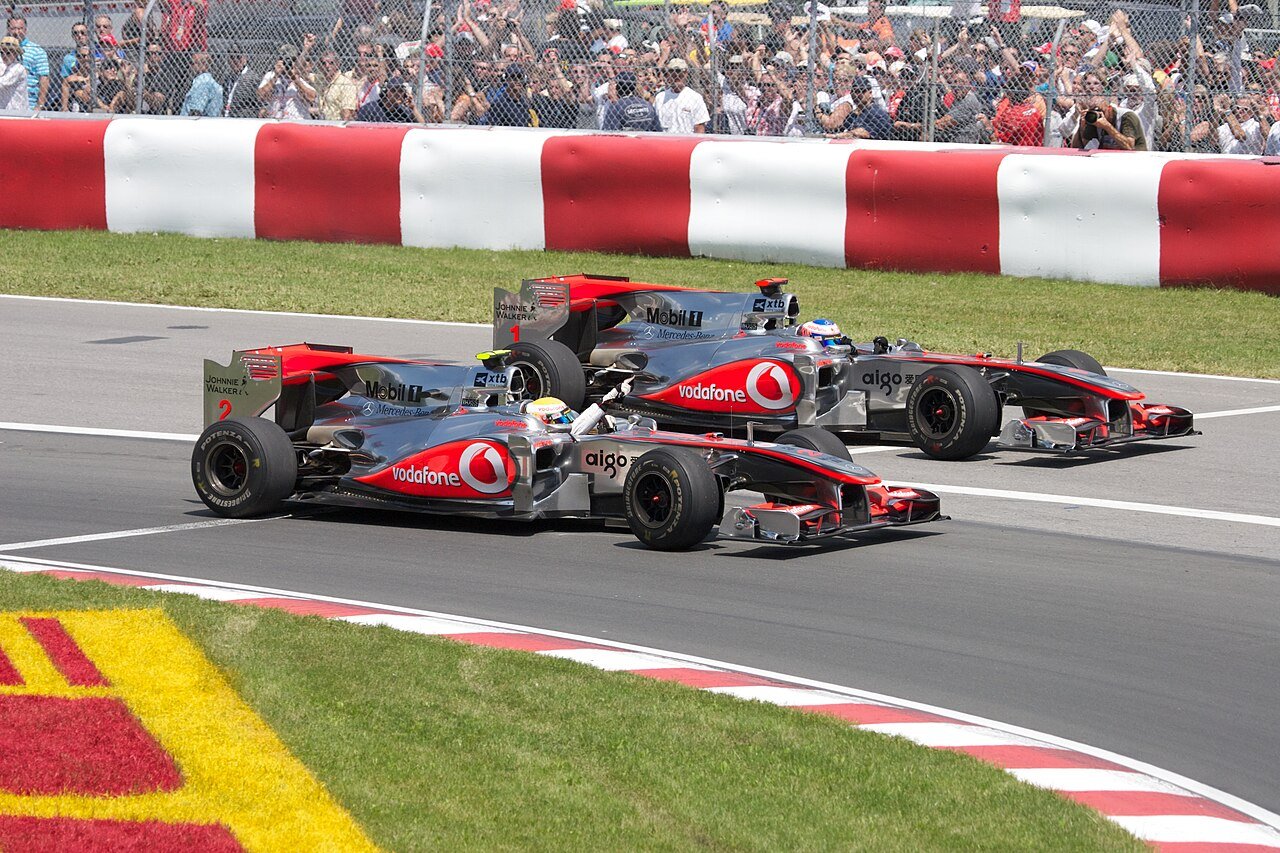
Of all the British drivers who have won the Formula 1 world championship, only two ever shared a garage as teammates. Lewis Hamilton and Jenson Button spent three seasons together at McLaren, from 2010 to 2012, and the pairing produced one of the closest teammate battles in the sport. Hamilton was the established star; Button was the reigning champion, fresh from the most unlikely title win the sport had ever seen. Between them they hold eight world championships, won by two very different routes.
Two Very Different Roads to the Top
Hamilton was born on 7 January 1985 in Stevenage, Hertfordshire. He started karting at eight, won the British Kart Championship at ten, and at thirteen joined the McLaren and Mercedes-Benz Young Driver Support Programme. The funding meant Hamilton never had to worry about money the way most young drivers do. He won British Formula Renault in 2003, Formula 3 Euroseries in 2005, and the GP2 title in 2006, his only season in the series.
Button was born on 19 January 1980 in Frome, Somerset, five years before Hamilton. His father John was a rallycross driver, and the young Button grew up around engines. He too started karting at eight, winning his first race in the little 60cc kart his father gave him for Christmas. He won the British Karting Championship at eleven and the European Karting Championship at seventeen. But where Hamilton’s path was mapped out by a single team from childhood, Button’s was a scramble. He reached Formula 1 with Williams in 2000 at twenty, and then spent a decade with teams that could not give him a winning car.
Hamilton: The Prodigy Who Arrived Ready
Hamilton’s Formula 1 debut with McLaren in 2007 remains the most impressive rookie season the sport has seen. He finished on the podium in his first nine races, won his first grand prix in Canada on 10 June 2007, only his sixth start, and ended the year second, one point behind Kimi Raikkonen. He shared the team with Fernando Alonso, a double world champion, and the two finished level on points in a season so tense that Alonso left the team at the end of it.
A year later he became world champion. In 2008, at twenty-three, he won five races and beat Felipe Massa by a single point, clinching the title with a last-corner overtake of Timo Glock on the final lap of the Brazilian Grand Prix. He was the youngest world champion in history at the time, and the first Black driver to win the title. Red Bull and Sebastian Vettel dominated from 2010, and Hamilton won two races in 2009, three in 2010, three in 2011 and four in 2012. In September 2012 he announced he was leaving McLaren for Mercedes, a move many thought was a mistake: Mercedes had won a single race in three seasons.
Button: Ten Years of Waiting, Then the Fairytale
Button’s first decade in Formula 1 was a lesson in patience. After Williams he drove for Benetton and Renault, then BAR and Honda, teams that promised much and delivered little. His first win took 113 races to arrive, at the Hungarian Grand Prix in 2006, in a wet race for Honda. Honda finished near the back of the field in 2007 and 2008, and in December 2008 the company pulled out of Formula 1 altogether. Button had no drive, no team, and no obvious future, ten years into a career that had promised so much.
What happened next is the strangest title run in modern Formula 1. Team principal Ross Brawn led a management buyout, bolted a Mercedes engine into a car designed for a Honda, and entered 2009 as Brawn GP, a team that had almost not existed at all. The car had a rear diffuser the other teams had not thought of, and Button won six of the first seven races, including Monaco. He did not win again all season as the field caught up, but the cushion was enough. He clinched the championship at the Brazilian Grand Prix with a race to spare, finishing the season on 95 points to Sebastian Vettel’s 84, and Brawn GP won the constructors’ championship in its only season before being sold to Mercedes. Button was world champion.
Teammates at McLaren, 2010 to 2012
Rather than defend his title with the team that had become Mercedes, Button surprised everyone by joining McLaren alongside Hamilton for 2010. Most observers expected him to be buried. Hamilton was the home favourite and the quicker qualifier, the driver the team had raised since childhood, while Button was the quieter, smoother racer, famous for his feel for a car in changing conditions. At the 2010 Canadian Grand Prix, McLaren finished first and second, Hamilton ahead of Button.
Over the three seasons together, the numbers were astonishingly close. Button outscored Hamilton across the three years combined, 672 points to 657, the only teammate ever to outscore him over more than one season together. In 2011, Button’s best year, he finished runner-up with 270 points to Hamilton’s 227, winning three races including a famous last-lap victory in a rain-soaked Canadian Grand Prix. Hamilton won more races across the three seasons, ten to Button’s eight, but Button took more podiums, twenty-five to twenty-two. But one gap was never close. Hamilton beat Button 44 to 14 in qualifying, and took nine pole positions to Button’s one. It was the speed of one against the racecraft of the other.
The partnership was not always smooth. In 2012 Hamilton briefly posted team telemetry data on Twitter, embarrassing McLaren and underlining the tension inside the garage. That year Hamilton finished ahead of Button by two points, 190 to 188, but Button won the final race of the season in Brazil, his fifteenth and last grand prix victory. A few weeks later Hamilton’s move to Mercedes was confirmed, and the partnership ended. They had pushed each other harder than either had been pushed before.
After McLaren: Dominance and the Long Goodbye
Hamilton’s move to Mercedes, questioned at the time, became the most successful driver-team partnership in the history of the sport. He won his second title in 2014 and his third in 2015, lost to teammate Nico Rosberg in 2016, then won four more championships in a row from 2017 to 2020. His seventh title in 2020 tied Michael Schumacher’s record, and his win at the Portuguese Grand Prix that year took him past Schumacher’s 91 victories. The 2021 season ended in controversy in Abu Dhabi, where a decision by race officials handed the title to Max Verstappen on the final lap, while Hamilton went without a win in 2022 and 2023 as Mercedes struggled. He won the British Grand Prix in July 2024, his first victory since 2021 and a record ninth win at his home race, then moved to Ferrari for 2025, announced in February 2024.
Button stayed at McLaren for seven seasons in total, through the difficult Honda years after Hamilton’s departure. There were no more wins after Brazil 2012, and he stepped back from full-time racing at the end of 2016, making a one-off return at the 2017 Monaco Grand Prix to stand in for Fernando Alonso. His Formula 1 career ended with 306 starts, fifteen wins, eight pole positions, fifty podium finishes and 1,235 points. He went on to win the Super GT championship in Japan in 2018, raced in the World Endurance Championship in 2024 and 2025, and serves as an Aston Martin ambassador from 2026.
Where They Stand Now
Hamilton’s first Ferrari season, in 2025, was the hardest of his career. He won the sprint race in China in March, his first victory in red, but the car never suited him over a full race distance. He finished sixth in the championship with 156 points, and for the first time in his career he went a whole season without a grand prix podium. The 2026 season, under new regulations, brought a turnaround. He took his first grand prix win for Ferrari at Barcelona on 14 June 2026, his 106th career victory, at forty-one the oldest grand prix winner since Jack Brabham in 1970. He remains tied with Schumacher on seven world championships, with more wins (106), pole positions (104) and podiums (206) than any driver in history.
Beyond the titles, the two men share a particular place in British sporting life. Hamilton is the most successful driver the country has ever produced, knighted in 2021, who has used his platform to push for diversity in motorsport through the Hamilton Commission and his Mission 44 foundation. Button is the nearly man who became champion against all odds, and then proved his quality again by outscoring the greatest driver of his generation as teammates. Like the great British sporting double acts, from Gary Lineker and Alan Shearer on the football pitch, they were rivals who made each other better, and teammates who shared three seasons nobody who watched them will forget.