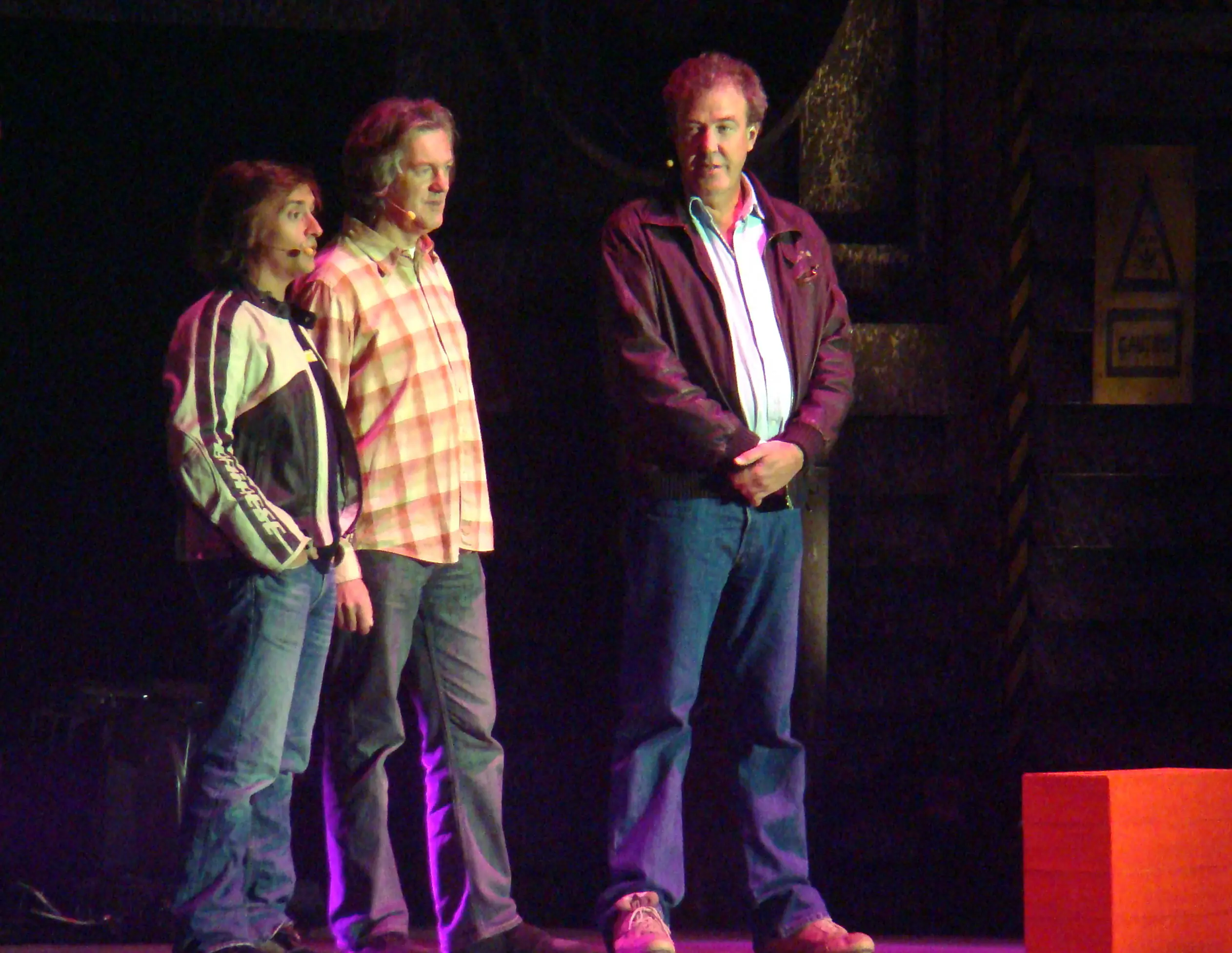
For thirteen years they were the loudest, funniest and most argumentative trio on British television, and at the centre of it all were two men who could not have been more different. One was Jeremy Clarkson, a tall, blunt Yorkshireman who treated every car like a punchline and every rule like a suggestion. The other was James May, a quiet, precise man from Bristol who collected dictionaries, played the piano and was nicknamed Captain Slow. Together with Richard Hammond they turned a BBC motoring show into a global entertainment machine, then walked away from it and built an even bigger one on Amazon.
The journalist from Doncaster
Jeremy Charles Robert Clarkson was born on 11 April 1960 in Doncaster, South Yorkshire. His parents ran a business selling tea cosies, and the young Clarkson was sent to Repton School in Derbyshire. He did not go to university. Instead he went straight into local journalism, starting at the Rotherham Advertiser before moving into motoring writing. By the late nineteen eighties he was writing for the Shropshire Star, and later for The Sun and The Sunday Times, two columns he still writes today.
Television came calling in 1988, when Clarkson joined the original Top Gear, a straightforward BBC motoring magazine that had been running since 1977. He stayed with that version of the show until 2000. What made him different from other motoring journalists was his voice. He did not write about cars the way engineers did. He wrote about them the way a pub argument sounds: loud, funny, exaggerated and impossible to ignore. That voice would become the sound of the new Top Gear.
Clarkson has always been a controversial figure, and he has never seemed to mind. His columns and broadcasts have drawn complaints, apologies and headlines in roughly equal measure. But behind the bluster there has always been a serious motoring journalist who knows his subject inside out, and a presenter with a rare gift for making a television audience care about a car they will never drive.
The slow man from Bristol
James Daniel May was born on 16 January 1963 in Bristol, and his path to television could hardly have been more different. He studied music at Lancaster University, where he learned the flute and piano, and spent a year studying metalwork at a technical college. He became a sub-editor at Autocar magazine, and in 1992 he was dismissed from the job after a famous prank: while assembling the magazine’s Road Test Yearbook, he arranged the large opening letters of each review so that they spelled out a rude message. Readers started ringing in to ask about the prize they thought they had won, and management decided he had to go.
May’s television career began with a brief appearance on the old Top Gear in 1999, and he went on to present the Channel 4 motoring show Driven. He was precise, dry and quietly funny, the opposite of the shouting motoring presenter. He liked engineering, history and things done properly. When Top Gear was relaunched in 2002, May auditioned and was turned down by BBC executives who felt his background was too close to Clarkson’s and Hammond’s. Clarkson disagreed, and in 2003 he persuaded the producer Andy Wilman to hire May as the replacement for Jason Dawe. From the second series of the relaunch, the three were permanent hosts.
The nickname Captain Slow came from Clarkson, a joke about May’s careful driving style and his love of doing things at his own pace. May embraced it. It fitted a man who would rather understand a machine properly than rush past it, and it became part of the act: Clarkson the showman, Hammond the daredevil, and May the thoughtful one.
The relaunch that changed everything
Top Gear was relaunched on 20 October 2002, devised by Clarkson and the producer Andy Wilman as a complete reinvention of the old motoring magazine. The new show mixed serious car reviews with studio banter, madcap challenges, races across continents and celebrity laps in a reasonably priced car. It was filmed at Dunsfold Aerodrome in Surrey, and it looked and sounded like nothing else on television. The first series was presented by Clarkson, Richard Hammond and Jason Dawe, with the anonymous test driver known as The Stig. From the second series, May took Dawe’s place, and the line-up stayed unchanged for more than a decade.
The trio became the most-watched programme on BBC Two, and the show was rebroadcast in more than a hundred countries. Guinness World Records described it as the most widely watched factual television programme in the world. The format was simple but hard to copy: three presenters with genuine chemistry, a production team willing to spend real money on spectacular films, and a willingness to be silly. Clarkson and May were the engine of that chemistry. Clarkson provided the noise and the opinions. May provided the counterweight, the man who would point out, calmly, that Clarkson’s brilliant plan was nonsense.
Some of their most famous adventures came from the challenges: driving across Africa, racing a car against a train, building amphibious vehicles that sank, and attempting to drive to the North Pole. May’s finest hours often came when things went wrong slowly and methodically, while Clarkson shouted. The two men also shared a genuine love of engineering and history, and the show’s best films owed as much to May’s curiosity as to Clarkson’s showmanship.
The break-up of 2015
It ended suddenly. In March 2015, during filming on location, Clarkson assaulted a Top Gear producer, Oisin Tymon, after an argument about catering. The BBC suspended him, and on 25 March 2015 the director-general announced that the corporation would not renew his contract. Hammond’s contract ran out on 31 March, and both he and May said they would not carry on without Clarkson, even though the BBC was offering generous salaries. Wilman left as well. The trio that had defined Top Gear for thirteen years was finished, and the BBC relaunched the show with new presenters.
Within four months, the three men had a new deal. In July 2015 Clarkson announced that he had signed with Amazon for a motoring show in the Top Gear mould, with Hammond and May as co-hosts and Wilman as producer. The deal covered 36 episodes across three series. The Grand Tour premiered on Amazon Prime Video in November 2016, with a bigger budget and more freedom than the BBC had ever allowed. The final episode, One for the Road, aired on 13 September 2024, a two-hour farewell in which the three men drove classic cars across Zimbabwe. After twenty-two years together on screen, the trio bowed out on their own terms.
Clarkson’s Farm and the second act
Clarkson, meanwhile, had already started a second career that nobody had predicted. He had bought Diddly Squat Farm near Chadlington in Oxfordshire in 2008, and in 2021 Amazon released Clarkson’s Farm, a documentary series following his often disastrous attempts to run it. The show was a huge hit, funny, honest and surprisingly moving, and it turned the farm shop into a tourist attraction. Clarkson later opened a pub, The Farmer’s Dog, and the farm has become as much a part of his public image as any car. He has also hosted the quiz show Who Wants to Be a Millionaire? since 2018, a role that suits his love of a good argument.
May’s solo career has been quieter but just as distinctive. He presented James May’s Toy Stories, Man Lab and The Reassembler, programmes built around his love of taking things apart and putting them back together. He travelled the world in the Our Man in Japan series, followed by Our Man in Italy and Our Man in India, gentle travelogues that let his curiosity and dry humour take centre stage. He has written books on cars, science and history, and he remains the thinking man’s motoring presenter, the one who would rather explain how a gearbox works than shout about it.
Two kinds of petrolhead
Put the two men side by side and the difference is obvious, but so is the partnership. Clarkson is the loudest voice in the room, a man who turns every opinion into a headline. May is the quiet one, a man who reads the manual before he switches the machine on. One built his career on provocation, the other on patience. Yet both are, at heart, the same thing: enthusiasts who genuinely love machines, engineering and the stories behind them. For more on two very different British stars who defined an era, read our piece on Lewis Hamilton and Jenson Button.
Top Gear made them famous, the BBC sacking nearly ended them, and The Grand Tour gave them a second act that lasted almost a decade. What survives is the partnership itself: the showman and the slow man, the man who shouts and the man who thinks, driving off into the sunset together, arguing all the way.