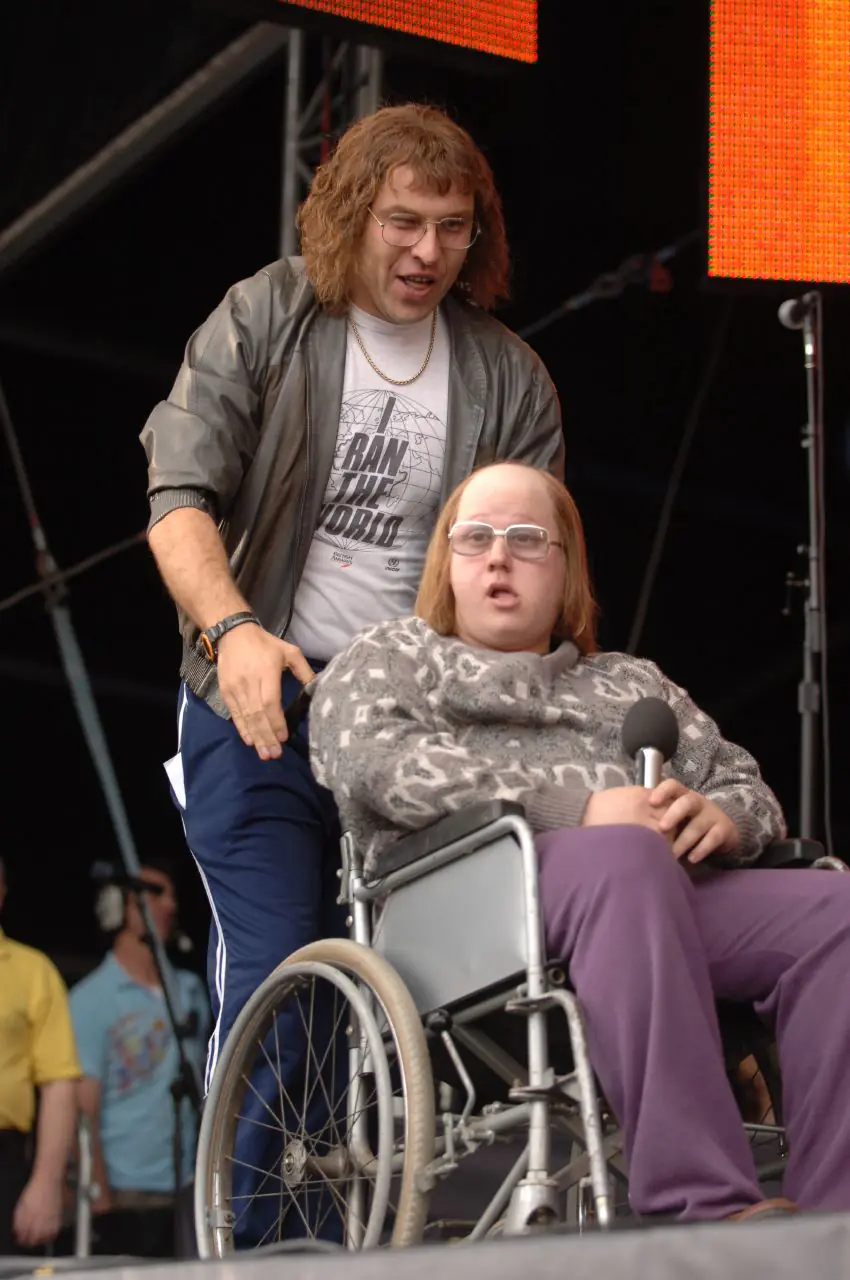
They met as teenagers at the National Youth Theatre, two young men with a gift for becoming other people. One was David Walliams, a tall, confident drama student from Banstead who could play anyone from a camp pensioner to a schoolboy. The other was Matt Lucas, a short, bald young comic from Paddington with a rubber face and a genius for grotesque characters. Together they created Little Britain, the sketch show that defined British comedy in the two thousands, filled the language with catchphrases and made them both household names. Then they went their separate ways, and each built a second career that was nothing like the first.
The boy from Banstead
David Edward Williams was born on 20 August 1971 in Banstead, Surrey. His father was an engineer for London Transport and his mother a lab technician. He studied drama at the University of Bristol, graduating in 1992, and spent his holidays performing at the National Youth Theatre, where he met Lucas. When he joined the actors’ union Equity, he discovered another David Williams was already registered, so he changed the spelling of his surname to Walliams, a name that would soon be famous across Britain.
Walliams began his career in comedy and theatre, taking small television roles and working as a jobbing actor. He had the training and the confidence of a stage actor, and he could switch between characters with ease. What he did not yet have was a vehicle of his own. That would come from the partnership with Lucas.
The boy from Paddington
Matthew Richard Lucas was born on 5 March 1974 in Paddington, London. He lost all his hair as a child after being struck by a car at the age of six, and he has had alopecia ever since. He attended Haberdashers’ Boys’ School and studied drama at the University of Bristol, though he left before graduating. It was at the National Youth Theatre that he met Walliams, and the two young men recognised something in each other: a shared love of character comedy, of dressing up, of disappearing into a role.
Lucas first came to fame on his own, as the scorekeeper George Dawes on the comedy panel show Shooting Stars, where he sat at a drum kit in a giant baby’s romper suit and delivered a string of meaningless gags before announcing the scores. It was a strange, brilliant performance, and it made him a cult figure. He appeared in The Smell of Reeves and Mortimer in 1995 and worked with Vic Reeves and Bob Mortimer, two of the most inventive comics of the era.
From radio to Little Britain
Walliams and Lucas began writing and acting together in the mid nineteen nineties, with the sketch comedy Mash and Peas in 1996 and the parody Sir Bernard’s Stately Homes in 1999. They gained a larger following with Rock Profile, a spoof interview show that ran from 1999 to 2001, in which the duo dressed as famous musicians such as Elton John, Bono and Liam Gallagher. It was clever, silly and full of the character work that would become their trademark.
Their breakout hit came when they adapted their radio show, Little Britain, to television in 2003. The programme began on BBC Three before moving to the more mainstream BBC One, and it ran for three series, from 2003 to 2006. In a series of sketches, the two played eccentric, sometimes grotesque characters living in all parts of Great Britain: Lou and Andy, the carer and the wheelchair user who was not as disabled as he seemed; Vicky Pollard, the foul-mouthed schoolgirl; Daffyd Thomas, the only gay in the village; Emily Howard, the unconvincing transvestite; and Marjorie Dawes, the cruel slimming-club leader. The show could be coarse and controversial at times, but it was enormously popular, and it introduced a myriad of catchphrases to British speech, from “computer says no” to “yeah but no but yeah but no”.
Little Britain won the BAFTA award for best comedy series in 2004 and 2005. A sold-out live tour followed, as well as a spin-off, Little Britain USA, which aired on the American cable station HBO for one season in 2008. In January 2005, Walliams and Lucas were named the most powerful people in TV comedy by Radio Times. They had gone from jobbing comics to the biggest names in British comedy in less than two years.
Come Fly with Me and the parting
The duo reteamed to create Come Fly with Me, a BBC One series set in an airport, in which they both played the flight and ground staff. It ran from 2010 to 2011, and its first episode was the third most-watched programme of Christmas Day 2010, and the most-watched comedy of the year. The show was a hit, but it would be their last series together. After Come Fly with Me, the two men went their separate ways, and each began building a solo career.
The world around them had also changed. In June 2020 the BBC pulled Little Britain from iPlayer during a wider debate about blackface in comedy, because some of the show’s characters involved Walliams and Lucas playing characters of a different race. It was a reminder that comedy which felt daring in 2003 could look very different seventeen years later, and it became part of a long public argument about what the show meant and whether it should still be watched. The catchphrases, though, never went away.
Lucas after Little Britain
Lucas went on to a varied career on stage and screen. He played Nardole in Doctor Who from 2015 to 2017, appearing alongside Peter Capaldi, and he took film roles in Alice in Wonderland in 2010, Bridesmaids in 2011, Paddington in 2014, Wonka in 2023 and Gladiator II in 2024. On stage he played Monsieur Thenardier in Les Miserables, a role he returned to several times. From 2020 to 2023 he co-presented The Great British Bake Off alongside Noel Fielding, a job that suited his warmth and his gift for gentle silliness, and he stepped down after three series.
Lucas has also worked as a writer and presenter, and in 2022 he returned to co-presenting the Fantasy Football League. He has become a familiar and much-liked figure on British television, a long way from the giant baby at the drum kit. He remains, at heart, a character comic, a man who disappears into a role and makes the audience forget the actor entirely.
Walliams after Little Britain
Walliams took a different path, and it made him one of the bestselling children’s authors in Britain. His first novel, The Boy in the Dress, was published in 2008, illustrated by Quentin Blake, and it quickly became a number one bestseller. It told the story of a twelve-year-old footballer who likes to cross-dress, and it combined compassion with gross-out jokes in a way that was compared to Roald Dahl. Mr Stink followed in 2009, then Billionaire Boy in 2010, Gangsta Granny in 2011 and Demon Dentist in 2013. Many of the books were adapted into television films and stage productions, with Walliams often playing the most memorable characters himself.
Alongside the books, Walliams built a television career of his own. In 2012 he joined the panel of judges on Britain’s Got Talent, where he was known for his chemistry with Simon Cowell, and he took acting roles in the TV movie Capturing Mary in 2007, the film Dinner for Schmucks in 2010, and the miniseries Partners in Crime in 2015. He wrote the sitcom Big School, in which he played an uptight science teacher, and he appeared on stage in No Man’s Land with Michael Gambon and in A Midsummer Night’s Dream. He also raised millions for Sport Relief with charity swims, crossing the English Channel in 2006 and swimming the length of the Thames in 2011. In 2017 he was appointed OBE for services to charity and the arts.
Two kinds of funny
Put the two men side by side and the difference is clear, but so is the partnership that made them famous. Lucas is the character man, the one who vanishes into a costume and a voice. Walliams is the showman, the one who holds the room and sells the joke. One built a career on stage and screen, the other built one in bookshops. Yet both of them learned their trade in the same place, playing two dozen characters between them in a sketch show that nobody expected to become a phenomenon. For more on two very different British stars who defined an era, read our piece on Rowan Atkinson and John Cleese.
Little Britain made them famous, and then they walked away from it and became famous for other things. Lucas became a beloved presenter and character actor. Walliams became the children’s author of his generation. The partnership lasted a decade, the catchphrases lasted longer, and the two men who created them are still, separately, at the centre of British entertainment.