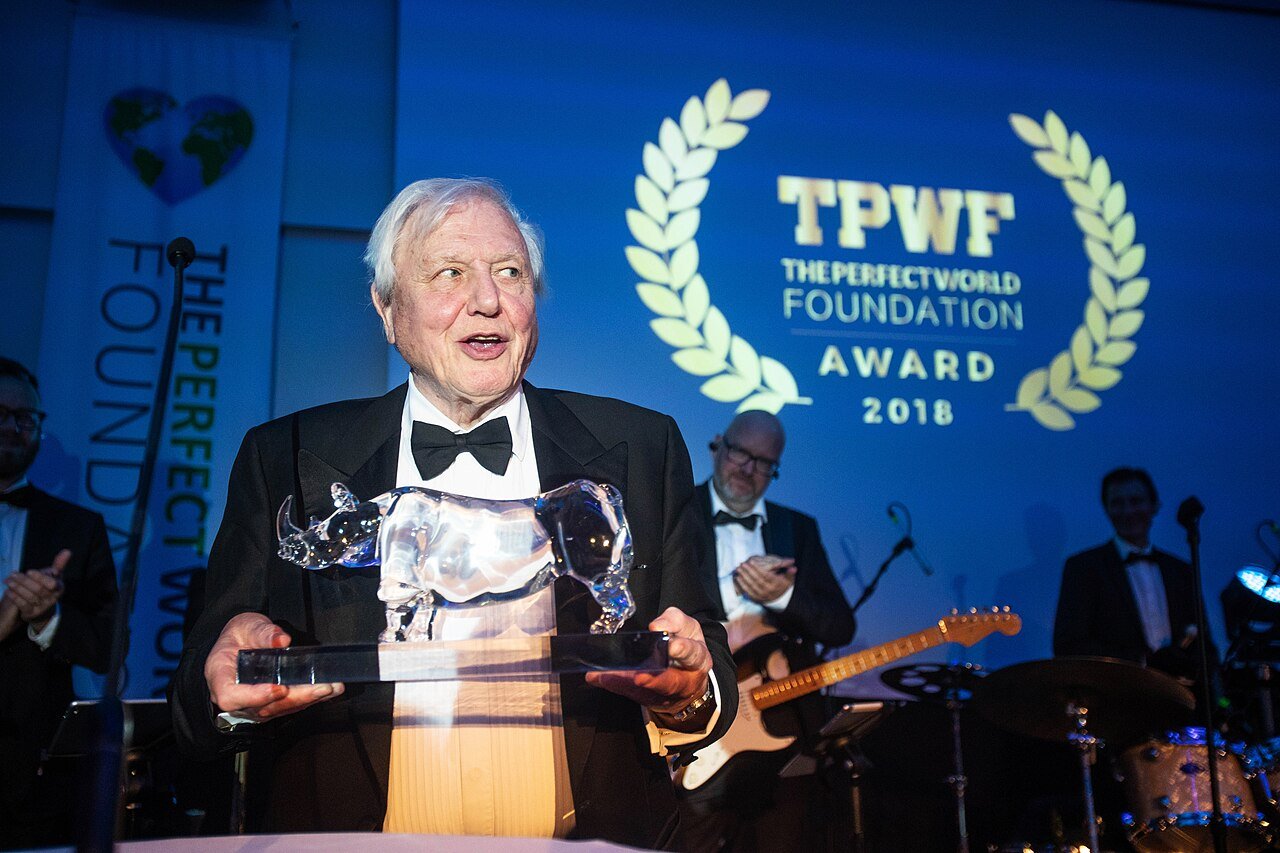
For more than seventy years, one voice has explained the natural world to Britain. It belongs to David Attenborough, the broadcaster who took television cameras to the ends of the earth and made millions of people care about animals they had never seen. For the last fifteen years, a second voice has joined him: Chris Packham, the outspoken naturalist who presents Springwatch and campaigns for wildlife with a bluntness Attenborough never uses. They are two generations of the same tradition, the teacher and the campaigner, and together they tell the story of how British natural history television grew up.
The boy from Leicester
David Frederick Attenborough was born on 8 May 1926 in Isleworth, London, and grew up in Leicester, where his father was principal of the local university college. As a boy he collected fossils, eggshells and newts, and he once sold newts he had caught to the university’s zoology department. He was educated at Wyggeston Grammar School in Leicester before winning a scholarship to Clare College, Cambridge, in 1945, where he studied geology and zoology. He graduated with an accelerated wartime degree in natural sciences in 1947, then spent two years in the Royal Navy and worked briefly at an educational publishing house.
In 1952 he completed a training programme at the BBC and joined its staff as a television producer. Two years later, together with the reptile curator Jack Lester, he originated the television series Zoo Quest, in which live animals were filmed in the wild and in zoos. Appearing on screen, Attenborough developed the engaging and personable style that would become his hallmark: evident curiosity, gentle humour and delight in discovery. The show proved enormously popular, and it made him a recognisable figure. He went on to become controller of the BBC’s new second channel, BBC Two, in 1965, where he helped launch The Forsyte Saga and the landmark series Civilisation, and introduced audiences to Monty Python’s Flying Circus. He served as director of television programming from 1968 to 1972, then resigned to write and produce documentaries full time.
The Life series
What followed was the most celebrated run of natural history programmes ever made. Beginning with Life on Earth in 1979, Attenborough wrote, developed and narrated a sequence of award-winning series that became known as the Life series: The Living Planet in 1984, The Trials of Life in 1990, Life in the Freezer in 1993, The Private Life of Plants in 1995, The Life of Birds in 1998, The Life of Mammals in 2002, Life in the Undergrowth in 2005 and Life in Cold Blood in 2008. The series used time-lapse photography, slow motion, macro cinematography and infrared cameras to show animal behaviour that had never been filmed before, and they attracted a global audience estimated at more than five hundred million viewers.
Alongside the Life series came The Blue Planet in 2001, which explored the world’s oceans, and the landmark series Planet Earth in 2006, followed by Planet Earth II in 2016 and Blue Planet II in 2017, for which his narration won him an Emmy Award. He later narrated Our Planet, which debuted on Netflix in 2019, and David Attenborough: A Life on Our Planet in 2020, which he described as his witness statement on the accelerating environmental crisis. He has continued working into his nineties, narrating Planet Earth III, Wild Isles and Our Planet II in 2023, and Ocean with David Attenborough in 2025.
The honours have piled up: he was first knighted in 1985 and appointed a Knight Grand Cross of the Order of St Michael and St George, a second knighthood, in 2022. He was elected a fellow of the Royal Society in 1983, appointed to the Order of Merit in 2005, and has won eight BAFTAs, a Peabody Award and three Primetime Emmy Awards for outstanding narrator, in 2018, 2019 and 2020. In 2025 he became the oldest ever Daytime Emmy winner. More than fifty organisms have been named in his honour, from frogs and dragonflies to a fossilised plesiosaur.
The advocate
In later life Attenborough’s role has shifted from film-maker to advocate. He has served as an ambassador for the World Wide Fund for Nature, as a member of the Earthshot Prize Council since 2020, and as president emeritus of the Wildlife Trusts. He addressed world leaders at the United Nations climate conference in Glasgow in 2021, warning that the failure to act on climate change could lead to the collapse of societies. His books include Life on Air, his memoirs as a broadcaster, published in 2002, and companion volumes to his television series. The message of his later work is consistent: the natural world is in trouble, and the time to save it is now.
The boy from Southampton
Christopher Gary Packham was born on 4 May 1961 in Southampton, Hampshire. He went to Bitterne Park Secondary School and Taunton’s College, and in 1979 he enrolled in biological sciences at the University of Southampton, where he took a degree in zoology. As a teenager he studied kestrels, shrews and badgers, and he originally planned to become a wildlife cameraman. He started building sets and cleaning cameras in 1984, and two years later he was presenting television.
Packham’s television career began in 1986 with the BAFTA-winning BBC children’s programme The Really Wild Show, which he presented until 1995 alongside Terry Nutkins and Michaela Strachan. The show made him a familiar face to a generation of children, and it established him as a broadcaster who could explain nature without talking down to his audience. He went on to present the nature photography series Wild Shots on Channel 4, and BBC programmes including The X Creatures, Hands on Nature and Nature’s Calendar. In June 2009 he began co-presenting the BBC Two nature programme Springwatch, replacing Bill Oddie, and he has presented it, along with its sister programmes Autumnwatch and Winterwatch, ever since.
The photographer
Packham is also an award-winning wildlife photographer, and his photographs have appeared in books, magazines and exhibitions around the world. He began his career intending to work behind the camera, and he has never lost that eye: his Springwatch broadcasts are full of the small details a photographer notices, the angle of a feather, the light on a leaf, the moment a bird turns. He has written books on the natural world, and he serves as president or vice-president of several conservation organisations, including the Hawk Conservancy Trust and the Bat Conservation Trust. His stepdaughter Megan McCubbin is also a wildlife presenter, and the two have appeared together on television.
The campaigner
Where Attenborough persuades gently, Packham confronts. He has become one of Britain’s most outspoken conservation campaigners, and he has never been afraid of an argument. In February 2019 he co-founded Wild Justice with Mark Avery and Ruth Tingay, a not-for-profit group that takes legal challenges against the government and its agencies on behalf of wildlife. In September 2018 he organised the People’s Walk for Wildlife, a march through London that drew thousands of people, and he has campaigned against illegal bird hunting in Malta, against the HS2 rail project and for action on climate change.
Packham has spoken openly about being autistic, and he is an ambassador for the National Autistic Society. His memoir, Fingers in the Sparkle Jar, describes his childhood in the New Forest and his love of the natural world, and it was voted the UK’s favourite nature book in a public poll. He was appointed a Commander of the Order of the British Empire in the 2019 New Year Honours for services to nature conservation. He has also presented Blue Planet Live in 2019, the documentary series Animal Einsteins in 2021, and Chris Packham: A Walk That Made Me, a one-hour special in which he walked a familiar path in Hampshire.
Two generations of the same mission
Attenborough and Packham have never presented a series together, but they belong to the same story. Attenborough built the audience for natural history television, and Packham inherited it. Attenborough showed viewers the wonders of the world; Packham tells them what is happening to it, and what can be done. One is the voice of wonder, the other the voice of urgency. Between them they span the whole history of wildlife broadcasting in Britain, from Zoo Quest in 1954 to Springwatch today.
They also share something rarer than a career: a genuine, lifelong love of the natural world that began in childhood, one boy collecting newts in Leicester, the other studying kestrels in Southampton. That love has never left either of them. Attenborough is still narrating at ninety-nine. Packham is still presenting Springwatch and marching for wildlife. For more on two very different British stars who defined an era, read our piece on Stephen Fry and Hugh Laurie.
The teacher and the campaigner, the whisper and the shout. British natural history television needed both of them, and it still does. One showed us the world. The other is fighting to save it.