
Damp homes, persistent indoor humidity, and heavy window condensation are among the most common and frustrating challenges faced by UK households, particularly during wet autumns and freezing winters. With relative indoor humidity frequently rising above 70% in poorly ventilated UK properties, excess moisture creates the ideal breeding ground for black mould spores, dust mites, musty odours, and structural wood rot. For homeowners, tenants, and landlords across the United Kingdom, investing in a high-performance dehumidifier is not just a convenience—it is an essential tool for protecting personal health, maintaining property value, and significantly reducing indoor laundry drying costs.
From compact city apartments and coastal flats to large period properties, unheated garages, and conservatories, choosing the correct dehumidifier requires matching daily extraction rates, technology types, and energy consumption against your specific living space. In this comprehensive 2026 review and buying guide, we analyze top-rated dehumidifier models available in the UK, conduct direct technical comparisons, examine running costs under current energy tariffs, and detail how to select the perfect moisture control system for your home.
Quick Comparison: Top UK Dehumidifiers at a Glance
| Model Name | Type | Tank / Extraction | Noise (dB) | Est. Running Cost | Best For |
|---|---|---|---|---|---|
| MeacoDry Arete One 20L | Refrigerant | 4.8L / 20L per day | 38 – 40 dB | ~5p – 7p / hour | Overall UK Homes & Laundry |
| MeacoDry Arete Two 20L | Refrigerant Smart | 4.8L / 20L per day | 38 – 40 dB | ~5p – 7p / hour | Smart App & Premium Air Purifier |
| Ebac 4650 18L | Refrigerant Smart | 3.5L / 18L per day | 42 – 44 dB | ~6p – 8p / hour | Cold UK Homes & Smart Sensing |
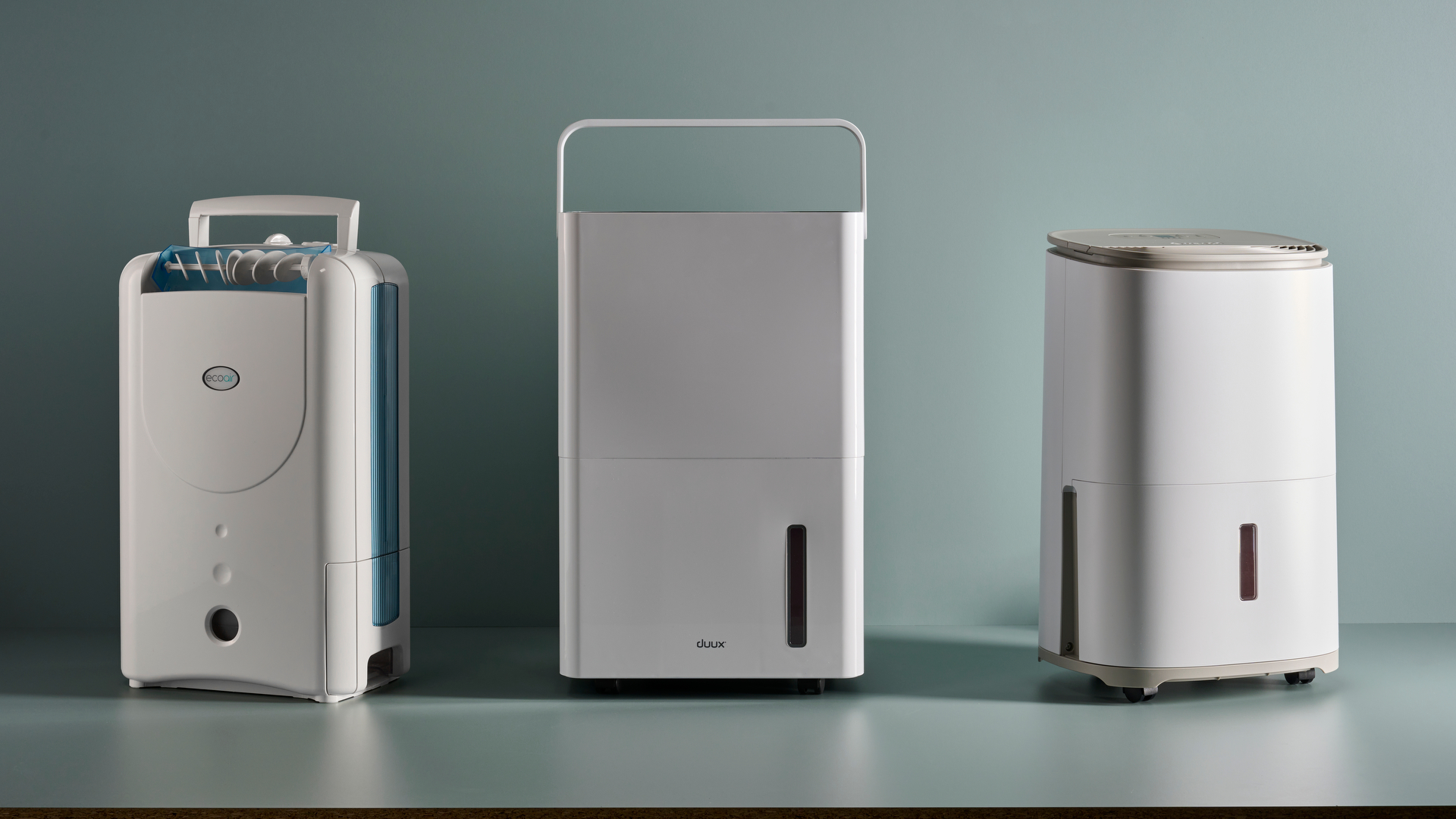
| EcoAir DD1 Classic | Desiccant | 2.0L / 7L per day | 34 – 40 dB | ~8p – 14p / hour | Unheated Garages, Lofts & Winter |
| Duux Bora Smart 20L | Refrigerant Smart | 4.0L / 20L per day | 40 – 42 dB | ~6p – 8p / hour | Modern Homes & App Automation |
| Pro Breeze 12L Compact | Refrigerant | 1.8L / 12L per day | 40 – 42 dB | ~4p – 5p / hour | Small Flats, Bedrooms & Budget |
| Dreo 20L Smart WiFi | Refrigerant Smart | 4.0L / 20L per day | 38 – 42 dB | ~6p – 7p / hour | Tech-Savvy Large Families |
| MeacoDry ABC 10L | Refrigerant | 2.6L / 10L per day | 35 – 39 dB | ~3p – 4p / hour | Bedrooms & Ultra-Quiet Operation |
| Russell Hobbs 20L (RHDH2002) | Refrigerant | 3.0L / 20L per day | 45 – 48 dB | ~7p – 9p / hour | Large Living Spaces & High Output |
| ElectriQ 20L Smart Low Energy | Refrigerant Smart | 4.0L / 20L per day | 42 – 45 dB | ~5p – 7p / hour | Cost-Conscious Tech Users |
In-Depth Reviews of the Best Dehumidifiers in the UK (2026)
MeacoDry Arete One 20L Dehumidifier & Air Purifier
Category: Best Overall UK Dehumidifier
Specifically engineered for the British climate following five years of UK customer feedback, the MeacoDry Arete One 20L stands as the gold standard in home moisture control. It combines high-capacity extraction with a medical-grade HEPA H13 filter, allowing it to purify indoor air while extracting up to 20 litres of water daily. Its dedicated Smart Laundry Mode operates at maximum efficiency to dry clothes rapidly without reliance on costly tumble dryers.
- Extraction Capacity: 20 Litres / 24 Hours
- Water Tank Capacity: 4.8 Litres with Splash Guard
- Power Consumption: 216 Watts (Ultra-low running cost)
- Noise Level: 38 dB to 40 dB (Quiet Mark Certified)
- Filter Type: H13 Medical Grade HEPA Filter
- Ideal Coverage: Up to 5-Bedroom UK Houses / 65 m²
Key Advantages (Pros):
- Extremely low power usage (only 216W power draw).
- Whisper-quiet operation suitable for hallways and landings.
- Combined HEPA air purification works independently in summer.
- Large 4.8L water tank requires less frequent emptying.
Limitations (Cons):
- Lacks built-in Wi-Fi / smart app connectivity.
- Heavier unit (15 kg), though offset by castor wheels.
MeacoDry Arete Two 20L Smart Dehumidifier
Category: Best Smart Dehumidifier
Building upon the award-winning Arete One platform, the Arete Two integrates modern Smart App controls, voice commands via Amazon Alexa/Google Assistant, and an upgraded Premium LCD Display. It retains the ultra-efficient compressor and HEPA filtration while adding an automated ‘Laundry Boost’ function and precise humidistat targets via the Meaco app, making remote climate control effortless.
- Extraction Capacity: 20 Litres / 24 Hours
- Water Tank Capacity: 4.8 Litres
- Power Consumption: 216 Watts
- Noise Level: 38 dB to 40 dB
- Connectivity: Wi-Fi Smart App & Voice Control
- Ideal Coverage: 3–5 Bedroom Homes / 65 m²
Key Advantages (Pros):
- Full smartphone integration and voice assistant compatibility.
- Chic, modernized interface with live humidity feedback.
- Top-tier energy performance with H13 air purification.
Limitations (Cons):
- Higher initial purchase price than the Arete One.
- Requires Wi-Fi setup for full smart feature access.
Ebac 4650 18L Smart Dehumidifier
Category: Best for Cold UK Homes
Manufactured directly in Great Britain, the Ebac 4650 is tailored to solve damp issues in unheated or drafty UK properties. Featuring Ebac’s patented ‘Smart Control’ system, the unit learns household patterns and automatically turns on or off based on moisture spikes, saving up to 30% in running costs compared to standard humidistats. Its intelligent defrost system ensures optimal operation even when indoor temperatures drop.
- Extraction Capacity: 18 Litres / 24 Hours
- Water Tank Capacity: 3.5 Litres (Front-loading)
- Power Consumption: 240 Watts
- Noise Level: 42 dB to 44 dB
- Origin: Made in Great Britain
- Ideal Coverage: 3–4 Bedroom Properties / 55 m²
Key Advantages (Pros):
- Patented Smart Control optimizes energy based on habits.
- Engineered specifically for cold UK winters and high humidity.
- Front-loading container prevents spills during disposal.
Limitations (Cons):
- Slightly smaller tank capacity (3.5L) for an 18L unit.
- No integrated HEPA filter included as standard.
EcoAir DD1 Classic Desiccant Dehumidifier
Category: Best Desiccant Unit for Garages & Conservatories
For unheated spaces like garages, outbuildings, conservatories, or lofts where temperatures plummet below 10°C, refrigerant models lose efficiency. The EcoAir DD1 Classic utilizes advanced desiccant technology, extracting moisture consistently down to 1°C while emitting gentle background warmth that helps heat the surrounding room during winter months.
- Extraction Capacity: 7 Litres / 24 Hours (Equal to 20L Compressor in cold rooms)
- Water Tank Capacity: 2.0 Litres with Continuous Drain option
- Power Consumption: 300W (Low) / 580W (High)
- Noise Level: 34 dB (Whisper Quiet)
- Technology: Desiccant Rotor (No Compressor)
- Ideal Coverage: Garages, Conservatories & Cold Rooms
Key Advantages (Pros):
- Performs flawlessly in near-freezing environments (down to 1°C).
- Warms ambient air by 10°C–12°C during operation.
- Lightweight build (6 kg) with ionizer for air freshness.
Limitations (Cons):
- Higher wattage consumption on high mode compared to refrigerants.
- Smaller water tank capacity requires continuous drainage tube for garages.
Duux Bora Smart 20L Dehumidifier
Category: Best Contemporary Design
Combining sleek Scandinavian aesthetics with modern smart technology, the Duux Bora 20L is designed for living spaces where aesthetics matter. It processes up to 200 m³ of air per hour, utilizing a carbon filter to remove unwanted odours alongside excess moisture. The accompanying smartphone app allows users to monitor real-time humidity levels and create custom schedules remotely.
- Extraction Capacity: 20 Litres / 24 Hours
- Water Tank Capacity: 4.0 Litres
- Power Consumption: 240 Watts
- Noise Level: 40 dB to 42 dB
- Smart Connectivity: Duux App, Google Home, Alexa
- Ideal Coverage: Medium-to-Large Open Plan Spaces / 50 m²
Key Advantages (Pros):
- Minimalist, stylish design that blends seamlessly into decor.
- Carbon filter neutralizes damp smells and cooking odours.
- Robust app control and automated night mode lighting.
Limitations (Cons):
- Premium pricing tier.
- Carbon filter requires periodic replacement.
Pro Breeze 12L Compact Compressor Dehumidifier
Category: Best Budget Compact
The Pro Breeze 12L Compact is the go-to budget solution for small flats, studio apartments, or single damp bedrooms. Despite its compact footprint, it features a digital LED display, automated humidistat targeting, a 24-hour timer, and a specialized laundry mode. It provides an efficient moisture barrier without occupying valuable floor space.
- Extraction Capacity: 12 Litres / 24 Hours
- Water Tank Capacity: 1.8 Litres
- Power Consumption: 200 Watts
- Noise Level: 40 dB to 42 dB
- Features: Digital Touch Panel, Child Lock
- Ideal Coverage: Flats, Bedrooms & Small Offices / 20 m²
Key Advantages (Pros):
- Affordable entry price with reliable daily performance.
- Compact design equipped with caster wheels and carry handle.
- Low energy consumption keeps electricity bills minimal.
Limitations (Cons):
- 1.8L tank requires daily emptying during heavy damp.
- Not suitable for whole-house dehumidification.
Dreo 20L Smart WiFi Dehumidifier
Category: Best Value Smart Model
The Dreo 20L Smart Dehumidifier delivers high-spec smart features at a highly competitive price point. Featuring a powerful compressor capable of rapidly pulling ambient moisture down to comfortable levels, the unit includes target humidity settings from 30% to 80%, real-time ambient color indicators, and custom smart routines via the Dreo app.
- Extraction Capacity: 20 Litres / 24 Hours
- Water Tank Capacity: 4.0 Litres
- Power Consumption: 230 Watts
- Noise Level: 38 dB to 42 dB
- Features: Target Humidity Lights, App Control
- Ideal Coverage: 3–4 Bedroom Family Homes / 50 m²
Key Advantages (Pros):
- Exceptional value-for-money considering its 20L capacity.
- Intuitive visual color ring for immediate humidity check.
- Fast laundry drying performance.
Limitations (Cons):
- App setup can occasionally drop on 5GHz Wi-Fi bands.
- Basic dust filter without HEPA grade purification.
MeacoDry ABC 10L Quiet Dehumidifier
Category: Best for Bedrooms
Awarded a Quiet Mark accreditation, the MeacoDry ABC 10L is purposefully designed for night-time operation in bedrooms and nursery rooms. Operating at just 35 dB, it is virtually imperceptible during operation while remaining efficient enough to prevent morning window condensation and damp bedding.
- Extraction Capacity: 10 Litres / 24 Hours
- Water Tank Capacity: 2.6 Litres
- Power Consumption: 160 Watts (Ultra Efficient)
- Noise Level: 35 dB to 39 dB (Ultra-quiet)
- Certification: Quiet Mark Approved
- Ideal Coverage: 1–2 Bedroom Flats / Small Homes / 20 m²
Key Advantages (Pros):
- Lowest noise profile in its class (35 dB).
- Ultra-low power consumption (only 160W).
- Multiple casing color options to match bedroom decor.
Limitations (Cons):
- Lower daily extraction capacity unsuitable for severe whole-house damp.
- No continuous drain hose included in standard box.
Russell Hobbs 20L (RHDH2002) Dehumidifier
Category: Best High-Output Unit
The Russell Hobbs RHDH2002 is a heavy-duty household dehumidifier built to tackle severe moisture problems, heavy condensation, and multi-story moisture spread. Featuring a simple LED interface, continuous drainage port, and electronic auto-defrost, it offers dependable performance backed by a widely trusted UK home appliance brand.
- Extraction Capacity: 20 Litres / 24 Hours
- Water Tank Capacity: 3.0 Litres
- Power Consumption: 330 Watts
- Noise Level: 45 dB to 48 dB
- Safety Features: Auto-Shutoff, Water Full Indicator
- Ideal Coverage: Large Houses / Open Plan Living / 50 m²
Key Advantages (Pros):
- Rapid moisture reduction across large floor plans.
- Simple, user-friendly controls without complicated sub-menus.
- Sturdy construction with integrated omni-directional wheels.
Limitations (Cons):
- Noticeably louder during high fan speeds (48 dB).
- Higher power draw than the Meaco Arete range.
ElectriQ 20L Smart Low Energy Dehumidifier
Category: Best Low Energy Tech
Engineered to minimize operating expenses, the ElectriQ 20L Smart Low Energy unit combines advanced digital controls with high airflow management. Equipped with an air-purifying UV filter and digital humidistat, it provides home climate control, anti-mould protection, and smart app integration at an attractive price point.
- Extraction Capacity: 20 Litres / 24 Hours
- Water Tank Capacity: 4.0 Litres
- Power Consumption: 240 Watts
- Noise Level: 42 dB to 45 dB
- Filtration: Dust Filter + UV Light Purifier
- Ideal Coverage: 3–4 Bedroom Homes / 55 m²
Key Advantages (Pros):
- Low energy design minimizes ongoing electrical costs.
- UV light air sterilization assists in killing bacteria and spores.
- Smart app compatibility with custom scheduling.
Limitations (Cons):
- Build quality feels slightly more plastic-heavy than premium competitors.
- Display lights remain bright at night if used in bedrooms.
Desiccant vs. Refrigerant Dehumidifiers: Which Type Do You Need?
Understanding the fundamental technology difference between desiccant and refrigerant (compressor) dehumidifiers is critical for selecting a unit that will perform reliably in your specific UK property environment.
Refrigerant (Compressor) Dehumidifiers
These operate similarly to a domestic refrigerator by drawing in humid air, cooling it over cold refrigerated coils to condense water droplets into the tank, and blowing warm dry air back into the room.
- Best Suited For: Heated living spaces, bedrooms, kitchens, and modern insulated UK homes (temperatures above 15°C).
- Efficiency: Extremely low power consumption (typically 160W–240W). Highly energy efficient in standard room temperatures.
Desiccant Dehumidifiers
These use a chemical desiccant wheel (similar to silica gel) to absorb water vapor directly from the air before using an internal heater to dry the wheel and collect liquid.
- Best Suited For: Cold, unheated areas such as garages, lofts, conservatories, cellars, or holiday homes (temperatures below 10°C).
- Efficiency: Higher power consumption (300W–600W), but they perform consistently in near-freezing conditions where refrigerant coils freeze over. Bonus: They raise ambient room temperature by 10°C–12°C.
Ultimate UK Buying Guide: Key Factors to Consider
Sizing and Extraction Capacity
Dehumidifiers in the UK are rated by the total volume of water they can extract in 24 hours (e.g., 10L, 12L, 20L). Note that this refers to daily extraction rate, not the size of the water tank itself.
- 10L – 12L Units: Ideal for 1 to 2-bedroom flats, single damp rooms, or small apartments (up to 30 m²).
- 18L – 20L Units: Ideal for 3 to 5-bedroom semi-detached or detached houses, open-plan properties, or drying heavy laundry loads (up to 65 m²).
UK Energy Bills & Running Costs
With UK electricity prices being a major consideration, running efficiency is paramount. Modern eco-rated refrigerant models (like the Meaco Arete draw 160W–216W) cost roughly 5p to 7p per hour to run under typical UK energy tariffs. Using a dehumidifier to dry laundry costs a fraction of operating a 2500W tumble dryer (which can cost up to 70p–£1.00 per hour), making a dehumidifier one of the most cost-effective investments for winter clothes drying.
Noise Levels (dB) and Night Operation
If you plan to run your unit in a hallway near bedrooms or directly inside a bedroom, target noise levels below 40 dB. Look for units accredited with the Quiet Mark certification (such as the Meaco ABC 10L or Arete One), which operate at whisper-quiet levels comparable to a library.
Essential Features to Look For
- Smart Laundry Mode: Runs the fan at maximum speed and lowers target humidity to 35% for 6 hours to dry wet clothes rapidly indoors.
- Integrated HEPA Filter: Captures 99.97% of airborne dust mites, mould spores, and pollen, acting as a true 2-in-1 dehumidifier and air purifier.
- Continuous Drainage Option: Includes a hose attachment so water drains directly into a sink or drain, ideal for unattended garages or lofts.
- Automated Humidistat: Automatically turns the unit off once target indoor humidity (ideally 50%) is reached, saving electricity.
Frequently Asked Questions (FAQs)
What is the ideal humidity level for a UK home?
The ideal relative humidity for a UK home is between 40% and 50%. Humidity above 60% encourages mould growth and condensation, while humidity below 30% can cause dry skin and throat irritation.
How much does it cost to run a dehumidifier per day in the UK?
An energy-efficient 20L refrigerant dehumidifier running for 6 hours a day uses roughly 1.3 kWh of electricity, costing approximately 30p to 45p per day based on current average UK electricity rates.
Is a dehumidifier cheaper than using a tumble dryer for laundry?
Yes, significantly cheaper. A typical tumble dryer consumes 2000W to 3000W of power, costing 70p to £1.00+ per cycle. An energy-efficient dehumidifier operating on Laundry Mode consumes ~200W, drying a full rack of clothes in a small room for around 25p to 35p.
Where is the best place to put a dehumidifier in a house?
For whole-house dehumidification, place the unit in a central location like a hallway or landing with interior doors left open. For targeted issues (like drying clothes or window condensation), place it directly in that specific room, keeping external windows and doors closed.
Will a dehumidifier kill existing mould?
A dehumidifier will not remove existing mould patches already on walls, but by keeping relative humidity below 50%, it stops new mould spores from developing and spreading. Existing mould should be cleaned off with a specialized fungicide or bleach solution.
Investing in a quality dehumidifier is one of the most effective steps you can take to maintain a healthy home environment, eliminate window condensation, and prevent destructive mould growth across British winters. For total home performance, whisper-quiet operation, and low running costs, the MeacoDry Arete One 20L remains our top recommendation for 2026. If you require app control, opt for the MeacoDry Arete Two or Duux Bora 20L, while cold garages and unheated conservatories will benefit most from the EcoAir DD1 Classic Desiccant.
You may also read:
What is Hire and Reward Insurance?
kind protein bars