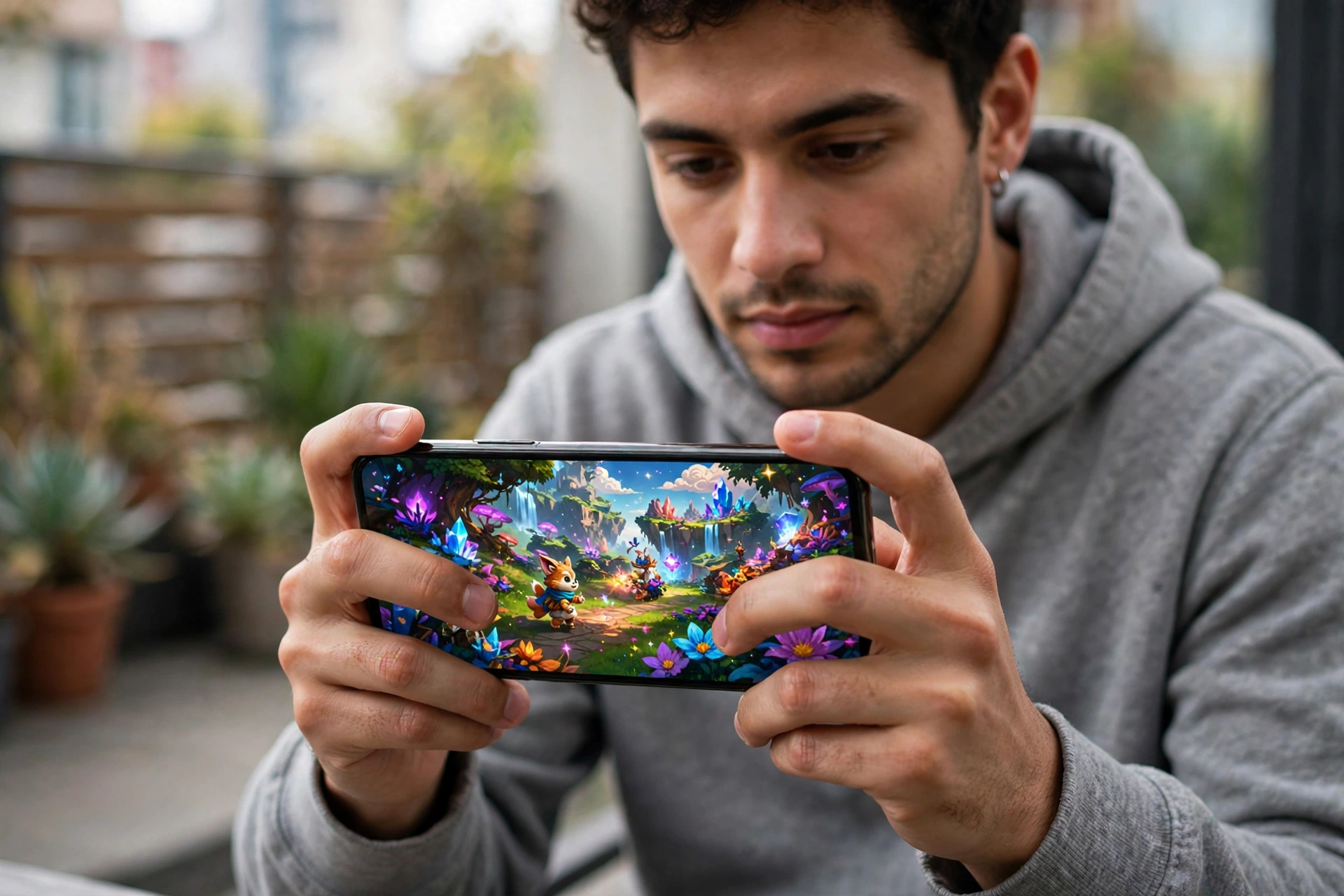
The game-changing tech transforming mobile gaming in 2025 did not arrive as a single breakthrough. It arrived as several technologies maturing at the same time: faster and more efficient phone chips, cloud servers that can stream a demanding game to an ordinary handset, artificial intelligence woven into both game design and graphics, 5G and edge networks that cut the delay between your touch and the action on screen, and cross-platform systems that let you carry progress from phone to console to PC. Together, they explain why a phone in 2025 can plausibly run games that once needed a dedicated console, and why the gap between casual and serious mobile play has narrowed so sharply.
The short answer to what changed is that the phone stopped being the limiting factor for most players. For years, mobile games were designed around what a small battery, a small screen, and a thermally constrained chip could handle, which meant simpler graphics, shorter sessions, and mechanics built for touch alone. In 2025, the limiting factors shifted to connection quality, game design, and business models instead. That is good news for players, because it means better games on more devices, but it also means that buying advice changed: the best gaming phone is no longer simply the one with the fastest chip on paper, and the best experience often depends on your network and on how a game is built as much as on your handset.
The State of Mobile Gaming in 2025
Mobile gaming entered 2025 as the largest single segment of the global games industry, and the scale is worth stating plainly because it explains where development money goes. According to the Newzoo figures cited in the Global Mobile Gaming Trends 2025–2026 report, the worldwide games market was projected to generate approximately 188.8 billion dollars in 2025, with mobile accounting for roughly 103 billion dollars, or about 55 percent of total revenue. Those are estimates, and different analysts produce different totals, but every major source agrees on the direction: more than half of games revenue now comes from phones, which is why flagship chip makers, engine developers, and major publishers all treat mobile as a first-class platform rather than a scaled-down afterthought.
That scale has also changed what success looks like. Downloads alone no longer tell the story, because a game can be downloaded by millions of people and still fail if players leave within days. Publishers in 2025 put far more weight on retention, on how many players are still playing after a week or a month, and on whether a game’s economy and live events keep a community engaged over years rather than weeks. One visible result is the rise of hybrid-casual games, which keep the simple, pick-up-and-play feel of hyper-casual titles but add progression systems, upgrades, collectibles, and optional purchases that give players a reason to return. For players, the practical effect is that many free games now feel deeper than the quick distractions of a few years ago, while also asking more of your time and attention, which is worth noticing before you invest months in a single title.
Cloud Gaming Comes of Age on Phones
Cloud gaming is the clearest example of game-changing tech transforming mobile gaming in 2025, because it breaks the link between the power of your phone and the power of the game you can play. Instead of running the whole game locally, a cloud service runs it on a remote server and streams the video to your phone, while your touches, taps, and controller inputs travel back in the other direction. Services such as Xbox Cloud Gaming and NVIDIA GeForce NOW made this model familiar, and in 2025 the combination of better server hardware, more efficient video compression, and wider 5G coverage made it practical for far more players than the early experiments ever reached.
The benefit is access. A mid-range phone that could never run a demanding console-style title locally can stream it, try it within minutes without a huge download, and play it on a train, in a waiting room, or on a television through the same account. Cloud gaming also changes how games are updated, because patches and new content land on the server rather than requiring every player to download gigabytes before playing. For people who play across devices, that instant access is genuinely liberating, and it is one reason why subscription libraries have become such an important way of discovering games on mobile.
The limits, however, are real and should not be glossed over. Cloud gaming depends entirely on your connection: a weak signal, a congested network, or a long distance to the nearest server introduces latency, the delay between your input and the response on screen, which matters far more in a fast shooter than in a turn-based strategy game. It also uses a great deal of data, which can be expensive on a capped mobile plan, and it cannot fix a poor connection with a better phone. The honest advice is to treat cloud gaming as a superb option on strong Wi-Fi or solid 5G, and to keep native games, which run entirely on your phone, for travel, rural coverage, and competitive play where every millisecond counts.
5G, Edge Computing, and Why Latency Matters
If cloud gaming is the headline, 5G and edge computing are the infrastructure that makes it believable, and they deserve a section of their own in any account of the game-changing tech transforming mobile gaming in 2025. Fifth-generation mobile networks offer higher speeds and, more importantly for gaming, lower and more consistent latency than 4G, which means that inputs reach the server faster and streamed video returns sooner. Edge computing pushes that further by placing processing closer to the player, in local data centres rather than distant server farms, so that the round trip for each frame is shorter and more predictable.
For players, the difference shows up in real-time multiplayer first. A stable, low-latency connection means fairer matches, fewer moments where your character moves after you have already reacted, and smoother voice and team coordination. It also enables augmented reality experiences that need to track the real world and overlay digital objects in real time, which falls apart if the network stutters. None of this means that 5G alone guarantees a good experience: coverage varies enormously by area, indoor signal can be much weaker than outdoor signal, and a congested cell at a stadium or festival will still struggle. Checking real coverage where you actually play, rather than trusting a national coverage map, remains the sensible test.
There is also a longer-term point worth making without hype. Next-generation 6G networks are already part of industry discussion, but they are not a commercial reality for mobile gaming in 2025 or 2026, and early deployments are generally anticipated around 2030. Anyone selling a phone or a game on the promise of 6G gaming today is selling a future, not a feature. The technologies that matter for your next purchase are 5G, Wi-Fi 6 and Wi-Fi 7, edge servers, and efficient video compression, all of which are already shipping and already measurable in the games you play.
Artificial Intelligence Inside Games and Behind Them
Artificial intelligence is the second great force behind the game-changing tech transforming mobile gaming in 2025, and it works in two distinct places that players often confuse. Inside the game, AI adjusts difficulty to your performance, so that a session stays challenging without becoming frustrating, and it drives non-player characters that react more believably than the scripted opponents of earlier mobile titles. It also powers matchmaking, cheat detection, and personalised recommendations, quietly shaping which opponents you face and which events you are offered. Done well, this makes games feel responsive to you personally; done badly, it can feel manipulative, particularly when difficulty or rewards seem tuned to push purchases rather than fun.
Behind the game, AI has changed how mobile titles are made. Development tools now help generate environments, populate worlds, test for bugs before release, and produce marketing art and localised text far faster than a small team could by hand. That speed is one reason why mobile releases in 2025 look richer and arrive more frequently, and why independent studios can attempt scopes that once required a large publisher. It also raises questions that players are right to ask, about originality, about the use of creative work in training data, and about whether procedurally generated content can match hand-crafted design. The fair summary is that AI is a powerful production tool and a genuine gameplay ingredient, but it is not a substitute for good design, and the best mobile games of 2025 use it to support human creativity rather than replace it.
The most visible AI technology for players, though, is AI upscaling and frame generation in graphics. Modern phone chips include dedicated neural processing units that can reconstruct a sharper image from a lower-resolution render, or generate intermediate frames to make motion appear smoother, without the same battery and heat cost as rendering everything at full resolution natively. That is why a 2025 flagship can offer ray-traced lighting and high frame rates while lasting longer than an older phone doing the same work by brute force. The trade-off is that upscaling can introduce artefacts such as shimmering on fine detail, and frame generation can add a small amount of latency, so enthusiasts still value native rendering for competitive play. For most players, however, AI graphics are the reason premium visuals no longer demand a premium battery sacrifice.
Ray Tracing, Better Chips, and the Battery Reality
Graphics hardware is where the game-changing tech transforming mobile gaming in 2025 is easiest to see, because the improvement is visible on screen. Flagship mobile chips from Apple, Qualcomm, and MediaTek now support hardware-accelerated ray tracing, a technique that simulates how light actually behaves, producing realistic reflections, shadows, and global illumination that older rasterised graphics could only approximate. Engines such as Unreal Engine 5 and Unity now ship with mobile-optimised rendering pipelines, variable rate shading, and adaptive resolution scaling, which let developers deliver console-like scenes while adjusting detail on the fly to keep frame rates steady on different devices.
That progress comes with a physical constraint that no marketing slide can remove: heat. A phone has no fan, a small battery, and a thin body that must stay comfortable to hold, so sustained performance matters far more than a brief benchmark peak. A chip that runs beautifully for five minutes and then throttles to half speed will feel worse in a long session than a slightly slower chip that holds its pace. This is why cooling design, vapour chambers in gaming phones, and power-efficient architectures matter as much as headline clock speeds, and why reviews that test thirty minutes of continuous play are more useful than launch-day benchmark tables. Battery life follows the same logic: high refresh-rate displays, ray tracing, and 5G streaming all draw power, so a gaming session will drain a phone far faster than video playback, and carrying a charger is still part of serious mobile play.
For buyers, the practical conclusion is to match the phone to the games you actually play. A casual puzzle or hybrid-casual player gains little from a dedicated gaming phone with shoulder triggers and a fan, while a competitive shooter or open-world player will notice the difference in sustained frame rates, touch sampling, and thermal headroom. Mid-range phones in 2025 closed much of the gap for most genres, thanks to AI upscaling and efficient chips, which means that the premium is now paid for the last ten percent of performance rather than for basic playability. That is a healthy change, and it is why the used and mid-range markets are far more viable for mobile gamers than they were a few years ago.
Cross-Platform Play and Shared Progress
Cross-platform play is the feature that most changed how mobile gamers relate to the wider gaming world in 2025, and it completes the picture of game-changing tech transforming mobile gaming in 2025. Many major titles now launch with cross-play built in, allowing phone players to compete or cooperate with friends on console and PC, with cloud synchronisation carrying progress, purchases, and cosmetics across devices. You can start a session on your phone during a commute, continue on a console at home, and pick up on a tablet later, without manual transfers or separate accounts for each platform.

The social effect of that shift is at least as important as the technical one. Mobile players are no longer a separate community playing separate versions of a game; they are part of the same player base, the same leagues, and the same live events as console and PC players, which has driven investment in spectator modes, in-game streaming tools, and structured mobile competitions. That visibility has also raised expectations around fairness, because touch controls and mouse-and-keyboard controls are not equivalent in every genre. Good cross-platform games address this with input-based matchmaking, aim-assist tuning, and controller support, while weaker ones leave mobile players at a disadvantage that no amount of skill fully overcomes. Checking how a game handles cross-play, before investing in it, is now as important as checking its graphics.
Controller support deserves a special mention, because it bridges the gap between casual touch play and serious competition. A clip-on controller or a standard Bluetooth gamepad transforms many mobile titles, giving precise movement and camera control that a touchscreen cannot match, and most major games now support controllers natively. Combined with high-refresh-rate displays, faster touch response, and customisable controls, the modern phone is a credible competitive device in its own right, not merely a convenient one. The remaining barrier is habit and ergonomics rather than technology, and for many players a controller is the single best upgrade they can buy.
Augmented Reality, Haptics, and Feeling the Game
Augmented reality remains the most uneven of the 2025 mobile technologies: genuinely impressive in places, still experimental in others, and worth describing honestly rather than as a revolution that has already happened. AR overlays digital objects onto the real world through your phone’s camera, and in 2025 it worked best in location-based games, casual titles that place characters in your room, and shopping or training experiences that borrow game mechanics. The constraints are the camera, the battery, and the need for accurate tracking in varied lighting, which is why AR has not yet produced a dominant, must-play mobile genre to rival the mainstream successes of earlier location games.
Haptics and audio, by contrast, improved in ways every player can feel immediately. High-precision vibration motors now simulate subtle sensations, from the texture of a surface to the recoil of a weapon, and spatial audio places sounds convincingly around you through ordinary earphones. Together, they create a multi-sensory experience that deepens immersion without demanding a bigger screen or a more powerful chip, and developers increasingly design with these capabilities in mind rather than treating vibration as a simple on-or-off buzz. The lesson for players is that a phone’s speakers, haptics, and audio processing are gaming features in their own right, and that a good pair of earphones often improves a mobile game more than a small chip upgrade.
Looking ahead from 2025, the pattern is clear: the technologies that succeeded were the ones that removed friction, whether that friction was hardware cost, download size, device boundaries, or control limitations. Cloud gaming removed the hardware barrier, cross-platform play removed the device barrier, AI upscaling removed part of the battery barrier, and 5G removed part of the latency barrier. The technologies still finding their place, such as AR and spatial computing, are those that add friction of their own, in the form of battery drain, awkward holding positions, or content that does not yet justify the effort. That is a useful lens for judging whatever is announced next.
Conclusion
The game-changing tech transforming mobile gaming in 2025 is best understood as a system, not a single feature. Cloud gaming made demanding games accessible on ordinary phones, 5G and edge computing made streamed and multiplayer play feel responsive, AI made graphics sharper and games more personal without destroying battery life, ray tracing and efficient chips made phone games look genuinely premium, and cross-platform play made mobile gamers full citizens of the wider gaming world. No one of those advances alone would have changed the landscape; together, they moved mobile gaming from a convenient compromise to a primary way of playing.
For players, the advice that follows from that picture is refreshingly practical. Choose a phone for sustained performance and battery life rather than benchmark peaks, test cloud gaming on the connection you actually use, use a controller for any game where precision matters, and judge a game by its cross-play fairness and its long-term community as much as by its launch graphics. Technology will keep advancing, and later chips will make today’s flagships look modest, but the games and habits you build in 2025 will carry forward across devices in a way that was never true before. If you enjoy seeing how these trends fit into everyday life beyond gaming, you may also like our guide to technology in 2025, which covers AI, 5G, and augmented reality across work, entertainment, and the home.
Frequently Asked Questions
What is the most important game-changing tech transforming mobile gaming in 2025?
There is no single winner, but cloud gaming had the broadest effect, because it let mid-range phones play demanding titles without powerful local hardware. Combined with 5G, AI upscaling, and cross-platform progress, it changed who could play what, not just how good games looked.
Do I need a 5G phone to enjoy mobile gaming in 2025?
No. Most mobile games play well on 4G and Wi-Fi, and native games do not need 5G at all. 5G matters most for cloud gaming and fast-paced multiplayer, where lower latency improves responsiveness, but a stable connection matters more than the generation label on it.
What is ray tracing on a mobile phone?
Ray tracing is a graphics technique that simulates how light behaves, producing realistic reflections, shadows, and lighting. Flagship phone chips in 2025 support it in hardware, and AI upscaling helps deliver it without excessive battery drain, although sustained performance and heat still limit long sessions.
Is cloud gaming better than playing games installed on my phone?
It depends on your connection and your game. Cloud gaming offers instant access and no large downloads, but it needs a strong, stable connection and uses significant data. Installed games work offline, respond faster, and suit competitive play, so many players use both: cloud for discovery and casual play, native for serious sessions.
Will my mobile game progress carry over to console or PC?
In many major titles launched with cross-platform support in 2025, yes. Progress, purchases, and cosmetics sync through a shared account when the game supports cross-progression, but not every game offers it, so check a title’s cross-play and cross-progression support before investing time or money in it.