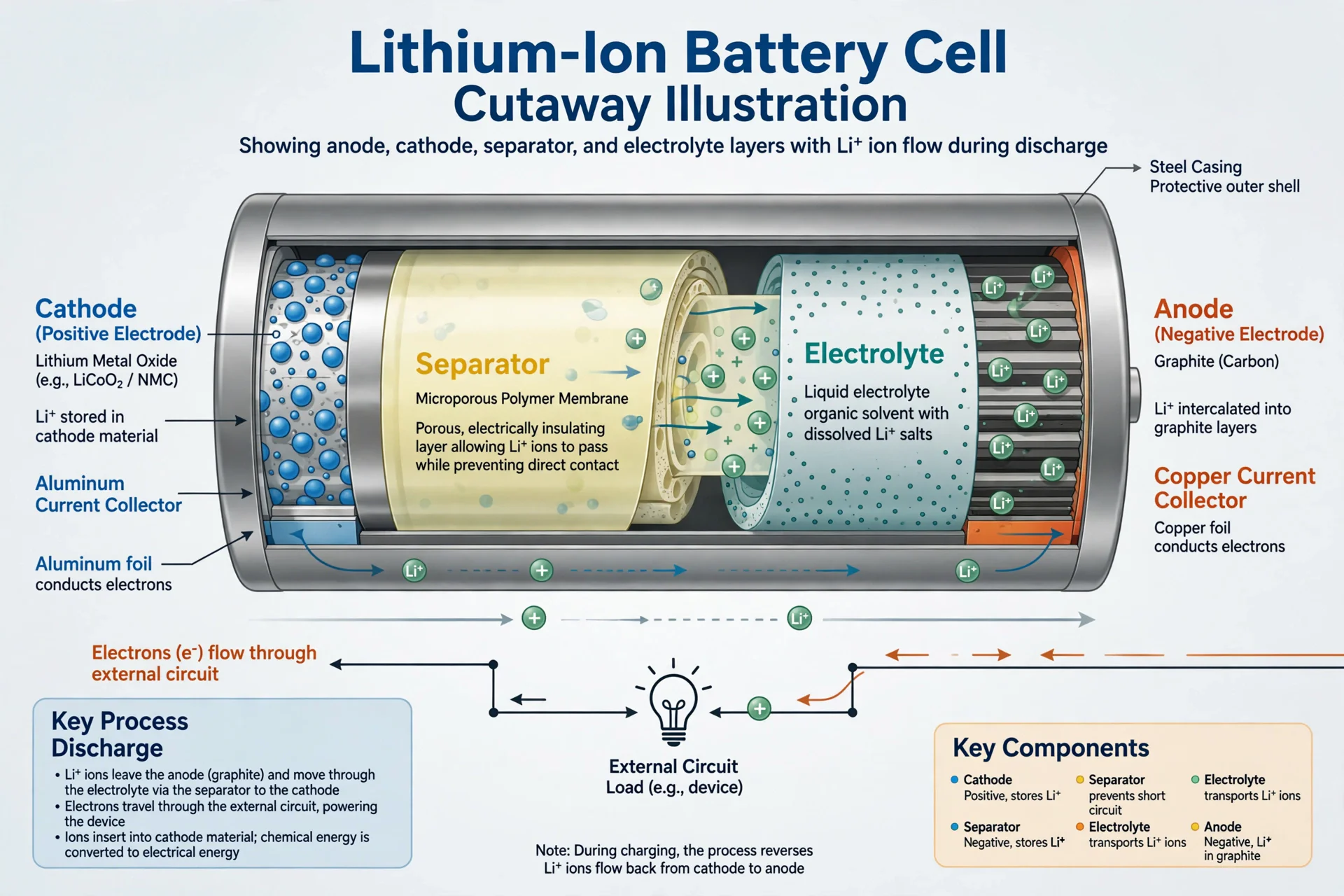
Your phone, your laptop, your car, and the grid-scale installations storing solar power overnight all depend on the same tiny invention: the battery cell. Most of us never think about what happens inside that sealed little package, yet it performs one of the most elegant tricks in all of technology — turning chemistry into electricity on demand, then reversing the trick to recharge, hundreds or thousands of times over. Understanding how battery cells work is understanding the engine of the modern world.
A battery cell is, at its core, a tiny power plant. It stores energy in chemical bonds and releases it as an electric current whenever you complete a circuit. The same basic design scales from the watch battery on your wrist to the enormous battery packs that move electric cars and balance national power grids. Once you grasp the three essential parts inside every cell and the beautiful back-and-forth dance of electrons and ions between them, the whole technology clicks into place.
What Is a Battery Cell?
A battery cell is the smallest unit that can produce electricity through a chemical reaction. Strictly speaking, what most people call a “battery” — the pack in a phone or an electric car — is actually a collection of individual cells wired together to deliver the required voltage and capacity. Each single cell typically produces only a few volts, so engineers combine dozens, hundreds or even thousands of them into battery packs for demanding applications. Every cell, regardless of its chemistry, contains three fundamental components working together. The anode is the negative electrode, usually made of graphite or a lithium compound in modern rechargeable cells. The cathode is the positive electrode, built from materials such as lithium cobalt oxide or nickel manganese cobalt. Between them sits the electrolyte, a chemical medium — liquid, gel or solid — that allows charged particles called ions to travel from one electrode to the other while keeping the electrodes themselves apart.
These three elements form an electrochemical system: chemical reactions at the electrodes liberate electrons, the electrons flow through your device as usable current, and ions shuttle through the electrolyte to keep everything in balance. This three-part architecture is the foundation of how battery cells work in every device you own. Change the electrode materials or the electrolyte chemistry, and you change the cell’s voltage, capacity, lifespan and safety profile — which is why battery research is, at heart, materials science.
The Science Behind It

At its most basic, electricity is simply the movement of electrons, and a battery cell is a machine for pushing electrons through a circuit in a controlled way. When you switch on your phone, a chemical reaction at the anode releases electrons, which travel through the external circuit — powering the screen, the processor, the radio — on their way to the cathode. That orderly stream of electrons is the electric current your device runs on. Meanwhile, inside the cell, positively charged lithium ions move through the electrolyte in the opposite direction, from anode to cathode, balancing the charge so the reactions can continue. A thin separator keeps the two electrodes from touching — which would cause a short circuit — while remaining porous enough for ions to pass through. This choreography is described beautifully in the U.S. Department of Energy’s battery science resources, which explain how electrons move through the circuit while ions move through the electrolyte to create a sustainable, rechargeable system.
The genius of the design is that it is reversible. Push electrons back the other way with a charger, and the ions obediently migrate back too, restoring the chemical imbalance that stores the energy. That reversibility is what separates rechargeable cells from single-use ones, and it is the property that made the entire portable-electronics and electric-vehicle revolutions possible. Once you can picture this reversible flow of electrons and ions, you genuinely understand how battery cells work in everyday life. It is a trick no other common energy store performs so elegantly, and it underpins the entire economics of rechargeable power.
Charging and Discharging Explained
Discharging is what happens whenever you use a battery-powered device. Electrons flow from the anode to the cathode through the external circuit, delivering energy to your phone, laptop or car motor as they go. Inside the cell, lithium ions drift through the electrolyte from anode to cathode to balance the charge. As this process continues, the chemical fuel of the cell is gradually spent, and the voltage slowly falls until the device needs recharging. Charging reverses the entire process. When you plug in, the charger forces electrons back into the anode, and the lithium ions migrate back through the electrolyte to join them. The cell’s chemistry is restored to its high-energy state, ready to discharge again. Modern battery management systems carefully control this process — regulating voltage, current and temperature — because pushing a cell too hard during charging is one of the main causes of degradation and, in extreme cases, safety failures.
This back-and-forth cycle can repeat hundreds or thousands of times depending on the chemistry and how gently the cell is treated. Shallow discharges, moderate temperatures and avoiding full charges to 100% all extend a lithium-ion cell’s life, which is why your phone’s battery settings offer optimised charging and why electric cars let you cap charging at 80% for daily driving. Treat your batteries kindly — avoiding extreme heat, deep discharges and constant 100% charging — and they will repay you with years of reliable service.
Types of Battery Cells
Alkaline cells are the classic single-use batteries found in remote controls, wall clocks and torches. They are cheap, dependable and hold their charge well on the shelf, but their chemistry cannot be reversed, so once they are spent they must be replaced and recycled. For low-drain devices used occasionally, they remain a practical and economical choice. Lithium-ion cells are the rechargeable workhorses of the modern world, powering smartphones, laptops, power tools and electric vehicles. They pack far more energy per kilogram than older rechargeable chemistries, lose little charge when idle, and survive hundreds of charge cycles. Their dominance comes with trade-offs — they need sophisticated management electronics, and damaged cells can overheat — but continuous improvements in chemistry and manufacturing keep extending their lead.
Nickel-metal hydride and nickel-cadmium cells are older rechargeable technologies still found in some power tools, cordless phones and hybrid cars. They are rugged and tolerant of abuse, but they store less energy for their weight than lithium-ion and, in the case of nickel-cadmium, suffer from memory effect and contain toxic cadmium. They are gradually being displaced as lithium-ion costs fall. Solid-state cells are the most exciting technology on the horizon. They replace the flammable liquid electrolyte with a solid ceramic or polymer material, promising greater safety, faster charging and significantly higher energy density. Major manufacturers and research labs are racing to commercialise them, and while mass production challenges remain, solid-state batteries could eventually transform electric vehicles, aviation and grid storage.
Why Battery Efficiency Matters
When engineers evaluate a battery cell, three criteria dominate: how much energy it stores, how long it lasts, and how safe it is. Energy density — watt-hours per kilogram — decides whether an electric car drives 200 or 400 miles and whether a phone lasts a day or two. Cycle life decides how many years of daily charging the cell survives before its capacity fades. Safety decides whether a damaged cell simply dies or dangerously overheats. Different applications weight these criteria differently. A smartphone battery must be thin, light and energy-dense above all else. An electric vehicle pack must deliver huge total energy while surviving a decade of daily cycling and crash testing. Grid storage prioritises low cost per cycle and absolute safety over weight, since the batteries sit in a field rather than flying through the air. There is no perfect cell — only the right trade-offs for the job, which is why engineers who deeply understand how battery cells work choose different chemistries for phones, cars and grid storage.
Manufacturers therefore innovate relentlessly on chemistry, electrode structure and cell design, chasing the ideal balance of cost, performance and safety. Advances like silicon-rich anodes, high-nickel cathodes and improved electrolytes each squeeze a few more percent of performance from the technology, and those incremental gains compound into the transformative improvements we see each decade. Each breakthrough, from silicon anodes to solid electrolytes, inches the technology closer to the dream of cheap, everlasting, ultra-safe energy storage. The result is a technology curve that has cut lithium-ion costs dramatically over the past decade while steadily improving safety.
Battery Cell Safety
Modern battery cells are remarkably safe, but their safety depends on respecting the chemistry inside. Overcharging, physical puncture, crushing or extreme overheating can destabilise the internal reactions and trigger thermal runaway — a self-reinforcing cycle in which the cell heats uncontrollably. That is why every lithium-ion pack includes protection circuits that cut off charging at safe limits, temperature sensors that throttle performance when hot, and robust mechanical casings. For most consumers, safe use comes down to simple habits: use the charger supplied with the device or a reputable equivalent, avoid charging on soft furnishings that trap heat, replace swollen or damaged batteries promptly, and never attempt to open a sealed cell. Electric vehicles add layers of engineering — liquid cooling, crash-resistant pack structures and battery management systems monitoring every cell — because the stakes and the energies involved are so much larger.
Regulators and industry bodies continue to tighten standards as batteries spread into e-bikes, scooters and home storage. Buying certified products from reputable brands, rather than suspiciously cheap unbranded cells, remains the single most effective safety step a consumer can take. Look for recognised safety certifications on anything you buy, from phone chargers to e-bike packs, and be deeply suspicious of no-name cells sold at improbable prices. These evolving rules are steadily making the cheapest, least-safe unbranded options harder to sell, which protects consumers.
Recycling and Sustainability
What happens to battery cells at the end of their lives is becoming as important as how they perform. Cells contain valuable and finite materials — lithium, cobalt, nickel, manganese — and disposing of them carelessly wastes those resources while risking soil and water contamination. Recycling recovers the metals for new cells, reducing both the environmental damage of mining and the cost of future batteries. The industry is moving fast on this front. Dedicated recycling plants now recover the majority of key metals from spent lithium-ion cells, researchers are designing cells that are easier to disassemble and recycle, and regulations in Europe and elsewhere increasingly require producers to take responsibility for end-of-life batteries. Second-life applications add another chapter: electric vehicle packs retired from cars, still holding most of their capacity, get a productive second career storing solar power for homes and grids.
With the global push for electric vehicles and renewable energy, sustainable battery manufacturing and recycling are no longer nice-to-haves but essential infrastructure. The battery cells of the future will be judged not only on performance but on the footprint of their entire lifecycle. The choices made today about battery design, recycling infrastructure and responsible sourcing will shape the environmental legacy of the entire clean-energy transition. Getting this right matters for every community hoping to benefit from clean, affordable and responsibly sourced energy.
Frequently Asked Questions
What are the three main parts of a battery cell? Every battery cell contains an anode (the negative electrode), a cathode (the positive electrode) and an electrolyte (the medium that lets ions travel between the electrodes). A separator keeps the electrodes apart while allowing ion flow. The anode is the negative electrode, the cathode is the positive electrode, and the electrolyte is the medium that carries ions between them. A thin separator keeps the electrodes apart while letting ions pass through.
How do battery cells produce electricity? Chemical reactions at the electrodes release electrons, which flow through an external circuit as electric current, while ions move through the electrolyte inside the cell to balance the charge. This conversion of chemical energy into electrical energy powers the connected device. The electrons do useful work as they travel through your device — lighting the screen and running the processor — before arriving at the cathode, while ions balance the charge inside the cell.
What is the difference between charging and discharging? Discharging is the normal use of the battery: electrons flow from anode to cathode through your device, releasing stored energy. Charging reverses this, with the charger pushing electrons back into the anode and restoring the cell’s chemical energy for the next cycle. Modern battery management systems carefully regulate this reversal, controlling voltage, current and temperature to maximise both safety and the cell’s long-term lifespan.
How long do lithium-ion battery cells last? A typical lithium-ion cell survives 500 to 1,000 full charge cycles before its capacity fades significantly, translating to roughly two to five years in a phone or eight to fifteen years in an electric car, depending on usage patterns and thermal management. Gentle habits extend life considerably: avoiding extreme heat, deep discharges and constant charging to 100% can add years to a battery’s useful service.
Are solid-state batteries available yet? Solid-state cells are in advanced development and limited production, with major manufacturers targeting mass-market electric vehicles later this decade. For anyone following how battery cells work and where the technology is heading, solid-state designs are the development to watch. They promise better safety and higher energy density than today’s lithium-ion cells but remain expensive to manufacture at scale. They promise greater safety, faster charging and higher energy density than today’s lithium-ion cells, but manufacturing them affordably at scale remains the industry’s biggest challenge.
Conclusion
Battery cells are marvels of applied chemistry: three humble components — anode, cathode and electrolyte — orchestrating a reversible dance of electrons and ions that powers everything from hearing aids to electric aircraft. The better we understand how battery cells work, the more we appreciate the decades of research behind the devices we take for granted, and the more clearly we see the path to safer, longer-lasting and more sustainable energy storage. As demand for clean energy accelerates, battery innovation will only speed up. Solid-state designs, improved recycling and smarter management systems are converging on a future of longer-range vehicles, longer-lived devices and grids run increasingly on stored sunshine and wind. The tiny power plant inside your phone is just getting started.
If you enjoyed this explainer, you may also like our guide to the top glass bottle manufacturers in Nigeria.
For more on sustainable manufacturing, read about the leading glass bottle manufacturers in Nigeria.