Introduction
The Mirror and the Light is the final installment of Hilary Mantel’s acclaimed Wolf Hall trilogy, concluding the extraordinary literary journey of Thomas Cromwell in the court of King Henry VIII. Published in 2020, the novel completes a sweeping historical narrative that began with Wolf Hall and continued in Bring Up the Bodies. It explores the final stage of Cromwell’s life, marked by political triumph, increasing isolation, and eventual downfall, while maintaining Mantel’s signature blend of historical precision and psychological insight.
Beyond being a continuation of a historical saga, the novel functions as a deep reflection on power, loyalty, and mortality. Mantel does not simply recount events; she reconstructs a world where every conversation carries political weight and every decision risks fatal consequences. The Mirror and the Light stands as both a literary achievement and a complex study of how ambition shapes human destiny within one of England’s most dangerous political environments.
Background and Publication Context
The Mirror and the Light was published in March 2020, nearly eight years after the release of Bring Up the Bodies. This long gap heightened anticipation among readers and critics, as Hilary Mantel had already established herself as one of the most important historical fiction writers of her time. The novel continues her meticulous reconstruction of Tudor England, focusing on the final four years of Thomas Cromwell’s life, from 1536 to his execution in 1540.
Upon release, the novel achieved immediate commercial success, with strong early sales in the UK and international markets. It was widely reviewed by major publications and praised for its depth and ambition. The book was shortlisted for the Women’s Prize for Fiction and later won the Walter Scott Prize for historical fiction, further cementing Mantel’s reputation. Its publication also reignited interest in the Wolf Hall trilogy as a defining achievement in modern historical literature.
Plot Overview and Story Arc

The Mirror and the Light continues the story after the execution of Anne Boleyn, where Thomas Cromwell has reached the height of his influence in King Henry VIII’s court. As the king’s chief minister, Cromwell navigates a political environment defined by shifting alliances, religious transformation, and constant suspicion. The novel follows his increasing efforts to maintain power while managing enemies who are quietly gathering strength against him.
As the narrative progresses, Cromwell’s position begins to weaken despite his earlier successes. Political favor proves fragile, and loyalty becomes increasingly uncertain in a court ruled by fear and ambition. The story builds toward his eventual arrest and execution, portraying not only the collapse of a political figure but also the emotional and psychological unraveling of a man who once believed in his ability to control events. Mantel presents this downfall with restraint, allowing tension to grow naturally through character interaction and historical inevitability.
Themes and Symbolism in The Mirror and the Light
One of the central themes of The Mirror and the Light is the nature of power and its instability. Mantel explores how authority in Tudor England is never permanent and how even the most capable political minds can be destroyed by shifting royal favor. Cromwell’s journey reflects the idea that power is both a tool and a trap, offering control while simultaneously creating vulnerability.
Symbolism plays a major role in enriching the narrative, particularly through the concepts of mirrors and light. The mirror represents self-reflection, truth, and the confrontation with one’s identity, while light symbolizes revelation, clarity, and sometimes exposure to danger. Together, these symbols highlight Cromwell’s internal struggle as he attempts to understand his place within a volatile political system. Mantel uses these motifs to deepen the emotional and philosophical layers of the story.
Thomas Cromwell Character Analysis
Thomas Cromwell is portrayed as one of the most complex characters in modern historical fiction. In The Mirror and the Light, he is neither purely heroic nor entirely villainous, but instead a deeply human figure shaped by intelligence, ambition, and survival instinct. Mantel presents him as someone who understands the mechanics of power better than most, yet remains emotionally vulnerable in his relationships and personal reflections.
As the novel progresses, Cromwell’s inner life becomes increasingly significant. His strategic mind is constantly at work, but he also experiences moments of doubt and introspection that reveal the emotional cost of his political career. The tension between his public authority and private uncertainty creates a layered portrait of a man who has risen from humble origins to the highest levels of power, only to discover how easily that power can disappear.
Critical Reception and Literary Recognition
The Mirror and the Light received widespread critical acclaim upon publication, with reviewers praising its narrative depth, historical accuracy, and literary craftsmanship. Many critics described it as a fitting conclusion to the Wolf Hall trilogy and one of the most important works of historical fiction in recent decades. Major publications highlighted Mantel’s ability to make historical events feel immediate and emotionally engaging.
The novel was also recognized through several major awards and nominations, including the Walter Scott Prize for historical fiction. It appeared on numerous best-books lists in 2020 and was frequently discussed in literary circles as a defining work of the year. While some critics noted its length and density, the overall reception confirmed Mantel’s position as a master storyteller capable of blending scholarly research with compelling narrative fiction.
Adaptations and Cultural Impact
The influence of The Mirror and the Light extends beyond literature into stage and screen adaptations. A theatrical version was developed in collaboration with the Royal Shakespeare Company, continuing the adaptation tradition of the Wolf Hall series. This stage production helped bring the story to new audiences while preserving the complexity of Mantel’s writing through performance.
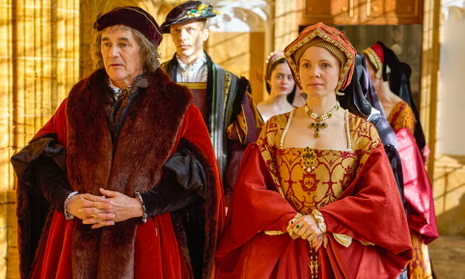
A major television adaptation followed, with production completed in the early 2020s and broadcast in 2024. The series brought renewed attention to the Wolf Hall trilogy, introducing Cromwell’s story to a global audience. These adaptations have contributed to a broader cultural interest in Tudor history, reinforcing the novel’s relevance in contemporary media and academic discussions of historical storytelling.
Why The Mirror and the Light Still Matters Today
The Mirror and the Light remains significant not only as a historical novel but also as a reflection on leadership, political instability, and human vulnerability. Its portrayal of power dynamics continues to resonate in modern contexts, where political environments remain unpredictable and shaped by shifting alliances. Mantel’s exploration of ambition and consequence gives the story a timeless quality that extends beyond its historical setting.
The novel also matters because it demonstrates the potential of historical fiction to combine academic research with emotional storytelling. Mantel’s ability to bring the past to life with psychological depth ensures that readers not only understand historical events but also feel their impact. This combination of intellectual rigor and narrative artistry is what makes The Mirror and the Light a lasting contribution to contemporary literature.
FAQ
The Mirror and the Light is the final novel in Hilary Mantel’s Wolf Hall trilogy, focusing on the last years of Thomas Cromwell’s life in the court of Henry VIII. It follows his rise to power, his political struggles, and his eventual downfall and execution. The novel is widely regarded as a major work of historical fiction due to its detailed research and psychological depth.
The book is highly regarded because it combines historical accuracy with literary sophistication. Critics praise its character development, particularly the portrayal of Thomas Cromwell, as well as its exploration of power, politics, and morality. It has also received major literary recognition, including the Walter Scott Prize and widespread critical acclaim from leading international publications.
Yes, The Mirror and the Light continues the story of Wolf Hall and Bring Up the Bodies, completing Thomas Cromwell’s narrative arc. It provides a final exploration of his life, from his peak in political influence to his eventual downfall. Readers are strongly encouraged to read the trilogy in order to fully understand character development and historical context.
You may also read: Highlights and Must-See Gardens