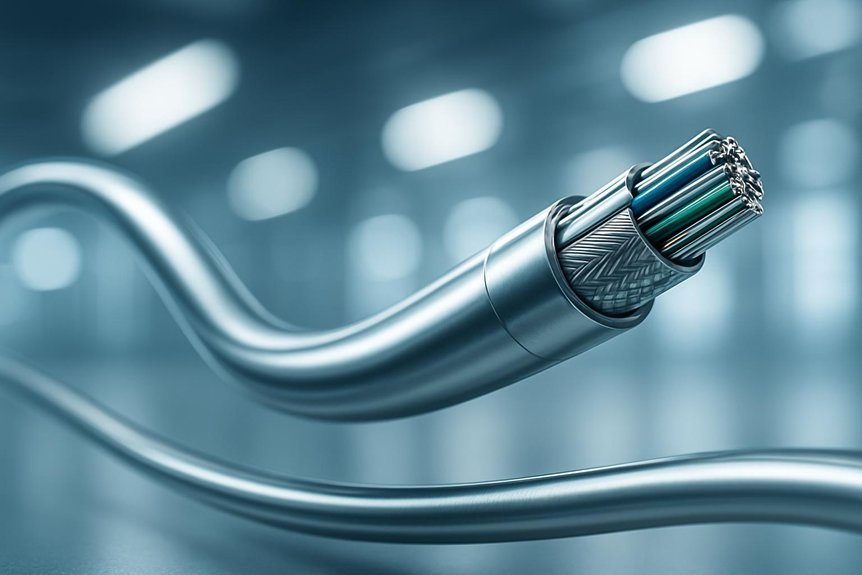
The demand for high-bandwidth, low-latency infrastructure is accelerating at an unprecedented rate. Data centers and 5G networks cable needs to be engineered for density, durability, and long-term scalability. Prysmian Group has positioned itself at the intersection of these requirements. Its fiber optic portfolio addresses specific architectural challenges across hyperscale and fronthaul environments. Whether the concern is signal integrity, deployment efficiency, or standards compliance, the technical answers warrant closer examination.
What Makes Modern Data Centers and 5G Networks Demand More From Cable
The rapid expansion of cloud computing, artificial intelligence workloads, and streaming media has fundamentally altered the performance thresholds that data center and 5G network infrastructure must meet. Bandwidth requirements have escalated dramatically, with modern hyperscale facilities now demanding aggregate throughputs measured in petabits per second.
Simultaneously, evolving transmission protocols — including IEEE 400GbE and emerging 800GbE standards — impose stricter signal integrity constraints across both copper and fiber media. Latency tolerances have compressed, thermal densities have increased, and physical layer components must now support higher port densities within constrained rack footprints.
5G fronthaul and midhaul architectures introduce additional complexity, requiring cables capable of sustaining precise timing synchronization alongside high-frequency RF transmission. These converging technical pressures render legacy cabling solutions structurally inadequate for contemporary deployment environments.
The Engineering Behind Prysmian’s High-Density, Low-Loss Cable Design
Precision engineering governs every structural layer of Prysmian’s high-density, low-loss cable architectures, from dielectric selection and conductor geometry to sheath compound formulation and connector interface tolerances. High density cable manufacturing demands exact fiber placement within tight spatial constraints, minimizing bend-induced attenuation while maximizing fiber count per unit cross-section.
Prysmian’s fiber optic cable design integrates ultra-low-loss glass compositions, optimized coating materials, and ribbon or loose-tube configurations calibrated for specific deployment environments. Controlled stranding geometries reduce micro-bending stress concentrations across thermal cycling ranges.
Jacket compounds are selected for flame resistance, chemical stability, and dimensional consistency under mechanical load. Each design parameter undergoes rigorous validation against IEC and IEEE transmission standards, ensuring signal integrity is maintained across extended link spans within hyperscale data center and dense 5G fronthaul infrastructures.
Prysmian’s Fiber Optic Solutions for Hyperscale Data Centers
Hyperscale data centers impose extraordinary bandwidth density and latency constraints that demand fiber optic infrastructure engineered beyond conventional performance thresholds. Prysmian Group addresses these requirements through ultra-low-loss multimode and single-mode fiber optic solutions optimized for high-density rack environments.
Its FlexTube and microduct cable architectures enable rapid deployment across spine-leaf topologies while sustaining fiber optic performance at extended transmission distances. Bend-insensitive fiber variants reduce signal attenuation in confined routing pathways, a critical consideration within high-density cable trays.
Prysmian’s structured cabling platforms further support network scalability by accommodating incremental capacity expansion without requiring full infrastructure replacement. Modular connectivity systems facilitate swift reconfiguration as compute workloads evolve.
Collectively, these engineered solutions position Prysmian as a technically credible supplier for operators managing petabyte-scale data throughput across geographically distributed hyperscale facilities.
How Prysmian Cables Power 5G Network Rollouts
5G network rollouts impose a fronthaul, midhaul, and backhaul architecture that demands fiber optic cabling capable of sustaining ultra-low latency, high-bandwidth density, and precise timing synchronization across distributed antenna systems. Prysmian addresses cable deployment challenges inherent to dense urban environments through its FlexRibbon and microduct-compatible cable systems, which enable high-fiber-count installations within constrained conduit pathways.
These solutions facilitate rapid deployment while maintaining structural integrity under mechanical stress and temperature variation. Prysmian’s bend-insensitive single-mode fibers further reduce signal attenuation across extended fronthaul links connecting remote radio units to centralized baseband units.
The cumulative effect of these engineered specifications translates directly into measurable network performance improvements, including reduced round-trip latency below one millisecond and sustained throughput consistency across heterogeneous network nodes operating under variable traffic loads.
How Prysmian Cables Comply With TIA, IEC, and IEEE Standards
Compliance with TIA, IEC, and IEEE standards governs how Prysmian cables are designed, tested, and validated across data center and telecommunications applications. Cable compliance requires adherence to TIA-568 structured cabling specifications, IEC 60794 optical fiber cable standards, and IEEE 802.3 Ethernet transmission requirements.
Each standard defines measurable performance thresholds covering insertion loss, return loss, bandwidth, and mechanical durability. Prysmian engineers subject products to rigorous third-party testing protocols to verify that performance standards are consistently satisfied under operational and environmental stress conditions.
Conformance documentation supports procurement decisions for hyperscale operators, network architects, and infrastructure contractors requiring certified components. By aligning manufacturing processes with globally recognized regulatory frameworks, Prysmian guarantees that its cable solutions maintain interoperability, reliability, and forward compatibility across evolving data center architectures and 5G deployment scenarios.
How to Specify Prysmian Cables for Your Next Infrastructure Project
Specifying Prysmian cables for an infrastructure project requires a structured evaluation of application requirements, environmental conditions, and performance benchmarks before any procurement decision is made. Cable selection considerations must address transmission distance, bandwidth capacity, fire rating classifications, and installation pathway constraints.
Engineers should cross-reference Prysmian’s product datasheets against TIA-568, IEC 11801, and relevant IEEE standards to validate specification alignment. Project implementation challenges frequently emerge from inadequate conduit sizing, bend radius violations, and mismatched connector compatibility, each requiring early-stage mitigation.
Prysmian’s technical documentation and application guides provide structured selection matrices that simplify product identification across fiber, copper, and hybrid cable families. Engaging Prysmian’s technical support during design phases reduces specification errors and guarantees the selected cable infrastructure meets both present operational demands and future scalability requirements.