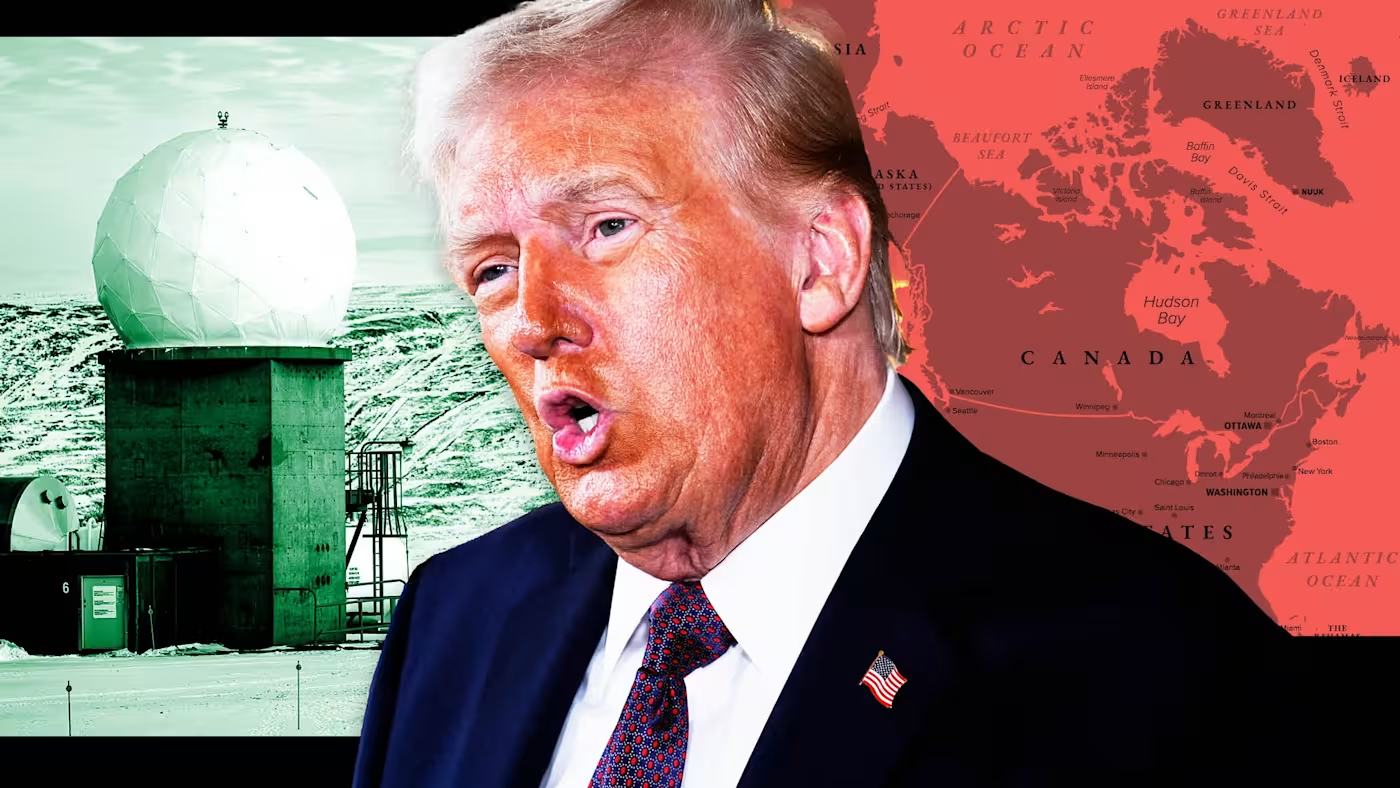
Introduction
The question Why Does Trump Want Greenland has moved from a strange political talking point to a serious geopolitical discussion because Greenland sits at the meeting point of military strategy, Arctic access, and mineral competition. In early 2026, Trump again pushed hard for U.S. control, while leaders in Greenland and Denmark publicly rejected the idea and stressed that the island is not for sale.
For readers in the UK and beyond, this debate matters because it is not really about ice and maps alone. It is about who shapes the Arctic in an era of rising tension with Russia, greater concern about China, fragile supply chains for critical minerals, and renewed attention to missile warning and NATO defence. Greenland has become a symbol of how geography can suddenly return to the centre of world politics.
Why Greenland matters on the world map
Greenland matters because location still rules strategy. The island lies between North America and Europe, close to the North Atlantic and deep inside the wider Arctic theatre. That position gives it significance for air routes, maritime observation, early warning systems, and military planning. In a crisis involving missiles, aircraft, or naval movement across the High North, Greenland is not peripheral land. It is a forward edge of the Western security map.
Its importance has also grown because the Arctic itself is changing. NOAA says changing sea ice extent and thickness are allowing more marine traffic and forcing governments to rethink national security. Reuters likewise reported that new Arctic routes are becoming more commercially and strategically meaningful, giving the region fresh relevance in global competition. That means Greenland matters not only for where it is today, but also for what the Arctic may become tomorrow.
Why does Trump want Greenland for national security
The most public answer to Why Does Trump Want Greenland is national security. Trump has repeatedly framed the island as essential to protecting the United States and the wider West from strategic rivals. Current reporting and parliamentary analysis both show that his administration has tied Greenland to concerns about Russia and China, as well as to missile defence and Arctic monitoring. Security is the language that makes the proposal sound most urgent and most defensible.
That security logic is not entirely invented out of thin air. Greenland already hosts U.S. military infrastructure, and the island sits on routes relevant to missile warning and northern defence. But the jump from strategic interest to ownership is exactly where the controversy begins. Denmark and Greenland have said the United States can cooperate on Arctic security, yet that does not give Washington a right to annex or acquire the territory. In other words, security explains the interest, but it does not settle the legal or political argument.

The role of Pituffik Space Base in America’s Arctic strategy
Any serious article on this subject must discuss Pituffik Space Base. The U.S. Space Force says the 12th Space Warning Squadron there operates an upgraded early warning radar that detects and reports threats from sea-launched and intercontinental ballistic missiles. The base also supports space surveillance, missile defence, and wider Arctic operations, making it central to Washington’s practical interest in Greenland.
Pituffik proves that Greenland is already part of American strategy without being American territory. The base exists under long-standing agreements with Denmark, and the arrangement shows the United States already has meaningful access when cooperation works. That is why some analysts see the debate less as a question of military necessity and more as a question of political ambition, leverage, and control over future choices in the Arctic.
Rare minerals and natural resources in Greenland
The second major answer to Why Does Trump Want Greenland is resources, especially critical minerals. Reuters reported that Greenland is rich in mineral, oil, and gas resources, and that a 2023 survey found 25 of the 34 minerals classified as critical raw materials by the European Commission on the island. In a world worried about supply chain dependence, that makes Greenland look less like a remote outpost and more like a strategic warehouse.
Rare earths and other critical minerals matter because they feed the modern economy as well as military technology. Advanced electronics, batteries, clean energy systems, aerospace components, and defence manufacturing all depend on secure mineral supply. That helps explain why Greenland appears in conversations about strategic autonomy and industrial resilience. The important nuance, though, is that mineral wealth does not automatically mean easy mining, fast profits, or social consent. Greenland’s resources are politically attractive long before they are commercially simple.
The Arctic shipping routes and future trade
The Arctic is not only a mineral story. It is also a transport story. As sea ice changes, northern shipping routes become more plausible for parts of the year, and that alters how governments think about trade resilience, ports, and naval positioning. Reuters noted that Arctic routes can serve as a hedge against disruption in more crowded corridors such as Suez or the Red Sea, which helps explain why Greenland has gained importance in strategic planning.
This does not mean the Arctic will suddenly replace traditional routes. Harsh weather, ice conditions, insurance costs, sparse infrastructure, and environmental risks still limit routine use. Yet in geopolitics, even partial viability can change behaviour. A route does not need to become dominant to become important. It only needs to influence military planning, bargaining power, and long-term investment decisions. Greenland’s location near evolving Arctic pathways makes it relevant to all three.
Trump’s history with Greenland
Trump’s interest in Greenland is not new. He first made headlines during his earlier presidency by floating the idea of buying the island, and the proposal returned with much greater pressure after his return to office. The House of Commons Library says that in January 2026 he increased pressure on Greenland, a constituent part of Denmark, to become part of the United States. Reuters reported the same pattern, describing repeated statements about acquiring the island.
What has changed is tone and intensity. The issue is no longer treated only as an unusual headline. It now sits within a broader Arctic argument about missiles, minerals, and superpower rivalry. That shift matters for SEO as well as substance, because readers searching Why Does Trump Want Greenland now expect an answer that connects past rhetoric to present strategic calculations. A useful article must therefore show continuity with 2019 while explaining why the stakes feel sharper in 2026.
What Greenland and Denmark say about the idea
Greenland and Denmark have been consistent: the island is not for sale, and any future must respect Greenlandic wishes. Reuters quoted Danish Prime Minister Mette Frederiksen saying it made no sense to talk about the United States taking over Greenland and that the U.S. had no right to annex any part of the Danish Kingdom. The House of Commons Library also notes that leaders in both Greenland and Denmark have repeatedly rejected sale or takeover.
That response is not just diplomatic theatre. It reflects the constitutional and political reality of the Kingdom of Denmark and the growing weight of Greenlandic self-government. Even when Greenland seeks stronger international partnerships, including with the United States or the European Union, its leaders have stressed that the future of Greenland is for Greenlanders to decide. Cooperation, investment, and defence dialogue may be welcome; coercion and ownership claims are not.
The law, self-determination and sovereignty
The legal side of this debate is often missing from dramatic headlines, but it is central to the story. Denmark’s official explanation of the Self-Government Act states that the people of Greenland are recognised as a people with the right to self-determination under international law. It also explains that Greenland has its own elected parliament and government and that the self-government framework is based on Greenland and Denmark as equal partners.
This means Greenland is neither a simple colonial possession nor a piece of land that can be treated like a private asset in an old imperial bargain. The 2008 referendum strongly supported self-government, and Denmark’s official materials show that Greenland has taken control over substantial internal responsibilities, including mineral resource activities. Foreign, defence, and security policy remain within the realm framework, but the core principle is still clear: sovereignty questions cannot be reduced to a real-estate transaction.
Why the debate matters to the UK, Europe and NATO
For the UK and Europe, Greenland matters because this is also a story about alliance trust. Greenland belongs to the Kingdom of Denmark, and Denmark is a NATO ally. When a U.S. president openly pressures an allied kingdom over territory, the issue immediately touches wider questions about NATO credibility, transatlantic solidarity, and whether security cooperation can survive coercive diplomacy among partners. Reuters reported that the Greenland dispute pushed NATO members to search for Arctic security formulas that could keep the alliance together.
The UK angle is practical as well as political. The House of Commons Library notes that the UK government echoed the view that Greenland is not for sale while still wanting good relations with the United States. For British readers, the controversy therefore sits at the intersection of Arctic defence, diplomacy, and rule-based order. It is not merely an American curiosity. It is a live question about how Western allies behave when strategic assets become more valuable.
Could the United States actually acquire Greenland
In legal and political terms, an outright American acquisition of Greenland looks extremely difficult. Reuters noted that Trump has repeatedly said he wants to acquire the island, possibly by purchasing it from Denmark, but Denmark and Greenland continue to reject the premise. The existence of self-government, the principle of self-determination, and the political cost of any coercive attempt all make the prospect far more complicated than the word “buy” suggests.
A more realistic future would involve negotiated cooperation rather than ownership: stronger defence coordination, more investment, expanded mining partnerships, infrastructure projects, or revised frameworks for U.S. activity already permitted under existing agreements. Reuters reported that Greenland itself wants to gain more from the long-standing defence arrangement with the United States, including broader cooperation on climate, education, and business. That points toward a smarter question than “Can America take Greenland?” The smarter question is “What kind of relationship can all sides accept?”
What Greenlanders might gain or lose
Supporters of closer U.S. ties can point to possible gains. More investment could mean better infrastructure, jobs, research links, business activity, and more leverage for Greenland as it balances relations with Denmark, Europe, and Washington. Reuters has reported Greenlandic interest in extracting more value from existing agreements and diversifying the economy, especially around critical minerals and external partnerships. That shows local leaders are not rejecting all outside engagement. They are rejecting external control.
The risks, however, are just as important. Greenland is warming rapidly, and Reuters reported in early 2026 that climate shifts were already redrawing parts of the island’s economy, from fisheries toward potential mining. That raises difficult questions about environment, identity, labour, land use, and who really benefits from extraction. For many Greenlanders, the fear is not only geopolitical pressure from abroad. It is also being forced to trade long-term self-determination for short-term promises made by much larger powers.
Media drama and strategic reality
Part of the reason this story spreads so easily is that it has dramatic ingredients: a giant Arctic island, an unpredictable president, a map that instantly looks important, and a headline that feels almost surreal. But the spectacle can hide the deeper pattern. Beneath the theatre lies a hard strategic logic involving radar, missile warning, Arctic sea access, minerals, and great-power competition. That is why the topic has lasted well beyond one news cycle.
A strong article should therefore avoid two mistakes. The first is mocking the idea so much that readers miss the real strategic stakes. The second is repeating security language so uncritically that annexation starts to sound normal. The truth is more layered. Greenland is genuinely important, but importance does not erase law, consent, or allied sovereignty. The best writing explains both the seriousness of the asset and the seriousness of the objections.
What this reveals about modern geopolitics
The Greenland debate reveals how twenty-first century power works. Military geography has returned, but it now overlaps with supply chains, climate change, clean technology, data systems, and resource politics. An island once treated in much public discourse as distant and frozen is now discussed in relation to rare earths, missile defence, Arctic logistics, and industrial resilience. Greenland is not suddenly important because the world discovered it. It is important because several strategic trends have collided at once.
It also shows that climate change is not only an environmental issue. It is a geopolitical accelerator. As sea ice declines and economic possibilities shift, states recalculate interests, alliances, and vulnerabilities. Greenland stands at that crossroads. It is a territory of immense symbolic value, but also of real operational significance. The modern struggle over Greenland is therefore not only about territory. It is about who writes the rules for an Arctic that is becoming more open, more contested, and more consequential.
Conclusion
So, Why Does Trump Want Greenland? The clearest answer is that Greenland combines several forms of value in one place. It has a strategic military position, existing U.S. defence infrastructure, access to a changing Arctic, and large deposits of minerals considered important for future industry. Those factors make Greenland attractive to any major power thinking about the next decade, not just the next headline.
But the final lesson is just as important. Strategic interest does not equal strategic entitlement. Greenland’s status is shaped by self-government, Danish sovereignty within the realm, and the principle that Greenlanders must determine their own future. That is why this debate is bigger than one politician. It is a test of whether hard power, alliance politics, climate change, and democratic self-determination can be managed without sliding into coercion.
FAQs
What is the short answer to Why Does Trump Want Greenland?
The short answer is that Greenland offers three things at once: military value, critical minerals, and Arctic influence. Trump and his allies have repeatedly framed the island as important for national security, especially because of its location and existing U.S. military presence. At the same time, Greenland’s resource base and its role in a changing Arctic make it attractive in broader geopolitical terms.
Is Greenland rich in rare earth minerals?
Greenland is widely regarded as rich in critical raw materials, including rare earth elements and other strategic minerals. Reuters reported that a 2023 survey found 25 of the 34 minerals designated as critical raw materials by the European Commission in Greenland. That does not mean all of them are ready for quick extraction, but it does explain why the island features in major-power resource planning.
Why is Pituffik Space Base so important?
Pituffik Space Base matters because it supports missile warning, missile defence, and space surveillance. The U.S. Space Force says the 12th Space Warning Squadron there operates an upgraded early warning radar designed to detect threats from sea-launched and intercontinental ballistic missiles. In practice, that gives Greenland direct importance in the security architecture of the United States and its allies.
Can the United States legally buy Greenland?
The political and legal barriers are severe. Greenland has self-government, and Denmark’s official materials state that the people of Greenland are recognised as a people with the right to self-determination under international law. That means any discussion cannot ignore Greenlandic consent. Even if people talk casually about a purchase, the issue is really one of sovereignty, constitutional order, and democratic choice.
Who owns Greenland now?
Greenland is a self-governing part of the Kingdom of Denmark, not an independent state and not U.S. territory. Denmark’s official explanation of the unity of the realm says Greenland has its own parliament and government, while some fields such as foreign, defence, and security policy remain within the wider realm structure. That is why Denmark and Greenland both have standing in the debate.
What do Greenland and Denmark say about Trump’s interest?
Both governments have rejected the idea that Greenland can be taken over or sold. Reuters reported Danish Prime Minister Mette Frederiksen saying the United States has no right to annex any part of the Danish Kingdom, while parliamentary and official sources have repeated that Greenland is not for sale. They have generally favoured dialogue on security, but not territorial pressure.
Does climate change make Greenland more important?
Yes, because climate change is altering the Arctic’s strategic environment. NOAA says changing sea ice is allowing increased marine traffic and prompting fresh security concerns, while Reuters has described how warming and ice loss are reshaping Greenland’s economy and increasing attention on mining and access. Climate change does not create Greenland’s importance from nothing, but it intensifies and updates it.
Why should UK readers care about this story?
UK readers should care because Greenland sits within a wider NATO and Arctic security debate that affects Europe as well as the United States. The House of Commons Library has treated the issue as a live matter of British interest, and the controversy raises broader questions about alliance trust, strategic resources, and the future balance of power in the High North.
Could Greenland become more closely linked to the U.S. without becoming American territory?
Yes, that is the more realistic pathway. Existing defence agreements already allow a significant U.S. military presence, and Reuters reported that Greenland wants to gain more benefits from that relationship, including cooperation in education, climate, and business. Stronger partnership is very different from ownership, and that distinction is central to understanding the debate.
Why has this story become bigger in 2026 than before?
The issue has grown because several strategic trends now overlap: renewed American pressure, concerns about Russia and China, critical mineral competition, and a changing Arctic environment. What once sounded like an eccentric proposal now connects with real policy debates about missile defence, supply chains, and alliance politics. That combination gives the Greenland story much greater weight than it had as a one-off headline.
You may also read: Brooklyn Beckham’s Claims and Public Interpretation