Entering the world of sports wagering can feel overwhelming for beginners. Stepping into a sportsbook—whether digital or physical—reveals hundreds of numbers, symbols, and unfamiliar terminology. From negative and positive odds to exotic proposition wagers, the sheer volume of choices often creates confusion. However, once the foundational mechanics are understood, navigating a sportsbook slip becomes straightforward and logical. Having betting markets explained in clear, structured terms empowers sports fans to evaluate risk, uncover value, and make well-informed decisions.
A sports betting market simply refers to a specific outcome or set of outcomes within a sporting event upon which a bookmaker accepts wagers. Rather than merely choosing who wins a match, modern sportsbooks offer dozens—sometimes hundreds—of sub-markets for a single contest. These range from predicting the final margin of victory to forecasting individual player statistics. This comprehensive guide breaks down how betting markets function, details the primary and advanced bet types available today, and offers practical insight into selecting the right wagers for your overall strategy.
What Is a Betting Market? Key Concepts for Beginners
At its core, a betting market is an exchange structured around a specific sporting question. Will Team A defeat Team B? Will the total points scored in a basketball game exceed 215.5? Will a particular soccer player receive a yellow card? Each of these questions represents an independent market hosted by a bookmaker.
To participate in any market, bettors must understand how bookmakers price these outcomes. Pricing is expressed through odds, which serve two critical functions: they indicate the theoretical probability of an event occurring and dictate the financial payout for a winning wager.
Odds are typically displayed in three primary formats across global sportsbooks:
- American Odds (+/-): Common in North America, these odds are built around a $100 baseline. A minus sign (-) designates the favorite and indicates how much money you must wager to win $100 profit (e.g., -150 means wagering $150 wins $100). A plus sign (+) designates the underdog and indicates the profit returned on a $100 wager (e.g., +130 means wagering $100 wins $130).
- Decimal Odds: Predominant in Europe, Australia, and Canada, decimal odds show the total return (stake plus profit) for every unit wagered. For example, odds of 2.50 mean a $10 wager returns $25 in total ($15 profit + $10 original stake). Bettors frequently research regional preferences and platforms through BettingTop10 Canada to see how odds formatting and market availability adapt across international borders.
- Fractional Odds: Traditional in the United Kingdom and Ireland, fractional odds (e.g., 5/1 or 2/5) display potential profit relative to the stake. Odds of 5/1 mean you win five units of profit for every one unit wagered.
Every market carries a built-in fee known as the vigorish, margin, or “vig.” This is the commission bookmakers charge to ensure a mathematical advantage regardless of the outcome. Understanding how odds represent implied probability—and factoring in the bookmaker’s margin—is the essential first step before placing any funds into an active market.
Primary Betting Markets Explained: Moneylines, Point Spreads, and Totals
When exploring sports wagering, you will encounter three core markets that form the backbone of sports betting worldwide. Virtually every sportsbook prioritizes these three options at the top of their match listings.
+-----------------------------------------------------------------------+
|                         CORE BETTING MARKETS                          |
+-------------------+---------------------------------------------------+
| Moneyline         | Pick the outright winner of the game/match.       |
+-------------------+---------------------------------------------------+
| Point Spread      | Bet on the margin of victory or defeat.           |
+-------------------+---------------------------------------------------+
| Totals (Over/Under| Bet on the combined points scored by both teams.  |
+-------------------+---------------------------------------------------+
1. Moneyline Bets
The moneyline is the simplest and most traditional wager in sports. In a moneyline market, you are simply picking which team or athlete will win the event outright. There are no margins or point thresholds to cover; the final victory is all that matters.
For example, in an NHL hockey game:
- Team A: -140 (Favorite)
- Team B: +120 (Underdog)
Here, backing Team A requires a $140 risk to yield a $100 profit, reflecting their higher likelihood of winning. Conversely, backing Team B offers a higher payout ($120 profit on a $100 stake) to compensate for the higher risk. In sports where ties are common—such as soccer—moneylines often feature three outcomes: Team A Win, Draw, or Team B Win (commonly referred to as 1X2 markets).
2. Point Spread Bets
Point spreads were created to level the playing field between two mismatched opponents. Instead of merely predicting the winner, a spread bet requires the favorite to win by a designated number of points, or the underdog to stay within a specified margin.
Consider an NFL football matchup:
- Kansas City: -6.5 (-110)
- Las Vegas: +6.5 (-110)
In this scenario, Kansas City is favored by 6.5 points. If you bet on Kansas City, they must win the game by 7 points or more for your wager to succeed. If you bet on Las Vegas, your wager wins if Las Vegas wins the game outright OR if they lose by 6 points or fewer. Reputable global sportsbooks, such as Betsafe, adjust these spread lines in real time leading up to kickoff based on betting volume, player injuries, and weather conditions.
3. Totals (Over/Under)
A totals market ignores which team wins or loses altogether. Instead, the bookmaker sets an estimated combined score for both teams, and bettors wager on whether the actual combined total will be Over or Under that benchmark.
If an NBA game lists a total of 224.5 points:
- An Over bet wins if the final combined score is 225 points or higher (e.g., 115-112).
- An Under bet wins if the total points scored equal 224 or fewer (e.g., 110-108).
Half-point increments (like .5) are intentionally used by bookmakers to eliminate the possibility of a push (a tie), ensuring every wager settles as a definitive win or loss.
Expanding Your Options: Prop Bets, Futures, and Outrights
Beyond the core game lines, modern bookmakers provide secondary markets that allow bettors to hone in on specific nuances of a game or an entire season. Having these secondary betting markets explained provides extra versatility, especially when main lines do not present clear value.
Proposition Bets (Props)
Proposition wagers—commonly known as prop bets—focus on individual events within a match rather than the overall outcome. Props generally fall into three categories:
- Player Props: Wagers tied directly to an individual athlete’s statistical performance. Examples include a quarterback’s total passing yards (Over/Under 265.5), a basketball player’s total rebounds, or a soccer player scoring an anytime goal.
- Team Props: Wagers focused on a single team’s milestones, such as which team will score first, total team points, or the number of corner kicks awarded in a match.
- Exotic / Game Props: Wagers on game flow mechanics, such as whether a football game will feature a successful two-point conversion or whether a contest will go into overtime.
Prop betting has expanded rapidly due to the rise of detailed analytical modeling. Sports fans who track player matchups, historical head-to-head statistics, and workload trends often find lucrative opportunities in player prop markets. When taking advantage of sign-up incentives or risk-free promotions, exploring curated list platforms like BettingBonus can help stretch your initial bankroll while you test different prop strategies.
Futures and Outright Markets
While moneyline and spread bets settle at the conclusion of a single game, futures markets operate over weeks, months, or an entire season. Futures involve predicting long-term achievements or major tournament outcomes well before they are decided.
Common futures wagers include:
- Predicting the winner of the Super Bowl, FIFA World Cup, or NBA Championship before or during the regular season.
- Wagering on individual seasonal awards, such as League MVP, Rookie of the Year, or the Cy Young Award.
- Predicting a team’s total regular-season win count (e.g., Over/Under 8.5 season wins).
Futures markets offer enticingly high odds because your capital is tied up for an extended period, and numerous unforeseen variables—such as long-term injuries or mid-season roster trades—can alter the trajectory of your wager.
Combination Wagers: Parlays, Teasers, and System Bets
For bettors looking to scale potential returns without increasing their initial stake on a single outcome, multi-selection wagers offer an alternative framework. However, these complex bet types come with elevated risk profiles that require careful management.
Parlays (Accumulators)
A parlay combines two or more individual wagers into a single bet slip. To win a parlay, every single selection (leg) must win. If even one leg loses, the entire ticket is graded as a loss.
+-----------------------------------------------------------------------+
|                        3-LEG PARLAY EXAMPLE                           |
+-----------------------------------------------------------------------+
| Leg 1: Team A Moneyline (-150)                                        |
| Leg 2: Team B Point Spread (-110)                                     |
| Leg 3: Team C Over 48.5 Points (-110)                                 |
+-----------------------------------------------------------------------+
| Status: ALL 3 must win to collect payout. Higher risk, high reward.   |
+-----------------------------------------------------------------------+
The primary appeal of a parlay is exponential payout growth. Because the odds of each individual selection multiply together, small stakes can yield significant returns. In recent years, Same Game Parlays (SGPs) have become immensely popular, allowing bettors to combine a point spread, a total, and multiple player props from a single contest into one unified wager. Modern bettors frequently utilize dedicated sports software and specialized resources, such as those reviewed on Betting-Apps.me.uk, to track live odds movements and construct complex multi-leg parlays on their smartphones.
Teasers and Pleasers
Teasers are specialized multi-leg wagers restricted primarily to football and basketball point spreads and totals. In exchange for a lower overall payout, the bettor is allowed to shift the point spreads or totals in their favor by a set number of points (typically 6.0, 6.5, or 7.0 points in football).
- Standard Spread: Team A -7.5
- 6-Point Teaser Adjusted Spread: Team A -1.5
By reducing the requirement from winning by 8 points to winning by just 2 points, the bettor significantly increases the probability of that leg hitting. Pleasers work in the exact opposite direction: the bettor moves the spread against themselves in exchange for drastically inflated payout multipliers.
System Bets (Round Robins)
A Round Robin is a structured method of placing multiple small parlays simultaneously across a master list of teams. For instance, if you choose three teams (A, B, and C), a Round Robin automatically creates three separate 2-leg parlays (A+B, A+C, and B+C). If one team loses, you still hold winning parlay tickets on the remaining combinations, mitigating the “all-or-nothing” flaw inherent in standard parlays.
Modern Betting Developments: Live Markets and Niche Options
The evolution of digital sports wagering platforms has introduced dynamic, real-time betting options that were impossible in the era of paper tickets. Having these contemporary betting markets explained highlights how real-time technology alters traditional wagering habits.
Live In-Play Betting
In-play betting allows sports fans to place wagers while a game or event is actively in progress. Algorithms adjust odds continually based on time remaining, score changes, possession, field position, and momentum shifts.
Live betting offers unique strategic advantages:
- Hedging Pre-Game Bets: If your pre-game pick takes an unexpected hit (such as a key player suffering an early injury), live markets allow you to wager on the opposing outcome to lock in a guaranteed profit or minimize loss.
- Capitalizing on Overreactions: Sportsbook algorithms often overreact to early game anomalies—such as a heavily favored soccer team giving up an accidental early goal. Experienced live bettors can grab significantly inflated odds on the pre-game favorite to mount a comeback.
As live wagering has expanded globally, specialized international coverage platforms like BetRaja have documented how live in-play markets, instant cash-outs, and ball-by-ball markets have transformed fan participation in sports like cricket, tennis, and football.
Cash-Out Features
Many contemporary sportsbooks offer a “Cash-Out” feature on active wagers. This tool gives bettors an early buyout price before an event has officially concluded. If your 4-leg parlay has hit its first 3 legs and the final game is closely contested, the bookmaker may offer a guaranteed cash payout to close the ticket early. Alternatively, if your pre-game single bet is performing poorly, cashing out early lets you recover a fraction of your stake rather than incurring a total loss.
Choosing the Right Market for Your Strategy
With so many options available across global sportsbooks, developing a structured approach to market selection is crucial for long-term consistency. No single bet type is universally superior; each carries distinct trade-offs regarding risk, variance, and potential return.
| Experience Level | Recommended Bet Types | Core Strategy Focus |
| Beginner | Moneylines, Point Spreads, Totals | Focus on bankroll management, learn odds movement, stick to single-game outcomes. |
| Intermediate | Player Props, 2-Leg Parlays, Futures | Target matchup statistics, spot mispriced player lines, hedge long-term futures. |
| Advanced | Live In-Play, Asian Handicaps, System Bets | Exploit real-time game flow shifts, execute arbitrage opportunities, manage complex portfolios. |
To maintain a balanced, disciplined approach:
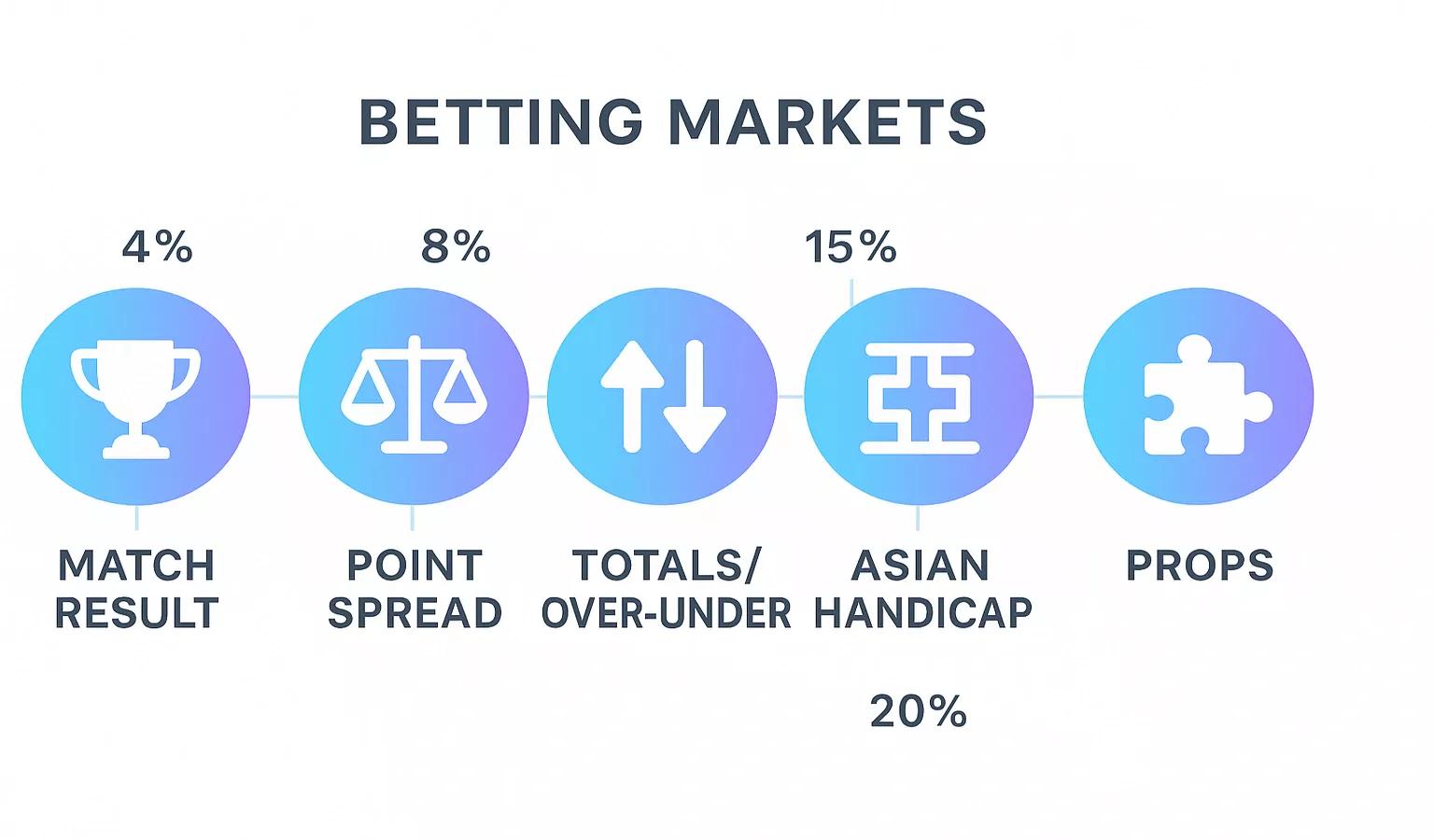
- Stick to Straight Bets Initially: Single moneyline, spread, and totals wagers carry a significantly lower bookmaker house edge (typically around 4% to 5%) compared to parlays and exotic props (which can exceed 15% to 20%).
- Avoid over-leveraging Parlays: While the allure of turning $10 into $1,000 is strong, parlays are mathematically designed to favor the sportsbook over time. Treat parlays as recreational side bets rather than the primary engine of your strategy.
- Shop for the Best Odds: Different sportsbooks frequently price the same market with slight variations (e.g., Team A listed at -110 on one platform and -105 on another). Consistently placing wagers at the best available price compound into significant savings over hundreds of bets.
related post: Enjoy Online Games
Conclusion
Navigating the modern sportsbook landscape does not have to be confusing. By breaking down the core concepts behind moneylines, point spreads, totals, props, and multi-leg combinations, you transform raw sports data into actionable insights. Every market presents a distinct mathematical puzzle with its own balance of risk and reward.
Whether you prefer the straightforward nature of a single moneyline wager or the multi-layered strategy of in-play prop betting, success ultimately relies on disciplined bankroll management, thorough matchup research, and realistic expectations. Focus on mastering one or two primary markets first, build a consistent analytical process, and treat sports wagering as a way to enhance your appreciation of the games you love.