To the casual sports fan, a betting line might look like a simple prediction of what is going to happen in a game. If a team is priced at 1.50 (1/2 or -200), it feels as though the bookmaker is declaring them a overwhelming favorite to win. However, behind those numbers lies a sophisticated blend of statistical modeling, probability theory, financial engineering, and real-time market psychology.
Understanding how bookmakers set odds reveals that sportsbooks are not in the business of predicting the future; they are in the business of managing financial risk. Whether you are analyzing a Premier League match, an NFL weekend, or an horse racing fixture, sportsbooks rely on precise mathematical frameworks to ensure they make a profit regardless of the event’s final score.
How Bookmakers Set Odds: From Raw Data to Initial Lines
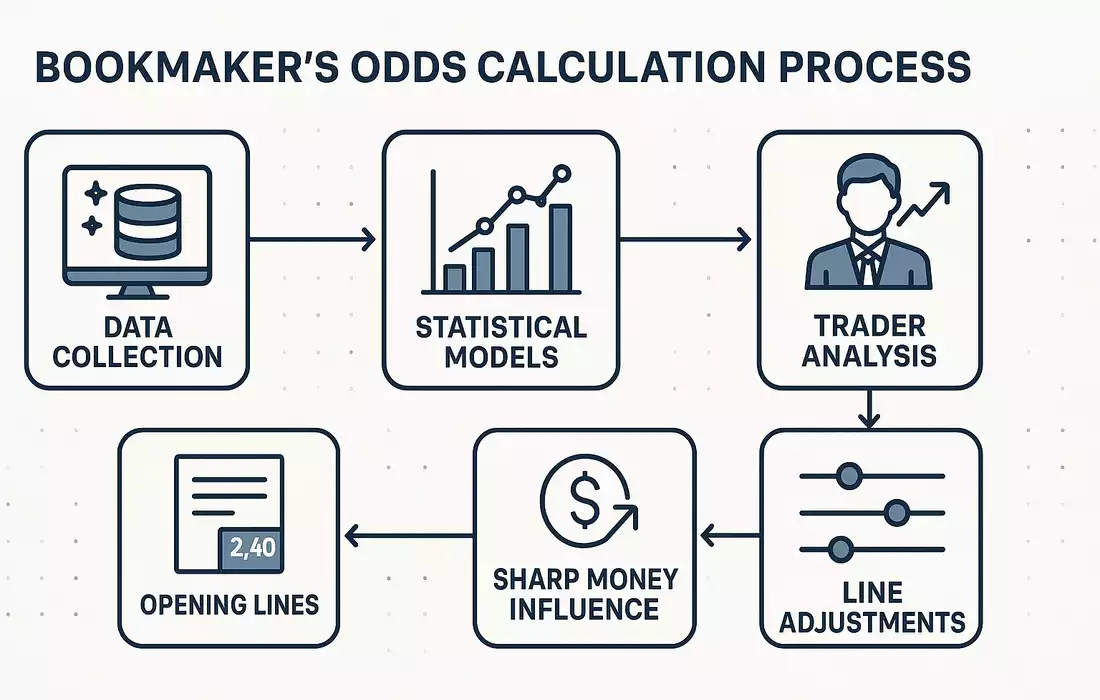
The process of creating a betting line begins long before a match appears on a sportsbook app. In the early days of sports betting, individual oddsmakers—known as odds compilers or traders—manually reviewed statistics, team news, and historical trends to craft prices. Today, while expert traders still oversee the process, the heavy lifting is driven by complex mathematical algorithms and predictive statistical models.
To establish the true probability of an outcome, oddsmakers gather vast amounts of quantitative data, including:
- Power Ratings & Efficiency Metrics: Specialized mathematical models rank teams based on offensive and defensive efficiency, expected goals (xG), net ratings, and pace of play.
- Historical Head-to-Head & Form: Recent performances over a 5 to 10-game window provide a baseline for current momentum.
- Contextual Variables: Home-field advantage, travel distance, rest days, weather forecasts, altitude, and pitch conditions are factored into the calculation.
- Roster Availability: Injuries, suspensions, tactical rotations, and key player rested status alter a team’s baseline probability instantly.
By processing these inputs, bookmakers generate an initial “fair probability” for every outcome in a given market. For instance, in a tennis match between Player A and Player B, a statistical model might determine that Player A has a 60% chance of winning, while Player B has a 40% chance.
In a perfectly neutral marketplace without overhead or profit, those probabilities would translate directly into “fair odds.” However, commercial sports betting platforms—ranging from global brands to independent software providers using services like Real Bookies—must operate as sustainable businesses. That requires altering fair probabilities into commercial odds.
The Mathematics of the Overround and Profit Margin
Once a sportsbook calculates the true mathematical chance of an event occurring, it applies its profit margin, commonly known as the “vigorish” (vig), “juice,” or “overround.” The overround is the mechanism that ensures the house maintains a mathematical edge over time.
In a fair market with two equally likely outcomes (a 50/50 coin toss), the true odds would be 2.00 in decimal format (+100 in American odds or 1/1 in fractional odds). If two bettors place $100 on opposite sides, the bookmaker takes in $200 total and pays out $200 to the winner, breaking even.
To build in a profit margin, the bookmaker shortens the odds on both sides. Instead of offering 2.00 (+100), they might offer 1.91 (-110).
- Bettor A bets $110 on Outcome 1 to win $100.
- Bettor B bets $110 on Outcome 2 to win $100.
- Total money collected by bookmaker: $220.
- Payout to winner: $210 ($100 profit + $110 stake returned).
- Guaranteed bookmaker profit: $10.
When you convert shortened odds back into implied probabilities, the total sum exceeds 100%.
$$\text{Implied Probability} = \frac{1}{\text{Decimal Odds}} \times 100$$
For decimal odds of 1.91:
$$\left(\frac{1}{1.91}\right) \times 100 = 52.36\%$$
Because both outcomes carry an implied probability of 52.36%, the total market equals 104.72%. The extra 4.72% represents the bookmaker’s overround.
When evaluating how bookmakers set odds in practice, margin sizes vary significantly across different sports and market types. High-volume, highly competitive markets like Premier League match results or NFL point spreads typically carry smaller margins (2% to 5%), whereas niche sports, multi-leg parlays, or exotic prop bets can feature margins exceeding 15% to 20%. Educational resources and sports handicap guides at Online Sports Betting often emphasize that identifying markets with lower overrounds is one of the most effective ways for bettors to reduce the house edge.
Opening Lines vs. Closing Lines: Market Reactions and Line Movement
Setting the initial line—known as the “opening line”—is only the first stage of bookmaking. Once an opening price is posted publicly, the betting market goes live, and public money begins to flow.
The primary objective of a bookmaker is not necessarily to predict who will win, but to balance their financial liability across all possible outcomes. If too much money accumulates on one side of a wager, the sportsbook faces major financial exposure if that outcome occurs. To manage this exposure, oddsmakers continuously adjust lines based on betting activity.
The Role of “Sharp” Money
Not all bets carry equal weight in the eyes of a sportsbook trader. Bookmakers categorize bettors into two primary groups:
- Recreational Bettors (Public Money): Casual fans who generally bet based on team popularity, star players, recent media narratives, or home-team bias.
- Sharp Bettors (Professional Money): Professional gamblers and syndicates who use complex algorithms to identify pricing errors.
When sharp bettors detect an opening line that deviates from true market value, they immediately place large wagers to exploit the edge. Bookmakers track these sharp accounts closely. When a sharp bettor backs a specific team, the oddsmaker immediately moves the line in that direction—even if overall public volume is relatively low. This sudden movement across multiple sportsbooks simultaneously is known as a “steam move.”
Related Post: Enjoy Online Games
Balancing the Book
As money accumulates, oddsmakers lengthen the odds on the under-backed side to make it more appealing to the public, while shortening the odds on the heavily backed side to deter further wagers.
To attract new players or incentivize action on specific high-profile events, operators frequently use promotional incentives. For example, sportsbooks featured on bonus hubs like OnlineBettingCodes UK offer deposit matches or boosted odds on select fixtures to drive recreational volume, which in turn gives traders greater liquidity to balance their overall books.
By the time an event begins, the odds have evolved into the “closing line.” Due to the collective intelligence of thousands of transactions and sharp market adjustments, the closing line is widely considered the most accurate reflection of true probability available anywhere in the world.
In-Play Odds: Real-Time Data and Algorithmic Adjustments
The evolution of mobile betting has shifted a massive portion of sports wagering from pre-match markets to live, in-play betting. Pricing a match before kickoff is complex, but setting odds while an event is actively unfolding in real time requires extraordinary computational speed.
Modern in-play odds engines rely on a three-tiered technical architecture that updates prices in fractions of a second:
[ Tier 1: Base Pre-Match Model ]
│
▼
[ Tier 2: Real-Time Event Feed (Data Latency < 500ms) ]
│
▼
[ Tier 3: Automated Liquidity & Exposure Engine ]
│
▼
[ Updated Live Odds Displayed to User ]
- Base Pre-Match Model: The starting probability serves as the anchor baseline.
- Real-Time Match State Feed: High-speed data providers track every event on the field—possession changes, dangerous attacks, red cards, corner kicks, or tennis points—with sub-second latency. Automated algorithms instantly re-calculate win probabilities after every play.
- Liquidity and Exposure Layer: The system constantly monitors incoming live wagers, adjusting prices dynamically to ensure the sportsbook’s exposure stays within predefined risk tolerances.
During dynamic live events, algorithms calculate how key events impact game trajectory. For example, if a home favorite in soccer surrenders an early goal, the live odds engine instantly recalculates their probability of winning based on historical comeback rates in similar scenario conditions.
Because live markets move so quickly, regulations governing in-play betting require strict oversight. Regional operator guides like Ontario Bets highlight how licensed jurisdictions enforce strict latency and compliance rules to ensure live pricing algorithms remain transparent, fair, and secure for consumers.
Risk Management, Hedging, and Bettor Profiling
Even with sophisticated algorithms, oddsmakers cannot eliminate financial risk entirely. A slate of popular favorites winning on a single afternoon can cause immense short-term losses for sportsbooks if public liability is lopsided.
To protect their bottom line, modern sportsbooks rely on robust risk management strategies:
1. Hedging and Laying Off Exposure
When a sportsbook collects an overwhelming amount of money on one side of a marquee event—such as a heavily favored team in a championship final—they may choose to hedge their exposure. Oddsmakers can place counter-wagers on betting exchanges or lay off risk with larger wholesale market makers. This offsets potential payout liabilities and guarantees a locked-in profit on the margin.
2. Stake Factors and Player Profiling
Sportsbooks analyze betting patterns using machine learning to categorize user accounts based on profitability, timing, and market selection.
- Recreational Profiles: Accounts that bet late in the market cycle, back popular accumulators/parlays, or follow public trends are given high betting limits.
- Sharp Profiles: Accounts that consistently beat the closing line, bet early on opening odds, or specialize in small-market props are assigned lower maximum stake limits (“stake restriction”) to minimize the bookmaker’s liability against professional play.
3. Dynamic Margin Adjustments
Sportsbooks often adjust their internal profit margins depending on the unpredictability of a sport or league. In high-profile, liquid markets like the NBA or Premier League, high transaction volume allows sportsbooks to operate with slim margins (3%–4%). Conversely, in volatile niche sports where news asymmetry is higher, sportsbooks protect themselves by widening the overround to 8% or more.
Established online betting sites such as PrimoBet structure their sportsbooks around these risk management principles, offering competitive odds on major global leagues while carefully managing market risk on niche events.
Conclusion
Understanding how bookmakers set odds demystifies the sports betting landscape. Odds are not arbitrary guesses or biased predictions about which team will win. Instead, they are finely tuned financial instruments built on complex statistical models, adjusted for profit margins, and refined by continuous market forces.
By converting true probabilities into shortened odds, sportsbooks secure an overround that ensures long-term commercial viability. Meanwhile, real-time line adjustments, risk management protocols, and dynamic algorithms allow oddsmakers to navigate market volatility and balance liability. For bettors looking to sharpen their strategy, recognizing the math and market dynamics behind these numbers is the first step toward evaluating real market value.