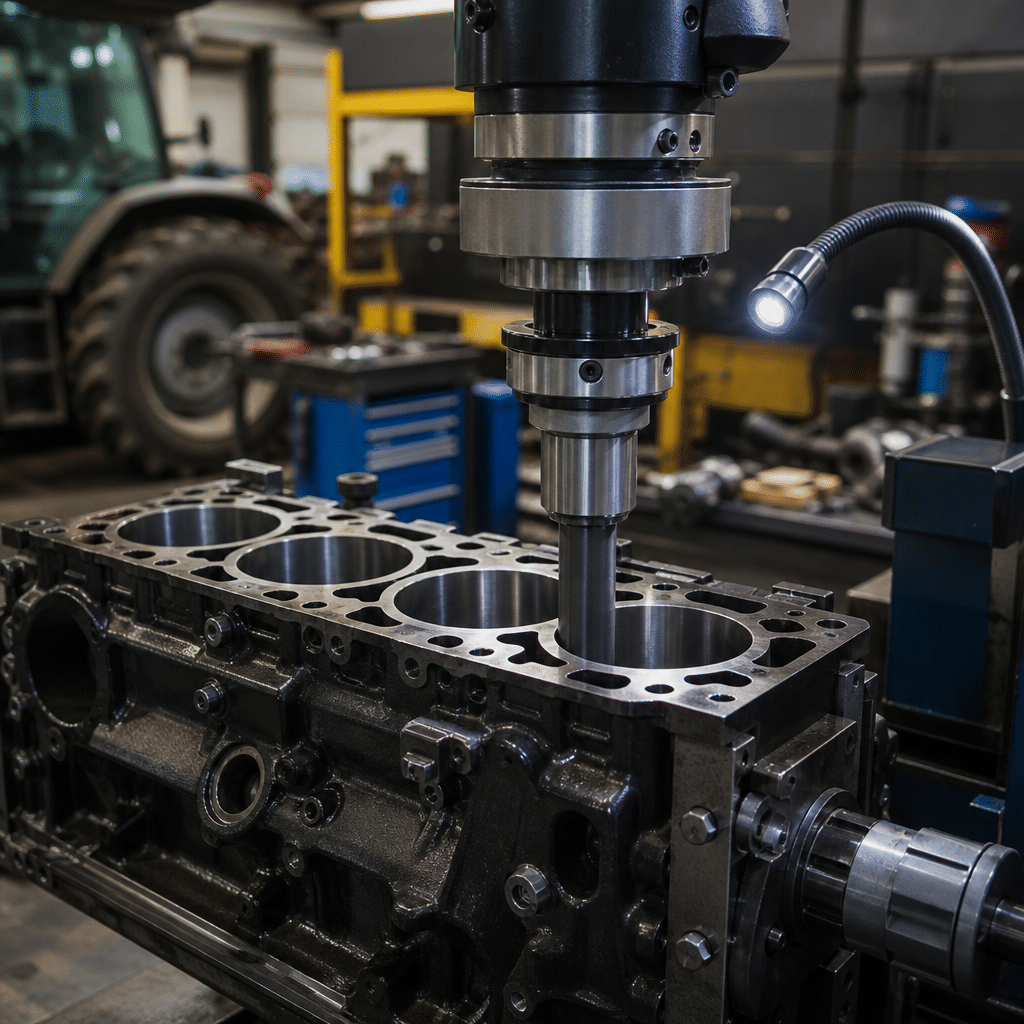
When a tractor engine reaches the end of its service life, farmers face a critical decision: replace the entire power unit at considerable expense, or rebuild the engine block to restore compression and performance. Engine rebuilding remains the more economical choice for most agricultural operations, but the quality of the rebuild depends entirely on the precision of the machining work—particularly the cylinder boring process that prepares worn engine blocks for new pistons and rings.
Cylinder boring removes damaged metal from engine cylinders that have been scored by piston wear, overheating, or contamination. The process must achieve tolerances measured in thousandths of an inch to ensure proper piston clearance, ring seal, and oil control. Agricultural diesel engines, which often operate under heavy loads in dusty conditions, present unique challenges that demand specialized boring equipment capable of handling large displacement blocks and maintaining accuracy across multiple cylinders.
Why Cylinder Geometry Matters in Diesel Rebuilds
Tractor engines develop characteristic wear patterns that differ from automotive applications. Extended operation at constant RPM under load creates cylinder taper—greater wear at the top of the cylinder where combustion temperatures peak and lubrication is minimal. Cross-hatch wear from abrasive dust entering through air filters compounds the problem, creating out-of-round cylinders that no longer seal properly against piston rings.
A proper rebuild requires restoring each cylinder to a perfect circle with parallel walls and a consistent diameter from top to bottom. This demands rigid boring equipment that resists deflection during cutting. Portable line boring machines lack the mass and structural support to maintain these tolerances on agricultural engines, which is why professional rebuilds use dedicated boring systems mounted on heavy cast-iron bases. The cutting head must track true to the crankshaft centerline, and the tooling must remove metal uniformly without chatter or vibration that would leave surface irregularities.
Surface Finish and Ring Seating
Beyond dimensional accuracy, the boring process establishes the surface finish that determines how quickly new piston rings will seat during break-in. Modern boring heads produce a controlled cross-hatch pattern at 22 to 32 degrees from the cylinder axis, creating microscopic valleys that retain oil while allowing rings to bed against the peaks. Too rough a finish causes excessive oil consumption; too smooth a surface prevents proper ring seating and leads to blow-by and compression loss.
Professional boring systems use carbide or ceramic cutting inserts that maintain sharp edges through multiple cylinders, producing consistent surface finishes across the entire block. Feed rates and spindle speeds must be matched to the engine’s cast iron composition—agricultural blocks often use different alloys than automotive castings, requiring adjusted cutting parameters to prevent work hardening or surface tearing.
Equipment Requirements for Agricultural Engine Work
Rebuilding shops that specialize in farm equipment need boring systems capable of handling cylinder diameters from 75mm compact tractor engines up to 150mm or larger for row-crop and utility tractors. The boring bar must have sufficient rigidity to resist deflection across these spans, which typically requires bars of 40mm diameter or greater with carbide-reinforced construction.
Vertical boring mills offer advantages for tractor work because the block can be fixtured on its side, allowing coolant and chips to drain freely during cutting. Horizontal systems require more careful chip management to prevent recutting, which degrades surface finish. Either configuration must provide measurement systems that verify diameter and geometry after each roughing pass, allowing the machinist to compensate for tool wear or deflection before the final sizing cut.
Shops performing this work often use angle boring spindles when rebuilding engines with angled cylinder banks or when boring auxiliary holes for oil galleries and coolant passages that don’t align with the main cylinder axis. These specialized heads maintain the same precision requirements as standard boring but add the complexity of compound angle setup and verification.
Finding Qualified Rebuild Services
Not every equipment dealer or repair shop has the machinery and expertise to perform precision engine boring. Farmers should look for rebuild specialists who can demonstrate their process, show examples of previous agricultural engine work, and explain how they verify cylinder geometry after machining. Asking about boring bar rigidity, measurement equipment, and surface finish targets separates shops with proper tooling from those attempting engine work with inadequate equipment.
Regional specialists who focus on agricultural equipment often maintain better familiarity with the specific engine families used in farming—knowing which blocks can be bored to oversize, which require sleeves, and what clearances work best for dusty field conditions versus clean industrial applications. For operators across Tennessee, Kentucky, and Illinois, working with facilities that understand regional farming practices and common tractor models ensures rebuilds are specced correctly for local conditions. Services like Agriculture Tractor Repair in Brownsville, TN focus specifically on the agricultural sector, bringing expertise in the compact and utility tractor engines most common in row-crop and livestock operations.
Cost Considerations and Rebuild Timing
Engine boring represents a fraction of total rebuild cost—most expense comes from new pistons, rings, bearings, gaskets, and labor for disassembly and reassembly. However, poor boring work compromises all these other components. A cylinder bored out-of-round by 0.003 inches will never seal properly regardless of ring quality, leading to oil consumption, blow-by, and shortened service life that negates the entire rebuild investment.
Farmers should plan rebuilds during the off-season when tractors can be down for the two to four weeks typically required for thorough machine work. Rushed rebuilds that skip proper measurement and verification steps often result in comebacks—engines that burn oil, lack power, or require premature re-ring jobs. Allocating time for proper boring, honing, and inspection ensures the rebuilt engine delivers another full service cycle.
When to Sleeve Instead of Boring
Engines that have been previously bored to maximum oversize, or blocks with deep scoring or cracks, require cylinder sleeves rather than additional boring. Sleeves restore the cylinder to standard diameter using a pressed-in liner, but installation demands even tighter tolerances than boring alone. The sleeve bore must be concentric and sized for a precise interference fit—too loose and the sleeve shifts during operation, too tight and it distorts the cylinder or cracks the block during installation.
Sleeving costs more than straightforward boring but extends block life indefinitely, making it worthwhile for expensive or hard-to-find engine castings. Some agricultural engines were designed for field sleeving and include provisions for thick-wall sleeves that simplify installation and improve durability in abrasive conditions.
Maintaining Rebuilt Engines
Proper break-in determines whether a precisely bored engine achieves its service life potential. New rings must wear against the cylinder walls in a controlled manner—too gentle and they glaze over without seating, too aggressive and they score the fresh bore. Most rebuilders recommend varying load and RPM for the first 20 hours while avoiding sustained full-throttle operation or extended idling.
Initial oil changes should occur at 10 hours and again at 50 hours to remove metal particles generated during ring seating. Using conventional mineral oil rather than synthetic during break-in allows proper ring bedding—synthetics can be too slippery to create the light abrasive action needed for seating. After break-in, switching to quality diesel-rated oil with appropriate viscosity for operating conditions protects the fresh bore and extends rebuild life.
Air filter maintenance becomes even more critical after rebuilding. Fresh cylinder walls are more vulnerable to abrasive wear until ring seal fully develops, making the first 100 hours particularly important for preventing dust ingestion. Operators working in dusty conditions should consider upgrading to high-capacity air filters or adding pre-cleaners that extend service intervals and reduce contamination risk. For practical maintenance strategies and field-tested solutions, resources like proven farm equipment maintenance techniques offer tested approaches that protect rebuilt engines.
Long-Term Value of Precision Work
The difference between adequate and precision boring becomes apparent 1,000 hours into a rebuild’s service life. Engines rebuilt with proper cylinder geometry maintain compression, develop full power, and consume normal amounts of oil throughout their service cycle. Those rebuilt with marginal boring work show progressive deterioration—gradually increasing oil consumption, declining power output, and eventually the same symptoms that prompted the original rebuild.
For farm operations where tractor downtime directly impacts productivity and profitability, investing in proper machine work pays dividends through extended service intervals and predictable performance. The precision boring systems used by qualified rebuild shops represent the difference between a rebuild that lasts one season and one that delivers years of reliable service under agricultural loads.