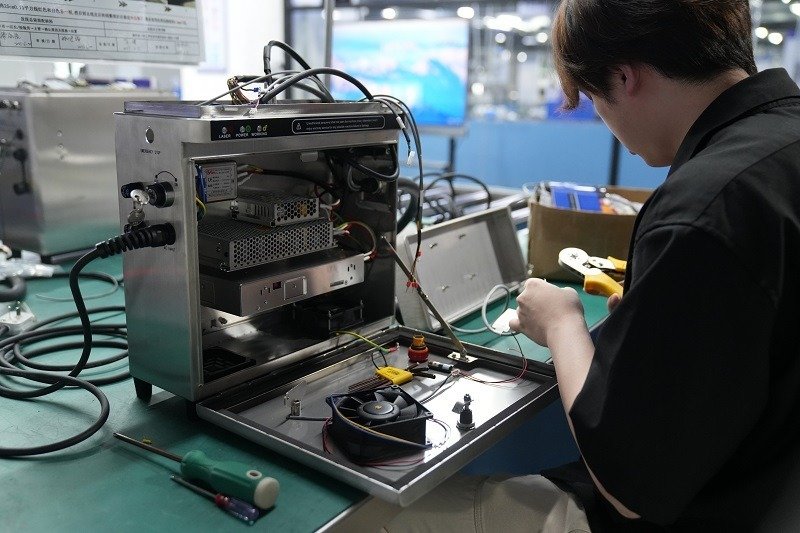
A portable fiber laser marking machine is a practical solution for businesses that need accurate, permanent markings on metal parts and industrial products. Unlike traditional marking equipment that may require a fixed workstation, portable models offer greater flexibility for marking large components, machinery, tools, and finished products directly at their location.
These machines use a concentrated laser beam to create text, serial numbers, logos, barcodes, and other identification marks on suitable materials. Their precision and relatively low maintenance requirements make them useful in manufacturing, automotive services, metal fabrication, and product identification.
Understanding how a portable fiber laser marking machine works can help businesses decide whether it fits their production requirements.
What Is a Portable Fiber Laser Marking Machine?
A portable fiber laser marking machine uses a fiber laser source to mark a material’s surface. The laser delivers concentrated energy to a selected area, producing a visible mark through controlled surface changes. Depending on the material and settings, this may involve annealing, discoloration, engraving, or surface removal.
Portable systems typically include a laser source, handheld or movable marking head, control unit, software, and a power supply. Some models use a handheld head connected to a separate controller, while others feature a more compact integrated design.
Although these machines are portable, they still require a stable working setup and appropriate laser safety controls. Portability refers to easier movement and access, not unrestricted operation in any environment.
How Does Fiber Laser Marking Work?
The marking process begins with preparing a design or entering the required information into compatible software. The operator positions the marking head and sets the appropriate parameters for the material.
The software directs the laser beam across the selected area. The laser interacts with the surface, creating the desired text, code, graphic, or identification mark.
Marking quality depends on several factors, including laser power, pulse characteristics, scanning speed, focal distance, material composition, and surface condition. A suitable combination produces clear, consistent results without unnecessary damage to the component.
Before marking a production batch, businesses should test the settings on a sample part. This helps confirm legibility, contrast, and repeatability.
Main Applications of Portable Fiber Laser Marking Machines
Metal Parts and Components
Manufacturers use portable fiber laser marking machines to identify metal components with part numbers, manufacturing dates, and serial numbers. These marks help distinguish similar components and support inventory management.
The equipment is particularly useful when components are too large or awkward to move to a conventional marking station.
Automotive Workshops
Automotive businesses may use laser marking to identify tools, metal components, replacement parts, and workshop equipment. Permanent identification can assist with asset tracking and quality documentation.
The exact marking method should be selected according to the component material, surface treatment, and applicable industry requirements.
Industrial Equipment
Large industrial equipment often needs identification plates, asset numbers, or maintenance references. A portable marking system can reach suitable surfaces without requiring the entire machine to be transported.
Operators must still ensure that the equipment is safely isolated where necessary and that the marking head can be positioned securely.
Tools and Hardware
Manufacturers and distributors can mark metal tools, fasteners, fittings, and hardware with brand names, logos, or product codes. The resulting markings can support product identification and reduce confusion between similar items.
Electronics and Electrical Components
Fiber laser marking can be used on suitable metal housings, connectors, and selected electronic components. Small markings can contain model information, serial numbers, and machine-readable codes.
For delicate components, the process requires careful parameter selection to avoid heat-related damage.
Benefits of Using Portable Equipment
Flexible Operation
The main advantage of a portable fiber laser marking machine is its ability to reach workpieces that cannot easily be moved. This can be valuable in fabrication facilities, repair workshops, and industrial maintenance environments.
Permanent Identification
Laser markings can provide durable identification when the correct marking method and settings are used. Their resistance to ordinary handling can make them suitable for traceability and asset identification.
However, durability varies with the material, marking depth, surface treatment, and environmental exposure.
Precise Results
Fiber laser technology can create fine text, detailed graphics, and compact identification codes. This helps businesses mark small components where conventional labeling may be difficult.
Reduced Consumable Requirements
Laser marking generally does not require ink, printing ribbons, or marking chemicals. Routine costs may therefore be lower than some traditional marking methods, although electricity, maintenance, safety equipment, and replacement parts still contribute to operating expenses.
Improved Workflow
Marking products near their assembly or inspection location can reduce unnecessary handling. It may also simplify the identification of large equipment and finished products.
Materials Suitable for Fiber Laser Marking
Fiber lasers are commonly used for marking many metals, including stainless steel, carbon steel, aluminum, brass, and selected copper alloys. The result depends on the alloy, surface finish, coating, and laser parameters.
Some coated materials can also be marked, but the process must be tested to ensure that the coating responds as intended.
Fiber lasers are not the ideal choice for every non-metallic material. Plastics, wood, glass, and other substrates may require a different laser wavelength or marking technology. Businesses should consult the equipment manufacturer before using unfamiliar materials.
How to Choose the Right Machine
Check Laser Power
Portable fiber laser marking machines are available with different power ratings. The right option depends on the materials, marking speed, required contrast, and intended application.
Higher power does not automatically guarantee better results. Fine identification marks may require precise control rather than maximum output.
Evaluate the Marking Area
Check the available marking field and whether the system supports the size and shape of your components. Large workpieces may require a movable head or additional positioning arrangements.
Review Software Compatibility
The control software should support your design workflow and required file formats. If your business uses serial numbers, barcodes, or QR codes, confirm that the software can generate and manage these efficiently.
Consider Portability and Ergonomics
Review the system’s total weight, cable arrangement, handle design, and controller size. If operators will use the machine throughout the day, comfortable handling and straightforward setup can improve productivity.
Confirm Safety Features
Choose equipment with appropriate safety controls and documentation. Ask the supplier about laser classification, required protective eyewear, interlocks where applicable, and safe operating procedures.
Safety and Maintenance
Fiber laser marking machines can produce hazardous laser radiation. Direct exposure and reflections from metal surfaces can cause serious eye or skin injuries.
Operate the machine only with the safety measures specified by the manufacturer. Use suitable protective eyewear, control access to the marking area, and implement an appropriate enclosure or controlled work zone where required by the laser classification and local regulations.
Metal marking may also produce fumes or particles, particularly when coatings are processed. Use suitable extraction and ventilation based on the material and application.
For maintenance, keep optical components clean according to the manufacturer’s instructions, inspect cables, and maintain the equipment in a dry, suitable environment. Do not open the laser source or modify safety systems without authorization.
Frequently Asked Questions
What is a portable fiber laser marking machine used for?
It is used to mark metal parts, tools, machinery, identification plates, and suitable components with serial numbers, logos, barcodes, and other information.
Can a portable fiber laser mark stainless steel?
Yes. Fiber lasers are widely used on stainless steel, although the final appearance depends on the laser settings and surface condition.
Is portable laser marking suitable for large parts?
Yes. Portable designs can make it easier to mark large or heavy workpieces without moving them to a fixed marking station.
Does a fiber laser marking machine require ink?
No. It marks through laser energy rather than conventional ink-based printing, although it still requires electricity and appropriate maintenance.
Conclusion
A portable fiber laser marking machine can help manufacturers, repair workshops, and industrial businesses create accurate product identification marks directly on suitable workpieces. Its flexibility, precision, and reduced dependence on consumables make it a useful option for many metal-marking applications.
Before purchasing, evaluate laser power, marking area, software, portability, material compatibility, and safety requirements. Testing sample parts and selecting a reliable supplier can help ensure that the equipment meets your actual production needs.