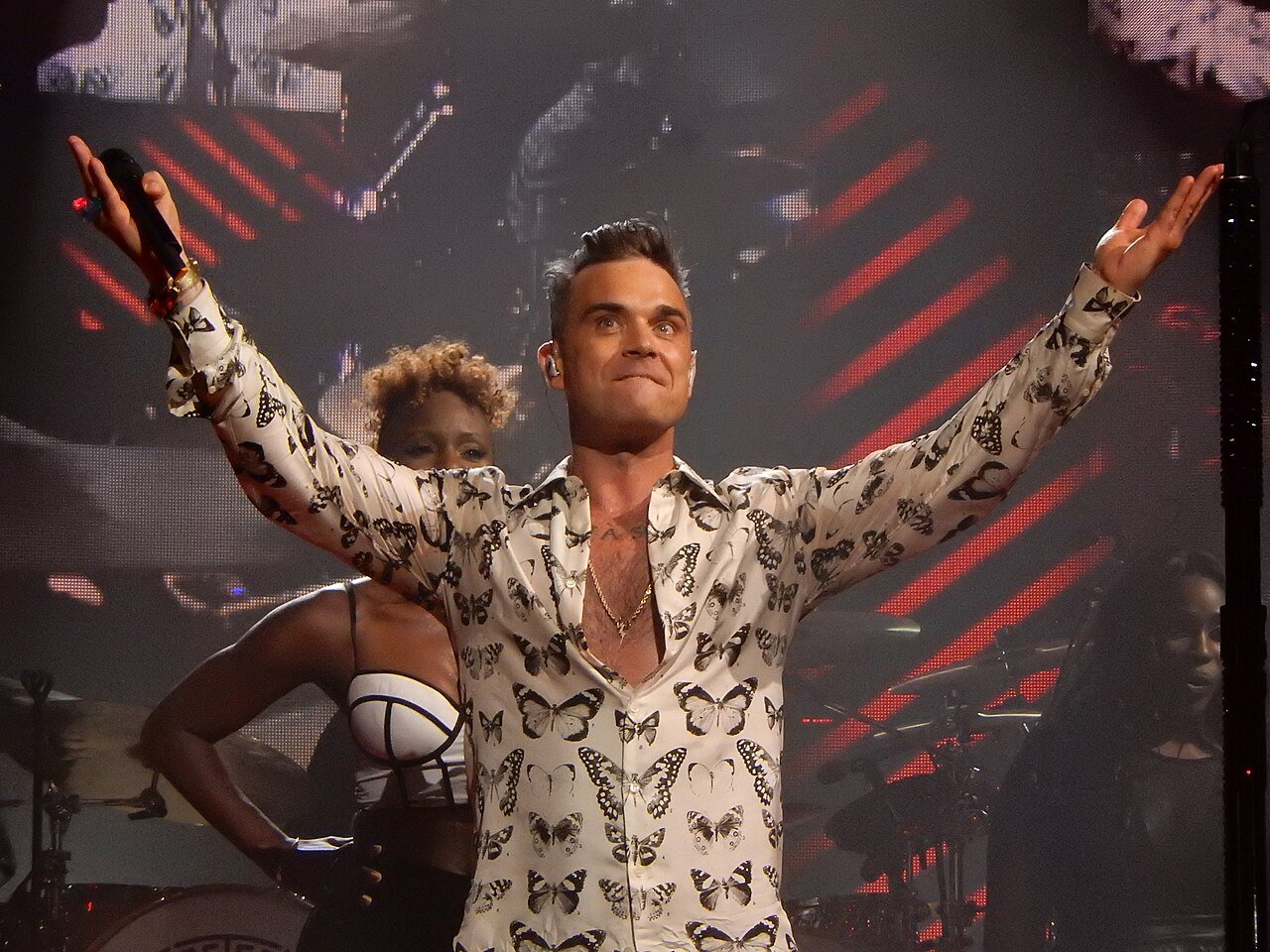
Few partnerships in British pop have travelled as far, or as roughly, as the one between Robbie Williams and Gary Barlow. They met as teenagers in a manufactured boy band, became its two most famous names for very different reasons, fell out in public, built rival solo careers, and then reunited.
Williams was the showman, the youngest member of Take That, the one the cameras loved. Barlow was the musician, the songwriter and lead singer who wrote the hits that made the band famous. Robbie Williams found fame in Take That from 1990 to 1995 before launching a solo career in 1996 that made him one of the biggest-selling British solo artists of all time.
Manchester, 1990: Five Boys and One Songwriter
Take That were put together in Manchester in 1990 by manager Nigel Martin-Smith, who had watched the success of New Kids on the Block in America and decided Britain needed its own version. He advertised in the Manchester Evening News and auditioned young men from across the North West. Gary Barlow, born on 20 January 1971 in Frodsham, Cheshire, was the first recruit, and the most important one.
The other members arrived one by one. Howard Donald came from Droylsden, a dancer and DJ. Jason Orange came from Crumpsall, a breakdancer. Mark Owen came from Oldham, a former bank clerk. And finally there was Robbie Williams, born Robert Peter Williams on 13 February 1974 in Stoke-on-Trent, the youngest of the five at sixteen. His mother had suggested he try out.
The Rise: Pray, Back for Good and the Biggest Band in Britain
Williams was a natural performer, but he was not a songwriter, and in the early days he sang backing vocals while Barlow took the lead. Take That did not become stars overnight. Their first singles reached the lower end of the Top 40
But Barlow kept writing better songs, and the band kept getting bigger. Their debut album, Take That and Party, arrived in 1992, and Everything Changes followed in 1993. Their first number one single, Pray, written by Barlow, arrived in 1993 and won him an Ivor Novello Award the following year.
By 1995 they were the biggest pop group in Britain. Their third album, Nobody Else, went straight to number one, and its lead single, Back for Good, became their most famous song. Written by Barlow, it reached number one in thirty-one countries and number seven on the American Billboard Hot 100. The band had eight number one singles in their first run.
The Split: Robbie Leaves in 1995
Behind the success, the balance of the band was shifting. Williams was growing restless, frustrated by his small share of the singing and the songwriting, and by a life tightly controlled by management. The showman wanted more room, and the songwriter wanted to keep the machine running as it was. The break came in the summer of 1995, and it was as public as a pop split can be. In July 1995 he agreed to leave, and a helpline was set up for distressed fans.
The remaining four carried on, but the heart had gone out of the group. On 13 February 1996, which happened to be Williams’s twenty-second birthday, Take That announced that they were splitting up altogether. For Barlow, it was the end of the world he had built. For Williams, it was freedom.
Robbie Alone: Angels, Knebworth and the Solo Crown
Williams launched his solo career in 1996 with a cover of George Michael’s Freedom, which reached number two in the UK. The real breakthrough came a year later. His debut solo album, Life thru a Lens, was released in September 1997, and at first it sold slowly, debuting at number eleven. Then came its fourth single, Angels, released in December 1997. It peaked at number four, yet became his best-selling single in Britain, with two million UK chart units, written with Guy Chambers.
What followed was one of the great runs in British pop. His second album, I’ve Been Expecting You, arrived in 1998 and gave him his first two solo number one singles, Millennium and She’s the One. Sing When You’re Winning followed in 2000, led by Rock DJ, another number one. He had seven UK number one singles as a solo artist.
In August 2003 he played three nights at Knebworth, in front of a combined audience of about 375,000 people, the biggest music event in British history at the time. He has won eighteen BRIT Awards, more than any other artist. In December 2024 his life story reached the cinema in Better Man, with Williams played by a computer-generated chimpanzee.
Gary Alone: Open Road and the Songwriter’s Second Act
Barlow’s solo career began faster than Williams’s, and for a short while it looked as though the songwriter would win the race. His first solo single, Forever Love, released in July 1996, went straight to number one, and his second, Love Won’t Wait, written by Madonna and Shep Pettibone, did the same. His debut solo album, Open Road, released in 1997, also reached number one in the UK. His second album, Twelve Months, Eleven Days, sold poorly in 1999, and his record company dropped him.
Barlow rebuilt his career as a songwriter for other people, writing songs for Shirley Bassey, Will Young, Westlife and Charlotte Church. From 2011 to 2013 he was head judge on The X Factor, and in 2012 he co-wrote Sing with Andrew Lloyd Webber, and was appointed an Officer of the Order of the British Empire. He has won six Ivor Novello Awards.
The Reunion Without Robbie: Beautiful World
By 2005, a decade after the split, something had changed. A greatest hits album, Never Forget: The Ultimate Collection, sold more than two million copies in Britain and reached number two, and an ITV documentary, Take That: For the Record, drew seven million viewers. The four remaining members announced a reunion tour in November 2005 as a four-piece, without Williams. The Ultimate Tour ran from April to June 2006, and every date sold out.
The comeback album, Beautiful World, released in November 2006, went to number one in the UK and sold more than 2.8 million copies there. Its lead single, Patience, reached number one in its second week and stayed there for four weeks, becoming the group’s ninth UK number one. On Beautiful World, all four members sang lead vocals and shared the songwriting, where once Barlow had written almost everything alone.
Robbie Comes Home: Progress and the Flood
The question nobody could answer was whether Williams would ever come back. The two men had said hard things about each other in public. Then, quietly, they began to work together again. In 2010 Barlow and Williams wrote and recorded a duet, Shame, a song about two old friends making peace, and it reached number two in the UK. The single The Flood reached number two.
On 15 July 2010 it was announced that Williams would rejoin Take That. Their sixth album, Progress, was released on 15 November 2010 and debuted at number one, becoming the second fastest-selling album in UK chart history. It sold more than a million copies in twenty-four days and became the biggest-selling album of 2010. The Progress Live tour sold 1.34 million tickets in less than twenty-four hours.
A Trio Carries On: III, Wonderland and This Life
Take That did not stop. In 2012 Williams and Barlow worked together again on Candy, a song they wrote together that became Williams’s seventh solo number one single. But the band itself was changing shape. In September 2014 Jason Orange left, and the group continued as a trio of Barlow, Donald and Owen.
Their seventh album, III, released in November 2014, still reached number one in the UK, led by the single These Days, their twelfth number one. Wonderland followed in March 2017, and This Life, their ninth studio album, was released on 24 November 2023 and debuted at number one. In January 2026 Williams released Britpop, his sixteenth UK number one album, passing the Beatles’ total of fifteen, with a collaboration with Barlow.
Where They Stand Now
Robbie Williams and Gary Barlow are no longer the teenager and the songwriter who argued over who sang what. They are men in their fifties, survivors of fame that arrived too young and stayed too long. Williams has spoken openly about his struggles with addiction and mental health. Barlow has spoken about rebuilding himself as a songwriter rather than a star after his solo career collapsed.
What they share now is a history that nobody else in British pop can claim. They made the songs that defined a decade, they broke each other’s hearts in public, and they found their way back to a working friendship. Like the great British sibling rivalries, from Liam Gallagher and Noel Gallagher theirs was built on talent, timing and a bond that neither success nor failure could quite break.