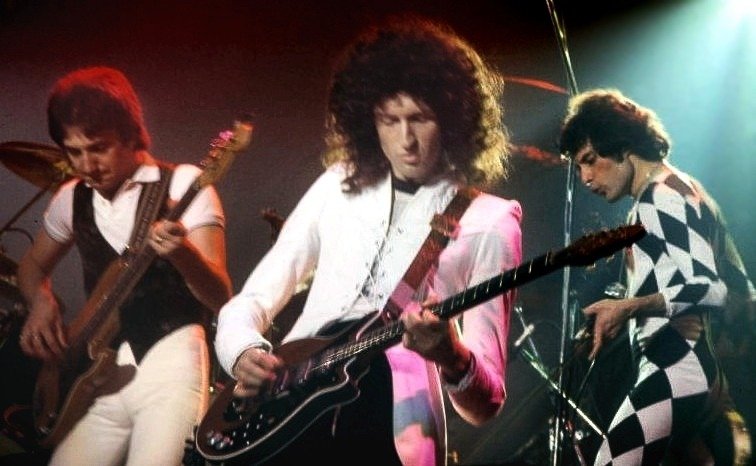
Few partnerships in British music have ever been as perfectly matched as Freddie Mercury and Brian May. One was a showman whose voice could fill a stadium; the other was a quiet physics student who built his own guitar and invented a sound the world recognised in a single note. Together they were Queen.
Mercury wrote the anthems, while May wrote the riffs and layered his guitar into harmonies that sounded like an orchestra. Queen were inducted into the Rock & Roll Hall of Fame in 2001, and decades after Mercury died, their songs still fill football grounds, films and wedding dances. This is the story of how a boy from Zanzibar and a boy from Hampton found each other, and what they built together across two decades of hit records and sold-out stadiums.
Zanzibar and Hampton: Two Very Different Beginnings
Freddie Mercury was born Farrokh Bulsara on 5 September 1946 in Stone Town, Zanzibar, then a British protectorate off the coast of East Africa and now part of Tanzania. His parents, Bomi and Jer Bulsara, were Parsis from western India. He was schooled in India, learning piano and singing in the choir. In 1964, when revolution broke out on the island, the Bulsaras fled to England and settled in Feltham, Middlesex, when he was seventeen.
Brian Harold May was born on 19 July 1947 in Hampton, Middlesex, the only child of Ruth and Harold May. His father, a draughtsman at the Ministry of Aviation, helped him build the instrument that would define his life. In 1963, when May was sixteen, the two of them set out to make an electric guitar from scratch. They carved the neck from a hundred-year-old mahogany fireplace mantel, built the body from blockboard and oak, and made the tremolo arm from a bicycle saddlebag holder and a knitting needle. The result was the Red Special, the guitar May still plays today, struck not with a plastic plectrum but with a sixpence coin.
Smile: The Band Before Queen
May studied physics and mathematics at Imperial College London, graduating in 1968, and it was there that music pulled him in a different direction. He formed a band called Smile with singer and bassist Tim Staffell, and dental student Roger Taylor joined on drums after answering a college noticeboard advertisement. Smile were signed to Mercury Records in 1969 and supported Jimi Hendrix, Pink Floyd and Yes, but they had no hit, and when Staffell left in 1970, Smile seemed finished.
The man who refused to let it finish was a friend of the band. Farrokh Bulsara had met Staffell at Ealing Art College, where he studied graphic design, and had become Smile’s most devoted fan, urging them to be bigger, louder and more theatrical. He also worked with Taylor selling second-hand clothes at Kensington Market. When Staffell left, Bulsara stepped forward as singer, bringing a new name for the band, Queen, and a new name for himself, Freddie Mercury. John Deacon joined as bassist in February 1971, and the classic line-up was complete.
Queen: A Name, a Sound and a Debut
Queen spent two years shaping a sound unlike anything else in British rock. Mercury brought opera, music hall and showmanship. May brought a guitar style built on layers, overdubbing harmony after harmony until one guitar sounded like a brass section. Their self-titled debut album, released in July 1973, mixed heavy riffs with high harmonies, though it sold modestly at first.
Queen II arrived in early 1974 and reached the top five in Britain, while its single Seven Seas of Rhye gave the band its first hit. Later that year, Sheer Heart Attack produced Killer Queen, which reached number two in the UK. A waltz-time pop song with a music-hall guitar solo, it showed Queen were no longer a promising act but contenders.
Bohemian Rhapsody and the Operatic Peak
Everything changed with A Night at the Opera, released in November 1975. It was one of the most expensive albums ever made up to that point, and its centrepiece was Bohemian Rhapsody, a song Mercury had built in pieces over years. It ran for nearly six minutes, moving from a piano ballad to an operatic section with more than 180 vocal overdubs, then to hard rock and back again. Record companies thought it was far too long for a single. It went to number one in Britain and stayed there for nine weeks.
The song also changed how pop music looked. Its promotional film, made because the band were touring and could not appear on Top of the Pops, is widely regarded as one of the first true music videos. A Day at the Races in 1976 brought Somebody to Love, and News of the World in 1977 brought the two songs that would follow the band everywhere. May wrote We Will Rock You, built on a stomping rhythm the crowd could join in with, and Mercury wrote We Are the Champions, still played at sporting finals around the world.
The Voice and the Guitar: How They Worked Together
What made Mercury and May special was how their talents fitted together. Mercury is often described as having a four-octave vocal range, and he was born with four extra incisor teeth, something he himself joked had given him his voice. A 2016 scientific study of his singing, led by Professor Christian Herbst, measured just over three octaves, from F sharp 2 to G5, and found his unusually fast vibrato set him apart from opera singers. Whatever the exact measurement, no other rock singer of his time combined that power with that theatrical control.
May’s contribution was just as distinctive. The Red Special, with its hand-wound pickups and coin-struck strings, produced a singing, violin-like tone nobody else could copy, and May stacked it into harmonies on songs like Killer Queen. He also wrote some of Queen’s most durable songs: We Will Rock You, Tie Your Mother Down, Fat Bottomed Girls, Hammer to Fall, I Want It All and Who Wants to Live Forever. Mercury, meanwhile, wrote Bohemian Rhapsody, Killer Queen, Somebody to Love, Don’t Stop Me Now and Crazy Little Thing Called Love. Each of them knew exactly how to write for the other’s strengths.
Live Aid: Twenty Minutes at Wembley
By the early 1980s, Queen’s fortunes had dipped. The dance-flavoured Hot Space, released in 1982, had divided fans, and the band had spent years touring while Britain moved on to newer sounds. The Works in 1984 steadied things with Radio Ga Ga and I Want to Break Free. On 13 July 1985, Queen took the stage at Wembley Stadium for Live Aid, the charity concert for famine relief in Ethiopia, before about 72,000 people and a television audience estimated at close to two billion.
They had just twenty minutes, and they used every second of it. Mercury worked the crowd like a conductor, getting 72,000 people to clap along to Radio Ga Ga and sing back the Ay-Oh chant. May’s guitar soared through Hammer to Fall and We Are the Champions, and the whole set ran with a precision that made the rest of the day look loose by comparison. It has been voted the greatest live performance in rock history, and it gave Queen a second career. The Magic Tour that followed in 1986 sold out stadiums across Europe.
The Last Years and the Legacy
The final show of that tour, at Knebworth Park on 9 August 1986, turned out to be Mercury’s last live performance with Queen. Diagnosed with AIDS in 1987, he poured what strength he had left into recording as his health declined. The Miracle arrived in 1989, then Innuendo in February 1991. Its closing song, The Show Must Go On, was written by May and sung by Mercury in a single session while he was seriously ill. On 23 November 1991, Mercury issued a public statement confirming that he had AIDS. He died the following day, 24 November 1991, at his home in Kensington, London, aged 45, of bronchial pneumonia brought on by the disease.
Five months later, on 20 April 1992, May, Taylor and Deacon staged the Freddie Mercury Tribute Concert at Wembley, which raised money for AIDS charities and led to the Mercury Phoenix Trust. Made in Heaven, built from Mercury’s last recordings, reached number one in Britain in November 1995. May then earned the PhD in astrophysics he had set aside in 1971, finishing at Imperial College in 2007, and he was knighted in 2023. Since 2011 he and Taylor have toured the world as Queen with Adam Lambert. Queen have sold more than 250 million records, and their 1981 Greatest Hits is Britain’s best-selling album. Like the great British pairings who came after them, from Elton John and Dua Lipa onwards, their strength was in the combination. Mercury died in 1991, but every time We Will Rock You starts in a stadium, the voice and the guitar are together again.