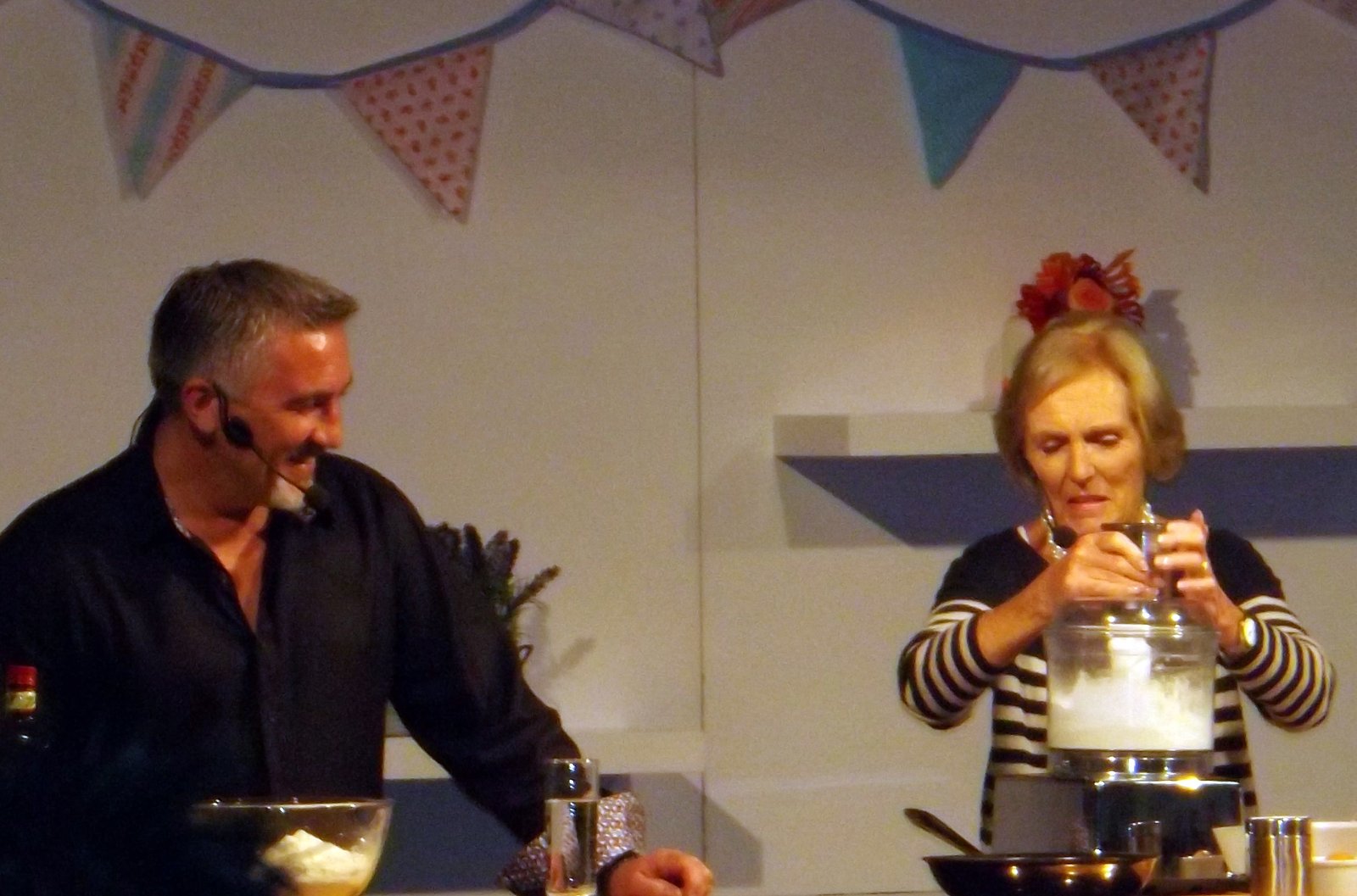
There is a particular kind of British television magic that happens when two people who genuinely like each other are allowed to be themselves on screen, and for seven years the best example of it stood behind a gingham-covered table in a white tent. The Great British Bake Off began in the summer of 2010 as a modest BBC Two contest for amateur bakers, and it grew into the most watched programme on British television. On one side sat Mary Berry, a cookery writer in her seventies who had been teaching Britain to bake since before most of the contestants were born. On the other sat Paul Hollywood, a professional baker thirty years her junior who could spot a soggy bottom from across a field. They were an unlikely pair, and that was exactly why they worked.
The cook from Bath
Mary Rosa Alleyne Berry was born on 24 March 1935 in Bath, Somerset, the second of three children. Her father, Alleyne Berry, was a chartered surveyor who served as mayor of Bath in 1952. She discovered cooking at school, where she was far better with a treacle sponge pudding than with Latin or mathematics. At thirteen she contracted polio and spent three months in an isolation hospital, an illness that left her with a twisted spine and a weaker left hand.
After school she trained at the Bath College of Domestic Science and then at Le Cordon Bleu in Paris, before taking a job in the showroom of the Bath Electricity Board, visiting new customers at home to show them how to use their electric ovens. From there she became a recipe tester for the public relations firm Benson’s, and in 1966 she became food editor of Housewife magazine, the year she married Paul Hunnings. She held the same post at Ideal Home from 1970 to 1973, and her first cookbook, The Hamlyn All Colour Cookbook, appeared in 1970.
Seventy-five books and a damehood
What followed was one of the longest careers in British food writing: more than seventy-five cookbooks and sales of over five million copies. Her best-selling book, Mary Berry’s Baking Bible, was published in 2009 and was named one of the ten best baking books by The Independent. She wrote for the home cook with an ordinary oven and a busy week, testing every recipe until it could be trusted.
Her autobiography, Recipe for Life, was published in 2013, and in it she wrote about the hardest event of her life: the death of her son William, who was killed in a car accident in 1989 at the age of nineteen. The honours caught up with her late. She was appointed a Commander of the Order of the British Empire in the 2012 Birthday Honours, and in the 2020 Birthday Honours she was made a Dame Commander for services to broadcasting, the culinary arts and charity. In May 2026 she received the BAFTA Fellowship, the academy’s highest individual honour, presented by Mel Giedroyc and Sue Perkins.
The baker from the Wirral
Paul John Hollywood was born on 1 March 1966 in Wallasey, on the Wirral peninsula near Liverpool, into a family where baking was the trade. His father, John, ran a chain of bakeries called Bread Winner, and Paul grew up in the business, doing early morning shifts before school and spending his holidays in the kitchen. He enrolled to study sculpture at the Wallasey School of Art, but at seventeen his father offered him five hundred pounds to leave college and join the family firm. He took the money, and he has been a baker ever since.
From the family bakery he worked his way up to head baker at some of the grandest hotels in the country, including the Dorchester in London, the Chester Grosvenor and Cliveden, and he spent time working at luxury resorts in Cyprus. In 2008, before television made him a household name, he created an almond and roquefort sourdough that was reported to be the most expensive loaf in Britain. He was appointed a Member of the Order of the British Empire in the 2024 New Year Honours for services to baking and broadcasting.
Seven series in the tent
When the BBC launched The Great British Bake Off on 17 August 2010, nobody involved expected it to become a national institution. The first series had ten bakers, six episodes and a tour of locations that moved from the Cotswolds to Scone Palace, Sandwich, Bakewell, Mousehole and Fulham Palace. Mel Giedroyc and Sue Perkins presented, and the development team had chosen Berry as a judge first, with Hollywood appointed after an audition. Edd Kimber won the first series, and the show was an immediate, gentle success.
What made it work was the balance at the judging table. Berry judged like a grandmother who wanted you to do well, warm and encouraging but never vague about what was wrong. Hollywood judged like a craftsman, dissecting crumb, bake and structure with a bluntness that made contestants quake. His rare handshake for an exceptional bake, the Hollywood handshake, became one of the most coveted moments in British reality television.
The audience grew with every series. The show moved to BBC One in 2014, and by 2015 and 2016 it was the most watched programme on British television. The 2016 final drew around fifteen million viewers, and the tent had become a fixture of the British autumn. Berry and Hollywood had judged seven series together, and their partnership was so natural that viewers assumed it would go on forever.
The split, and what came after
It ended, as these things do, over money and ownership. In September 2016 Love Productions, which owned the format, signed a three-year deal to move the show to Channel 4. Mel and Sue announced they would not follow it, and on 22 September 2016 Berry announced that she would stay with the BBC, citing loyalty to the broadcaster that had nurtured her and the show. Hollywood, the only member of the on-screen team to make the move, signed a three-series deal to continue as a judge on Channel 4.
In March 2017 it was announced that Prue Leith would join him as the second judge, with Noel Fielding and Sandi Toksvig taking over as presenters. Berry never looked back in anger. She stayed with the BBC and built a run of solo series around her, including Mary Berry’s Absolute Favourites, Mary Makes It Easy and Mary’s Foolproof Dinners, each with a companion book, and in 2019 she fronted A Berry Royal Christmas with the Duke and Duchess of Cambridge. In the autumn of 2025 the BBC marked her ninetieth birthday with Mary at 90, a series and a best-selling book of her finest recipes.
Why the pairing worked
Great television partnerships are usually built on contrast, and Berry and Hollywood were a study in it. She was seventy-five when the show began, he was forty-four. She was a home cook who wrote for ordinary kitchens, he was a professional who had spent his life in hotel bakeries. She softened his verdicts, and he sharpened hers, and the contestants got the best of both: kindness from one judge and honesty from the other. Viewers trusted them because the trust was real.
It also worked because both of them respected the bakers. The contestants were amateurs, not celebrities, and the judges treated their efforts seriously, even when the results were a mess. Berry would find something kind to say about a collapsed sponge, and Hollywood would explain, precisely, why it had collapsed. That combination of warmth and rigour is why the show survived the move to Channel 4, and why the original seven series are still remembered so fondly.
The judges who changed British baking
Before 2010, baking in Britain was something your grandmother did, or a skill you picked up from a book. After Berry and Hollywood, it was a national pastime. Shops reported sharp rises in sales of baking ingredients and equipment, cookbooks sold in their millions, and a generation of home bakers learned to make a Victoria sponge, a sourdough loaf and a showstopper, often in that order. Berry proved that a recipe could be both simple and exact, and Hollywood proved that bread was a craft worth taking seriously.
Sixteen years after that first episode, the tent is still standing, and Hollywood is still judging in it. He has now judged every series of the show since its first in 2010, and from series seventeen in 2026 he sits alongside Nigella Lawson, after Prue Leith announced her departure in January of that year. Berry, at ninety-one, is still writing books and still appearing on television, a dame and a BAFTA fellow with more than seventy-five cookbooks behind her. They only shared a judging table for seven series, but those seven series changed British food television. For more on two British stars who built a partnership that defined an era, read our piece on Gordon Ramsay and Jamie Oliver.