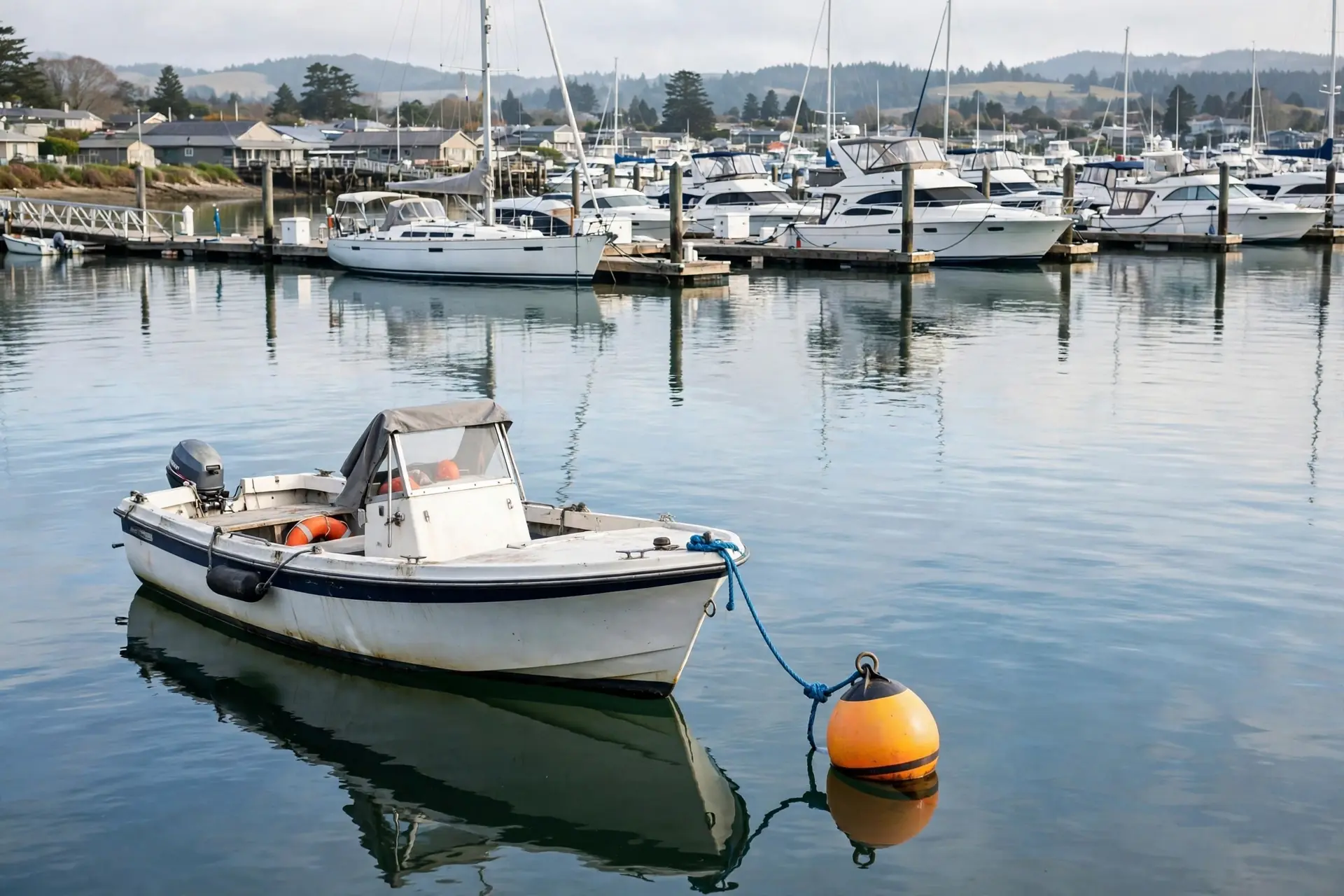
When you need to leave your boat somewhere safe, the choice usually comes down to mooring vs docking, and getting that choice right matters far more than most new boat owners expect. In short, mooring means securing your vessel to a fixed anchor system out in the water, most often a mooring buoy, while docking means bringing it alongside a pier, pontoon or quay where you can step directly ashore. Both methods keep a boat in place, but they differ sharply in cost, convenience, safety and the kind of boating life they give you, so the better option depends entirely on your boat, your budget and how you actually use the water.
This guide compares mooring vs docking in practical detail, covering what each method involves, the equipment it needs, what it costs, the risks to watch for, and which option suits different kinds of boaters. Whether you keep a small daysailer on a swinging mooring, a motor cruiser in a marina berth, or a commercial vessel working out of a busy port, understanding the real differences will help you protect your boat, your crew and your wallet, and avoid the expensive mistake of paying for facilities you do not need or trusting gear that was never meant for your conditions.
What Mooring Really Means
Mooring is the practice of securing a vessel to a permanent anchor system installed in the water, rather than to a shoreside structure. In everyday boating language, mooring most often means picking up a mooring buoy: a float connected by chain or heavy line to a substantial anchor on the seabed, such as a mushroom anchor, a pyramid anchor, a helical screw anchor or a concrete deadweight block. The boat is attached to the buoy by a pennant, a short strop with an anti-chafe cover, and it then swings freely around that single point as the wind and tide change direction. That swinging room is a defining feature of mooring, because the boat needs a full circle of clear water around the buoy, and neighbouring boats must be spaced far enough apart that their swinging circles never overlap.
Mooring is also used in a broader technical sense for any permanent securing arrangement, including pile moorings, where a boat is tied between pairs of piles driven into the seabed, and trot moorings, where several buoys are laid in a line in a river or estuary. What these arrangements share is that the boat stays out in the water, away from the shore, and reaching it requires a dinghy, a tender or a harbour launch. Mooring fields are common in crowded harbours, rivers and bays where there is simply not enough quayside for every boat, and they are often managed by a harbour authority, a sailing club or a private operator who inspects and maintains the ground tackle. For many owners, a mooring is a long-term home for the boat during the sailing season, and the annual fee is usually far lower than the price of a marina berth.
What Docking Really Means
Docking means manoeuvring a vessel alongside a fixed shoreside structure, such as a dock, pier, pontoon, quay or slip, and securing it there with dock lines. A typical docking arrangement uses bow, stern and spring lines made fast to cleats, bollards or rings on the structure, with fenders hung between the hull and the hard surface to absorb contact and prevent damage. Unlike a moored boat, a docked boat does not swing freely; it sits in a defined berth, held close to the structure, and the crew can step on and off directly. That direct access is the single biggest practical advantage of docking, because it turns the boat into something you can load, clean, repair and board without any intermediate journey across the water.
Docking is the standard arrangement in marinas, where finger pontoons create individual berths, and in commercial ports, where ships come alongside quays to load and unload cargo, take on fuel and embark passengers. It is also the arrangement most newcomers picture when they think of keeping a boat, and it is generally the easier option for day sailing, because there is no dinghy to launch, no wet ride out to the mooring and no balancing act while transferring bags, children or provisions. The trade-off is that docking depends on built infrastructure, which is expensive to construct and maintain, and that cost is passed on to berth holders through higher fees, waiting lists in popular marinas, and exposure to the wear and noise of a busy waterfront.
Mooring vs Docking: The Key Differences
The heart of the mooring vs docking comparison is location, and almost every other difference flows from it. A moored boat sits out in open water, held by ground tackle below the surface, while a docked boat sits against a structure attached to the land. That difference decides how you reach your boat, what services you can use, how much you pay, and what can go wrong. Mooring keeps the vessel away from hard surfaces and other boats, which reduces the risk of fender damage and hull scuffs, but it also means no shore power, no mains water at the boat, and no simple walk ashore. Docking gives you all of those conveniences, plus security, lighting and often Wi-Fi, fuel and repair yards, but it puts your boat in close contact with pontoons, pilings and neighbours, where a failed fender or a badly handled manoeuvre can cause real damage.
Equipment is the second major difference in this mooring vs docking comparison. Mooring relies on the ground tackle: the anchor, the heavy ground chain that keeps the pull angle low, the riser chain, the buoy and the pennant, plus swivels that stop the chain twisting as the boat swings. Docking relies on the boat’s own lines and fenders, and on the marina’s cleats, bollards and pontoon hardware. Maintenance differs accordingly. A mooring must be lifted and inspected regularly, with chains checked for wear and corrosion, because a link worn thin near the seabed can fail without any visible warning from the surface. Docking gear, by contrast, is visible every time you visit the boat, so chafed lines and split fenders are easier to spot, although the lines themselves need regular replacement because ultraviolet light, salt and constant working degrade them.
Types of Moorings and Docking Arrangements
Not all moorings are the same, and choosing the right type matters as much as choosing mooring over docking in the first place. A swing mooring, with a single anchor and buoy, is the most common and the cheapest to lay, but it needs the most swinging room and leaves the boat exposed to wind and waves from every direction. A pile mooring holds the boat between fixed piles, which limits swinging and suits tidal harbours, but it requires the boat to be positioned carefully and the piles themselves need maintenance. Mediterranean mooring, often called Med mooring, is a hybrid: the boat drops its anchor ahead of the quay and reverses stern-to, so the stern is secured to the shore while the bow is held by the anchor, a space-saving arrangement common in crowded Mediterranean harbours but demanding in crosswinds. Fore-and-aft moorings, where the boat is secured at both bow and stern to fixed points, are used in rivers and tight anchorages where swinging room does not exist.
Docking arrangements vary just as much, from alongside berths on a quay wall, where the full length of the boat lies against the structure, to finger pontoons in a marina, where the boat sits in a slip between two short pontoons, and to stern-to or bow-to berths, where only one end of the boat faces the quay. Each has its own handling challenges: an alongside berth is the simplest to enter but exposes the whole hull to the structure, while a finger pontoon berth protects the boat better but demands more precise manoeuvring in wind and tide. For a fuller explanation of mooring hardware, anchor types and inspection routines, Sea Tow’s guide to mooring a boat is a useful reference, because it walks through each part of the system and the maintenance checks that keep it trustworthy. Whatever arrangement you choose, the principle is the same: understand the forces acting on your boat, and make sure every component in the chain from seabed to cleat is rated for them.
Costs, Access and Everyday Practicalities
Cost is often the deciding factor in the mooring vs docking debate, and here mooring usually wins by a wide margin. A swinging mooring in a harbour or river typically costs a fraction of an equivalent marina berth, because there is no pontoon to build and maintain and no shoreside services to provide. That saving is real money over a season, and it is one reason sailing clubs and harbour authorities maintain large mooring fields. Docking, on the other hand, buys convenience: you walk straight onto your boat, plug into shore power to keep batteries charged and run heaters or dehumidifiers, fill the water tank from a quayside tap, and carry provisions aboard without a dinghy trip. For owners who sail most weekends or live aboard, that convenience can easily justify the higher fee, while owners who sail occasionally may find the mooring’s lower cost far more sensible.

Everyday practicality goes beyond the fee, however, and this is where many new owners are caught out. Reaching a moored boat means keeping a dinghy, maintaining its outboard, and accepting wet and sometimes cold transfers in bad weather, which is a genuine barrier for families with small children, older sailors or anyone with limited mobility. Leaving a moored boat also takes longer, because the dinghy must be secured, the mooring pennant stowed, and the boat prepared before departure, whereas a docked boat can be under way within minutes. Security differs too: a marina berth usually benefits from gated access, lighting, CCTV and neighbours who notice strangers, while a moored boat sits alone on the water, more vulnerable to theft and harder to check after a storm. On the other hand, a moored boat is quieter, more private and often in a more beautiful setting than a crowded marina, and many sailors consider that solitude worth the extra effort.
Safety Risks and How to Manage Them
Neither mooring nor docking is free of risk, and the dangers are different enough that they deserve separate attention. Mooring risks centre on the ground tackle: a chafed pennant, a corroded chain, an anchor dragged by a storm, or a buoy that has lost buoyancy can all set a boat adrift, and because the boat is unattended for long periods, the failure may only be discovered when it is too late. The defences are straightforward but non-negotiable: size the anchor and chain for your boat and the worst local conditions rather than average ones, inspect the entire system at least once a season by lifting it or hiring a diver, replace any chain link worn by more than about a third of its original diameter, and fit a pennant with proper chafe protection where it passes through the bow chock. Checking the mooring after every gale, and knowing which neighbouring boats could drift onto yours, is part of responsible mooring ownership.
Docking risks centre on contact and manoeuvring. A boat coming alongside too fast, a gust catching the bow, a misjudged tide or a fender that slips can all cause hull damage, and in a crowded marina a single error can damage several boats. The defences here are seamanship and preparation: approach slowly, with fenders rigged on both sides and lines ready before entering the marina, brief the crew so everyone knows their job, and use a midships spring line first to stop the boat, since a single line around a cleat transforms a difficult manoeuvre into a controlled one. Tidal ranges add another docking hazard, because lines that are correct at high water can hang a boat from its cleats at low water or leave it surging in a swell, so lines must be adjusted for the tide and checked regularly. In both cases, the real safety lesson is the same: the method is only as safe as the gear and the habits behind it.
Which Option Suits Your Boat and Your Plans
Choosing between mooring and docking starts with an honest look at how you actually use your boat, rather than how you imagine using it. A small daysailer or a trailer-sailer that is used occasionally, kept on a budget, and sailed by a fit crew will usually be happiest on a mooring, where low cost and a peaceful setting outweigh the inconvenience of a dinghy. A larger cruising yacht, a motor cruiser used for weekends away, or any boat whose owners value easy boarding, shore power and on-site services will usually justify a marina berth, because the convenience translates directly into more time on the water. Commercial vessels follow a different logic altogether: cargo ships dock to work, loading and unloading at quays, but they moor offshore when berths are congested, waiting their turn at anchor or on a mooring buoy until space opens up.
Location and local conditions can override personal preference entirely. Some harbours have no marina at all and offer only moorings, while others have waiting lists for berths measured in years, making a mooring the only realistic option. Tidal ranges, exposure to prevailing winds, winter icing and the availability of winter storage all affect the decision, and many experienced owners use both methods across the year: a mooring in the sailing season, when the boat is in regular use and the weather is kind, and a marina berth or ashore storage in winter, when storms, ice and maintenance make a sheltered, accessible berth far more valuable. Talking to the harbourmaster, the sailing club and other owners in your area is the fastest way to learn which option genuinely works in your waters, because local knowledge about holding ground, currents and exposure is worth more than any general guide.
Conclusion
Mooring vs docking is not a contest with a single winner, because the two methods solve different problems. Mooring keeps a vessel secure out in the water on a permanent anchor system, at lower cost and with greater peace and privacy, but it demands a dinghy, regular ground-tackle inspection and acceptance of a wilder, more exposed berth. Docking brings a vessel alongside a pier or pontoon, giving direct shore access, services, security and convenience, but it costs more and puts the boat in close contact with hard structures and neighbours. The right choice is the one that matches your boat, your budget, your crew and your local waters, and many sailors sensibly use both at different times of year.
Whatever you choose, invest in the details that actually keep a boat safe: properly sized ground tackle or well-maintained lines and fenders, regular inspections, and a realistic assessment of your own handling skills in wind and tide. A boat is a significant investment and a source of real joy, and securing it properly is the unglamorous work that protects both. Get the mooring vs docking decision right, and you will spend less time worrying about your boat and more time enjoying it.
If you enjoy learning how specialist roles work in other fields, our guide to rugby positions explains all 15 roles and numbers in rugby union, from the powerful forwards to the creative backs.
Frequently Asked Questions
Is mooring cheaper than docking?
In most harbours, yes, and often by a large margin. A swinging mooring typically costs a fraction of a marina berth because there is no pontoon or shoreside infrastructure to maintain. The saving should be weighed against the cost of a dinghy and its outboard, plus the time and effort of reaching the boat, but for occasional sailors the mooring is usually the cheaper overall option.
Can I moor my boat anywhere?
No. Moorings must be laid in authorised mooring fields or with the harbour authority’s permission, because a mooring occupies seabed, affects navigation and needs a swinging circle clear of other boats, channels and cables. Laying a mooring without permission can lead to its removal and a fine, and it may not be insured, so always check with the local harbourmaster first.
What is the difference between mooring and anchoring?
Anchoring uses the boat’s own portable anchor, dropped wherever the boat stops, while mooring uses a fixed, permanent anchor system installed in advance, usually marked by a buoy. Mooring generally gives stronger holding power and a smaller swinging circle, but it requires a fee and a designated space, whereas anchoring is free and flexible but demands good holding ground, correct scope and constant vigilance.
Do I need a dinghy if my boat is on a mooring?
In almost all cases, yes. A moored boat sits out in the water, away from the shore, so you need a dinghy, tender or harbour launch to reach it. Some mooring fields offer a water-taxi or launch service, which is worth asking about, especially if you sail with children or have limited mobility.
Is docking safer than mooring in a storm?
Not necessarily. A docked boat can be battered against pontoons and pilings in a storm surge, while a well-found mooring lets the boat swing and ride out wind and waves away from hard surfaces. The safest option in severe weather is often to haul the boat ashore or move it to a sheltered hurricane hole, and in any case the condition of your lines, fenders or ground tackle matters more than the method itself.