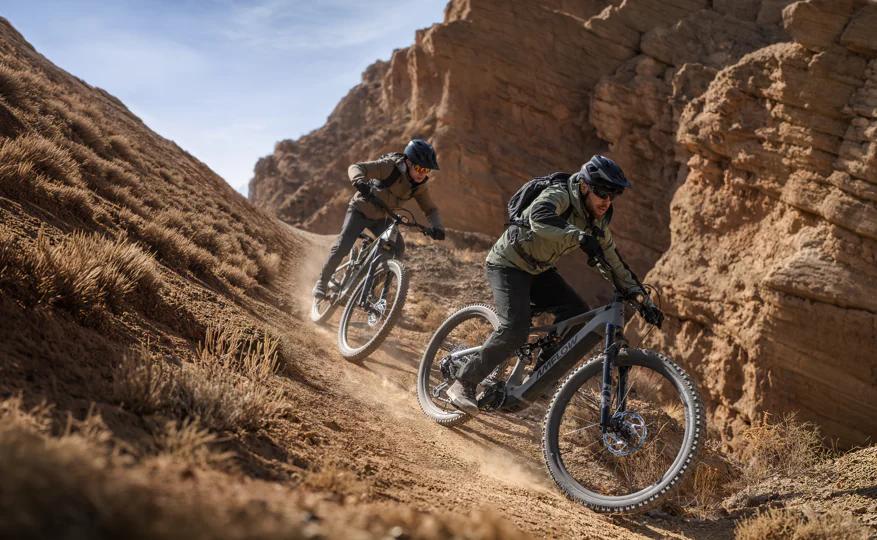
The Amflow PX Carbon Pro and Mondraker Zendit RR S share the Avinox M2S drive system but differ in suspension travel, frame geometry and component selection. The PX has 160mm of front travel and 150mm at the rear, compared with 170mm and 165mm respectively on the Zendit.
Both are carbon-framed electric mountain bikes aimed at technical terrain, although their designs reflect different priorities. The PX offers extensive geometry adjustment and a shorter-travel chassis, while the Zendit uses Mondraker’s Forward Geometry and ZERO suspension system to support more enduro-focused riding.
This comparison examines how those differences affect climbing, descending, battery range and suitability for UK trails.
Amflow PX Carbon Pro vs Mondraker Zendit RR S: Quick Verdict
The Amflow PX Carbon Pro may appeal to riders who favour technical climbing, geometry flexibility and responsive handling. The Mondraker Zendit RR S is more oriented towards sustained rough descents, with longer-travel suspension and a stability-focused chassis.
Both bikes use the Avinox M2S motor, although their published peak-power figures differ. Choosing an emtb between these two models therefore involves considering the complete bike rather than motor torque alone.
| Comparison Area | Amflow PX Carbon Pro | Mondraker Zendit RR S |
| Riding Focus | Trail and all-mountain | All-mountain and enduro |
| Technical Climbing | Adjustable geometry and responsive handling | Stable climbing position and traction-focused suspension |
| Descending | Agile handling with 150mm rear travel | Longer-travel chassis for sustained rough terrain |
| Geometry | Five head-angle, two bottom-bracket and four chainstay settings | Standard/Low geometry settings and wheel-size adjustment |
| Motor | Avinox M2S | Avinox M2S |
| Published Peak Power | Up to 1,500W | Up to 1,300W |
| Battery | 700Wh integrated | 800Wh integrated |
| Standard Charger | Avinox 508W | Avinox 168W |
| Wheel Configuration | Mullet, with 29in rear-wheel compatibility | Mullet, with 29in rear-wheel compatibility |
Peak-power figures come from manufacturer specifications and depend on battery configuration and operating conditions. The riding assessments are based on separate independent reviews rather than a controlled head-to-head test.
Frame Geometry and Handling: Agility vs Stability
The PX Carbon Pro offers a wider range of geometry adjustments, whereas the Zendit RR S uses a longer, slacker layout designed with demanding descents in mind.
The Amflow has a standard 64.2-degree head angle, adjustable between 63.2 and 65.2 degrees through interchangeable headset cups. Its chainstay length can be set between approximately 438mm and 451mm, alongside two bottom-bracket height settings.
These adjustments allow riders to alter steering response and weight distribution. Shorter chainstays can encourage quicker direction changes, while longer settings may help maintain front-wheel contact on steep climbs. Amflow quotes up to 40 theoretical geometry combinations, although the effects depend on the overall setup.
The Mondraker uses Forward Geometry, combining a relatively long front centre with a short stem. Its standard head angle is 63.5 degrees, with 450mm chainstays on sizes S, M and M/L, increasing to 455mm on L and XL.
A flip chip provides Standard and Low geometry positions. The Low setting slackens the head angle by approximately 0.35 degrees and lowers the bottom bracket by 5mm.
Independent testing describes the Zendit as composed at speed, although changing direction quickly requires more deliberate input. BikeRadar found the PX relatively easy to reposition through tighter terrain, particularly with its adjustable chassis configured for the conditions.
These observations come from separate tests. Reach, stack, wheelbase, suspension setup and frame size remain important when comparing how either bike might feel.
Suspension and Descending Performance
The Zendit RR S provides an additional 10mm of front suspension travel and 15mm at the rear. Its configuration is more gravity-oriented, while the PX combines shorter travel with adjustable handling characteristics.
Amflow PX Carbon Pro: 160/150mm Suspension
The PX Carbon Pro uses a FOX 36 Factory fork with a GRIP X2 damper and a FOX Float X Factory rear shock. Both offer adjustable damping for different rider weights, terrain and preferences.
In BikeRadar’s September 2026 review, the PX was described as balanced and responsive through corners and flowing trails. Its suspension provided support when pumping through undulating sections, while the bike’s comparatively manageable weight helped with changes of line.
The limits of its travel became more apparent on repeated rough descents. Rocks, roots and braking bumps transmitted more feedback than on some longer-travel bikes in the same test.
E-MOUNTAINBIKE Magazine found the rear suspension sensitive over smaller impacts but noted less mid-stroke support during aggressive pumping and compression.
The PX may therefore suit riders who regularly alternate between technical singletrack and descending, although those prioritising prolonged rough descents might prefer additional suspension travel.
Mondraker Zendit RR S: 170/165mm Suspension
The Zendit RR S combines a 170mm FOX Podium Factory fork with GRIP X2 damping and a FOX Float X Factory rear shock delivering 165mm of rear-wheel travel.
Its updated ZERO suspension system uses a dual-link layout with a floating shock. The design is intended to maintain traction while providing support through repeated impacts.
The inverted FOX Podium fork distinguishes the Zendit from the PX’s conventional FOX 36. Its construction and longer travel reflect the bike’s emphasis on demanding descents.
In E-MOUNTAINBIKE Magazine’s test, the Zendit felt particularly stable when carrying speed through rocky sections. The chassis encouraged committing to a line, although quick steering corrections required more rider effort.
The reviewers also noted a difference between the front and rear suspension response. While the Podium fork performed well over rough terrain, the Float X shock was less sensitive in particularly demanding situations.
The Zendit’s additional travel may appeal to riders spending more time on steep natural descents, while the PX’s shorter-travel setup may feel more responsive on smoother or tighter trails.
Technical Climbing and Avinox M2S Performance
Both bikes use the Avinox M2S mid-drive motor, which can deliver up to 130Nm of torque in regular assistance modes and up to 150Nm in Boost mode. Boost can operate for up to 60 seconds before returning to the previously selected mode.
The M2S has a rated power of 250W. Its peak output varies with the battery configuration and operating conditions.
Avinox specifies up to 1,500W when the M2S is paired with an FP700 or RS800 battery under defined conditions. With FS600 or FS800 battery configurations, the published peak output is 1,300W.
The PX Carbon Pro uses the FP700 battery, matching Amflow’s published maximum of 1,500W. Mondraker quotes up to 1,300W for the Zendit RR S. These figures should not be interpreted as sustained output or as a direct measure of climbing performance.
For UK-spec Avinox systems, pedal assistance is limited to 25km/h, approximately 15.5mph. This assistance cut-off is separate from the motor’s short-duration peak-power capability.
On technical climbs, the way assistance is delivered matters alongside motor output. The Avinox system uses pedal-torque, cadence and other sensor data to regulate assistance, with Auto mode adapting support as riding resistance changes.
BikeRadar found the PX particularly capable on steep technical climbs. With its chainstays set to 451mm, the test bike maintained good front-wheel control, while the motor’s response to pedal pressure helped the rider manage traction.
The Zendit’s climbing behaviour is influenced by its longer wheelbase and ZERO suspension platform. E-MOUNTAINBIKE Magazine reported a stable seated position and predictable assistance on loose, steep sections, with the rear suspension helping the tyre maintain contact.
The PX’s geometry adjustments may offer greater flexibility for riders negotiating tight uphill switchbacks. The Zendit’s more planted chassis could appeal to those tackling longer, rougher climbs.
Neither bike’s climbing ability can be determined from peak power alone. Tyres, suspension settings, rider technique and terrain all influence the result.
Battery Capacity, Range and Charging
The Mondraker Zendit RR S uses an integrated 800Wh Avinox battery, while the Amflow PX Carbon Pro has a 700Wh FP700 battery.
The Zendit stores approximately 14% more energy, providing the potential for greater range under comparable riding conditions. Actual range will depend on elevation gain, assistance mode, rider effort, temperature and tyre rolling resistance.
In BikeRadar’s maximum-assistance range test, the PX Carbon Pro covered 23km with 1,390m of elevation gain. This provides a reference for demanding riding but cannot be directly compared with results obtained on different routes or using different test methods.
The standard charging equipment also differs. The PX includes an Avinox 508W charger, while the Zendit RR S comes with a 4A charger rated at 168W.
In Avinox laboratory testing, the 508W charger can charge the FP700 battery from 0% to 80% in approximately 76 minutes. Charging times may vary with battery temperature, condition and other operating factors.
Both bikes use fixed, integrated battery systems rather than batteries intended for routine removal. Riders normally charge them with the batteries installed.
For longer UK rides involving substantial climbing, the choice involves balancing additional stored energy against charging convenience and complete-bike weight.
Components and Braking Performance
The PX Carbon Pro and Zendit RR S use different brakes, wheels and tyres, reflecting their respective component choices.
The Amflow has SRAM X0 Eagle AXS Transmission, Magura Gustav Pro four-piston brakes with 203mm rotors, and Amflow XMC-30 carbon wheels.
Its standard tyre combination includes a Schwalbe Magic Mary Radial Gravity Pro with Ultra Soft compound at the front and an Albert Radial Gravity Pro with Soft compound at the rear.
The Mondraker also uses SRAM X0 Eagle AXS Transmission, paired with SRAM Maven Silver brakes and 200mm rotors. Its DT Swiss Hybrid HX 1700 aluminium wheels are fitted with a Maxxis Assegai front tyre in MaxxGrip compound and a Minion DHR II rear with MaxxTerra compound and DoubleDown casing.
Tyre construction and compound are particularly relevant on wet roots, loose rock and steep natural trails. Braking performance also depends on pad compound, rotor condition, setup and rider preference, rather than caliper specification alone.
E-MOUNTAINBIKE Magazine reported limited modulation from the Magura Gustav Pro brakes on its PX test bike and experienced a cracked rear carbon rim. BikeRadar did not report the same wheel issue and found its test wheels durable.
These observations reflect individual test experiences and are not sufficient to establish the wider reliability of either wheelset.
For UK riding conditions, tyre selection, brake feel and wheel durability are worth evaluating alongside the suspension specification.
Which eMTB Is Better for UK Trails?
The PX Carbon Pro may suit riders who favour varied trail-centre riding and technical singletrack, while the Zendit RR S is more closely aligned with sustained rocky descents and enduro-focused terrain.
On flowing trail-centre routes, where berms, shorter climbs and frequent changes of direction are common, the PX’s adjustable geometry and relatively responsive handling may appeal to riders who prefer an active riding style.
Its technical climbing characteristics could also be useful on natural trails with awkward steps, loose surfaces and tight uphill turns.
The Zendit’s longer-travel suspension and stable geometry become more relevant as descending difficulty increases. These characteristics may suit demanding natural trails in areas such as the Lake District or Scottish Borders, where riders can encounter exposed rock, steep gradients and uneven braking surfaces.
For bike-park riding, the Zendit’s suspension configuration provides greater travel for repeated impacts. However, the benefits depend on rider skill, trail difficulty and suspension setup.
Riders who regularly alternate between trail centres and natural enduro routes may find either bike suitable. The PX places greater emphasis on adjustability and manoeuvrability, while the Zendit adopts a more gravity-focused approach.
These assessments are based on published specifications and independent tests, not a direct comparison on each UK trail mentioned.
Frequently Asked Questions
Are the Batteries Removable for Indoor Charging?
Both bikes use integrated batteries that are not designed for routine removal. Charging is normally carried out with the battery installed, so access to a suitable power point near the bike is worth considering.
Can Both Bikes Be Converted to a Full 29-Inch Wheel Setup?
Yes. Both support a 29in rear wheel. The PX uses its adjustable rear-end hardware, while the Zendit has a dedicated wheel-size flip chip that increases chainstay length by 7mm. Conversion should follow the manufacturer’s fitting and geometry instructions.
How Should I Compare Frame Sizes Between Amflow and Mondraker?
Compare reach, stack, effective seat-tube angle and standover clearance rather than relying on size labels. The two bikes use different geometry approaches, and similar reach measurements may still produce different riding positions and handling characteristics.
Final Verdict: Amflow PX Carbon Pro or Mondraker Zendit RR S?
The Amflow PX Carbon Pro and Mondraker Zendit RR S share the Avinox M2S platform but offer different combinations of suspension, geometry and components.
The Amflow PX Carbon Pro may suit riders who value technical climbing, geometry adjustment and responsive handling across mixed terrain. Its 160/150mm suspension offers a versatile platform, although longer-travel bikes may provide greater comfort on sustained rough descents.
The Mondraker Zendit RR S is more oriented towards stability and descending capability. Its 170/165mm suspension and Forward Geometry make it worth considering for riders who regularly tackle demanding natural enduro trails.
For UK riders, the choice depends on the balance between handling agility, descending priorities, frame fit and the terrain ridden most frequently.