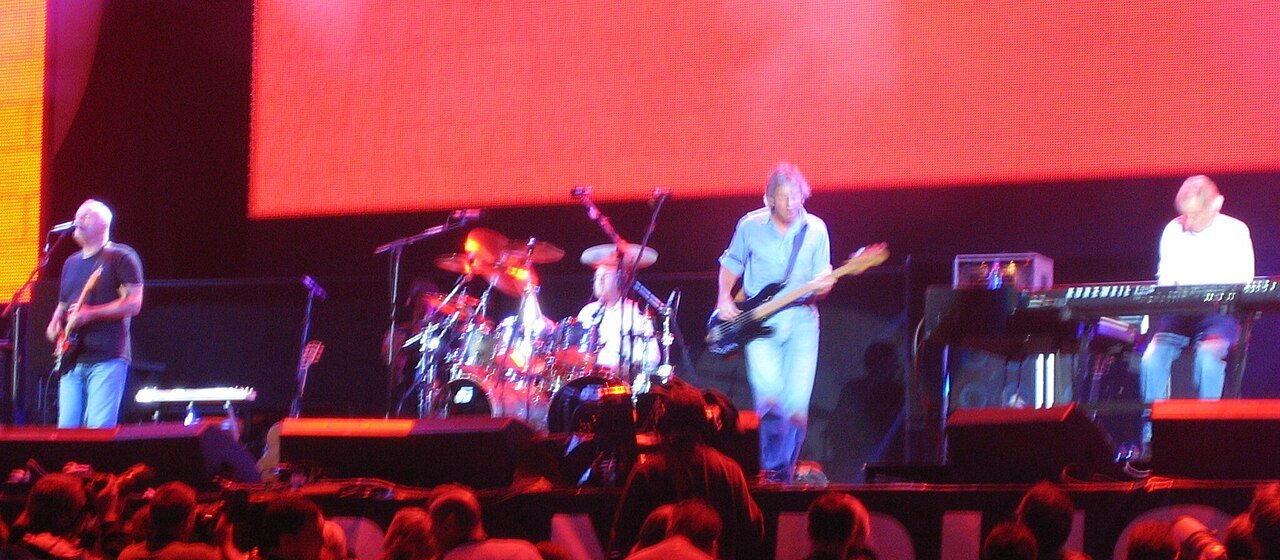
There is no more famous falling-out in British rock than the one between David Gilmour and Roger Waters. Together, they turned Pink Floyd from a psychedelic curiosity into the biggest band on the planet. Then they stopped speaking, fought in court over the band’s name, and spent four decades answering questions about each other. Yet the music they made together never went away.
Two Cambridge Boys
Roger Waters was born George Roger Waters on 6 September 1943 in Great Bookham, Surrey. His father, a teacher and Second World War soldier, was killed at Anzio in Italy when Roger was only five months old, a loss that would echo through his songwriting for the rest of his life. Brought up by his mother in Cambridge, he met the future Pink Floyd drummer Nick Mason at Regent Street Polytechnic in London, and Syd Barrett at school in Cambridge.
David Gilmour was born on 6 March 1946 in Cambridge, a couple of years younger than Waters and a near neighbour of Barrett’s. He learned guitar as a teenager, busked around France, and played in a string of unsuccessful bands. He was not a founding member of Pink Floyd, but he knew the band from the start, having taught Barrett a few guitar chords.
Pink Floyd formed in London in 1965, with Barrett, Waters, Mason and keyboard player Rick Wright. Their debut single, “Arnold Layne”, and their first album, The Piper at the Gates of Dawn (1967), were driven by Barrett’s songs. But Barrett’s mental health was collapsing under heavy LSD use, and by late 1967 he could barely perform. Gilmour joined as a second guitarist in December 1967 to cover for him, and by April 1968 Barrett was out and Gilmour was his replacement.
Learning to Be a Band Again
Losing their frontman and chief songwriter could have finished Pink Floyd. Instead, the remaining four rebuilt themselves. The albums that followed — A Saucerful of Secrets (1968), Ummagumma (1969) and Atom Heart Mother (1970) — were uneven, but they showed a band searching for a new identity. Waters was gradually taking over the writing, while Gilmour’s guitar gave the band its sound. By Meddle (1971), the pieces were falling into place.
The Golden Run
What followed was one of the greatest runs in recorded music. The Dark Side of the Moon, released in March 1973, was Waters’s concept from start to finish: an album about madness, money, time and death, with every lyric written by him. It stayed on the American album chart for more than 900 weeks and has sold over 45 million copies worldwide. A deluxe 50th anniversary box set followed in March 2023.
Wish You Were Here (1975) was a tribute to Barrett, and Animals (1977) was a bleak, Orwell-inspired attack on British society. Then came The Wall in 1979, Waters’s double-album rock opera about isolation and fame. It became a stage spectacular, a film, and the band’s best-selling work after Dark Side. On all of these records, Gilmour’s guitar and voice were the counterweight to Waters’s words: the soaring solo on “Comfortably Numb”, co-written by the two men, is still regularly voted the greatest guitar solo ever recorded.
The partnership worked because the two men were opposites. Waters was driven, political and conceptual, happiest with a big idea and a deadline. Gilmour was instinctive and musical, happiest chasing a sound. In the studio they argued constantly, and the arguments made the records better.
The Break
By the early 1980s the partnership was fraying. The Final Cut (1983) was effectively a Waters solo album released under the Pink Floyd name, and the sessions were miserable. Wright had already been pushed out during The Wall, and Mason was barely playing. In December 1985 Waters announced he was leaving, declaring Pink Floyd “a spent force creatively”.
What followed was a bitter legal dispute. Waters argued that the band could not continue without him and went to the High Court to stop Gilmour and Mason using the Pink Floyd name. The case was settled out of court in 1987: Gilmour and Mason kept the name, while Waters kept the rights to The Wall concept and certain other material. Neither side came out of it happy, and the two men barely spoke for years afterwards.
Waters launched his solo career with The Pros and Cons of Hitch Hiking (1984), Radio K.A.O.S. (1987) and the acclaimed Amused to Death (1992). His grandest gesture came in 1990, when he staged The Wall – Live in Berlin before a crowd estimated at 350,000, just months after the Berlin Wall had fallen.
Two Pink Floyds
Meanwhile, Gilmour rebuilt Pink Floyd around himself, Mason and a returning Wright. A Momentary Lapse of Reason (1987) was a deliberate return to the band’s widescreen sound, and it sold in huge numbers despite Waters dismissing it in public. The Division Bell followed in 1994, topping the charts on both sides of the Atlantic. Waters, meanwhile, toured his own vast productions of The Wall between 2010 and 2013, while Gilmour toured as Pink Floyd and then as a solo artist. Neither man would concede that the other had been the more important half of Pink Floyd.
Live 8: One Night Only
Then, on 2 July 2005, Bob Geldof persuaded the four surviving members of Pink Floyd to reunite for Live 8 in Hyde Park, London, their first performance together in 24 years. They played a four-song set — “Speak to Me/Breathe”, “Money”, “Wish You Were Here” and “Comfortably Numb” — to a crowd of around 200,000 people and a television audience in the hundreds of millions.
The moment everyone remembers came at the end, when Waters put his arm around Gilmour’s shoulder and the two men hugged. For a few minutes, the feud seemed over. But the hug was not a reunion. Gilmour turned down offers of a full tour, including a reported $150 million, saying the band had said what it needed to say. Waters said he would have liked to carry on.
Solo Lives After the Reunion
After Live 8, the two men went their separate ways again. Wright died in September 2008, closing the door on any full reunion for good. Pink Floyd’s final studio album, The Endless River (2014), was built from unreleased sessions with Wright.
Gilmour’s fifth solo album, Luck and Strange, arrived in September 2024, nine years after its predecessor, and he toured it that autumn with residencies in Rome, London, Los Angeles and New York. The album, which included material recorded with Wright before his death, was widely praised as his most reflective work. His wife and lyricist, Polly Samson, has said he has been back in the studio since March 2025 working on a follow-up, with a possible tour in 2026 or 2027, though no dates have been announced.
Roger Waters, meanwhile, toured his vast This Is Not a Drill show from 2022 to 2023, billed as his first farewell tour. A concert film and live album from the Prague dates followed in August 2025. He has also been working on his memoirs, reading extracts at the London Palladium in October 2023, and in June 2026 he released a re-recorded “Comfortably Numb” with Palestinian singer-songwriter Mona Miari. In November 2026 he played an intimate acoustic show with guitarist G.E. Smith at The Suffolk theatre in Riverhead, New York.
Where They Stand in 2026
As of late 2026, the two men are not reconciled, and there is no sign of another reunion. Their disagreements, once about songwriting credits and the band’s name, have widened into public disputes about politics, including the war in Ukraine and Waters’s views on the Middle East, which Gilmour and Samson have publicly criticised. The band’s recorded music rights were sold in 2024 in a deal reported to be worth around $400 million.
Yet the music itself has never been in dispute. The albums they made together remain among the best-selling and most-loved in rock history.
Why the Partnership Still Matters
The story of Gilmour and Waters endures because it is about more than a band. It is about what happens when two people make something greater than either of them could make alone, and then cannot agree on who it belongs to. Waters needed Gilmour’s guitar and voice to make his ideas sing; Gilmour needed Waters’s concepts and lyrics to give his playing somewhere to go.
That is the paradox at the heart of Pink Floyd. The tension that made the records great was the same tension that tore the band apart. In the tradition of great British double acts such as Graham Norton and Alan Carr, their partnership was built on contrast, and the contrast eventually became a conflict. But on the night of Live 8, the two men stood on the same stage and played the songs they wrote together as if none of it had ever happened. For the millions watching, that was enough.