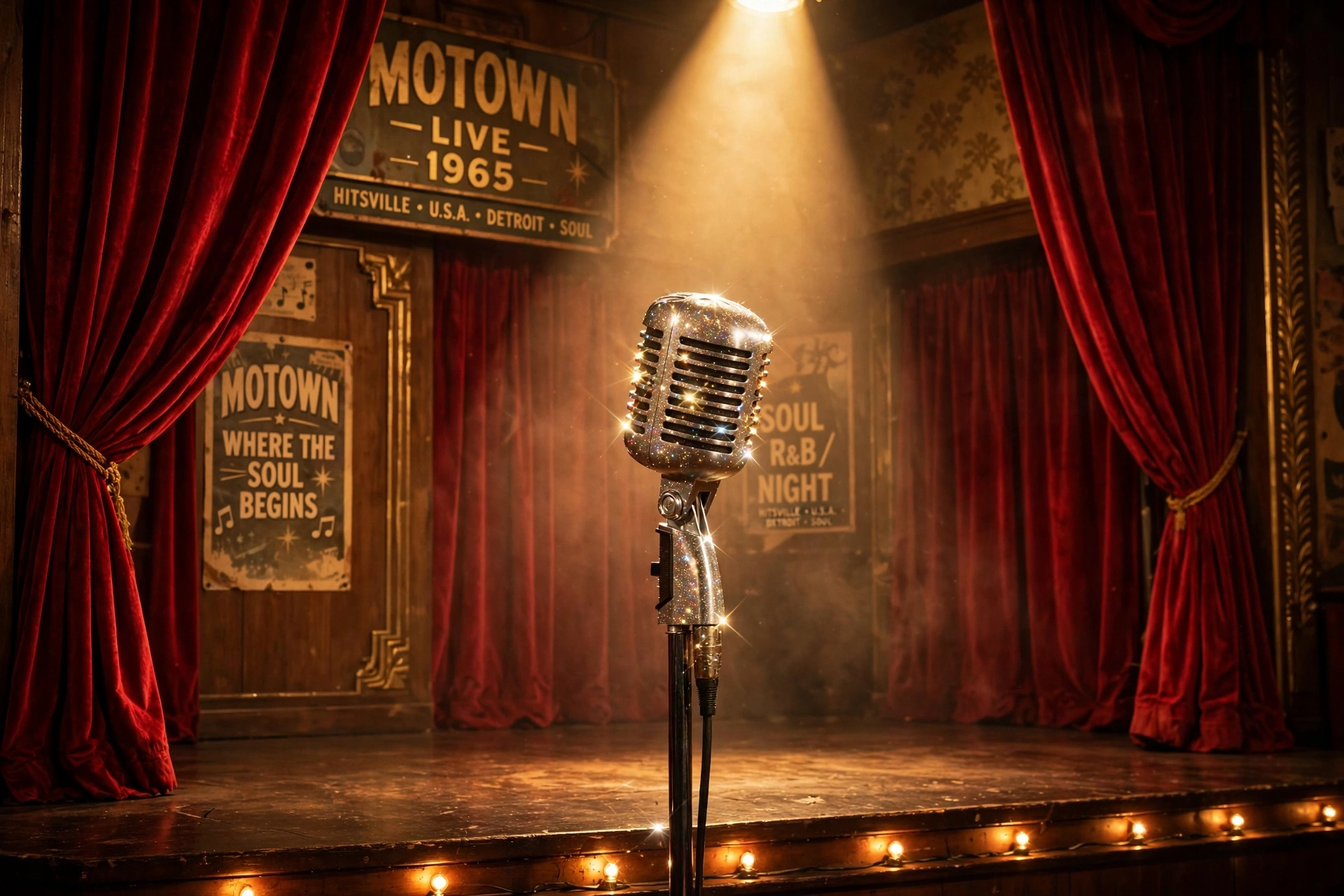
Diana Ross: The Queen of Motown, From The Supremes to Solo Stardom
There are few careers in popular music to match that of Diana Ross. As the lead singer of The Supremes, she fronted the most successful vocal group of the 1960s and helped define the sound of Motown for a generation. As a solo artist, she reinvented herself with a string of number-one hits, a celebrated film career, and a stage presence that made her one of the most recognisable entertainers in the world. Across more than six decades in the spotlight, she has sold over 100 million records, collected honours from the Grammy Awards to the Presidential Medal of Freedom, and remained a working performer into her eighties.
This article traces that remarkable journey from a Detroit housing project to the Rock and Roll Hall of Fame. It covers her childhood, the formation of The Supremes, the twelve number-one hits that made the group a phenomenon, her solo career and her acclaimed acting, and the honours that have recognised her contribution to music and culture. It is a story about talent, ambition and longevity, and about a singer who became far more than a voice on a record.
The Early Life of a Detroit Star
Diana Ernestine Earle Ross was born on 26 March 1944 in Detroit, Michigan, and she grew up in the city’s Brewster-Douglass housing projects. Detroit in the 1940s and 1950s was a city of factories and music in equal measure, and the young Ross was surrounded by both. She sang in church, listened to the radio constantly, and dreamed of a life beyond the neighbourhood where she lived. Her family later moved to the Brewster projects, and it was there, as a teenager, that she formed a singing group with friends Mary Wilson, Florence Ballard and Betty McGlown.
The group called themselves the Primettes, and they began by singing at local talent shows and school events, copying the harmonies of the girl groups they admired. Their break came when they auditioned for Berry Gordy, the founder of Motown Records, who signed them in January 1961 and renamed them The Supremes. Gordy saw something in the young lead singer that others had missed: a voice that could carry a song, and a presence that could hold a stage. The decision would change the course of popular music, and it made the teenage Ross the public face of the most successful act in Motown’s history.
Diana Ross and The Supremes
The Supremes did not become stars overnight. Their early singles sold modestly, and for two years they were known inside Motown as the “no-hit Supremes”, a nickname that reflected the frustration of a group that could not find a hit. Everything changed in 1964, when the songwriting and production team of Holland-Dozier-Holland gave them “Where Did Our Love Go”, a song that went to number one and began one of the most extraordinary runs in chart history. Over the next five years, the group scored twelve number-one singles on the American pop charts, including “Baby Love”, “Come See About Me”, “Stop! In the Name of Love” and “You Can’t Hurry Love”.
The success made The Supremes the most successful vocal group of the 1960s and one of the best-selling girl groups of all time, and it made Ross herself a star. Her voice, clear, warm and instantly recognisable, carried the group’s biggest hits, and her glamorous stage presence set the template for the modern pop diva. In 1967, the group was renamed Diana Ross and the Supremes, a change that reflected her growing prominence and hinted at the solo career that was to come. The group also broke barriers: at a time when American popular culture was still segregated in many places, The Supremes performed on television, in Las Vegas showrooms and on tour around the world, and their success helped open doors for the Black artists who followed them.
The end of the Supremes era came on 14 January 1970, when Ross gave her final performance with the group at the Frontier Hotel in Las Vegas. It was an emotional farewell, and it marked the end of a decade that had transformed her from a Detroit teenager into an international star. The group continued without her, but the story of The Supremes is, for most listeners, the story of her voice, and her departure marked the beginning of an even longer second act.
The Solo Career Begins
The solo career began immediately, and it began at the top. Her eponymous debut solo album was released in 1970 on Motown, and its first single, “Ain’t No Mountain High Enough”, became her first number-one single as a solo artist. The song’s gospel-driven arrangement and her soaring vocal made it an instant classic, and it remains one of the most beloved recordings of her career. A full account of her recordings, chart history and awards is set out on her Wikipedia page, which traces a solo career that has now lasted for more than fifty years.
The 1970s brought a run of solo hits that confirmed her status as a star in her own right. “Touch Me in the Morning” reached number one in 1973, and the album “Diana”, released in 1980, became her most successful studio album, producing the hits “Upside Down” and “I’m Coming Out”, two songs that have become permanent fixtures of popular culture. Between 1972 and 1980 she recorded four top-ten albums, and across a fifteen-year span she recorded twelve top-ten singles, six of which reached number one. Added to the twelve number-one singles she had recorded with The Supremes, that gave her a career total of eighteen American number-one singles, a figure that led the Guinness Book of World Records to name her the most successful female music artist in history in 1993.
Her solo career also showed a willingness to change with the times. She moved from the orchestral soul of her early solo records to the disco sound of the late 1970s, then to the polished pop of the 1980s, and she continued to record and tour into the twenty-first century. In 2021, Billboard ranked her the thirtieth greatest charting artist of all time on the Billboard Hot 100, a measure of a career that has spanned generations of listeners.
The Film Career and Lady Sings the Blues
Singing was only one part of her talent, and in the 1970s she proved herself as an actress as well. Her first film role was as the jazz singer Billie Holiday in “Lady Sings the Blues” (1972), a performance that won her a Golden Globe Award and earned her an Academy Award nomination for Best Actress. She was the first African-American actress to receive an Academy Award nomination for a debut film performance, and the film’s success established her as a serious dramatic actress rather than a singer trying her hand at movies.
She followed it with “Mahogany” in 1975, a romantic drama in which she played a fashion designer, and “The Wiz” in 1978, a film adaptation of the Broadway musical in which she starred as Dorothy alongside Michael Jackson. Her acting career also brought her a Special Tony Award in 1977 for her one-woman Broadway show, a production that showcased her ability to hold a theatre audience alone for an entire evening. The film work mattered because it showed a range that few pop stars of her generation possessed, and it gave her a second artistic identity to sit alongside the music.
Honours, Awards and Recognition
The list of honours accumulated across her career is one of the longest in popular music. In 1976, Billboard magazine named her the Female Entertainer of the Century, and in 1988 she was inducted into the Rock and Roll Hall of Fame as a member of The Supremes. She is one of the rare performers to have two stars on the Hollywood Walk of Fame, one as a solo artist and one as a member of The Supremes, and she has been nominated for the Grammy Award thirteen times without ever winning a competitive honour, a quirk of awards history that makes her later lifetime honours all the more fitting.
Those lifetime honours came in abundance. She received the Grammy Lifetime Achievement Award in 2012 as a solo artist, and again in 2023 as a member of The Supremes, becoming the first woman to receive the award twice. She received the Kennedy Center Honors in 2007, the American Music Awards Lifetime Achievement Award in 2017, and the Presidential Medal of Freedom in 2016, presented by President Barack Obama. Each of these honours recognised a different part of her contribution: the music, the films, the barrier-breaking, and the sheer longevity of a career that has now lasted from 1959 to the present day.
The Voice, the Style and the Influence
It is hard to overstate how influential Ross has been on the generations of singers who followed her. Her vocal style, clear and controlled, with a warmth that could turn intimate or triumphant as a song required, became a model for pop singing, and her stagecraft set the standard for the modern diva. The gowns, the choreography and the commanding presence that she developed with The Supremes were copied by countless acts, and the idea of a singer as a glamorous, larger-than-life figure owes a great deal to her example.
Her influence extends beyond music into fashion, film and culture. She was a style icon of the 1960s and 1970s, and her look, from the beehive hairstyles of the early Supremes years to the flowing gowns of her solo tours, has been referenced by designers and performers ever since. She also mattered as a symbol: a young Black woman from a Detroit housing project who became one of the most famous people in the world, at a time when that path was far harder than it is today. For many of the artists who followed, from Whitney Houston to Beyonce, she was the proof that it could be done, and the standard against which they measured themselves.
Still Performing in Her Eighties
One of the most remarkable things about her career is that it has never really stopped. She has continued to tour and perform into her eighties, playing concerts for audiences that span three generations of fans, and her live shows remain a celebration of the catalogue she built with The Supremes and as a solo artist. The songs have become part of the shared language of popular music: “Ain’t No Mountain High Enough” is played at weddings, “I’m Coming Out” is an anthem of celebration, and “You Can’t Hurry Love” is still heard on the radio more than half a century after it was recorded.
That longevity is the real measure of her achievement. Pop music is a young person’s business, and most stars fade within a decade. To remain relevant, respected and in demand for more than sixty years requires not only talent, but also discipline, adaptability and a genuine love of performing. The fact that she is still on stage, still singing the songs that made her famous, and still drawing audiences who know every word, is the best evidence of all that her place in music history is secure.
How Old Is Diana Ross?
Diana Ross was born on 26 March 1944 in Detroit, Michigan, which makes her 82 years old in 2026. She began her professional career in 1959, when she formed the Primettes with friends, and she has been active in music ever since, a career spanning more than sixty-five years. Her longevity is one of the most remarkable features of her story: she was a star of the 1960s with The Supremes, a solo star of the 1970s and 1980s, and she continues to perform in her eighties.
How Many Number One Singles Did Diana Ross Have?
Diana Ross had eighteen number-one singles on the American pop charts across her career: twelve as the lead singer of The Supremes and six as a solo artist. With The Supremes, her number-one hits included “Where Did Our Love Go”, “Baby Love”, “Stop! In the Name of Love” and “You Can’t Hurry Love”. As a solo artist, her number-one singles included “Ain’t No Mountain High Enough”, “Touch Me in the Morning”, “Upside Down” and “I’m Coming Out”. The Guinness Book of World Records named her the most successful female music artist in history in 1993 on the strength of this record.
What Films Did She Star In?
Ross’s best-known film is “Lady Sings the Blues” (1972), in which she played the jazz singer Billie Holiday. The performance won her a Golden Globe Award and an Academy Award nomination for Best Actress, making her the first African-American actress to be nominated for an Oscar for a debut film performance. She also starred in “Mahogany” (1975) and “The Wiz” (1978), in which she played Dorothy alongside Michael Jackson. She received a Special Tony Award in 1977 for her one-woman Broadway show, “An Evening with Diana Ross”.
What Awards Has She Won?
Ross has received some of the highest honours in American entertainment. She was inducted into the Rock and Roll Hall of Fame in 1988 as a member of The Supremes, received the Kennedy Center Honors in 2007, and was awarded the Presidential Medal of Freedom in 2016. She won the Grammy Lifetime Achievement Award twice, in 2012 as a solo artist and in 2023 as a member of The Supremes, becoming the first woman to receive that award twice. She also won a Special Tony Award in 1977 and a Golden Globe for “Lady Sings the Blues”, and she has two stars on the Hollywood Walk of Fame.
Is She Still Performing?
Yes, Ross continues to perform and tour in her eighties, playing concerts for audiences that span several generations of fans. Her live shows celebrate the catalogue she built with The Supremes and as a solo artist, from “Where Did Our Love Go” to “Ain’t No Mountain High Enough” and “I’m Coming Out”. She has been active in music since 1959, and her career of more than six decades is one of the longest in popular music history.
What Is Her Most Famous Song?
It is difficult to choose a single most famous song from a catalogue as large as hers, but “Ain’t No Mountain High Enough” is the strongest candidate. Released in 1970 as her first solo single, it became her first solo number-one hit and remains her signature song, played at weddings, in films and at celebrations around the world. Other contenders include “Upside Down” and “I’m Coming Out” from her 1980 album “Diana”, and the Supremes classics “Where Did Our Love Go”, “Baby Love” and “Stop! In the Name of Love”.
Conclusion
The career of Diana Ross is one of the great stories of popular music. From a Detroit housing project to the top of the charts with The Supremes, from a solo career that produced some of the most enduring songs of the twentieth century to an acting career that earned her an Oscar nomination, she has done more, and lasted longer, than almost any of her contemporaries. Her eighteen number-one singles, her induction into the Rock and Roll Hall of Fame, her two Grammy Lifetime Achievement Awards and her Presidential Medal of Freedom are the formal record of that achievement. The real record, though, is in the songs themselves, which are still sung, still danced to and still loved more than sixty years after she first stepped onto a stage. That is a legacy that few artists in history can match.
For more celebrity profiles and entertainment guides, take a look at our guide to rugby positions.