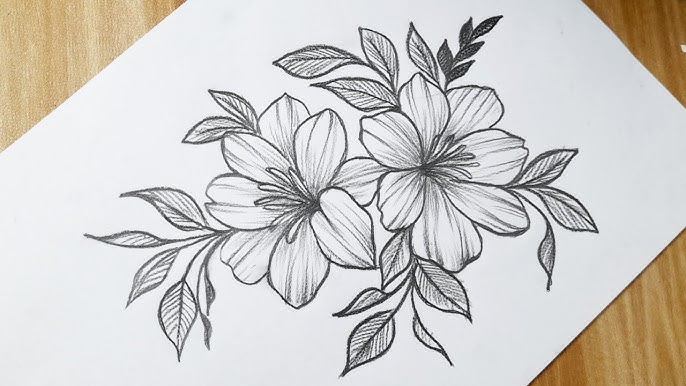
Introduction to Flower Drawing
Flower drawing is one of the most accessible and enjoyable forms of art for beginners because it combines simple shapes with natural beauty. It allows artists to observe real-world objects closely and translate them into sketches using basic techniques. Whether you are drawing for relaxation, practice, or creative expression, flower drawing helps develop patience, focus, and visual understanding of forms and proportions. It is also widely used in sketchbooks, design work, and illustration practice.
In modern art learning, flower drawing is often recommended as a starting point because it builds strong foundational skills. Beginners can learn how petals curve, how symmetry works, and how light affects natural objects. Many artists also find flower drawing therapeutic, as it encourages slow observation and mindful sketching. This makes it not just a technical skill but also a calming creative activity that improves both artistic ability and mental focus over time.
Essential Tools and Drawing Setup
To begin flower drawing effectively, having the right tools can make a significant difference in your results. A basic set of pencils ranging from HB to 6B is ideal for sketching outlines and adding shading depth. A smooth sketchbook allows better control of lines, while a good eraser helps refine shapes without damaging the paper. Optional tools such as blending stumps or fine liners can enhance detailing and make your flower sketches more polished and realistic.
Setting up your drawing space also plays an important role in improving focus and consistency. A well-lit area, preferably with natural light, helps you observe shapes and shadows more accurately. Beginners often benefit from keeping reference images or real flowers nearby while practicing. This allows you to understand structure and detail more clearly. A clean, distraction-free environment ensures better concentration, which is essential for improving flower drawing skills over time.
Understanding Basic Shapes for Flower Drawing

Every flower drawing starts with simple shapes that form the foundation of the structure. Circles, ovals, and lines are used to map out the placement of petals, stems, and centers. By breaking complex flowers into basic forms, beginners can maintain proportion and avoid distortion. This method is widely used in professional sketching because it simplifies even the most detailed flowers into manageable steps.
Once basic shapes are established, they act as a guide for building more detailed structures. Petals can be layered around a circle, while stems can follow curved or straight guidelines depending on the flower type. This approach makes it easier to maintain symmetry and balance in your drawing. Practicing this technique regularly helps beginners develop strong observational skills and improves their ability to draw more complex floral designs with confidence.
Step-by-Step Flower Drawing Method
The step-by-step approach in flower drawing begins with outlining the basic structure using light pencil strokes. Start with simple shapes like circles for flower centers and oval forms for petals. Once the structure is in place, gradually refine the shape by adding petal edges and adjusting proportions. This slow progression ensures that the drawing remains balanced and realistic, even for beginners who are still developing control over their pencil work.
After establishing the outline, the next stage involves adding depth and detail. This includes defining petal curves, adjusting symmetry, and refining the stem and leaves. Shading begins lightly and is gradually built up to create dimension. Observing how light falls on real flowers helps in creating more natural-looking results. This step-by-step method is widely used in botanical illustration because it ensures accuracy while allowing creative expression in flower drawing.
How to Draw Popular Flowers
Learning how to draw specific flowers improves both skill and creativity. Roses, lilies, daisies, sunflowers, and tulips are among the most popular choices for beginners. Each flower has a unique structure that teaches different techniques. For example, roses help with layered petal drawing, while sunflowers focus on symmetry and pattern repetition. Lilies and tulips are excellent for understanding elongated shapes and natural flow in petals.
Practicing different flowers also helps artists build versatility in their drawing style. By studying how each flower is structured, beginners learn how to adapt basic shapes into more complex designs. For instance, daisies are simple and perfect for practicing clean outlines, while sunflowers require attention to texture in the center. This variety strengthens overall flower drawing ability and builds confidence in handling different botanical forms.
Common Mistakes and Practice Tips
One common mistake in flower drawing is focusing too much on outlines without understanding structure. Beginners often rush into detailing without properly setting up basic shapes, which leads to uneven or unrealistic sketches. Another issue is over-shading, which can make drawings look heavy and lose natural softness. Learning to balance light pencil work with gradual shading is essential for improving quality.
To improve flower drawing skills, consistent practice is more important than perfection. Drawing simple flowers daily helps develop muscle memory and better control of lines. It is also helpful to study real flowers or high-quality references to understand natural variations. Practicing different angles and flower types ensures steady improvement. Over time, these small efforts lead to noticeable progress in both accuracy and artistic confidence.
Frequently Asked Questions (FAQ)
Many beginners ask how long it takes to improve in flower drawing. The answer depends on consistency rather than talent. With daily practice, noticeable improvement can be seen within a few weeks. Another common question is whether expensive tools are necessary. The truth is that basic pencils and paper are enough for learning; advanced tools only enhance results later.
Another frequently asked question is which flower is easiest to draw for beginners. Simple flowers like daisies and tulips are usually recommended because they have fewer petals and simpler structures. Beginners also ask whether tracing helps learning. While tracing can help understand shapes initially, true improvement comes from practicing freehand drawing. Regular observation, patience, and repetition are the key factors that lead to strong flower drawing skills over time.
You may also read: How to Find Rare Books and Build a Collection