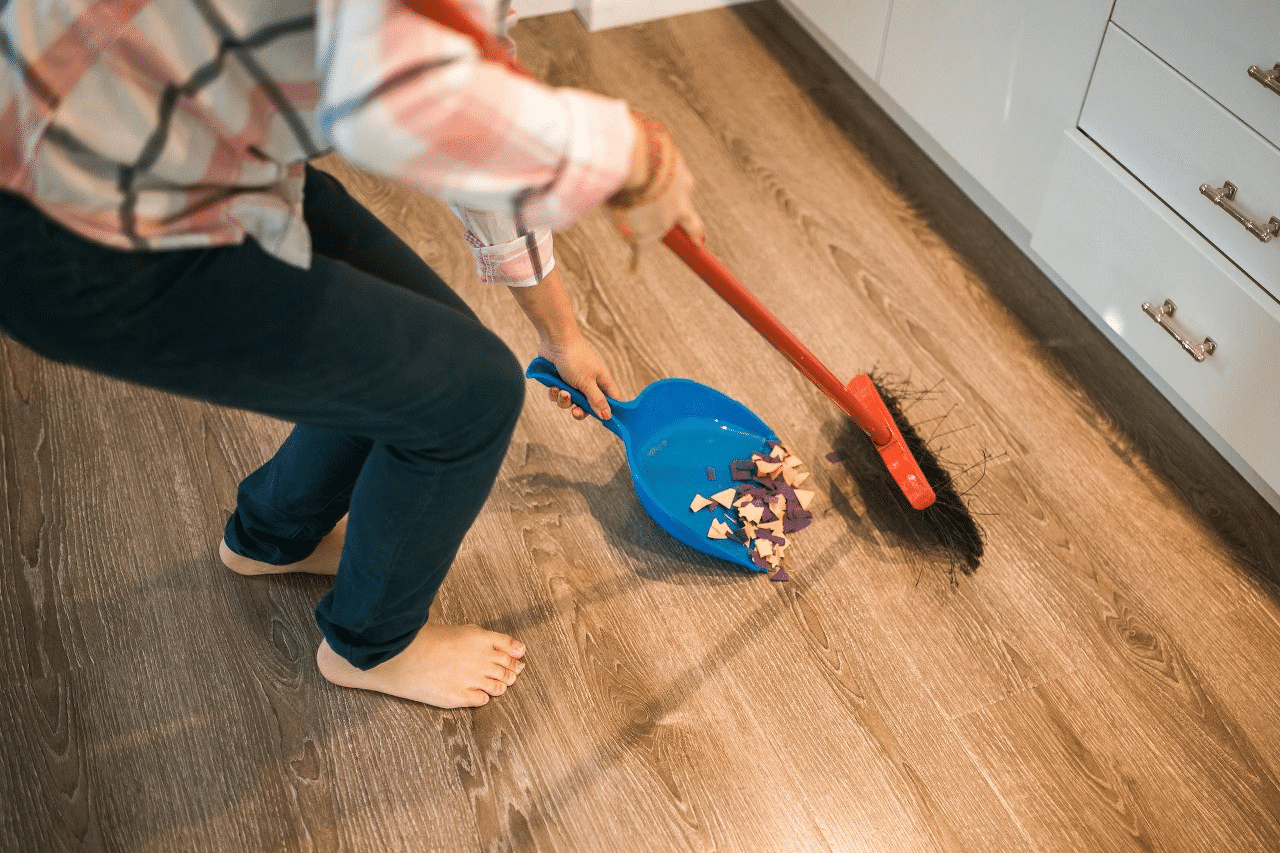
Corners and edges constitute a disproportionate amount of cleaning problems and re-work. Floor space is generally easy to clean and most floor cleaning tools can easily be used to clean open floor areas. However, ninety degree junctions between walls and floors and behind door stops and along the bottom of fixed displays, etc. Are extremely problematic areas where dirt and grime tend to accumulate and where failure during inspections is commonly found.
Typically, solving edge and corner problems is not more work than it takes to open up a floor area. Simply using the correct tools for cleaning floors and otherwise maintaining those tools (keeping them clean, etc.) will solve most problems related to cleaning edges and corners.
Why standard sweeping fails at the perimeter
Conventional flat broom heads turn corners badly because they are contacted by the bristles on either side of the point of contact and splay outward. As a result, the effective sweeping width at corners is dramatically reduced from that found in open floor areas and operators are forced into stabbing at corners to try and collect debris. However, this practice causes bristle damage and leads to them becoming figure-of-eight shaped and to be able to spread fine dust instead of collecting it.
Edge work, the baseboards, skirting and cove base of the building, is another matter altogether. Although a standard broom head appears to be a planar surface it in fact contacts the floor at a single point. If the bristles on either side of this point are not angled such that they sweep into the small vertical rebate of a baseboard, they will splay outward from the corner and be of little use in terms of picking up debris.
Diagnosing the problem on your own floors
Try running a dry microfiber cloth along a couple of feet of baseboard after your normal sweep. If the cloth becomes soiled with grit then the technique at edges is clearly a problem area. However if all that is picked up is a very fine gray powder then this is likely to be airborne settling and is a problem of filtration and frequency of cleaning rather than of sweeping.
Technique that reaches into the angle
The sequence of cleaning also needs to be planned and executed faster than walking to and from the cleaning store. The perimeter of a room needs to be cleared first to prevent being walked over by spoil that has been left in paths. Once the perimeter has been swept then the main body of the room can be swept towards a central point and then the dirt swept up in a dustpan.
- Start at the corner furthest from the exit and work the two walls that meet there.
- Hold the broom at roughly forty five degrees to the wall so the bristle tips, not the side of the head, engage the junction.
- Use short pulling strokes toward yourself rather than long pushing strokes, which fling grit back under equipment.
- Collect in small batches. Large piles shed fines when moved.
- Finish with a damp edge wipe on hard surfaces where dust film is visible.
Working around fixed obstacles
For objects such as equipment legs, cable tray or plinth details, decide whether these will ever be cleanable and seal the gap if necessary. A 20mm gap under fixed objects will never get cleaned with sweeping only. Clear closure strips or schedule out an occasional pull-out deep clean. This will not get cleared with normal weekly sweeping.
Choosing tools for angled access
Many tools can sweep open floor but none are better than others. Brooms with an angled head (with tapered end bristles) are better than others for corner work. Brushes with split tip bristles are very good at collecting fine dust whilst solid bristle brushes are better at larger grit and liquid debris.
| Tool type | Best suited to | Main limitation |
| Angled broom, split tip | Indoor hard floors, fine dust, baseboard edges | Poor on wet or heavy debris |
| Straight stiff bristle push broom | Open warehouse floor, coarse debris | Ineffective at corners |
| Corner brush or radiator brush | Tight angles, behind fixed equipment | Slow over any distance |
| Vacuum with crevice tool | Fine powder, allergen control, textured floors | Cost, cable management, noise |
Matching the dustpan to the broom
Dustpans and brooms must match well. An inappropriate pan often spoils good sweeping. The upper edge of the pan should lie flat on the floor, without sagging. The width of the pan should be at least as wide as the head of the broom, ideally slightly wider. If you are buying rather than pairing up odd items, a precision angle broom and dustpan set is worth the money because the angle of the broom sweeps the whole corner and leaves no space for the familiar thin line of dust.
Maintenance that preserves bristle geometry
Bristles lose their angle long before they wear out and then have to be thrown away. Typically, this is caused by the broom being stored standing up on its head for weeks, after which the angle of the bristles will have taken a permanent set and be useless for sweeping corners.
- Hang brooms by the handle, bristles clear of the floor.
- Comb out embedded hair and fiber weekly with a stiff plastic comb.
- Rinse in warm water with mild detergent, then dry bristles down, never near a heater.
- Replace when bristle tips are visibly rounded or the head has splayed beyond the handle line.
Setting a replacement trigger
Instead of swapping out brooms based on a set time frame, observe how well the bristles are picking up a line after you have run flour along the baseboard of a wall. If it takes more than two strokes to pick up a line of flour then the bristles have lost their edge. Mark this observation in your regular equipment check list.