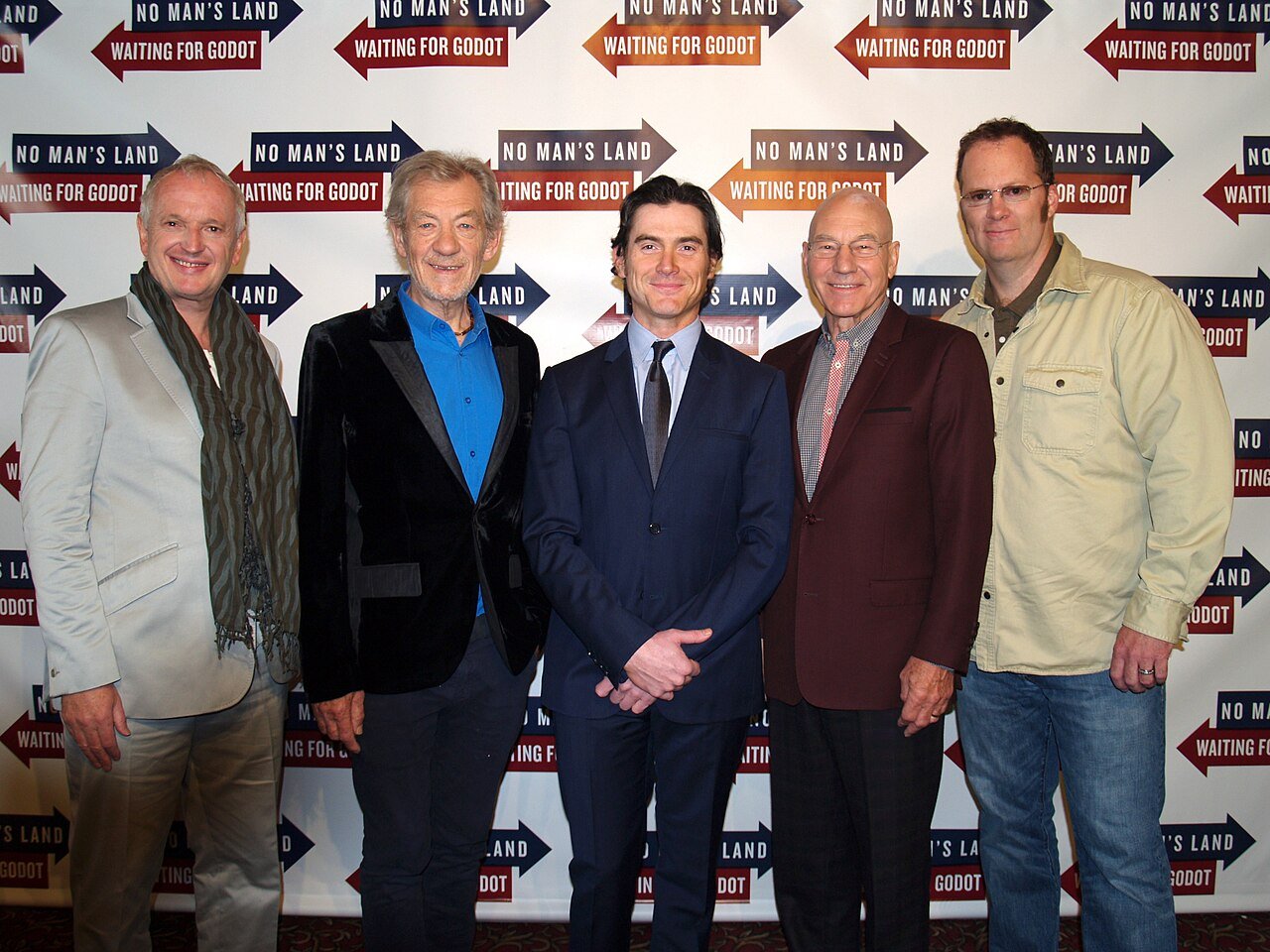
On screen, they were sworn enemies. One could move metal with a thought and wanted mutants to fight for their place in the world. The other could read minds and believed that humans and mutants could live side by side in peace. Yet away from the cameras, Ian McKellen and Patrick Stewart were close friends, fellow knights, and two of the finest stage actors Britain has ever produced. Two northern boys who loved Shakespeare, they became global stars in their sixties.
That friendship has now taken on a sadder meaning. Patrick Stewart died on 28 October 2026 at his home in Los Angeles, aged 86, after what his family described as a brief journey with Alzheimer’s disease and Lewy body dementia. The news, announced the following day, brought tributes from across theatre, television and film. For Ian McKellen, it meant the loss of a friend he had known since their early days at the Royal Shakespeare Company.
Two Northern Boys Who Found the Stage
McKellen and Stewart came from strikingly similar beginnings. McKellen was born Ian Murray McKellen on 25 May 1939 in Burnley, Lancashire, and grew up largely in Wigan. Stewart was born Patrick Hewes Stewart on 13 July 1940 in Mirfield, in the West Riding of Yorkshire, the youngest of three sons in a working-class family. Neither came from money or theatrical connections. Both found acting through school productions and local theatre.
McKellen won a scholarship to St Catharine’s College, Cambridge, where he studied English literature and acted in more than twenty plays. He made his professional stage debut in 1961 at the Belgrade Theatre in Coventry, and his first West End appearance followed in 1964. Stewart left school at fifteen and trained at the Bristol Old Vic Theatre School. He made his first professional appearance in 1959, joined the Royal Shakespeare Company in 1966, and stayed with the company until 1982. McKellen, too, became a mainstay of the Royal Shakespeare Company and the National Theatre during the 1970s.
Ian McKellen: From Shakespeare to Gandalf
By the time most filmgoers first noticed him, McKellen had already won a Tony Award for his performance as Antonio Salieri in Amadeus on Broadway in 1980, along with several Laurence Olivier Awards. He had also earned an Academy Award nomination for playing the film director James Whale in Gods and Monsters in 1998. His worldwide fame arrived almost all at once at the turn of the century.
In 2000 he played Magneto in X-Men, and in 2001 he appeared as Gandalf in The Lord of the Rings: The Fellowship of the Ring. He returned as Gandalf in the remaining Lord of the Rings films in 2002 and 2003, and again in The Hobbit trilogy from 2012 to 2014. He also returned as Magneto in X2 in 2003, X-Men: The Last Stand in 2006, and X-Men: Days of Future Past in 2014. Off screen, he came out publicly in 1988 and co-founded the gay rights charity Stonewall in 1989. He was knighted in the 1991 New Year Honours for services to the performing arts.
Patrick Stewart: From the RSC to the Starship Enterprise
Stewart’s path to fame took longer, and when it came, it came from an unexpected direction. After sixteen years with the Royal Shakespeare Company, he was cast in 1987, at the age of forty-seven, as Captain Jean-Luc Picard in Star Trek: The Next Generation. He was a bald, middle-aged Shakespearean actor taking command of a starship in an American science-fiction series, and the early reaction from some fans was sceptical. Within a few seasons, however, Picard had become one of the most respected captains in popular culture.
The series ran for seven seasons, from 1987 to 1994, and Stewart carried the role into four feature films between 1994 and 2002. He later returned as Picard in Star Trek: Picard, which ran for three seasons from 2020 to 2023. His best-known command, “Make it so,” later gave its title to his memoir, Making It So, published in 2023. He was appointed an Officer of the Order of the British Empire in 2001 and knighted in the 2010 New Year Honours for services to drama.
Magneto and Professor X: Enemies on Screen, Friends Off It
The X-Men films gave the two men their most famous shared screen roles. Stewart played Professor Charles Xavier, the telepath who founded a school for young mutants and believed in peaceful coexistence. McKellen played Erik Lehnsherr, known as Magneto, a Holocaust survivor who had lost faith in humanity and believed mutants must protect themselves by force. Their characters had once been friends, and that history gave their arguments a painful weight, because every scene carried the sense of two old friends who had chosen different paths. Stewart brought stillness and moral clarity to Xavier, while McKellen brought charm, anger and a deep sense of hurt to Magneto, and audiences who had never read an X-Men comic could follow the argument at once.
Waiting for Godot and No Man’s Land on Broadway
If the X-Men films made them famous together, the stage made them friends. They had known each other since at least the 1970s, when both were working at the Royal Shakespeare Company, and they first appeared on stage together in 1977. Their most celebrated collaboration came much later, when they starred together in Samuel Beckett’s Waiting for Godot in London’s West End in 2009. Directed by Sean Mathias, it was a great success. In the play, Stewart played Vladimir and McKellen played Estragon, two tramps waiting by a roadside for a mysterious figure called Godot who never arrives.
In 2013 they took the production to Broadway, where they performed it in repertory with Harold Pinter’s No Man’s Land at the Cort Theatre in New York. Previews began on 26 October 2013, the official opening was on 24 November, and the limited season ran until 30 March 2014. The two plays alternated, with Billy Crudup and Shuler Hensley joining the cast. In No Man’s Land, Stewart played Hirst, a successful writer, and McKellen played Spooner, a failed poet who arrives at his home and unsettles him. After the final performance of Godot, McKellen was reported to have wept in the wings, heartbroken that the run was over.
Two Knights, One Friendship
There is a pleasing symmetry to their honours. McKellen was knighted in 1991, almost twenty years before Stewart received the same honour in 2010, and both were recognised for services to drama. The friendship deepened over the years in ways that went beyond work. In September 2013, McKellen officiated at Stewart’s wedding to the singer-songwriter Sunny Ozell, having been ordained for the occasion. Stewart spoke openly in his memoir about a childhood shadowed by domestic violence and poverty, and about how the stage had given him a safe place as a boy. He became a campaigner for survivors of domestic abuse and a supporter of human rights, refugees and animal welfare
Recent Work and a Final Return
Neither man slowed down in the way people expected. McKellen continued to take on demanding stage roles well into his eighties. In June 2024, while playing Falstaff in Player Kings at the Noel Coward Theatre in London, he fell from the stage during a fight scene and fractured his wrist. He withdrew from the rest of the run on medical advice, but he recovered and returned to work. He was due to return as Magneto in Avengers: Doomsday, scheduled for release on 18 December 2026. Stewart, too, had filmed his return as Professor X for Avengers: Doomsday before his death, and the film is now set to stand as his final screen appearance, a fitting, if bittersweet, coda.
Why Their Partnership Endures
Part of the appeal of McKellen and Stewart is that they make excellence look like friendship. Audiences love watching people who clearly enjoy working together, and these two never hid that enjoyment. Whether they were arguing as Xavier and Magneto, waiting as Vladimir and Estragon, or posing for photographs in bowler hats in New York, they seemed to be having the time of their lives. Both men came from ordinary northern families, worked hard for decades, and found their greatest fame late in life. McKellen was sixty-one when the first X-Men film was released, and Stewart was fifty-nine.
Ian McKellen and Patrick Stewart will be remembered as Magneto and Professor X, as Gandalf and Captain Picard, and as Vladimir and Estragon. They will also be remembered as two friends who shared a lifetime in the theatre and brought the best out of each other. Stewart’s death in October 2026 has given that partnership a final, poignant chapter, but it has not diminished it. Like the best British screen pairings, from Hugh Grant and Colin Firth to the great stage partnerships of the past, theirs was built on trust, talent and time, and it will be remembered long after the final curtain has fallen.