
You hear it at almost every NHS weigh-in: one figure in kilograms, quickly followed by stones and pounds. That dual readout is standard practice, and with NHS weight-loss services expanding across England through 2026, the kg-to-stone conversion matters more now than it has in years.
What’s new in 2026: the kg-to-stone chart is back in the spotlight
The biggest reason this conversion is front of mind again is the NHS rollout of GLP-1 weight-loss medicines. NHS England is offering the drugs in phases, reaching 220,000 people between 2025 and 2028.
Access has been uneven so far. Months after Mounjaro’s introduction, less than half of England had NHS access to the injection.
Demand is the other headline. A December 2024 poll found 22% of UK adults would use a weight-loss drug if it were available on NHS prescription, and GP prescribing of semaglutide and tirzepatide climbed sharply through 2024–2025.
The scale of the problem explains the rush. An estimated 64% of adults in England were overweight or living with obesity in 2023, with that figure projected to reach around 7 in 10 people by 2040. NICE now recommends tirzepatide for adults with a BMI of 35 or above plus at least one weight-related condition.
For every patient starting these programmes, weight gets measured, recorded and discussed. In Britain, that discussion still happens in stones and pounds — which is why an accurate conversion chart is so useful right now.
Kg to Stone and Pounds NHS Conversion Chart
The table below follows the standard NHS conversion method, using exact values and the rounding conventions commonly used in UK healthcare.
| Kilograms (kg) | Stones (st) | Pounds (lb) |
| 50 kg | 7 st | 12 lb |
| 55 kg | 8 st | 9 lb |
| 60 kg | 9 st | 6 lb |
| 65 kg | 10 st | 3 lb |
| 70 kg | 11 st | 0 lb |
| 75 kg | 11 st | 11 lb |
| 80 kg | 12 st | 8 lb |
| 85 kg | 13 st | 5 lb |
| 90 kg | 14 st | 2 lb |
| 95 kg | 14 st | 13 lb |
| 100 kg | 15 st | 10 lb |
| 105 kg | 16 st | 7 lb |
| 110 kg | 17 st | 4 lb |
Note:
- 1 stone = 14 pounds
- 1 stone = 6.35 kilograms
- NHS charts typically round pounds to the nearest whole number for readability
This format mirrors how weight is displayed in clinical charts, BMI assessments, and patient-facing NHS materials.
Why the NHS Uses Both Kilograms and Stones
Although the metric system is the official standard for medical records in the UK, the NHS continues to display weight in stones and pounds alongside kilograms. This is done for clarity, inclusivity, and patient understanding.
Many patients:
- Know their weight only in stones and pounds
- Use home scales set to imperial units
- Find stones easier to interpret when tracking progress
By presenting weight in both formats, NHS professionals make sure patients can understand, discuss, and monitor their health accurately without confusion.
Research on how clinicians talk about weight supports this approach. Studies across the UK, USA and Australia found that patients rate “weight” and “BMI” as the most preferred and least offensive terms, while “fatness” was the least desirable word on offer.
Understanding the Weight Units Used in the UK
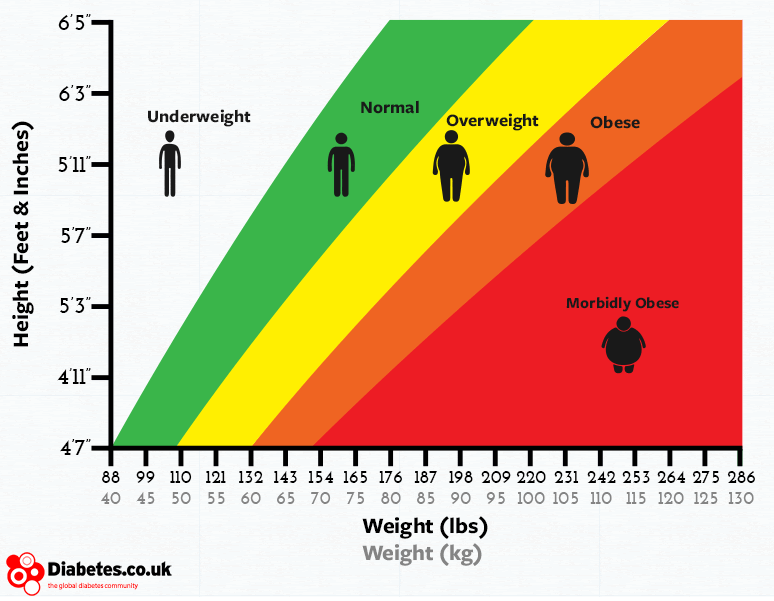
Kilograms (kg)
Kilograms are the internationally recognised unit for body weight and are used in:
- Medical records
- BMI calculations
- Growth charts
- Clinical assessments
Stones and Pounds (st & lb)
Stones and pounds are part of the imperial system and remain deeply rooted in UK culture. A weight such as 11 st 4 lb is immediately meaningful to most people in Britain, even if the clinical record stores the same value in kilograms.
The kg to stone and pounds NHS method ensures consistency between these two systems.
How to Convert Kg to Stone and Pounds
The NHS conversion method uses a two-step calculation:
Convert kilograms to stones
Divide the weight in kilograms by 6.35
Convert the remainder to pounds
Multiply the decimal remainder by 14
Example — convert 70 kg:
- 70 ÷ 6.35 = 11.02 stones
- 0.02 × 14 = 0.28 pounds
Result:
70 kg = 11 stone 0 pounds (rounded)
This approach matches NHS charts and avoids the rounding errors that can affect BMI or long-term tracking.
How the NHS Uses Weight Conversions in Practice
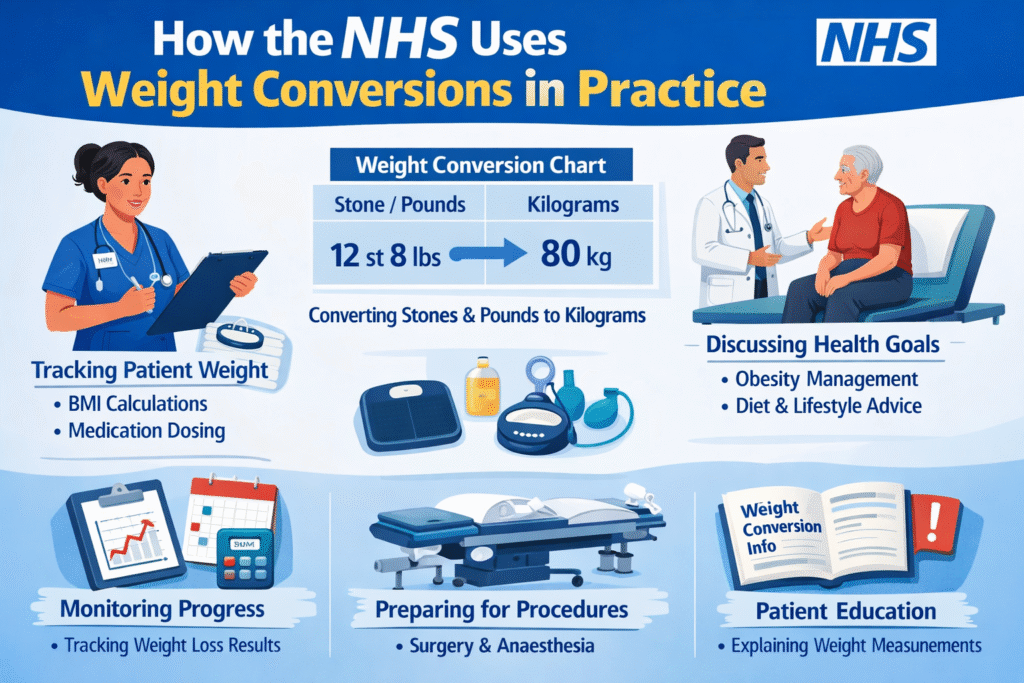
The kg to stone and pounds NHS format appears in many real-world healthcare scenarios:
BMI Calculations: Weight may be measured in kilograms but discussed in stones when results are explained to patients.
Pregnancy Weight Monitoring: Midwives often record weight in kilograms while showing progress in stones and pounds for clarity.
Child and Adult Growth Tracking: Parents and patients can easily understand charts when weights are displayed in familiar units.
Weight-Management Programmes: Progress is often discussed in stones lost or gained, even when the underlying calculations are metric-based.
Kg to Stone and Pounds NHS Calculators
Beyond printed charts, many NHS-aligned tools convert weight instantly. These calculators use the same formulas as clinical charts and appear in:
- NHS online tools
- GP systems
- Health apps
- Fitness trackers configured for UK users
When choosing a calculator, make sure it uses:
- 1 kg = 2.20462 pounds
- 1 stone = 6.35 kilograms
Using approximate values can cause small but cumulative inaccuracies.
Accuracy, Rounding, and Consistency
NHS charts prioritise clarity over excessive decimal precision. Internal systems may store weights to several decimal places, but patient-facing charts usually round to the nearest pound.
To track weight accurately:
- Use the same method consistently
- Avoid switching between calculators
- Refer to NHS-style charts where possible
Consistency matters more than tiny numerical differences.
Common Kg to Stone and Pounds NHS Conversions
- 56 kg → 8 st 11 lb
- 62 kg → 9 st 11 lb
- 68 kg → 10 st 10 lb
- 74 kg → 11 st 9 lb
- 82 kg → 12 st 13 lb
- 98 kg → 15 st 6 lb
These values match NHS-standard rounding conventions.
Conclusion
The kg to stone and pounds NHS system exists to ensure clarity, accuracy, and accessibility in UK healthcare. By combining precise metric measurement with familiar imperial units, the NHS makes weight information easier to understand and more meaningful for patients.
Whether you’re checking your BMI, tracking weight during pregnancy, or reviewing health records, using an NHS-aligned conversion chart keeps your numbers accurate, consistent, and easy to interpret. With the chart and guidance above, you can convert weight confidently and stay aligned with UK healthcare standards.
Frequently Asked Questions
What is 56 kg in stone and pounds NHS format?
56 kg is approximately 8 stone 11 pounds using NHS conversion standards.
Does the NHS officially use stones?
Medical records are stored in kilograms, but stones and pounds are commonly used alongside kg for patient communication.
Are NHS weight charts available to download?
Yes, many NHS services provide printable or digital conversion charts for clinical and public use.
Is the conversion method the same for adults and children?
Yes. The formula is the same, though children’s assessments also use age-specific growth percentiles.
Why not just use kilograms only?
Because many patients understand stones better, using both units improves communication and reduces misunderstanding.
You may also read:
BMI Chart: What’s a Healthy Weight Range for Your Height and Age?
Spotify Web Player Login – Open & Listen to Free Music Online (2026 Guide)