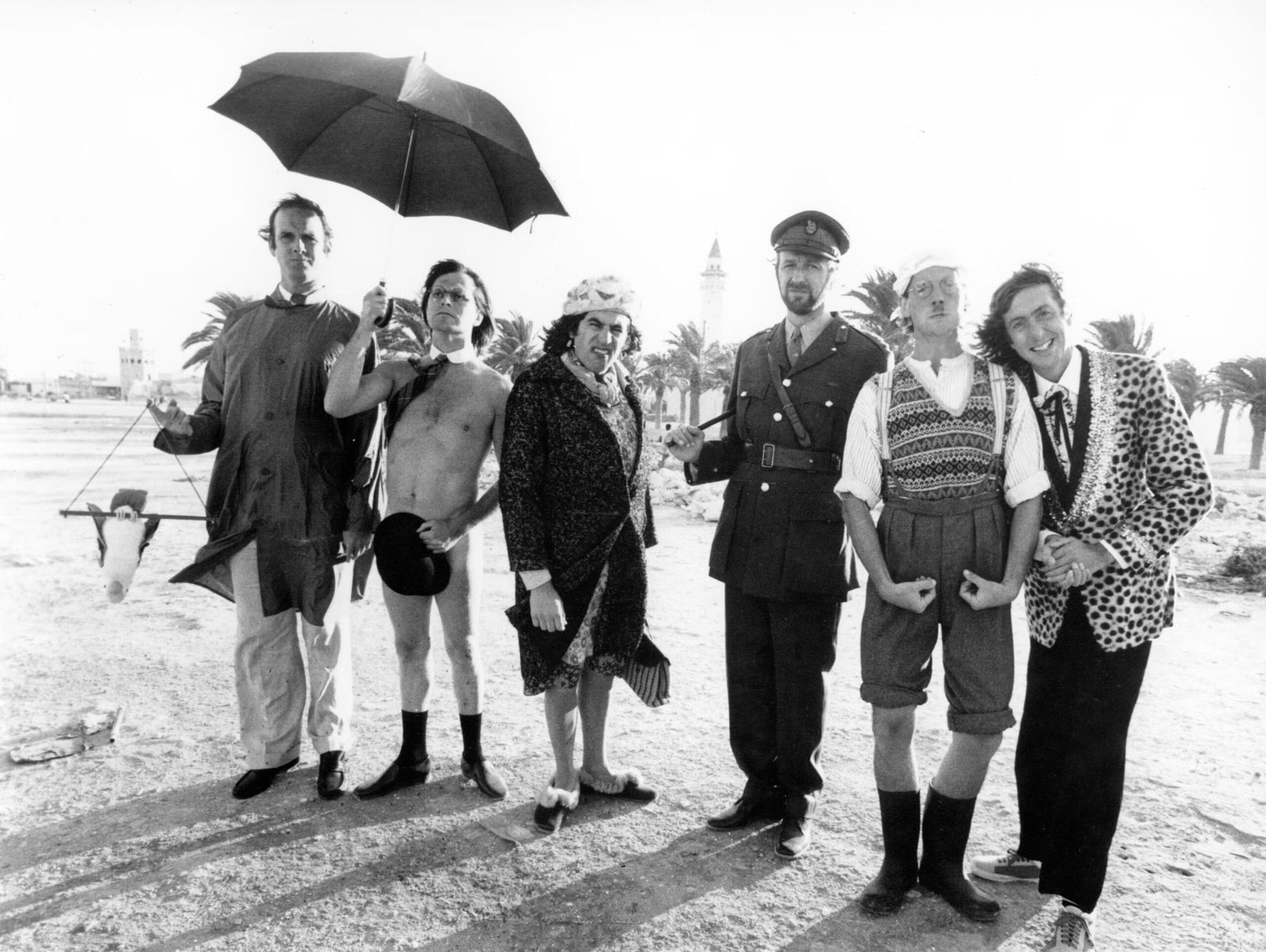
They met as students at Oxford, two young men who liked the same jokes, and they stayed friends for more than fifty years. One became the most travelled man on British television. The other became a film director, a medieval historian and a children’s author. Together, Michael Palin and Terry Jones helped create Monty Python, the comedy troupe that changed British humour for ever, and they wrote together, performed together and argued together from their first student revue until Jones’s death in 2020. Palin called him, in his tribute, one of his closest and most valued friends, and the complete Renaissance comedian. It was a partnership built on affection and curiosity, and it produced some of the funniest work Britain has ever seen.
Two students at Oxford
Michael Edward Palin was born on 5 May 1943 in Ranmoor, Sheffield, the second child and only son of an engineer father and a mother from a military family. He was educated at Birkdale School in Sheffield and then at Shrewsbury School, and in 1962 he went up to Brasenose College, Oxford, to read modern history. He had been acting since he was a small boy, and at Oxford he joined the Oxford Revue, the university’s comedy troupe.
Terence Graham Parry Jones was born on 1 February 1942 in Colwyn Bay, in north Wales, and was a year ahead of Palin at Oxford, where he read English. The two men met in the Oxford Revue and began writing together, and they discovered that they shared the same comic instincts: a love of the absurd, a distaste for the obvious joke, and a willingness to work hard at being silly. After graduating, they wrote together for the comedian Ken Dodd, for The Frost Report and for the children’s series Do Not Adjust Your Set, and they appeared together in the sketch show Twice a Fortnight in 1967.
The Pythons
In 1969, the BBC asked John Cleese and Graham Chapman to make a comedy series, and Cleese wanted Palin in it. Palin suggested bringing Jones, Eric Idle and the American animator Terry Gilliam along, and the six men became Monty Python. The first episode of Monty Python’s Flying Circus went out on 5 October 1969, and the series ran for four series and forty-five episodes until December 1974. It was unlike anything on television: sketches that flowed into one another without punchlines, animated interludes, historical parodies, songs about lumberjacks and dead parrots, and a complete refusal to explain the joke.
Jones was largely responsible for that structure. He believed that a sketch should not end with a punchline but should simply run into the next one, like a river, and he directed the troupe’s performances with a firm hand. Palin, meanwhile, became one of the group’s most popular performers, playing characters who were by turns genial, manic and completely unhinged: the lumberjack who wants to be a lumberjack, the pet shop owner who insists a dead parrot is resting, the cheese shop proprietor, the game show host Mr Anchovy, the bicycle repairman. He and Jones usually wrote together, complementing the Cleese and Chapman partnership, and their sketches had a distinctive warmth: silly, but never cruel.
The films
When the television series ended, the Pythons moved into films, and Jones became their director. He co-directed Monty Python and the Holy Grail with Terry Gilliam in 1975, a low-budget medieval farce that became one of the most quoted films ever made, and then directed the next two films on his own: Monty Python’s Life of Brian in 1979, a satire about a man mistaken for the Messiah, and Monty Python’s The Meaning of Life in 1983. Palin co-wrote and starred in all three, and his performances in them, from the stuttering Dennis the peasant to the cheerfully murderous Mr Creosote’s waiter, are among the funniest in British cinema.
The two men also worked together outside Python. They co-created and co-wrote Ripping Yarns, an anthology series of parodies of boys’ adventure stories that ran from 1977 to 1979, with Palin starring and Jones writing alongside him. Jones wrote an early draft of Jim Henson’s film Labyrinth in 1986 and is credited with the screenplay. Palin, meanwhile, was building a film career of his own: he starred in Gilliam’s Jabberwocky in 1977, and in 1988 he won the BAFTA for best supporting actor for A Fish Called Wanda, the heist comedy in which he played Ken, a stuttering animal lover who tries to kill a witness and keeps getting the wrong person. It was the biggest hit of his film career, and it showed what audiences already knew: Palin could be funny and heartbreaking in the same scene.
The traveller and the historian
After Python, the two friends went in different directions, and both found a second career. Palin’s began almost by accident. In 1980 he presented an episode of the BBC series Great Railway Journeys of the World, and in 1989 he was asked to retrace the journey of Phileas Fogg for Around the World in Eighty Days. The series was a huge success, and it led to a string of travel documentaries that made him a household name: Pole to Pole in 1992, Full Circle in 1997, a journey through the Sahara in 2002, the Himalayas in 2004, Brazil in 2012 and North Korea in 2018. He wrote a book to go with each journey, and he became the most trusted traveller on television: curious, courteous and genuinely interested in the people he met.
Jones’s second career was just as remarkable, and just as unlike anyone else’s. He became a respected medieval historian, writing books and presenting television documentaries about the period, and he was a prolific children’s author. He directed the film Erik the Viking in 1989 and a television adaptation of The Wind in the Willows in 1996. In 2016 he received a lifetime achievement award at the BAFTA Cymru Awards for his contribution to television and film. He was, as Palin put it, a Renaissance man: a writer, director, presenter, historian, children’s author and the warmest company anyone could wish for.
The reunion and the farewell
In July 2014, more than three decades after their last live performance, the five surviving Pythons reunited for ten nights at the O2 Arena in London, in a show called Monty Python Live (Mostly). It was a triumph, a victory lap for a troupe that had not performed together since 1980. But during the run, Palin noticed that Jones was struggling, for the first time, to remember his lines. Two years later, Jones’s family announced that he had been diagnosed with frontotemporal dementia, a rare form of the disease that gradually robbed him of the ability to speak and write. By September 2016 he could no longer give interviews.
Jones died on the evening of 21 January 2020, at his home in London, with his wife Anna Soderstrom by his side. He was seventy-seven. Palin’s tribute was immediate and heartfelt: Terry was one of my closest, most valued friends, he said, kind, generous, supportive and passionate about living life to the full. He was far more than one of the funniest writer-performers of his generation. The tributes poured in from across the world, from comedians, historians, children’s authors and fans who had grown up on Python, and they all said the same thing: Jones had been the engine of the troupe, the man who made it work.
Honours, and a statue
Palin’s own honours have come thick and fast since Python. He was appointed a Commander of the Order of the British Empire in 2000, received the BAFTA Fellowship, the highest honour the organisation can give, in 2013, and was knighted in 2019. From 2009 to 2012 he was president of the Royal Geographical Society, a fitting post for a man who had travelled to both poles. He married Helen Gibbins in 1966, and they had three children together. Helen died in 2023, and Palin has spoken since about how much he misses her, and about how lucky he feels to have had so long with her.
Jones’s legacy has been honoured in his home town. In April 2026 a statue of him, depicted by the sculptor Nick Elphick in his recurring Python role as the nude organist, was unveiled in Colwyn Bay by Palin and Terry Gilliam. It was a fitting tribute: funny, slightly rude and completely in the spirit of the man it honoured. For more on two British stars whose partnership spanned a lifetime, read our piece on Liam Gallagher and Noel Gallagher.
Palin and Jones met as students, wrote their first jokes together, and helped to build the most influential comedy troupe in British history. One became a traveller, the other a historian, but they never stopped being friends, and they never stopped making each other laugh. Python would not have existed without either of them, and British comedy would be a smaller, duller place without both.