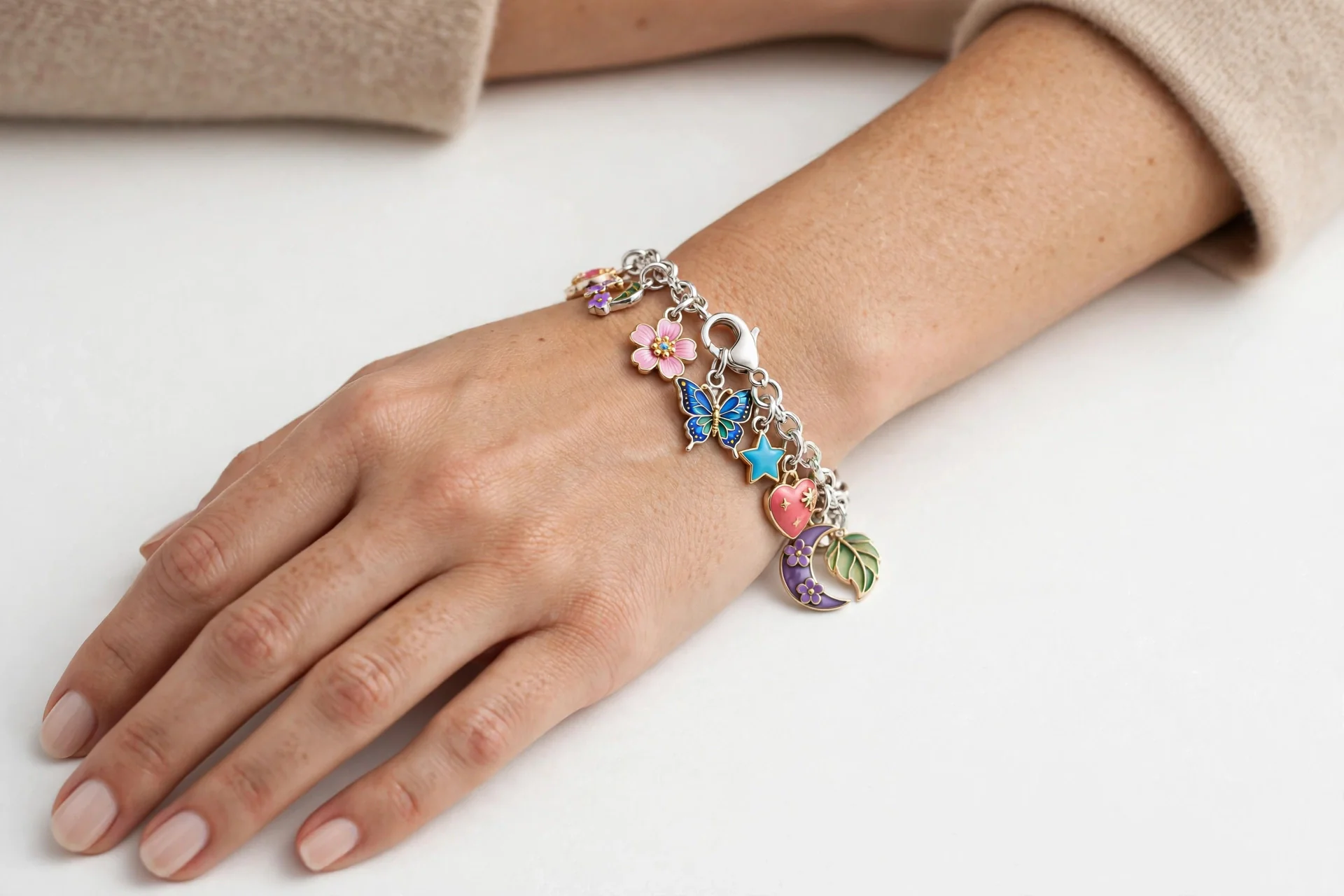
A pandora bracelet only becomes the piece of jewellery people imagine — personal, balanced, comfortable enough to wear every day — when the fit is right, and fit is where most buyers go wrong. This second Pogeo guide to the pandora bracelet takes a deliberately different angle from a general overview: it is entirely about sizing, charm space and styling. How to measure your wrist properly, how much extra room charms genuinely need, why a snake chain, a bangle and a leather bracelet all fit differently, and how to arrange charms so the bracelet looks designed rather than accumulated.
The stakes are practical as well as aesthetic. A bracelet sized for a bare wrist will strangle once it carries a dozen charms, because every charm takes up internal circumference; a bracelet sized too generously slides over the hand, bangs against desks and wears its charms unevenly. Getting the pandora bracelet decision right at the measuring stage saves exchanges, prevents the slow disappointment of a bracelet that lives in a drawer, and makes every later charm purchase more enjoyable, because it lands on a foundation that already works on your wrist.
How to Measure Your Wrist Correctly
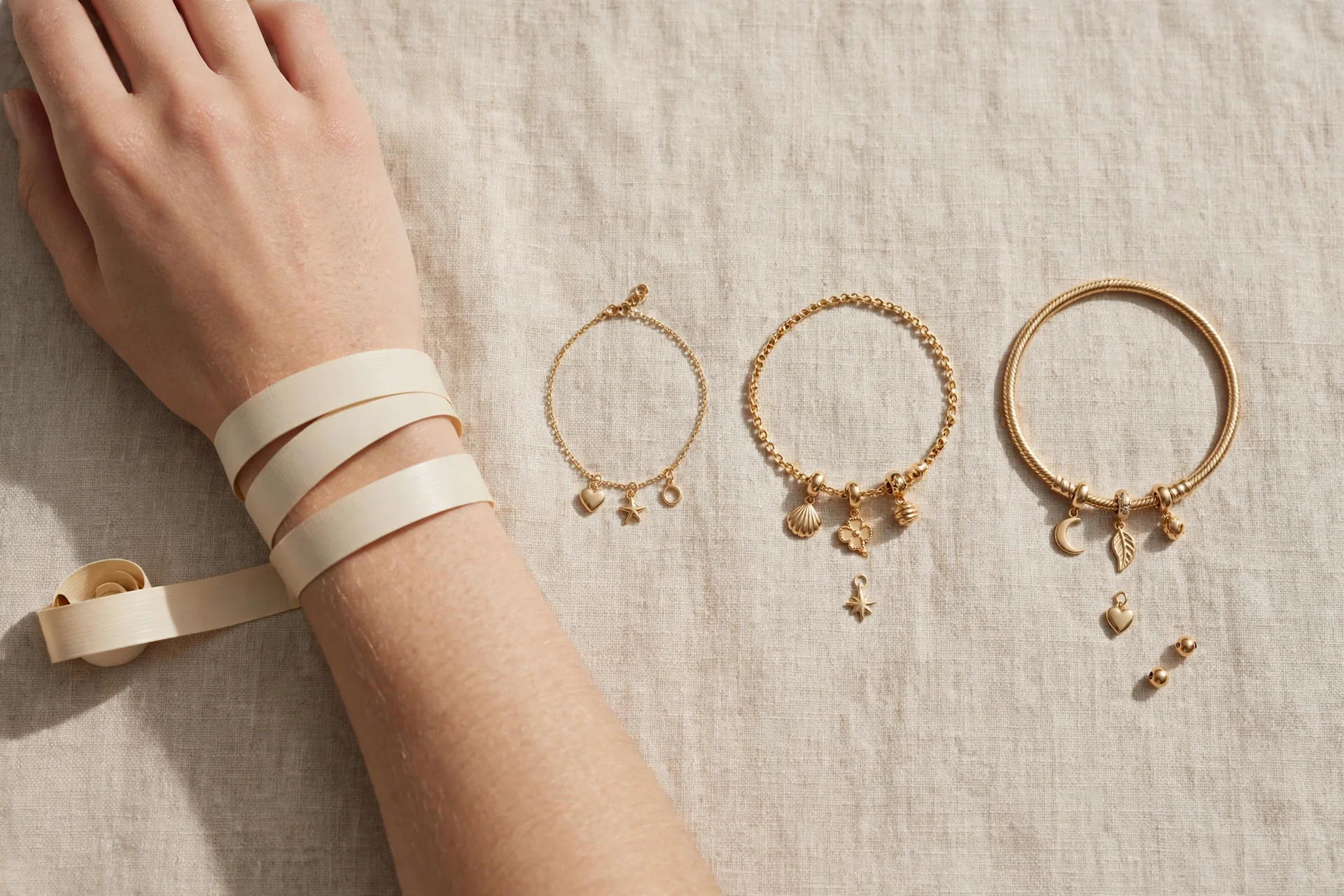
Measure your wrist with a flexible tape measure wrapped snugly — not tightly — around the wrist bone, at the exact place you intend the bracelet to sit, and note the measurement in centimetres. If you have no tape, wrap a strip of paper or string around the wrist, mark where it meets, and measure that length flat against a ruler. Do this at a normal time of day, because wrists swell slightly in heat and after exercise, and measure twice: a single centimetre of error is the difference between two pandora bracelet sizes, and it is the most common cause of exchanges.
Then apply the rule that governs everything else in this guide: the bracelet must be bigger than the wrist, by an amount that depends on how full it will become. As a working guide, add roughly one centimetre for a bracelet that will carry only a few charms, about two centimetres for a half-full bracelet, and up to three centimetres for a completely full design, because charms sit inside the bracelet’s circle and consume space exactly as beads on a string do. If you fall between sizes, choose according to your plan: size down for a minimalist bracelet worn snug, size up for a collector’s bracelet intended to fill over years of birthdays and milestones.
The Main Bracelet Styles and How Each One Fits
The classic snake chain is the default pandora bracelet for a reason: its smooth, flexible chain carries charms evenly, drapes naturally and tolerates a full load without changing shape. It is worn with the clearest sense of drop — a correctly sized snake chain rests a little below the wrist bone and moves as you move. Because it flexes, it is also the most forgiving style for buyers between sizes. Current styles, finishes and the sizes each is produced in can be checked on the official Pandora UK bracelet range, which is the reliable source for what is actually available this season.
Bangles and leather styles obey different physics, and treating them like snake chains is the second commonest sizing error. A rigid bangle must pass over the hand, so its fit is governed by hand width as much as wrist size, and it carries fewer charms in a fixed arrangement that should sit balanced rather than slide. Leather bracelets, including double-wrap designs, fit closer and more casually, hold a small number of charms, and stretch slightly with wear — so a leather pandora bracelet that begins snug is usually correct, while one that begins loose will end up sloppy. Match the style to the life it will lead: chains for collecting, bangles for polish, leather for everyday ease.
How Many Charms Fit, and How Spacing Works
A standard-length snake chain pandora bracelet typically holds around fifteen to twenty charms, clips and spacers combined, but the number that fits is less important than the number that fits comfortably — and those are rarely the same figure. As charms are added, the bracelet’s effective inner circle shrinks, which is why a bracelet bought to be worn nearly full should start from the generous end of your size range. Wearers planning a themed, fully loaded design should say so when being sized in store, because staff will steer them up a size precisely to protect that future fullness.
Spacing is the unglamorous technology that makes a full bracelet look intentional. Two clips, fixed on the raised threads of the chain, divide the bracelet into three sections and stop all the charms sliding into one clump at the bottom every time your arm moves; spacers — slim, purely decorative beads — fill gaps, separate statement charms so each can be seen, and fine-tune the fit as the bracelet fills. Murano glass charms add colour and width, dangling charms add movement but concentrate weight, and safety chains, which connect the clasp to both ends, protect the whole collection if the clasp ever opens. Build the skeleton of clips and spacers early; it is much harder to retrofit order onto a crowded pandora bracelet later.
Styling a Balanced Bracelet
A styled pandora bracelet obeys the same composition rules as any good design: a focal point, rhythm and restraint. Start with one or two statement charms — the largest, most meaningful or most colourful — and place them at the centre front of the middle section, where the eye lands first. Build outward with supporting charms in a roughly symmetrical rhythm of size and metal, so the bracelet looks balanced from every angle rather than telling its story in one crowded cluster. Repeating one accent colour three times across the design, often through Murano glass, is the oldest stylist’s trick in charm jewellery, because repetition is what separates a collection from a composition.
Occasion styling builds on that foundation rather than replacing it. For everyday wear, many owners edit down to a third of their charms — the meaningful core — which keeps the bracelet light, quiet at a keyboard and appropriate everywhere; for evenings and events, the full bracelet, or two coordinated bracelets stacked with a plain bangle or watch, delivers the deliberate, layered look. Mixed metals deserve confidence rather than apology: silver with rose-gold accents is a designed choice when it is repeated consistently. The only real styling rule for a pandora bracelet is that the wearer should be able to explain why each charm is there — a bracelet with a story always looks better than a bracelet with a receipt.
Prices, Buying and Care in the UK
In the UK, a sterling silver snake chain pandora bracelet generally starts in the region of £55 to £70 before charms, with solid gold and pavé designs costing considerably more, and individual charms commonly ranging from around £25 for simple silver pieces to £100 and beyond for gold and detailed designs. Prices change with collections and promotions, so treat those figures as orientation and check current pricing with official retailers before budgeting a gift. Because charms are bought one at a time, the total cost of a full bracelet is really a long-term collecting budget, which is precisely why sizing the foundation correctly matters more than any single charm decision.
Buy the bracelet itself from Pandora stores, the official UK website or authorised jewellers, because counterfeit bracelets are common, fit poorly and reject genuine charms. Care is simple but real: polish silver gently with a soft cloth, store the bracelet fastened in its pouch or box away from humidity, remove it for swimming, cleaning chemicals and perfume application, and have clasps and safety chains checked if the bracelet ever snags. A well-kept pandora bracelet holds its finish for years, and a correctly sized one is also a safer one — bracelets that fit properly are not dropped, caught or left behind nearly as often as bracelets that annoy their owners.
Conclusion
Getting a pandora bracelet right is a measuring exercise before it is a shopping one: measure the wrist honestly, decide how full the bracelet will honestly become, add the centimetres those charms will consume, and choose the style whose fit physics matches the wearer’s life. Do that, and everything else — clips and spacers in their sections, statement charms at the front, colours repeated with intent, charms added across years of occasions — falls into place on a foundation that is comfortable from the first day to the fifteenth charm.
That is the difference between a bracelet that is worn and a bracelet that is merely owned. If you are buying for yourself, size for the collector you intend to become; if you are buying as a gift, size carefully, keep the receipt and start the story with one meaningful charm. Pogeo’s fashion coverage continues beyond this guide, and readers who enjoy clear, practical explainers may also like our complete guide to rugby positions.
Frequently Asked Questions
What size Pandora bracelet should I buy?
Measure your wrist snugly in centimetres, then add roughly one centimetre for a bracelet that will carry a few charms, two centimetres for a half-full bracelet and up to three for a completely full one, and choose the bracelet size nearest to that total. If you are between sizes, size down for a minimalist, snug fit and up for a collecting bracelet that will fill over time. Remember that every charm added reduces the bracelet’s internal space, so a pandora bracelet intended to end up full must start generous.
How many charms fit on a Pandora bracelet?
A standard snake chain typically holds around fifteen to twenty charms, clips and spacers in total, but comfortable capacity depends on bracelet length and charm size — large Murano and dangle charms consume more room than slim silver ones. Two fixed clips dividing the chain into three sections, plus spacers between statement pieces, keep a full bracelet wearable and balanced. If a bracelet feels tight before it looks full, it is full: forcing more charms onto a short chain strains the bracelet and the clasp.
Should a Pandora bracelet be tight or loose?
Neither. A correctly fitted pandora bracelet rests just below the wrist bone, moves a little when you shake your hand, and allows roughly two fingers between bracelet and wrist when lightly loaded — less as it fills with charms. Too tight is uncomfortable and strains the clasp; too loose slides over the hand, knocks against surfaces and wears charms unevenly. Fit also differs by style: bangles are governed by the width of your hand, and leather bracelets start snug because the leather relaxes with wear.
Can I wear my Pandora bracelet every day?
Yes — with ordinary care, a pandora bracelet is designed for daily wear, and many owners only remove theirs for swimming, showering, sport and applying perfume or cleaning products, all of which can dull silver and damage leather and enamel. Polish it with a soft cloth as part of a weekly routine, store it fastened in a pouch or jewellery box, and consider a safety chain if you wear a full, valuable collection daily. Proper fit helps here too: a bracelet that fits well is knocked and caught far less than one that swings.
Do Pandora bracelets make good gifts?
They are among the most gifted jewellery items in the UK, precisely because the bracelet is a beginning rather than a finished present — each later charm marks another occasion. For gifting, the sizing guidance in this guide matters doubly: measure discreetly if you can, keep the receipt, and choose the versatile snake chain in the middle of the recipient’s likely size range, since Pandora stores exchange sizes readily. Adding one personally chosen charm — an initial, a shared memory, a milestone — turns a beautiful object into the start of someone’s story.
For more no-nonsense guides across style, sport and everyday life, keep browsing Pogeo — our rugby positions breakdown shows the same attention to getting the details right.