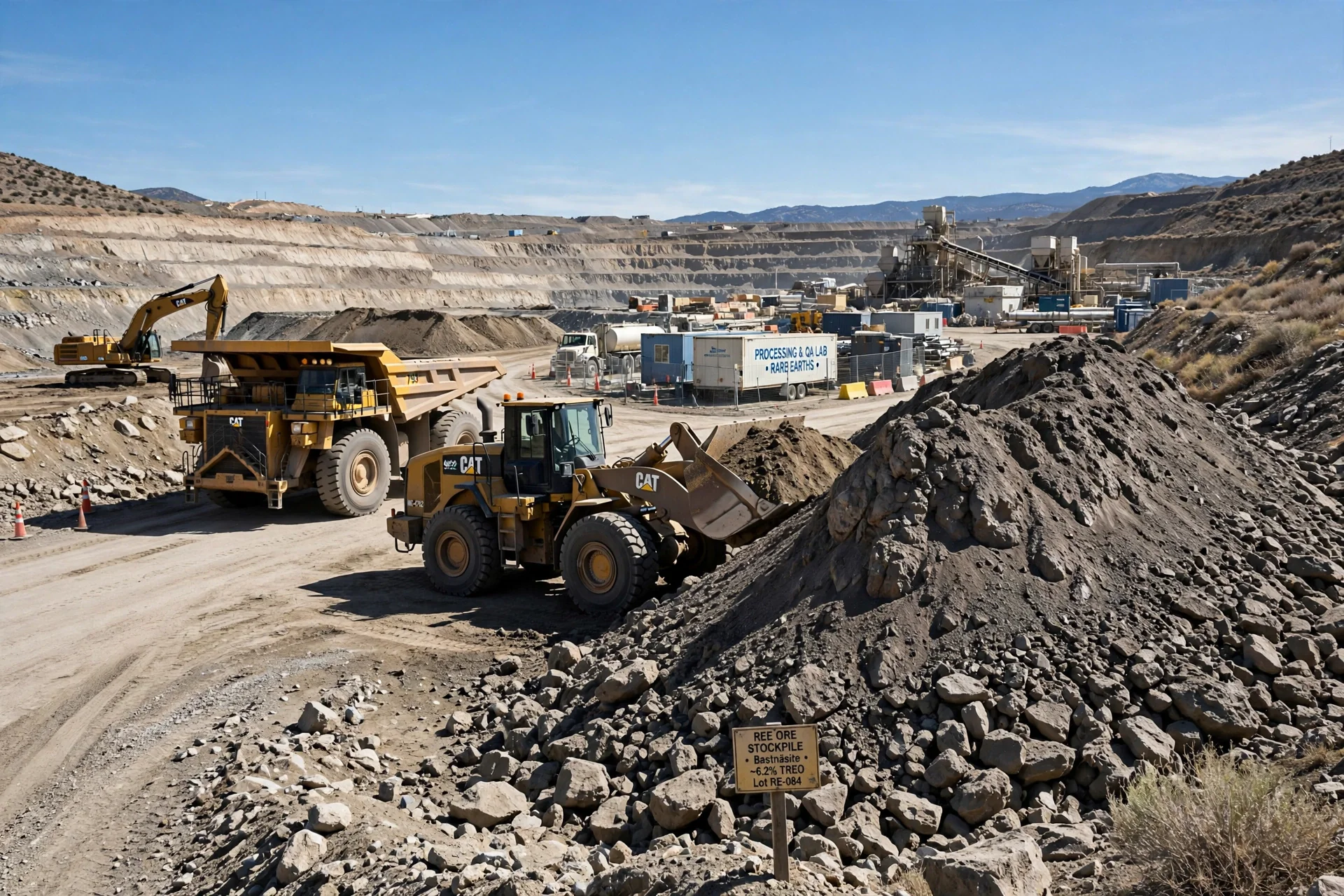
The pensana share price attracts attention out of proportion to the company’s size, and the reason is the material at the centre of its business: rare earths. These are the metals inside electric vehicle motors, wind turbine generators, robotics and defence systems, and the world’s supply of them is concentrated in very few hands. Pensana Plc, listed on the London Stock Exchange under the ticker PRE, is trying to build a mine-to-magnet supply chain outside that concentration, which makes its shares a popular way for UK investors to follow the critical minerals story. This article is informational only and is not investment advice.
One warning belongs at the top of any share price page, because it is the one readers most often skip: share prices change constantly, sometimes minute by minute while the market is open. Any specific price quoted in an older article — including earlier versions of this one — is a historical snapshot, not a live figure, and it will be wrong by the time you act on it. The value of this guide is therefore not a number but an understanding: what Pensana actually does, what genuinely moves the pensana share price, how to read its volatility without panicking, and where to check the real, current quote before drawing any conclusion.
Where the Pensana Share Price Comes From
Pensana is listed on the Main Market of the London Stock Exchange, and the PRE quote you see on financial websites ultimately traces back to trades on that exchange during market hours. Checking the live figure at the source, via the London Stock Exchange, is the most reliable habit a follower of this stock can build, because third-party pages and forum posts can lag, cache old data or quote prices in the wrong currency. PRE trades in pence sterling, often shown as GBX, which catches out readers who mistake a price of, say, one hundred pence for one hundred pounds.
It also helps to understand what kind of company sits behind the ticker. Pensana is a development-stage business, not a mature producer with steady sales and profits, and development-stage miners are valued almost entirely on expectations: the quality of the deposit, the credibility of the plan to build it, and the probability of reaching production. That single fact explains most of the behaviour of the pensana share price, including why it can move sharply on announcements that would barely register for a large, diversified mining company with producing assets and regular dividends.
What Pensana Does: Longonjo and Saltend
The company’s flagship asset is the Longonjo project in Angola, a large rare earth deposit intended to produce a mixed rare earth carbonate. Angola matters in this story because diversifying supply away from the dominant processing routes is a strategic priority for Western governments and manufacturers, and a significant, long-life deposit in a new jurisdiction is exactly the kind of asset that attracts policy attention as well as investor attention. Progress at Longonjo — construction milestones, financing packages, offtake agreements with buyers — is therefore the single biggest company-specific driver of sentiment around the shares.
The second half of the strategy sits in the UK, at Saltend Chemicals Park in the Humber Freeport, where Pensana has planned a rare earth separation and processing facility. The logic is vertical integration: rather than shipping raw material into someone else’s refinery, the company aims to process towards the higher-value separated oxides used in permanent magnets. When news flow connects the two halves of that chain — mine progress in Angola, funding or construction progress at Saltend — the market tends to treat it as de-risking the whole story, and the pensana share price usually responds accordingly, in either direction.
What Drives the Pensana Share Price

Company announcements are the most immediate driver, and they arrive through official regulatory news releases covering financing, construction, partnerships, government support and management changes. Positive updates can produce rapid rises as buyers compete for a relatively limited pool of shares, while delays, cost increases or funding uncertainty can produce equally rapid falls. Experienced followers read the actual announcement rather than the forum summary of it, because the details — how much money, on what terms, against which milestone — are what separate a genuinely de-risking update from a headline that merely sounds like one.
The second driver sits outside the company entirely: the price and politics of rare earths themselves. When electric vehicle demand forecasts rise, when magnet prices strengthen, or when export restrictions and trade tensions remind manufacturers how concentrated supply is, money flows towards the small group of Western rare earth developers and Pensana tends to benefit. When risk appetite fades across markets, or rare earth prices soften, the same shares are often sold first and hardest. Layered over both drivers is simple market mechanics: a small company with a passionate retail following will swing more, in both directions, than its fundamentals change on any given day.
How to Read the Volatility and the 52-Week Range
New followers are often unsettled by the size of the daily moves, so it helps to put the pensana share price in its proper frame. The 52-week range — the highest and lowest prices of the past year — shows the full width of the market’s changing opinion, and for development-stage miners that range is normally wide. A share sitting near the middle of its range is telling you the market is undecided; a share near its highs after concrete financing or construction news is telling a different story from one near its highs on rumour alone. Context, not the raw number, is what turns a quote into information.
Practical habits protect readers from the worst mistakes this volatility invites. Check whether a move coincides with an official announcement before reacting to it, be suspicious of dramatic claims in share chat forums where posters may be talking their own positions up or down, and remember that a percentage move in a small company can represent very little actual money changing hands. Above all, never treat a forecast graphic or a forum price target as a prediction you can rely on: forecasts for pre-production miners are scenarios built on assumptions about financing, construction and commodity prices, and every one of those assumptions can change.
Risks Every Follower Should Understand
The risks are real and should be stated plainly. Development projects can be delayed, cost more than planned, or require fundraisings that dilute existing shareholders, and a company without production revenue depends on continued access to capital on acceptable terms. Commodity risk runs alongside it: the economics of a rare earth project are sensitive to prices the company does not control, set in markets heavily influenced by the very supply concentration Pensana exists to challenge. Political and regulatory factors in multiple countries, from mining licences to processing permits to trade policy, add a further layer that no management team can fully manage away.
None of that makes the stock unusual — it makes it typical of its category, and that is precisely the point of this section. The pensana share price should be followed as what it is: a high-risk, expectation-driven quote attached to an ambitious industrial project, capable of strong rises on genuine progress and sharp falls on disappointment or silence. Anyone considering buying shares in any company should research independently, read the official announcements and annual reports, understand that they can lose money, and take regulated financial advice if they are unsure. This guide explains the story; it does not recommend the trade.
Frequently Asked Questions
What is the pensana share price today?
It changes throughout every trading day, so no article can give you a figure that stays accurate — anything printed here would be out of date on arrival. The reliable way to answer the question is to check the live PRE quote on the London Stock Exchange website or a reputable financial data service, making sure the price is shown in pence (GBX) and timestamped for the current session. Treat any price quoted in forums, social posts or older articles as a historical snapshot only, useful for context about where the shares have traded, not for what they cost now.
Why does the pensana share price move so much?
Three forces combine. First, company announcements about financing, construction and partnerships can materially change the probability of the projects succeeding, and the market reprices that probability quickly. Second, rare earth prices and the wider politics of critical minerals shift sentiment towards the whole sector at once. Third, Pensana is a relatively small company with an active retail following, so buying and selling pressure shows up in the price more dramatically than it would in a large, heavily traded stock. Sharp moves, in both directions, are a structural feature of this share rather than a sign something is broken.
What does Pensana actually do?
Pensana Plc is a rare earths company developing the Longonjo project in Angola, which is intended to produce rare earth carbonate, alongside a planned separation and processing facility at Saltend in the UK. Its strategy is to help build a mine-to-magnet supply chain for the metals used in electric vehicles, wind turbines and other advanced technologies, outside the currently dominant supply routes. It is a development-stage company, meaning its value rests mainly on delivering those projects rather than on existing production revenue, which is why its share price reacts so strongly to project and financing news.
Is Pensana listed in the UK?
Yes. Pensana Plc trades on the London Stock Exchange under the ticker symbol PRE, and its shares are priced in pence sterling. That listing is one reason the company attracts a strong UK retail following: it offers London-market access to the rare earths theme, its regulatory announcements are published through official UK channels, and its planned Saltend processing facility gives the story a direct UK industrial angle alongside the Angolan mine. As with any listed company, its annual reports, announcements and admission documents are public and should be the first source for anyone researching it seriously.
Does Pensana pay a dividend?
Development-stage mining companies in Pensana’s position generally do not pay dividends, because every pound of available capital is directed towards building the projects that are supposed to create future value. Investors in PRE are therefore relying on share price appreciation if the strategy succeeds, not on income along the way, and they carry the corresponding risk that delays, dilution or commodity weakness can push that value further into the future. Anyone whose investment goals depend on regular dividend income should understand clearly that this category of stock is not designed to provide it.
Conclusion
Followed properly, the pensana share price is a running referendum on one of the defining industrial questions of the decade: can the West build its own supply of the rare earth metals its vehicles, turbines and technologies depend on? Pensana’s answer rests on two projects — Longonjo in Angola and Saltend in the UK — and the price moves as the market updates its judgement on financing, construction and rare earth politics, sometimes calmly and sometimes all at once. Understanding those drivers is worth far more than any single day’s number.
Use this guide as the frame and the official sources as the facts: check the live quote at the exchange, read the regulatory announcements rather than summaries of them, and keep the risks of a development-stage company in full view at all times. Nothing here is investment advice, and no responsible guide would present it as such. What an informed follower gains is the ability to see a dramatic headline move and know which question to ask next — what actually changed — instead of simply reacting to the colour of an arrow.
Readers who follow UK finance and business topics may also find our guide to personal liability insurance Towergate useful for understanding how specialist cover works.
For more plain-English money and business explainers, browse our personal liability insurance Towergate guide next time you are reviewing your cover.