
A technician is one of the most trusted and essential professionals in healthcare, yet many people have never heard of the role or do not know how it differs from that of a pharmacist. If you have ever collected a prescription from your local chemist or received medicines on a hospital ward, a technician has almost certainly been involved in getting the right medicine to the right person safely. Technicians work at the heart of the medicines supply chain, checking prescriptions, dispensing medicines, advising patients, and supporting pharmacists in community pharmacies, hospitals, GP practices, and many other settings across the UK. For anyone who wants a hands-on healthcare career without spending years at university, becoming a technician is one of the most practical and rewarding routes into the NHS and the wider health sector.
This guide explains everything you need to know about the technician career, from what the job actually involves day to day to how you qualify, register, and progress. It covers the training route, the entry requirements, the role of the General Pharmaceutical Council, where technicians work, what the pay looks like, and how the career can develop over time. Whether you are a school leaver weighing up your options, a career changer looking for a stable healthcare role, or someone already working in a pharmacy who wants to take the next step, this article gives you a clear and honest picture of the profession.
What Is a Pharmacy Technician?
A technician is a registered healthcare professional who works under the supervision of a pharmacist to prepare, dispense, and supply medicines safely. The title “pharmacy technician” is a protected title in Great Britain, which means you may only call yourself a pharmacy technician once you are registered with the General Pharmaceutical Council, known as the GPhC. This legal protection matters because it tells the public that anyone using the title has completed approved training, met professional standards, and is accountable to a regulator. It places technicians alongside other regulated healthcare professionals, and it means that the role carries real responsibility and real professional standing.
The relationship between a technician and a pharmacist is a close working partnership rather than a simple hierarchy. Pharmacists are responsible for the clinical decisions about medicines, but technicians carry out much of the practical work that makes safe medicines supply possible. A technician checks prescriptions for accuracy, labels and dispenses medicines, manages stock, and talks directly with patients about how to take their medicines. In hospitals, technicians may also prepare specialist medicines, manage ward stock, and take part in medicines reconciliation, which means checking that the medicines a patient is prescribed match what they were taking before admission. The work is detailed, precise, and people-facing, and it suits anyone who is organised, careful, and comfortable talking to the public.
What Does the Role Involve Day to Day?
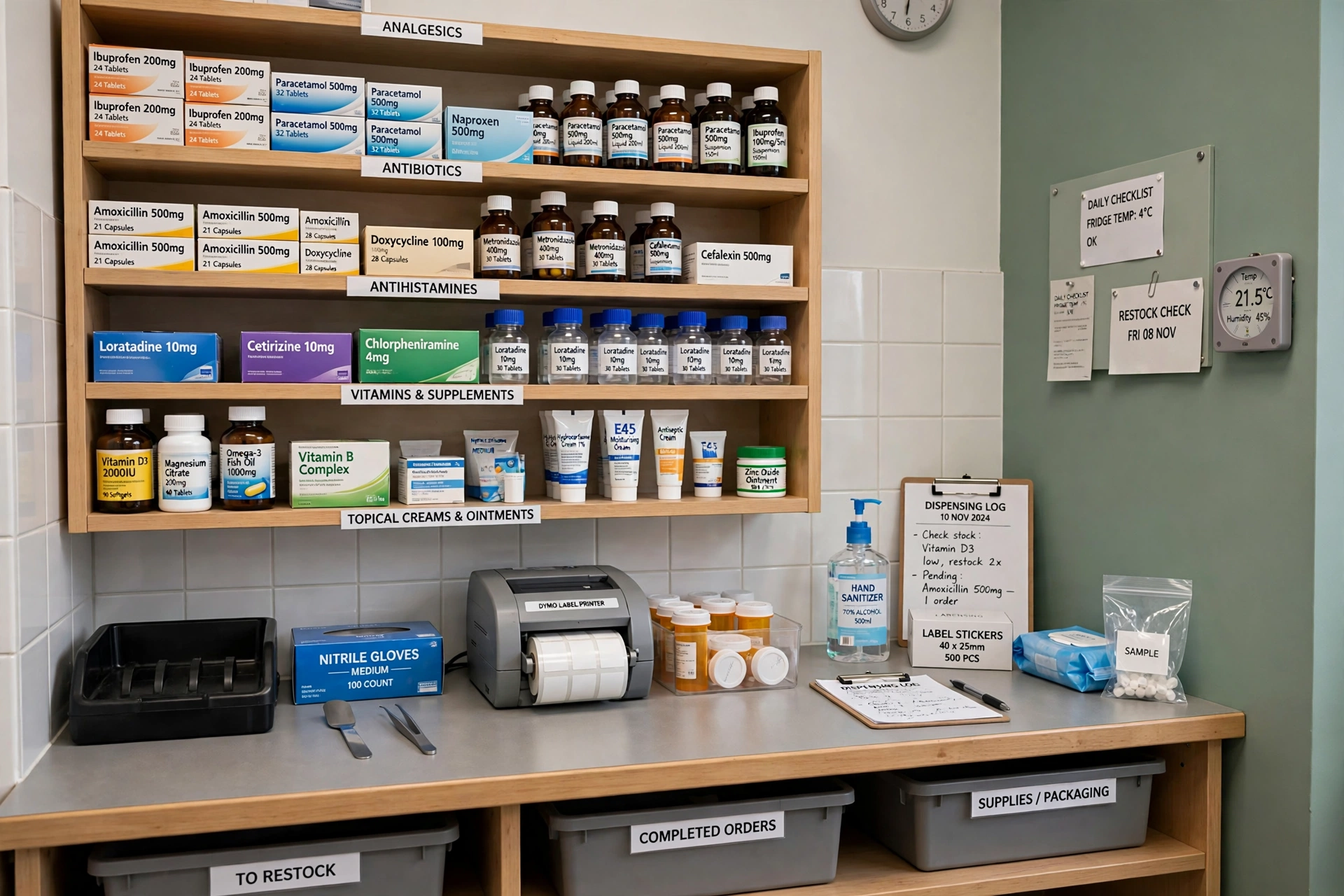
The daily work of a technician varies a great deal depending on where they are based, but some core tasks appear in almost every setting. The most familiar task is dispensing, which means taking a prescription, selecting the correct medicine in the correct strength and quantity, labelling it accurately, and checking it against the prescription before it is handed to the patient. This sounds straightforward, but it demands constant attention to detail, because a single wrong dose or a lookalike medicine picked in error can have serious consequences. Technicians are trained to follow strict checking procedures, to spot errors before they reach the patient, and to record their work so that every medicine can be traced.
Beyond dispensing, a technician spends a large part of the day talking to patients and customers. They answer questions about how and when to take medicines, explain the difference between branded and generic products, advise on over-the-counter remedies for minor ailments, and signpost people to other healthcare services when needed. They also handle prescription requests, manage repeat prescription systems, order and receive stock, check expiry dates, and keep accurate records. In a hospital, the day might include visiting wards to check medicine cupboards, preparing medicines in an aseptic unit under sterile conditions, and working with nurses and doctors to make sure patients have the medicines they need. In a GP practice, a technician might review repeat prescriptions, help manage patients on multiple medicines, and support medicines safety audits.
How to Qualify and Register
The route to becoming a technician in Great Britain is a structured two-year training programme that combines paid employment with study. You start as a pre-registration trainee technician, employed in a pharmacy setting such as a community pharmacy, a hospital pharmacy, or a GP practice, and you work towards a GPhC-approved Level 3 qualification while you learn on the job. The two main qualification routes are the Level 3 Diploma in the Principles and Practice for Pharmacy Technicians, offered by awarding bodies such as Pearson BTEC and Open Awards, and the Level 3 Pharmacy Technician apprenticeship in England, which follows the same standard through an apprenticeship framework. Both routes take around two years to complete, and both combine classroom or distance learning with supervised practical experience in the workplace.
The best place to start researching the role and the training routes is the official NHS Health Careers website, which sets out the job description, the entry requirements, and the training pathway in detail. The NHS Health Careers pages are written for people considering a healthcare career, and they explain how the pre-registration training year works, what you will learn, and where the qualification can take you. Once you have read the official guidance, the practical next step is to look for trainee technician vacancies, which are advertised by NHS trusts, community pharmacy chains, and independent pharmacies, often through the NHS Jobs website or directly on employer websites. Competition for trainee places can be strong, particularly in hospital pharmacy, so it is worth applying widely and showing genuine enthusiasm for the role in your application.
Entry Requirements and Skills You Will Need
The standard entry requirements for pre-registration technician training are GCSEs at grade 4 or C or above in English and maths, and usually science as well, although the exact requirements can vary slightly between employers and training providers. Some employers may also ask for additional GCSEs or for relevant work experience, and hospital posts in particular may attract applicants who already hold A-levels or a degree. If you do not yet have the required GCSE grades, many colleges offer functional skills courses in English and maths that can help you meet the standard, and some employers will support you to gain these qualifications as part of your training.
Beyond the formal qualifications, the personal qualities that make a good technician matter just as much. Accuracy and attention to detail are essential, because the work involves medicines where small errors can cause harm. You need to be organised and able to follow procedures carefully, comfortable with numbers and calculations, and able to stay calm and focused when the pharmacy is busy. Communication skills are equally important, because you will be talking to patients who may be worried, confused, or unwell, and you need to explain things clearly and kindly. Teamwork matters too, since technicians work closely with pharmacists, other technicians, dispensers, and healthcare professionals. If you enjoy practical work, like helping people, and take pride in getting the details right, the role is likely to suit you.
GPhC Registration and Revalidation
Once you have completed your Level 3 qualification and your two years of pre-registration training, you apply to join the GPhC register. Registration is what allows you to use the protected title of pharmacy technician, and it is a legal requirement for practising in Great Britain. The GPhC checks that you have completed an approved qualification, that you are of good character, and that you meet its standards for pharmacy professionals. Once registered, you are accountable to the GPhC for your professional conduct, and you must follow its standards and guidance in your daily work, just as pharmacists do.
Registration is not a one-off event. Every year, registered technicians must complete revalidation, which means showing the GPhC that they are keeping their knowledge and skills up to date through continuing professional development, known as CPD. Revalidation involves recording learning activities, reflecting on how they have improved your practice, and completing a peer discussion with another healthcare professional. This process keeps technicians current with new medicines, new guidance, and changing ways of working, and it gives the public confidence that registered professionals are maintaining their competence throughout their careers. Failure to complete revalidation can lead to removal from the register, so it is something every practising technician takes seriously.
Where Technicians Work
Community pharmacy is the largest employer of technicians, and it is where most people encounter the profession. In a high street or supermarket pharmacy, a technician dispenses prescriptions, advises customers, manages stock, and supports the pharmacist in running the pharmacy. Hospital pharmacy is the second major setting, and it offers a broader range of specialist work, including aseptic preparation, clinical trials support, medicines information, and ward-based roles. Hospital technicians often work as part of a larger team and may have the chance to specialise in areas such as oncology, paediatrics, or intensive care.
Beyond these two main settings, technicians increasingly work in GP practices, where they help manage repeat prescriptions and support medicines optimisation for patients taking multiple medicines. They also work in care homes, prisons, the pharmaceutical industry, medicines regulatory bodies, and the armed forces. Some technicians move into teaching, training, or management roles, while others become independent prescribers’ support staff or work in primary care networks. This variety is one of the strengths of the profession, because it means you can change setting or specialism without leaving the career, and you can build a working life that fits your interests and circumstances.
Pay, Hours and Career Progression
Pay for technicians varies by setting, experience, and location, and it is important to be realistic about what the role offers. Job adverts for newly registered technicians typically show a range of around £24,000 to £30,000, and this is best understood as a typical advertised range rather than a fixed national salary. NHS posts are paid on the Agenda for Change pay bands, and technicians in the NHS usually start at Band 4, with progression to Band 5 and beyond for senior or specialist roles. Community pharmacy pay is set by the employer and can vary between large chains and independent pharmacies, while hospital and GP practice roles may offer additional benefits such as NHS pension membership and generous annual leave.
Career progression for a technician can take several directions. Many technicians move into senior or lead technician roles, managing a dispensary team or running a pharmacy department. Others specialise in areas such as aseptic services, clinical trials, medicines information, or procurement, and some complete further qualifications to become accuracy checking technicians, which allows them to carry out the final accuracy check on dispensed medicines. There are also opportunities to move into education and training, quality assurance, or management, and some technicians go on to study pharmacy at university and become pharmacists. The profession rewards experience and further study, and the GPhC revalidation process means that learning is built into the career from the start.
Is This Career Right for You?
A technician career suits people who want a stable, respected healthcare role with clear training, a protected professional title, and the chance to help patients every day. It is a good choice if you like practical, detail-focused work, if you enjoy talking to people, and if you want to work in healthcare without the long university degree that pharmacy or medicine requires. The two-year training route means you are earning while you learn, and the qualification is recognised across the NHS, community pharmacy, and beyond, which gives you genuine job security and flexibility.
There are challenges to be honest about as well. The work can be repetitive at times, the pace in a busy pharmacy can be intense, and the responsibility for medicines safety is real and constant. Pay is solid rather than spectacular, particularly in the early years, and progression often depends on taking on extra qualifications and responsibilities. But for many technicians, the rewards outweigh these drawbacks: the satisfaction of knowing that your accuracy keeps patients safe, the variety of settings and specialisms, the camaraderie of a pharmacy team, and the knowledge that you are part of a regulated profession with a clear identity and a future. If that combination appeals to you, the next step is to research trainee vacancies and talk to technicians already doing the job.
What Qualifications Do You Need for This Career?
To become a technician in Great Britain you need to complete a GPhC-approved Level 3 qualification, either the Level 3 Diploma in the Principles and Practice for Pharmacy Technicians or the equivalent Level 3 apprenticeship in England, alongside two years of pre-registration training in a pharmacy. Entry to training usually requires GCSEs at grade 4 or C or above in English and maths, and usually science as well, although exact requirements vary by employer. Once you have completed the qualification and training, you apply to join the GPhC register, which allows you to use the protected title of technician.
How Long Does the Training Take?
Training as a technician takes around two years, during which you work as a pre-registration trainee technician in a pharmacy setting while completing your Level 3 qualification. The training combines paid employment with study, so you earn a salary while you learn, and you gain supervised practical experience in dispensing, checking, and patient care. After the two years, you apply for GPhC registration, and once registered you can practise as a technician and must complete annual revalidation to stay on the register.
What Is the Difference Between a Technician and a Pharmacist?
A pharmacist holds a university degree in pharmacy and is responsible for clinical decisions about medicines, including prescribing advice, medicine reviews, and checking the clinical appropriateness of prescriptions. A technician holds a Level 3 qualification and focuses on the practical side of medicines supply, including dispensing, checking, stock management, and patient counselling, working under the supervision of a pharmacist. Both are registered with the GPhC and both are accountable for their professional practice, but the pharmacist has a broader clinical role and a longer period of university education behind them.
How Much Does the Role Pay in the UK?
Pay for technicians varies by setting, experience, and location, and job adverts for newly registered technicians typically show a range of around £24,000 to £30,000, which should be read as a typical advertised range rather than a fixed national salary. In the NHS, technicians are usually paid on Agenda for Change Band 4, with progression to Band 5 and beyond for senior or specialist roles, and NHS posts also come with pension and annual leave benefits. Community pharmacy pay is set by individual employers and can vary between large chains and independent pharmacies, while specialist hospital roles may pay more.
Where Can You Work in This Role?
Technicians work in community pharmacies, hospital pharmacies, GP practices, care homes, prisons, the pharmaceutical industry, and the armed forces. Community pharmacy is the largest employer, followed by hospital pharmacy, which offers specialist work such as aseptic preparation and ward-based roles. GP practices increasingly employ technicians to manage repeat prescriptions and support medicines optimisation, and some technicians move into teaching, training, quality assurance, or management roles as their careers develop.
Can a Pharmacy Technician Become a Pharmacist?
Yes, a technician can go on to become a pharmacist, although it requires further study. The usual route is to apply for a Master of Pharmacy degree at university, which takes four years, followed by a foundation training year and GPhC registration as a pharmacist. Some universities may take prior pharmacy experience into account, but the degree itself must still be completed in full. Many technicians choose instead to progress within the technician profession, moving into senior, specialist, or accuracy checking roles, which offer advancement without returning to university full time.
Conclusion
Becoming a pharmacy technician is one of the most accessible and rewarding routes into healthcare in the UK. The role combines practical medicines work with direct patient contact, a protected professional title, and a clear two-year training pathway that lets you earn while you learn. From dispensing and checking medicines to counselling patients, managing stock, and preparing specialist treatments, technicians keep the medicines system running safely in community pharmacies, hospitals, GP practices, and many other settings. Registration with the GPhC and annual revalidation give the profession its standing and its accountability, and the range of settings and specialisms means the career can grow with you over time.
If you are organised, careful, and motivated by helping people, the technician career is well worth serious consideration. Start by reading the official guidance, look for trainee vacancies in your area, and speak to technicians already in the role to hear what the job is really like. The training is demanding and the responsibility is real, but for those who complete it, the reward is a respected healthcare profession with genuine job security and the daily satisfaction of knowing that your work keeps patients safe.
If you enjoy team sports and want to understand another one better, read our guide to rugby positions and the fifteen roles that make a rugby team work.