Team Sport Go Karting: Tracks, Prices and What to Expect
Team sport go karting is the indoor karting experience offered by TeamSport, the UK’s largest indoor karting company, with 38 tracks across the country, and it is built around short, fast, wheel-to-wheel races on purpose-built indoor circuits. Drivers aged eight and over can take part, which means the same venues work for a family day out, a birthday party, a group of friends, or a corporate event, and every session starts with a safety briefing before anyone gets near a kart. The appeal is simple: you arrive, you get kitted out, you race against the clock and against the other drivers on the track, and you leave with lap times and a result to argue about afterwards.
The direct answer to what team sport go karting involves is two timed driving sessions, usually of around fifteen minutes each, with a break in between, although the exact format depends on the package and the venue you book. Most adult and family packages follow that two-session pattern, while younger drivers get shorter sessions in smaller cadet karts, and competitive formats such as a Grand Prix add qualifying and a final race. Prices vary by venue and by date, so the figures in this guide are examples rather than a fixed national price list, and the booking page for your chosen track is the place to confirm the exact cost before you go.
What the Experience Is Like on the Track
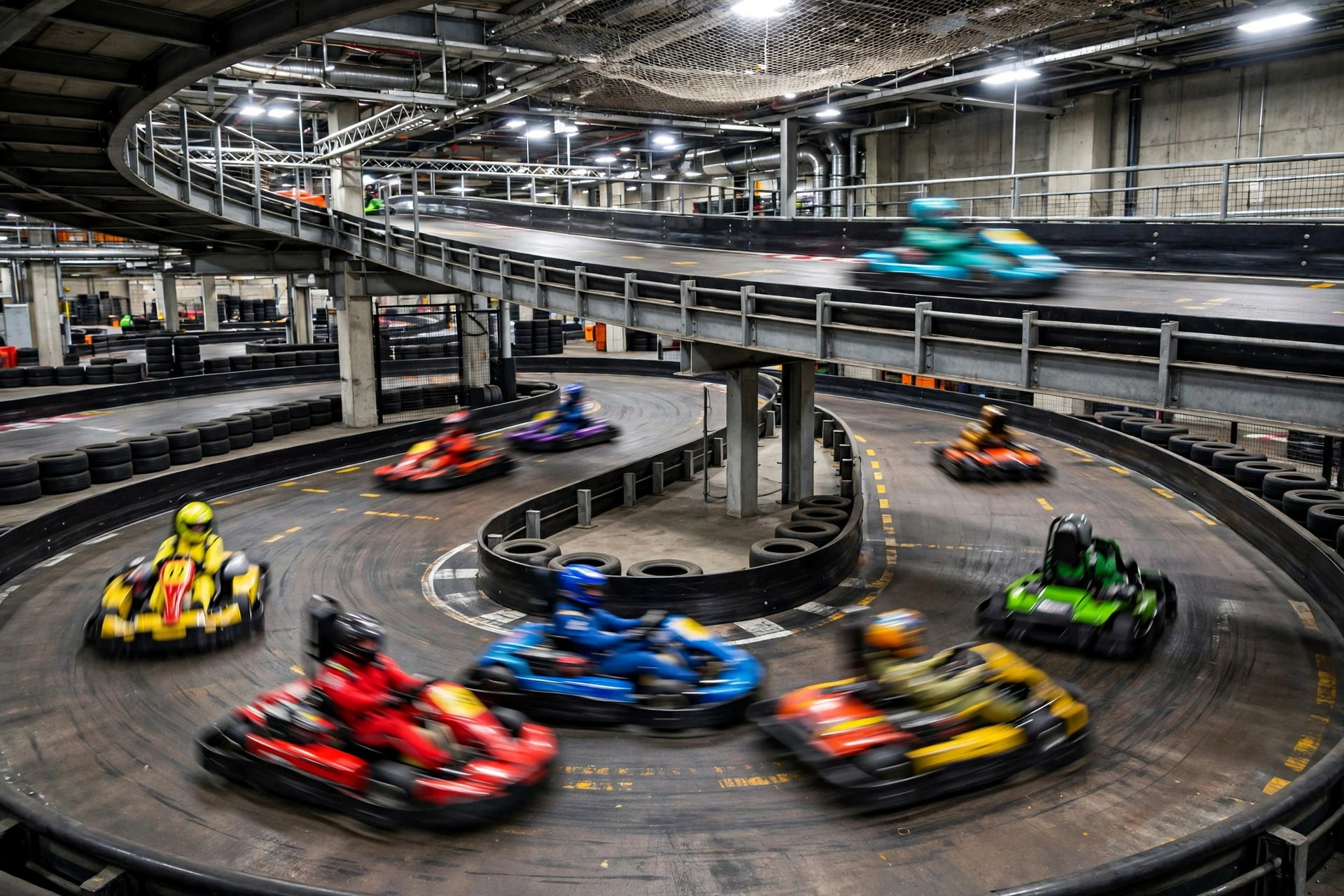
A karting session here is faster and more physical than most first-time drivers expect, because the karts are low to the ground, the acceleration is sharp, and the corners arrive quickly on circuits that are often built across more than one level. The tracks use a mix of tight hairpins, sweeping bends, long straights, and in many venues a flyover or an elevated section, so you are constantly braking, turning, and looking for a gap to overtake. Because the racing is indoors, the weather never matters, the track surface stays consistent, and sessions run all year round, which is one of the reasons indoor karting has become such a reliable choice for birthdays and group days out.
The racing itself is timed rather than simply a free drive, which changes the feel of the whole session in a good way, because every lap counts and you can watch your times improve as you learn the racing line. After each session you get a printout or a screen showing your lap times, your best lap, and where you finished against the other drivers, and that competitive element is what brings most people back for a second visit. Marshals watch the track throughout, flags are used to warn drivers about hazards or to penalise contact, and anyone driving dangerously can be brought in, so the racing stays competitive without becoming reckless.
The Tracks: Multi-Level Circuits Across the UK
TeamSport operates 38 tracks across the UK, according to its own website, with six tracks in London alone and venues stretching from Cardiff to Dundee and from Liverpool to Brighton, so most people in the UK live within a reasonable drive of one. The circuits are not identical, and that variety is part of the appeal, because each track has its own length, layout, and character, with some built underground, some spread across several levels, and some using long elevated sections that are unusual for indoor karting. Nottingham’s track, for example, is a 750-metre circuit with fifteen corners and flyovers, while Birmingham’s multi-level track runs to around 1,000 metres and is described as the biggest indoor circuit in the West Midlands.
Track length and layout matter because they change how a race feels, and a longer circuit with more corners rewards smooth driving and patience, while a shorter, tighter track produces closer racing and more overtaking. At Manchester Trafford Park the circuit is around 450 metres with a flyover, at Manchester Victoria the track runs underground for around 550 metres beneath the arena car park, and at Mitcham in south London the multi-level circuit is around 800 metres, so even regular visitors can find a new challenge by trying a different venue. The karts themselves are a mix of petrol and electric models depending on the venue, with electric karts at some tracks reaching speeds of up to 45 miles per hour, and all of them are maintained by the venue’s own team between sessions.
What Happens When You Arrive
Arriving for a karting session is a straightforward process, but it helps to know the order of events so that you can plan your time and arrive early enough to enjoy the session rather than rushing. You should aim to arrive at least half an hour before your booked start time, because you will need to check in, complete any registration that has not already been done online, and be fitted with a race suit, gloves, and a helmet before the briefing begins. Drivers are usually asked to bring a driving licence or another form of identification if they are driving an adult kart, and everyone is asked to wear flat, closed-toe shoes, because open footwear is not suitable for driving a kart.
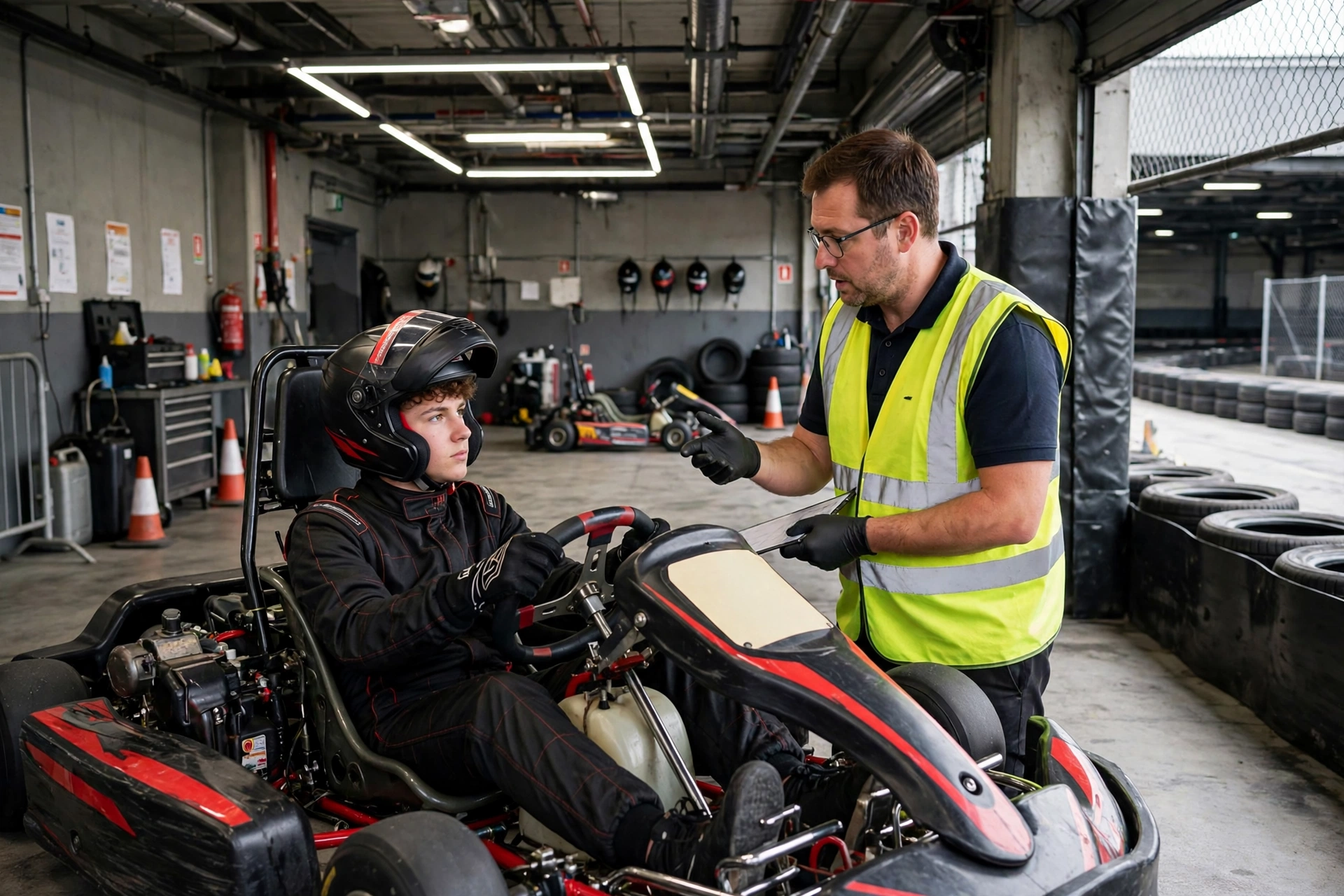
Once everyone is kitted out, the whole group attends a safety briefing, which covers the flags, the rules of the track, how to behave if you spin or stop, and what the marshals expect from you, and it is worth listening carefully even if you have been karting before, because the rules and the flag signals can vary slightly between venues. After the briefing you are shown to your kart, the staff help you adjust the seat and pedals, and then you head out onto the track for your first session, usually starting behind a pace kart or in a staggered formation so that the field spreads out safely. Between sessions there is a break for a drink, a look at the lap times, and a rest, and after the final session the results are confirmed and, depending on the package, there may be a presentation for the winners.
Junior and Cadet Sessions for Younger Drivers
Younger drivers are a central part of team sport go karting, because the company accepts drivers from the age of eight, and its cadet sessions are designed specifically for children rather than simply being a smaller version of the adult experience. Children aged eight to twelve drive specially built cadet karts that are smaller, slower, and easier to control than the adult karts, and they race on the same circuits but in sessions that are reserved for their age group, with trained staff supervising throughout. The cadet sessions usually run for around twelve minutes per drive, with two sessions and a break in a typical package, and the emphasis is on fun, confidence, and learning the basics of racing rather than on outright competition.
For children who want to take karting more seriously, TeamSport runs a Race Academy for drivers aged eight to fifteen, which provides structured coaching from beginner level through to advanced driving, delivered by trained instructors over a series of sessions. The Academy covers kart control, racing lines, braking, overtaking, and racecraft, and there are taster sessions available for children who want to try it before committing to a full course, with some venues offering a first taster session for around ten pounds, although that price is an example from venue listings and should be checked at booking. Birthday parties are also built around the cadet sessions, with party packages that combine driving with food and a presentation, which makes them a popular choice for children’s birthdays.
Adult Sessions, Groups and Parties
Adult sessions at team sport go karting are aimed at drivers aged sixteen and over for the standard open races, and they are the most popular format for groups of friends, stag and hen parties, and work colleagues looking for something more active than a meal out. The standard adult and family package, usually called the Ultimate Race Experience, gives each driver two fifteen-minute sessions with a break between them, and the group races together on the track, which means you are competing directly against your own friends rather than against strangers. For groups that want a more formal competition, the Exclusive Grand Prix format adds qualifying heats and a final, with a trophy presentation for the winners at the end.
Larger groups are well catered for, because the venues are used to handling stag dos, hen dos, birthday parties, and team events, and many tracks have private rooms, bars, and catering options that turn a karting session into a full event. Some venues also offer activities beyond karting, including laser combat, bowling, and mini golf at selected sites, so a group can build a whole afternoon or evening around the visit rather than just the time on the track. Booking in advance is strongly recommended for groups, especially at weekends, because the most popular time slots fill up quickly, and booking ahead also lets the venue plan the session format around the size of your group.
How Much Team Sport Go Karting Costs
Prices for team sport go karting vary by venue, by day of the week, and by the package you choose, so there is no single national price, and the figures below are examples taken from venue listings in November 2026 that should be checked against the booking page for your track. At Manchester Trafford Park and Manchester Victoria, the adult and family Ultimate Race Experience and the cadet activity day were listed at 44.40 pounds per person, with the Exclusive Grand Prix at 54.40 pounds per person, while at Nottingham the same packages were listed slightly higher at 47.74 pounds and 57.75 pounds per person. At Mitcham in south London the equivalent prices were listed at 49.96 pounds and 59.96 pounds per person, which shows how much the price can change between cities.
Discounted sessions are available for some groups, with student, NHS, and armed forces race experiences listed at 27.99 pounds per person at several venues outside London, and 29.99 pounds at Mitcham, although availability and eligibility conditions apply and should be confirmed when booking. The Race Academy membership was listed at 34.99 pounds, and taster sessions for younger drivers were listed from around ten pounds at some venues, but these are examples only and prices can change, so the booking page is the final authority. What the price always includes is the safety briefing, the race suit, gloves and helmet, the driving sessions themselves, and the lap-time printout, so there are no hidden charges for the basic equipment, although food, drink, and extra activities are charged separately.
Why Team Sport Go Karting Works Well for Beginners
Team sport go karting is well suited to beginners, because no previous experience is needed, the safety briefing explains everything before you drive, and the first session is as much about learning the track as it is about racing. Most first-time drivers spend their opening laps getting used to the steering, the brakes, and the racing line, and their lap times usually improve noticeably by the second session, which is one of the most satisfying parts of the experience. The staff are used to nervous first-timers and will help with seating position, pedal reach, and any questions about the kart, and there is no pressure to drive flat out if you would rather build up speed gradually.
Beginners should expect to feel tired after a session, because karting is more physically demanding than it looks, with the steering requiring real effort and the braking and cornering putting strain on the arms and neck, so it is worth wearing comfortable clothes and bringing water. It is also worth remembering that karting is a non-contact sport in principle, even though light contact happens, and deliberately ramming other karts will lead to a warning or to being removed from the session, so the best approach is to race cleanly and to overtake with patience. For anyone who enjoys the first visit, the Race Academy and the regular race events offer a natural next step, and many drivers who start as complete beginners go on to race regularly.
How Old Do You Need to Be to Go Karting at TeamSport?
Drivers need to be at least eight years old to take part, and that minimum age applies across the company’s venues, although the type of kart and the format of the session change with age. Children aged eight to twelve drive cadet karts in sessions reserved for their age group, teenagers aged thirteen to fifteen can join junior sessions and the Race Academy, and drivers aged sixteen and over can take part in the standard adult races. There is no upper age limit stated by the company, and older drivers regularly take part, although anyone with a medical condition that could be affected by the physical demands of karting should check with the venue and, if necessary, with their doctor before booking.
How Long Does a Session Last?
A standard adult or family session lasts for two fifteen-minute drives with a break in between, so the driving itself takes around half an hour, although the whole visit takes considerably longer once check-in, kitting out, the safety briefing, and the results are included. Younger drivers usually get two twelve-minute drives, which is slightly shorter to suit their age and stamina, and Grand Prix formats take longer still because they add qualifying heats and a final race. Visitors should allow at least two hours for the whole experience, and longer if they are part of a larger group, have booked food, or plan to use the other activities at the venue.
Do You Need a Driving Licence to Go Karting?
You do not need a driving licence to go karting at TeamSport, because karting takes place on a private circuit and not on public roads, so the normal rules of the road do not apply. Adult drivers are usually asked to bring some form of photographic identification when they check in, and a driving licence is the most convenient form of identification for that purpose, but it is used to confirm identity rather than to prove driving ability. Complete beginners are welcome, and the safety briefing before the session explains everything a first-time driver needs to know, so the only real requirements are meeting the minimum age and height for the kart and being physically able to drive it safely.
What Should You Wear for Indoor Karting?
You should wear comfortable clothes that you do not mind getting dusty, along with flat, closed-toe shoes, because open footwear such as sandals and flip-flops is not allowed on the track. The venue provides a race suit, gloves, and a helmet, which are worn over your own clothes, so you do not need to bring any specialist equipment, although long hair should be tied back and loose items such as scarves and large jewellery should be left in the lockers. Glasses can usually be worn underneath the helmet, but contact lenses are more comfortable if you have them, and it is worth bringing a bottle of water, because karting is physically demanding and you will want a drink during the break between sessions.
Can You Book TeamSport Karting for a Birthday Party?
Birthday parties are one of the most popular reasons to book, and the venues offer dedicated party packages for both children and adults that combine driving with food, a presentation, and in many cases a trophy for the winner. Children’s parties are built around cadet sessions for drivers aged eight to twelve, with party food and a presentation included, while adult parties use the standard adult race formats and can add a meal, drinks, and use of a private room. Booking in advance is recommended, especially for weekend parties, and the venue can advise on the best format for the age and size of the group, as well as on any dietary requirements for the food.
Is Indoor Karting Affected by the Weather?
Indoor karting is not affected by the weather, which is one of its main advantages over outdoor circuits, because the tracks are inside large warehouse-style buildings and sessions run in rain, cold, and heat alike. The track surface stays dry and consistent whatever the weather outside, which means lap times are comparable from one visit to the next, and there is no risk of a session being cancelled because of rain. The buildings themselves are heated in winter and ventilated in summer, although the temperature inside can still feel warm during a busy session, so light clothing underneath the race suit is a sensible choice at any time of year.
Conclusion
Team sport go karting offers a fast, competitive, and well-organised indoor racing experience that works for a wide range of visitors, from children trying karting for the first time to groups of friends and colleagues looking for a shared challenge. The variety of the tracks, the clear session formats, the structured approach to safety, and the timed racing that lets you measure your progress all add up to an experience that is easy to enjoy on a first visit and rewarding enough to repeat. Prices vary by venue and by date, so checking the booking page for your chosen track is the sensible final step before you go.
Whether you are planning a birthday party, a family day out, a stag or hen event, or simply an afternoon of racing with friends, the practical advice is the same: book in advance, arrive early, listen to the safety briefing, and take the first session steadily while you learn the track. Do that, and the second session is where the real racing begins, with faster laps, closer battles, and a result that will give you something to talk about long after you have handed back your helmet.
If you enjoy team sports and want to understand another one better, read our guide to rugby positions and the fifteen roles that make a rugby team work.