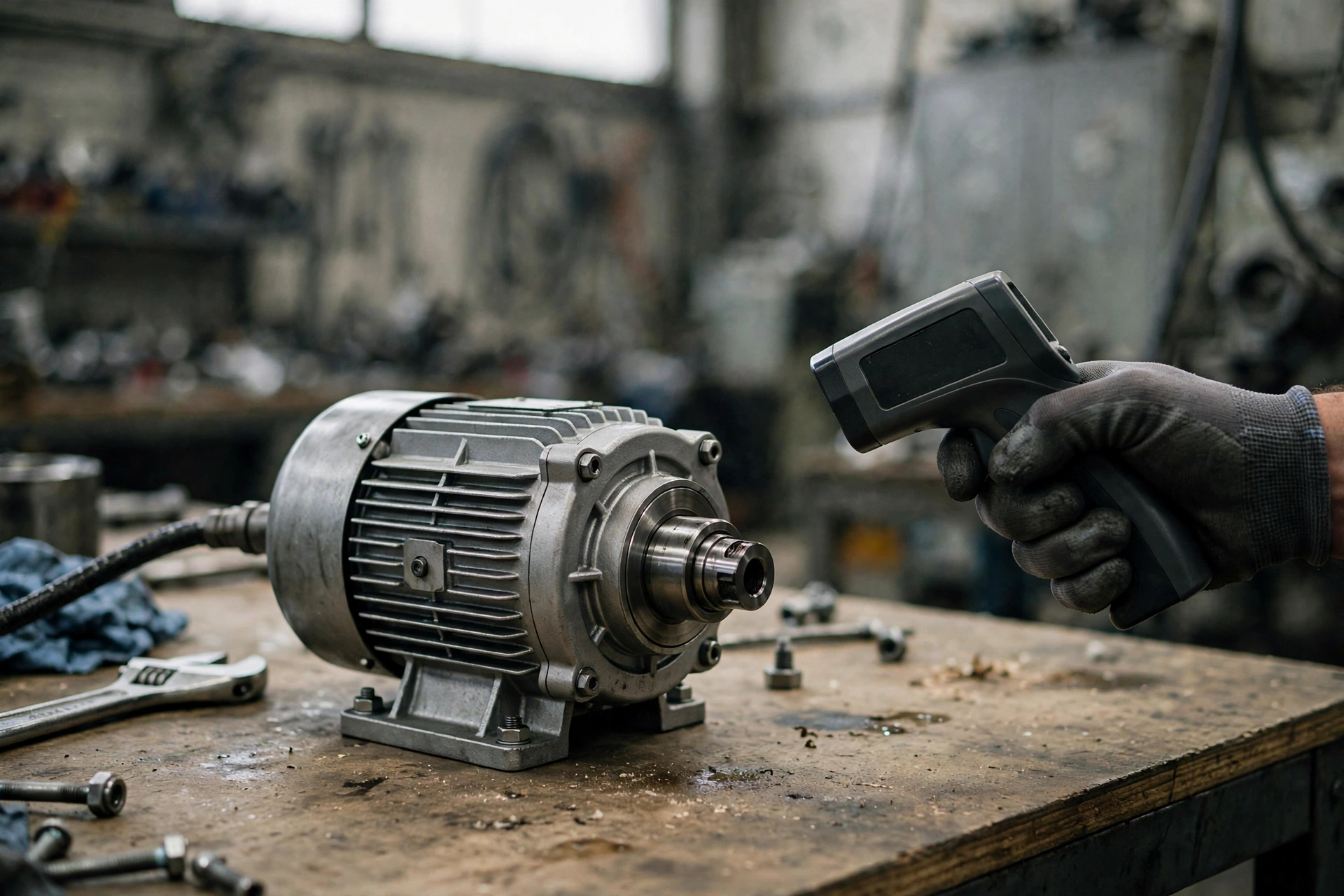
In industrial automation, servo motors find applications in CNC machines, industrial robots, packaging machinery, and precision positioning systems. Their high accuracy, fast response, and reliable motion control make them essential components in modern manufacturing. However, overheating can reduce performance, shorten service life, and cause unexpected equipment downtime. An AC servo motor may overheat due to excessive loads, unstable power supplies, poor ventilation, incorrect drive parameters, or mechanical failures. Understanding these causes and applying appropriate troubleshooting methods can help prevent equipment damage and maintain stable production.
1. What Is AC Servo Motor Overheating?
Overheating occurs when the heat generated during operation exceeds the motor's ability to dissipate it, causing internal components or the housing to reach temperatures beyond their permitted operating limits. During normal operation, heat mainly comes from winding resistance, magnetic losses in the motor core, and mechanical friction. When cooling conditions deteriorate or operating loads increase, heat gradually accumulates.
Common warning signs include:
- High housing temperature: The motor surface becomes unusually hot.
- Drive alarms: The servo drive activates overload or overtemperature protection.
- Unstable operation: Speed fluctuations or positioning errors may occur.
- Abnormal noise: Bearing wear or mechanical friction can produce unusual sounds.
It is important to note that housing temperature does not directly represent winding temperature. Permissible temperatures depend on insulation class, cooling method, and motor design. Always refer to the manufacturer's specifications.
2. 8 Common Causes of AC Servo Motor Overheating
Identifying the root cause is essential for resolving overheating problems. The following factors are frequently encountered in industrial applications.
2.1 Excessive Motor Load
When the mechanical load exceeds the rated capacity, the motor requires greater torque and current. This increases winding copper losses, which are proportional to the square of the current. For example, if the rated current is 5 A but the actual operating current reaches 7 A, winding copper losses can increase by approximately 96%, assuming comparable winding resistance and operating conditions. Continuous overload may eventually damage insulation.
2.2 Incorrect Supply Voltage
An unstable or unsuitable power supply can interfere with normal motor and drive operation.
Common electrical problems include:
- Supply voltage outside the specified operating range.
- Frequent voltage fluctuations.
- Loose electrical connections.
- Improperly sized power cables.
Check the actual supply voltage and compare it with the manufacturer's requirements to identify potential electrical problems.
2.3 Poor Heat Dissipation
Insufficient ventilation prevents heat from escaping efficiently. This often occurs when equipment is installed in enclosed spaces with limited airflow. Dust accumulation, blocked cooling passages, and damaged cooling fans can further reduce heat dissipation. Keeping the installation area clean and maintaining sufficient ventilation are essential for thermal management.
2.4 Incorrect Servo Drive Parameters
The servo drive controls motor speed, position, and torque. Incorrect parameter settings may increase operating current and heat generation. For example, excessively short acceleration times require greater acceleration torque. In applications involving frequent starts and stops, this can cause sustained high-current operation. Incorrect current limits and motor configuration may also contribute to overheating.
2.5 Continuous High-Load Operation
Even when the motor operates within its peak torque limit, prolonged high-load operation can cause excessive heat accumulation. If an AC servo motor operates close to its rated continuous torque for extended periods, insufficient cooling intervals may cause its temperature to rise. Motor selection should therefore consider continuous torque, peak torque, and duty cycle rather than peak torque alone.
2.6 Mechanical Transmission Problems
Mechanical resistance increases the torque required from the motor. Common problems include:
- Worn bearings or insufficient lubrication.
- Misaligned couplings that create additional mechanical loads.
- Binding in ball screws, gears, or transmission mechanisms.
- Excessive friction caused by improper installation.
These conditions increase current consumption and operating temperature. Regular mechanical inspections can help prevent further damage.
2.7 Internal Motor Winding Faults
Winding short circuits, insulation deterioration, and localized insulation damage can cause abnormal heating. A partial winding short may create uneven current distribution and localized hot spots. If ignored, insulation damage can become more severe and eventually cause motor failure.
2.8 Encoder or Feedback System Problems
The encoder provides position and speed information to the servo drive. Damaged cables, unstable feedback signals, or encoder malfunctions can interfere with accurate motion control. In certain situations, feedback errors cause repeated position corrections, increasing motor activity and operating current. Checking encoder connections and feedback signals is therefore an important troubleshooting step.
3. How to Fix AC Servo Motor Overheating Problems?
Once abnormal heating is detected, replacing the motor should not be the first response. A systematic inspection helps identify the actual problem and avoid unnecessary maintenance costs.
| Possible Cause | Inspection Method | Recommended Solution |
|---|---|---|
| Excessive load | Check operating current | Reduce load or select a suitable motor |
| Incorrect voltage | Measure supply voltage | Repair power connections |
| Poor cooling | Inspect fans and ventilation | Clean cooling passages |
| Incorrect parameters | Review drive settings | Optimize control parameters |
| Mechanical resistance | Inspect bearings and couplings | Lubricate or replace components |
| Winding damage | Test insulation and resistance | Arrange professional repair |
| Encoder failure | Check feedback signals | Repair cables or replace encoder |
3.1 Reduce Mechanical Load Check whether the actual load exceeds the motor's rated capacity. Review acceleration requirements, transmission ratios, and operating cycles. If necessary, consider selecting a motor with a higher continuous torque rating.
3.2 Improve Cooling Conditions
Remove dust and oil from the motor housing and ventilation passages. Inspect cooling fans and ensure sufficient airflow around the equipment. Avoid installing motors close to heat sources or inside poorly ventilated enclosures.
3.3 Optimize Servo Drive Parameters
Review acceleration and deceleration times, torque limits, and motor configuration. For applications involving frequent starts and stops, appropriately extending acceleration time may reduce peak torque requirements. All adjustments should follow the manufacturer's recommendations.
3.4 Inspect Mechanical Components
Examine bearings, couplings, gears, and ball screws for wear, misalignment, or excessive friction. Replace damaged components and correct installation problems before restarting the equipment.
3.5 Check Internal Electrical Components
If overheating continues after external problems have been eliminated, inspect winding resistance, insulation condition, and encoder performance. These tests should be performed by qualified technicians using appropriate instruments.
4. How to Prevent AC Servo Motor Overheating?
Preventive maintenance is more effective and economical than dealing with unexpected equipment failures. The following practices can improve long-term operating reliability:
l Choose the right motor: Consider rated torque, peak torque, speed, and duty cycle according to actual application requirements. l Monitor operating temperature: Use an infrared thermometer to record housing temperature and identify unusual changes. l Maintain proper ventilation: Regularly clean cooling passages and ensure that fans operate correctly. l Inspect mechanical components: Check bearings, couplings, and transmission systems for wear, vibration, and abnormal noise. l Check electrical connections: Inspect power cables, terminals, and connectors to prevent loose connections. l Optimize operating parameters: Adjust drive settings according to actual working conditions and avoid unnecessary high-torque operation. For an AC servo motor, keeping historical temperature records is also useful. Comparing readings under similar load and environmental conditions can help technicians identify gradual changes before they develop into serious problems.
Conclusion
Overheating can result from excessive loads, unstable power supplies, insufficient cooling, incorrect drive parameters, mechanical resistance, and internal electrical faults. Understanding the root of the problem is necessary in order to find a solution. Through proper motor selection, optimized operating parameters, regular inspections, and effective cooling, manufacturers can reduce overheating risks, improve equipment reliability, and extend service life. Timely maintenance is essential for maintaining stable performance in industrial automation systems.