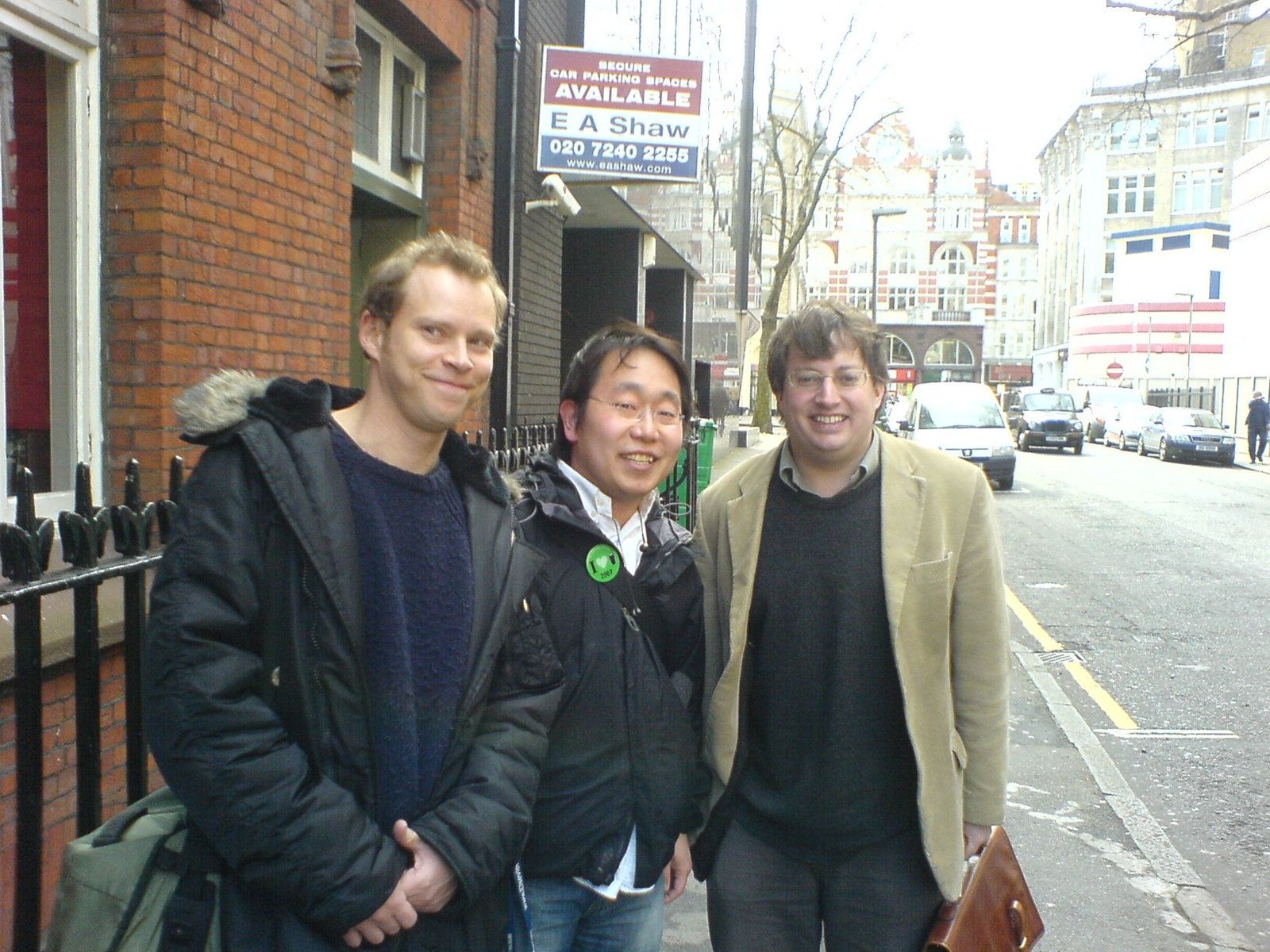
They are the flatmates Britain never quite got over: one a neurotic loan manager who plans his life in spreadsheets and panics about everything, the other a permanently unemployed would-be musician who has never had a plan at all. For twelve years, David Mitchell and Robert Webb played Mark Corrigan and Jeremy Usborne in Peep Show, the Channel 4 sitcom that filmed almost everything from the characters’ own point of view, so the audience could hear exactly what they were thinking and none of what they were brave enough to say. It became the longest-running sitcom in Channel 4 history, and it made Mitchell and Webb one of the most recognisable double acts in British comedy. They had met as students at Cambridge, and they have barely stopped working together since.
Two students at Cambridge
David James Stuart Mitchell was born on 14 July 1974 in Salisbury, Wiltshire, the son of hotel managers. The family moved to Oxford when he was small, and he was educated at Abingdon School before going up to Peterhouse, Cambridge, in 1993 to read history. He had been rejected by Merton College, Oxford, and arrived at Cambridge hoping to write and perform comedy. He joined the Footlights, the university’s famous satirical troupe, and in his first year he turned up to an audition for a Footlights pantomime of Cinderella.
Robert Patrick Webb was born on 29 September 1972 in Boston, Lincolnshire, and was two years older than Mitchell. He had come to Cambridge to read English at Robinson College, and he was at the same Cinderella audition. The two men started talking, started writing sketches together, and found that their humour fitted like a lock and key. Mitchell was precise, verbal and anxious, the kind of comic who can turn a single awkward sentence into a five-minute routine. Webb was warmer, looser and more physical, happy to play the fool and to let a scene run wild. Their first project together came in January 1995, a show about a nuclear apocalypse called Innocent Millions Dead or Dying, which they performed at the Edinburgh Fringe.
The long road to Peep Show
After university, Mitchell and Webb worked as jobbing writers and performers, the way most young comics do: writing sketches for other people’s shows, taking small parts, and staging their own material at Edinburgh whenever they could. They wrote for the sketch show Big Train, and in 2000 they starred in Bruiser, a short-lived BBC sketch series that also featured Olivia Colman and Martin Freeman, two actors who would go on to become stars in their own right. In 2001 they got their own sketch show, The Mitchell and Webb Situation, six episodes on the now-defunct channel Play UK.
Meanwhile, two writers called Jesse Armstrong and Sam Bain were trying to make a sitcom. They brought Mitchell and Webb in to help, and the idea changed shape into something much stranger: a sitcom filmed almost entirely from the characters’ point of view, with the audience hearing their unspoken thoughts as a voiceover. The two characters were flatmates in Croydon, and they were, in the writers’ own description, two men who brought out the worst in each other. Armstrong and Bain wrote the scripts, with additional material from Mitchell and Webb themselves, and in September 2003 Peep Show arrived on Channel 4.
Mark and Jez
Mitchell played Mark Corrigan, a loan manager at the fictional company JLB Credit: intelligent, hard-working, socially awkward and permanently terrified of saying the wrong thing. Webb played Jeremy Usborne, known as Jez, a delusional, self-styled musician who lived in Mark’s spare room, never held down a job and believed, against all evidence, that he was on the verge of greatness. The joke of the show was that neither man was really the hero. Mark was a snob who dreamed of being a historian and behaved appallingly whenever he got the chance. Jez was a narcissist who coasted through life on other people’s patience. Yet the audience loved them both, because the voiceover let you hear their fear and their hope underneath the awfulness.
Peep Show never had big viewing figures, and it was nearly cancelled more than once. What it had instead was devotion. Critics loved it, the audience that found it stayed with it, and it ran for nine series and fifty-four episodes, from 19 September 2003 to 16 December 2015, becoming the longest-running sitcom in Channel 4 history. It won the BAFTA for best situation comedy in 2008, and Mitchell won the BAFTA for best comedy performance in 2009. In 2019, three years after the final episode, a Radio Times poll named it the thirteenth greatest British sitcom of all time. For a show that started as a cult oddity, that was a remarkable afterlife.
The sketch years
Peep Show was only half the story. In 2003, the same year it began, Mitchell and Webb started a sketch show on BBC Radio 4 called That Mitchell and Webb Sound, which ran for four series. It was adapted for television as That Mitchell and Webb Look, which ran for four series on BBC Two from 2006 to 2010 and won the BAFTA for best comedy programme in 2007. The sketches were sharp, literate and often surprisingly angry: a snooker commentator who cannot stop talking, a quiz show in which the contestants already know the answers, a pair of Second World War German officers wondering whether the skulls on their uniforms mean they might be the bad guys. It was the kind of comedy that trusted the audience to keep up, and the audience did.
The duo also made a film, Magicians, in 2007, in which they played rival stage magicians, and they became the faces of Apple’s Get a Mac advertising campaign in Britain, with Mitchell as the buttoned-up PC and Webb as the laid-back Mac. They were jointly nominated for the British Comedy Award for best television comedy actor in 2006, and Mitchell won it the following year.
Going solo, together
What is unusual about Mitchell and Webb is how much they have done apart without ever really splitting up. Mitchell became a fixture of panel shows, as team captain on Would I Lie to You? since 2007 and as host of The Unbelievable Truth on BBC Radio 4. He played William Shakespeare in the BBC Two historical comedy Upstart Crow from 2016 to 2020, wrote a memoir, Back Story, in 2012, and in 2012 he married the television presenter and writer Victoria Coren. Since 2024 he has starred in Ludwig, a BBC One detective comedy-drama in which he plays a puzzle setter who has to solve crimes.
Webb’s solo career has been just as busy. He played Dan, a geology lecturer, in the Channel 4 series Fresh Meat from 2011 to 2016, won Let’s Dance for Comic Relief in 2009 with a celebrated routine to the film Flashdance, and wrote a memoir, How Not to Be a Boy, in 2017. In 2021 he joined Strictly Come Dancing but had to withdraw early on medical advice. A year or two earlier, a routine medical ahead of filming had revealed that he had a heart murmur caused by a mitral valve prolapse, a congenital condition, and he underwent emergency open-heart surgery. He has said since that the experience changed his outlook completely, and that it forced him to stop smoking and drinking. Mitchell, speaking publicly about the scare, said it had reminded him how grateful he was to have his friend in his life.
Back, and still going
The two men came back together for Back, a Channel 4 sitcom that ran from 2017 to 2021, in which Mitchell played Stephen, a man who inherits the family pub, and Webb played Andrew, a drifter who turns up claiming to be his foster brother. It was darker and sadder than Peep Show, a comedy about grief and resentment, and it showed how far the partnership had travelled.
In 2025 they returned to sketch comedy together with Mitchell and Webb Are Not Helping, a brand-new Channel 4 series that showed the act still had plenty left to say. More than thirty years after a Footlights audition in Cambridge, they are still writing together today, still performing together, and still, by all accounts, very good company indeed. For more on two British stars whose partnership survived fame, failure and a health scare, read our piece on Robbie Williams and Gary Barlow.
Peep Show ended in 2015, but Mark and Jez never really left. The show is still quoted, still rewatched, still discovered by new viewers who find themselves in that Croydon flat. Mitchell and Webb made a sitcom about two losers and turned it into a classic, and they did it the way they have done everything since 1993: together, in a room, writing jokes until they were good enough to perform.