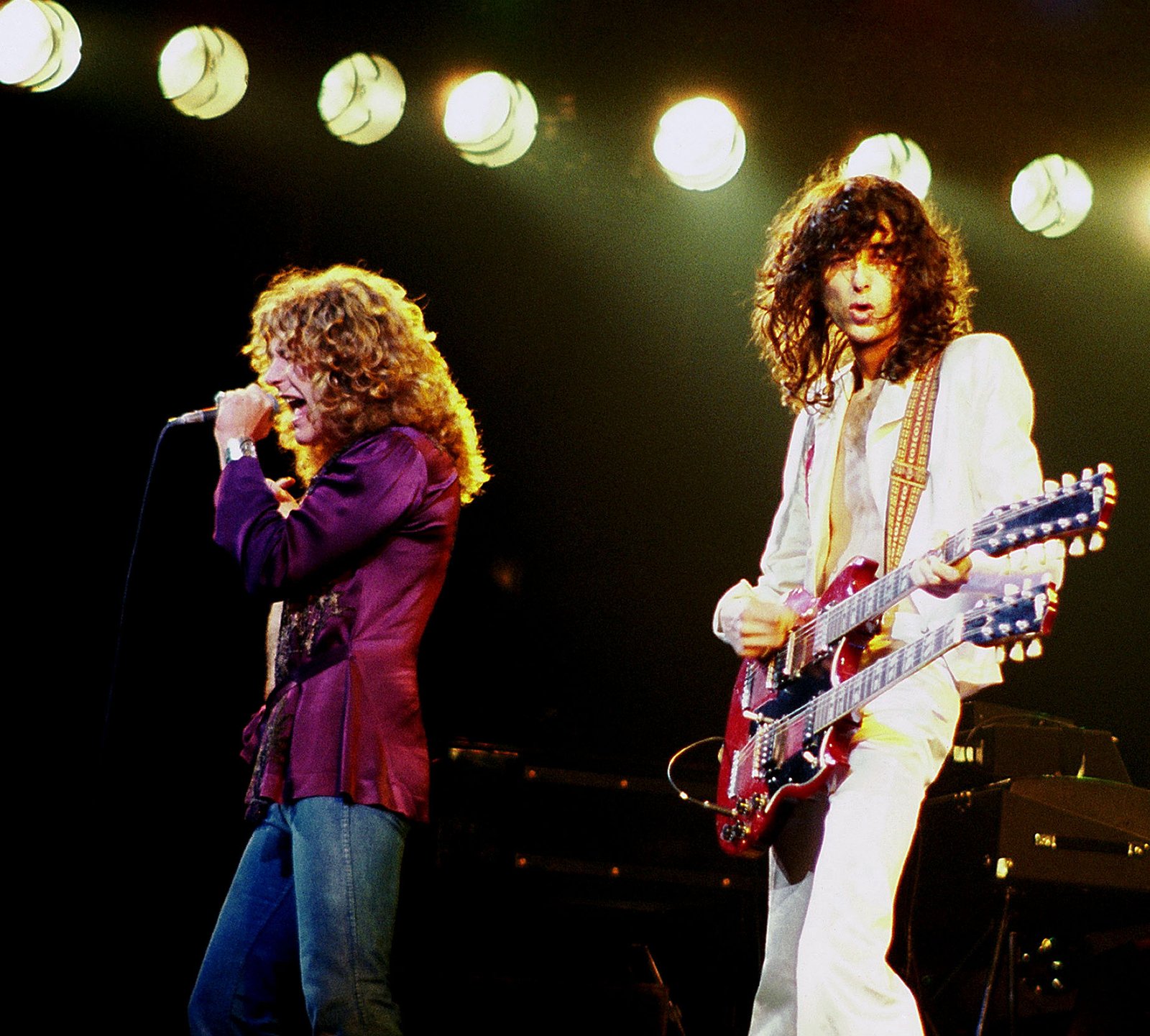
Every great band has a sound you can recognise in two seconds, and for Led Zeppelin that sound was two men at once: a guitar riff that seemed to come from somewhere older and heavier than rock music, and a voice that could climb above it like a cry. The guitarist was Jimmy Page, the man who built the band from nothing. The singer was Robert Plant, a nineteen-year-old from the Black Country with hair down to his shoulders and a voice nobody in London had heard before. Together they made eight studio albums in ten years, sold somewhere between two hundred and three hundred million records, and became the biggest rock band in the world.
The session man from Heston
James Patrick Page was born on 9 January 1944 in Heston, Middlesex, and grew up in Epsom, Surrey. He picked up the guitar as a teenager, played in skiffle groups, and then discovered that he had a rarer talent than playing: he could walk into a recording studio, hear a song once, and play exactly what it needed. By the middle of the nineteen sixties he was the most sought-after session guitarist in London, playing on records by the Who, the Kinks, Donovan and Joe Cocker.
In 1966 he joined the Yardbirds, first on bass and then as lead guitarist, and spent two years touring the world with a band that was falling apart around him. When the Yardbirds finally broke up in the summer of 1968, Page was left with the rights to the name and a handful of Scandinavian tour dates still to play. He needed a new band, fast.
Page was not a frontman. He was a quiet, precise man who thought in terms of sound: the weight of a riff, the space between the drums, the way a guitar could be layered until it sounded like an orchestra. To find his singer, his first choice, Terry Reid, turned him down and suggested someone else instead: a young singer from the Midlands called Robert Plant.
The singer from the Black Country
Robert Anthony Plant was born on 20 August 1948 in West Bromwich, Staffordshire, and grew up in Halesowen, Worcestershire. His father was a civil engineer who wanted his son to have a proper profession, and Plant briefly trained as a chartered accountant before leaving home at sixteen to sing in local blues bands. He idolised Elvis Presley and the great blues singers, and he sang with a high, keening voice full of blues phrasing and sudden, thrilling leaps.
Before Page found him, Plant was singing in a band called Hobbstweedle and had played in Band of Joy alongside a drummer from Redditch called John Bonham. Page saw him perform and heard what he needed: a singer who could match the power of the music he was writing, and who could also sing quietly, tenderly, when a song demanded it. Plant accepted on the spot, and then did Page the greatest favour of his career: he recommended Bonham as the drummer. Bassist John Paul Jones, an old session colleague of Page’s, completed the line-up. The four men first played together in August 1968, in a rehearsal room below a record shop on Gerrard Street in London.
They played a short tour of Scandinavia as the New Yardbirds, honouring Page’s old commitments, and made their first appearance on 7 September 1968 at the Gladsaxe Teen Club in Denmark. Within weeks they had a new name, Led Zeppelin, and an advance from Atlantic Records reported at two hundred thousand dollars, then the largest ever given to a new band. Their first album, released on 12 January 1969, was recorded in about thirty hours. It reached the top ten on both sides of the Atlantic.
Eight albums in ten years
What followed was the most concentrated run of creativity in rock history. Led Zeppelin II arrived later in 1969, with Whole Lotta Love, the riff that became their signature. Led Zeppelin III followed in 1970, full of acoustic folk and Welsh hillside ballads. Then came the untitled fourth album in 1971, the record with Stairway to Heaven on it. Houses of the Holy came in 1973, Physical Graffiti, a sprawling double album, in 1975, Presence in 1976 and In Through the Out Door in 1979.
The partnership at the centre of it was simple and perfectly balanced. Page wrote most of the music, building songs out of riffs, tunings and studio experiments. Plant wrote most of the words, filling them with mythology, Tolkien, folk tales and open-hearted romance. On stage, they were a matched pair: Page in his white suits and later his dragon-embroidered jackets, hunched over a Gibson Les Paul or the double-neck guitar he used for Stairway to Heaven; Plant bare-chested, hair flying, working the front of the stage like a preacher.
The numbers are almost absurd. All eight of the band’s original studio albums reached the top ten of the American album chart, and six of them reached number one. In Britain they had eight consecutive number-one albums. The band’s total sales are estimated at between two hundred and three hundred million albums, with more than a hundred million certified in the United States alone. They were inducted into the Rock and Roll Hall of Fame in 1995.
The end, and the long afterlife
It ended on 25 September 1980, when John Bonham died at Page’s home in Windsor after a day of heavy drinking. He was thirty-two. The three surviving members issued a short statement in December of that year: they could not continue as they were, and the band was over. There would be no replacement drummer, no attempt to carry on under the same name.
Both men went on to long solo careers, and neither tried to repeat what they had done together. Plant released his first solo album, Pictures at Eleven, in 1982, and built a career that kept moving: the hard rock of Now and Zen in 1988, the folk and world-music experiments of the nineties, and then, in 2007, Raising Sand, a duet album with the bluegrass singer Alison Krauss that won five Grammy Awards in 2009, including album of the year. Plant was appointed a Commander of the Order of the British Empire in 2009, and in recent years he has toured with his band Saving Grace, playing small halls and folk clubs.
Page’s path was quieter. He formed the Firm with the singer Paul Rodgers in the mid nineteen eighties, made an album with David Coverdale in 1993, and played on the occasional soundtrack and tribute. He spent much of his energy looking after the band’s legacy, remastering the catalogue and overseeing the deluxe reissues of the first three albums in 2014. He was awarded an OBE in 2005, and he remains, by common consent, one of the greatest guitarists who ever lived.
Page and Plant, together again
The two men did come back together, twice, and both times it mattered. In 1994 they reunited as Page and Plant for No Quarter, an MTV Unplugged special and album that reimagined Zeppelin songs with orchestras, Moroccan musicians and acoustic instruments. It led to a world tour and a second album, Walking into Clarksdale, in 1998. Then they went their separate ways again.
The exception came on 10 December 2007, at the O2 Arena in London, for a tribute concert to Ahmet Ertegun, the founder of Atlantic Records. Plant, Page and John Paul Jones played a two-hour set, with Jason Bonham, John’s son, on drums. Twenty million people applied for tickets, according to Guinness World Records. The concert was released as the film Celebration Day in 2012, and it remains the last time the three surviving members played together.
Since then, the story has continued in other forms. Becoming Led Zeppelin, the first documentary made with the band’s participation, reached cinemas in February 2025, telling the story of the band’s formation and early years. Plant keeps touring with Saving Grace, and Page keeps the archive alive. Neither man has any interest in pretending that 1968 can happen again, and that is precisely why the music still sounds so alive.
The voice and the guitar
Put them side by side and the partnership is easy to see. Page is the architect: the man who heard the band before it existed, who wrote the riffs, produced the records and built the sound from the ground up. Plant is the voice: the singer who gave that sound its human heart, its romance and its wildness. Together they were Led Zeppelin. For more on two British stars who built a partnership that defined an era, read our piece on Mick Jagger and Keith Richards.
Nearly sixty years after a rehearsal room in Gerrard Street, the songs are still everywhere: on the radio, in films, in stadiums, in the record collections of people who were not born when the band ended. Stairway to Heaven still gets requested. Whole Lotta Love still sounds dangerous.