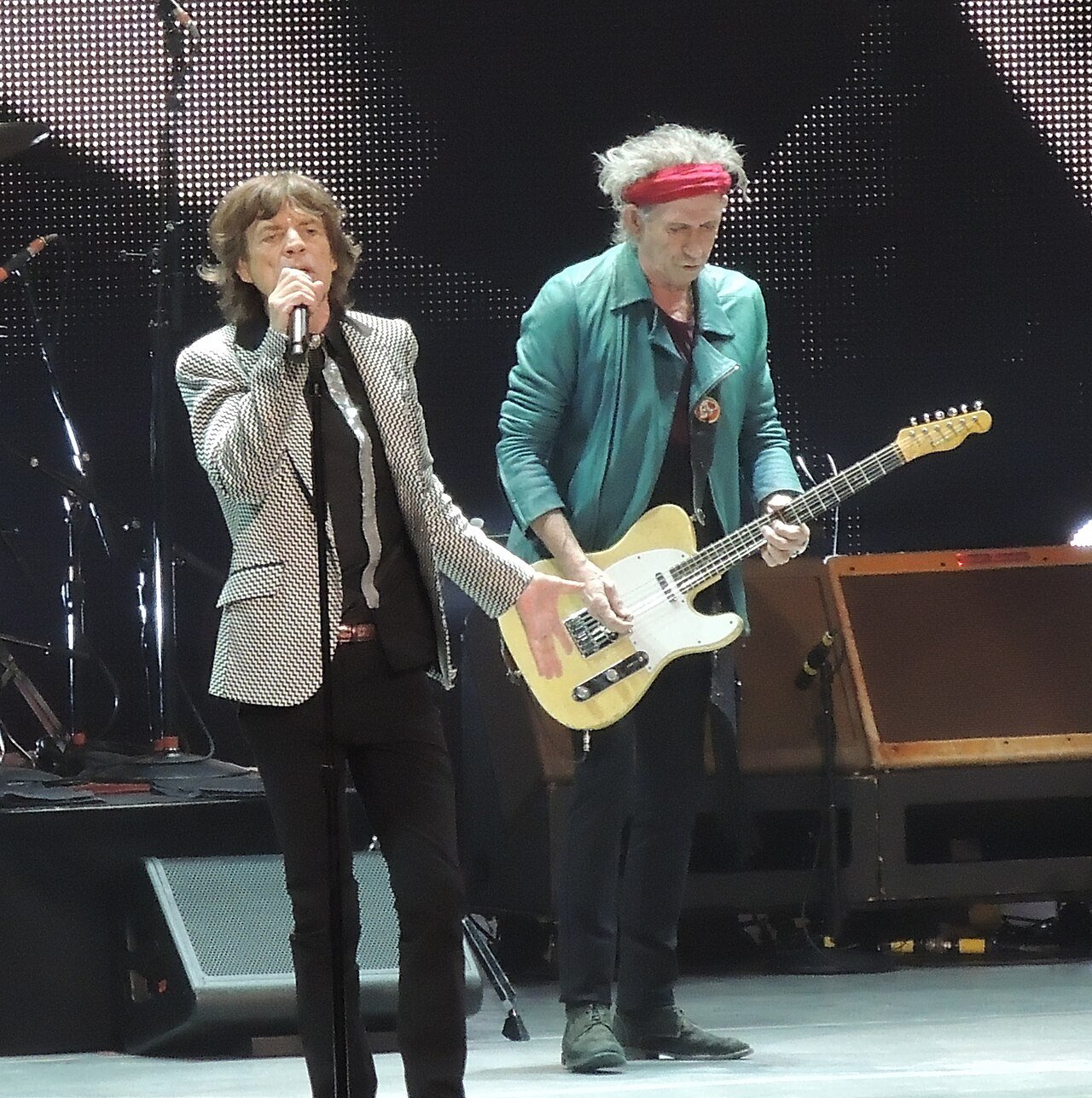
Some partnerships in rock music last for an album or two. Mick Jagger and Keith Richards have lasted for more than sixty years. Born five months apart in the same Kent town, they met as schoolboys, lost touch, met again on a railway platform, and wrote some of the most famous songs ever recorded. They have quarrelled bitterly, yet they always come back to the same stage. That is the story of the Glimmer Twins, one of the great partnerships in British music.
The Rolling Stones formed in London in 1962, and Jagger and Richards have been at the centre of the band ever since. Jagger is the singer and restless frontman. Richards is the guitarist and riff-maker, the keeper of the band’s sound. Between them they wrote the songs that made the Stones the self-styled greatest rock and roll band in the world, and they kept the band going long after most rivals had gone.
Two Dartford Boys
Michael Philip Jagger was born on 26 July 1943 in Dartford, Kent. Keith Richards was born in the same town on 18 December 1943, the son of Bert Richards, a factory worker, and his wife Doris. The two boys met at Wentworth Primary School in Dartford, where they were classmates in the early 1950s. They lived a street apart and played together as children.
They drifted apart when the Jagger family moved, and they went to different secondary schools. Jagger won a place at the London School of Economics, while Richards went to Sidcup Art College. Then, on 17 October 1961, they met again on platform two of Dartford railway station. Jagger was carrying records by Chuck Berry and Muddy Waters, ordered from Chess Records in Chicago. Richards, carrying his guitar, had only heard of Muddy Waters. The records started a conversation, the conversation became a friendship, and the friendship became a band.
Mick Jagger: The Frontman
Jagger was the singer from the start, and he soon became one of the most recognisable frontmen in rock. Where the Beatles looked charming in matching suits, Jagger looked dangerous. He sang with a sneer and moved like no one else on stage. Off stage he handled the band’s business, a role that later caused friction with Richards.
He was also the band’s lyricist, the one who gave their songs their bite. His words could be funny, cruel, political, and romantic. As the decades passed, his energy on stage barely seemed to dim. Well into his eighties, he still runs and dances across stadiums. He was knighted for services to music, with the ceremony taking place in December 2003, yet the band has always been his home.
Keith Richards: The Riff-Maker
If Jagger is the face of the Rolling Stones, Richards is their sound. He is the guitarist who built the band’s songs around riffs, short repeated patterns that lodge in the memory and never quite leave. The opening riff of “(I Can’t Get No) Satisfaction” is one of the most famous sounds in popular music.
Richards learned his craft from the American blues records he and Jagger collected as teenagers. He bent that music into a harder, more modern sound, mixing rhythm and lead guitar into the Stones’ trademark weave. Other guitarists came and went, but Richards was always there.
The Jagger-Richards Songwriting Partnership
The partnership began because their manager, Andrew Loog Oldham, told them to write their own songs. At first the Stones had survived on covers of American blues and rock and roll, but Oldham saw that the Beatles were writing their own material, and he wanted the same for his band. Jagger and Richards were locked in a room together and told not to come out until they had written something. Within a couple of years they were writing hits.
Their way of working was simple and uneven. Sometimes Richards brought a riff and Jagger added words. Sometimes Jagger brought a nearly finished song and Richards roughened it up. Sometimes one of them wrote almost everything alone, yet the credit was always shared. The Jagger-Richards credit became one of the most famous names in songwriting, and a source of resentment, since the split was always equal.
They also produced the band’s albums together under the name the Glimmer Twins. The nickname came from a cruise to Brazil around the turn of 1969, when an older English passenger kept asking the two men who they were. When they refused to say, she asked them to give her just a glimmer, a hint, and the phrase stuck. From 1974’s It’s Only Rock ’n’ Roll onwards, the Glimmer Twins took the production credits.
The Golden Run of Songs
The hits arrived quickly once the partnership found its feet. “(I Can’t Get No) Satisfaction” came in 1965, with Richards’s famous fuzz-guitar riff, and it became the band’s first American number one. “Paint It Black” followed in 1966, on Aftermath, the band’s first album of entirely original material. Then came “Jumpin’ Jack Flash” in 1968, “Sympathy for the Devil” on Beggars Banquet the same year, and “Gimme Shelter” on Let It Bleed in 1969.
Those songs did more than sell records. They gave the Stones an identity that no other band could copy. The Beatles sang about love, while the Stones sang about darker things. Sticky Fingers arrived in 1971, Exile on Main St. in 1972, and Some Girls in 1978. “Start Me Up”, from Tattoo You in 1981, still opens their shows more than forty years later. What made the songs last was the tension inside them: Jagger’s voice pushing forward while Richards’s guitar held the groove.
The Feud and Life
By the 1980s, the partnership was in trouble. Jagger wanted to make solo records and slow the band down. Richards wanted to tour and record as a band, and he thought Jagger was putting himself before the Stones. The arguments became public, and for a time the band barely functioned. In 1989 they were inducted into the Rock and Roll Hall of Fame and made Steel Wheels, widely seen as a comeback, before going back on the road.
The wounds reopened in 2010, when Richards published his autobiography, Life, on 26 October that year. The book was a bestseller and widely praised, but it also contained passages that mocked Jagger, including remarks about his anatomy and his appetite for honours. Jagger was furious, and for a while it seemed the damage might be permanent. Richards later softened his tone, saying that time had eased the anger, and the two men went back to work. The book showed the public what the band had always known: a real, complicated, sometimes angry friendship.
Loss, Survival, and the Later Years
The band changed around them. Brian Jones died in July 1969, Mick Taylor came and went, Ronnie Wood took his place, and Bill Wyman left in 1993. Through it all, Jagger and Richards remained.
The hardest loss came in August 2021, when Charlie Watts, the band’s drummer since 1963, died at the age of eighty. Watts had been the band’s quiet centre. Jagger and Richards decided the band could go on, with Steve Jordan, a longtime friend and collaborator of Richards, taking over the drums. After nearly sixty years, they still believed there were songs left to write.
Hackney Diamonds and Still Going
That belief produced Hackney Diamonds, released on 20 October 2023. It was the band’s first album of original material since A Bigger Bang in 2005, and their first since the death of Charlie Watts. The album featured guest appearances from Elton John, Lady Gaga, Paul McCartney, and Stevie Wonder, and it won the Grammy Award for best rock album in 2025. A Hackney Diamonds tour followed in 2024.
The album mattered because it was not a nostalgia exercise. Jagger and Richards had set a deadline and written new songs together, as they had since the 1960s. For two men in their eighties, it proved the partnership still worked. The Stones have never formally broken up, and Jagger and Richards have never walked away from each other for good.
Why Their Partnership Endures
Part of the answer is simple: they need each other. Jagger without Richards would be a great frontman without his sound. Richards without Jagger would be a great guitarist without his voice. Together, they are the Rolling Stones, and both men know it. The songs need the singer and the riff, and the show needs them both.
The other part is harder to explain, and it is the part that keeps people fascinated. They have known each other longer than almost anyone else. They shared a childhood, a railway platform, a love of American blues, and sixty years of triumph and disaster. Like brothers, they can be cruel and fiercely loyal at the same time, and they always come back. Like the great British pairings, from Liam Gallagher and Noel Gallagher onwards, theirs was built on talent, trust, and time, and it will be remembered long after the final encore.