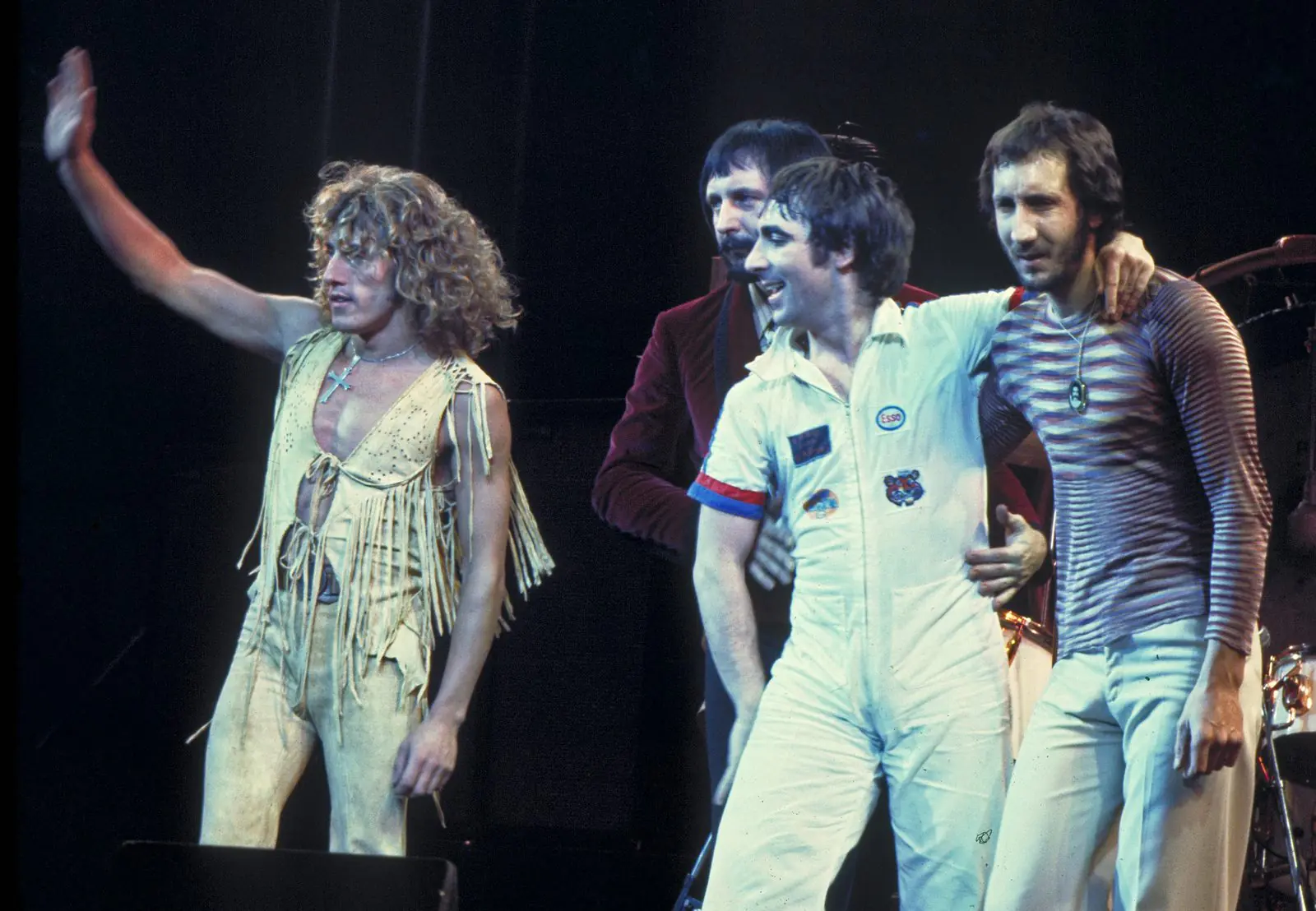
There is a moment in every Who concert, somewhere near the end, when Pete Townshend winds his arm in a great circle and brings it crashing down on his guitar, and Roger Daltrey steps up to the microphone and lets out a scream that has not changed in sixty years. It is the sound of a band that was supposed to have burned out by 1970, and it is still happening in 2026. Townshend and Daltrey have been the heart of The Who for more than six decades, through the deaths of two bandmates, through break-ups and reunions, through a farewell tour that may not even have been the farewell. They have argued in public and in private for most of their adult lives, but they are one of the great partnerships in British rock, and the band they built is still standing when almost everything else from their era has gone.
Two London boys
Roger Harry Daltrey was born on 1 March 1944 in East Acton, London, and grew up in a working-class household in Shepherd’s Bush. He was expelled from school, worked as a sheet-metal worker, and played guitar in a skiffle band before he ever thought of singing. He was tough, ambitious and impatient, and he wanted to be in a band that mattered.
Peter Dennis Blandford Townshend was born on 19 May 1945 in Chiswick, the son of a professional saxophonist and a singer. He grew up surrounded by music, studied at Ealing Art College, and arrived at the guitar with a head full of art-school ideas about what rock music could be. He was the thinker of the partnership, Daltrey was the doer, and the tension between them has driven the band ever since.
They met through the local music scene in west London. Daltrey was the frontman of a band called The Detours, and Townshend joined on guitar in 1961. By 1964, with John Entwistle on bass and Keith Moon on drums, the band had become The Who. Their early singles, “I Can’t Explain” and “My Generation”, announced a band with a sound like nothing else: Townshend’s power chords, Moon’s drumming like a small explosion, Entwistle’s bass playing lead, and Daltrey’s voice cutting through the noise.
Tommy and the rock opera
The Who’s first great leap came with Tommy in 1969, a double album that told the story of a deaf, dumb and blind boy who becomes a pinball champion and a messianic figure. It was Townshend’s idea, a rock opera at a time when nobody quite knew what that meant, and it was a huge commercial success. The band played it at Woodstock in August 1969, at dawn, to an audience that had been awake all night, and the performance made them one of the biggest bands in the world.
What followed was the run of albums that defined them. Who’s Next, released in 1971, contained “Baba O’Riley”, “Won’t Get Fooled Again” and “The Song Is Over”, and it remains their most loved record. Quadrophenia, from 1973, was another concept album, this time about the mod culture of the early 1960s, and it gave the band a second masterpiece. They were built on a partnership in which Townshend wrote the songs and Daltrey gave them their voice. Townshend wrote more than a hundred songs for the band, but it was Daltrey who made them sound like The Who.
Loss and survival
The first great loss came on 7 September 1978, when Keith Moon died at the age of thirty-two. Moon had been the wildest drummer in rock, a man whose playing was as unpredictable off stage as on it, and the band was never the same without him. They carried on with Kenney Jones on drums, but the spark was dimmer, and in 1983 Townshend announced that the band was splitting up. They played a farewell tour that year, and for a while it looked as if that was the end.
It was not. They reunited for Live Aid in 1985, and they have been coming back ever since, in one form or another. The full-time reunion began in 1999, with Zak Starkey, the son of Ringo Starr, on drums, and it brought a new energy to the band. But the second great loss was already in the past by then. On 27 June 2002, John Entwistle died of a heart attack in a Las Vegas hotel room, on the eve of a tour, at the age of fifty-seven. Townshend and Daltrey decided to carry on as a duo at the front of the band, with a rotating cast of musicians behind them, and they have done so ever since.
The drummer problem
If there is a single episode that captures the strange, fractious nature of the Townshend and Daltrey partnership, it is the saga of Zak Starkey in 2025. Starkey had been the band’s drummer for more than two decades, and he was popular with fans. But at a Teenage Cancer Trust concert at the Royal Albert Hall on 30 March 2025, Daltrey stopped the band in the middle of “The Song Is Over”, telling the audience he could not hear the key of the song over the drums. It was an extraordinary moment, played out in front of a charity audience, and it led to Starkey being fired on 16 April 2025.
Three days later, after Townshend posted a message online saying “Who Back Zak!”, Starkey was rehired. A month later, on 18 May, he was fired again, and Scott Devours, the drummer from Daltrey’s solo band, took his place for the farewell tour. The Who carried on, as they always have.
The farewell tour
The Song Is Over farewell tour was announced on 8 May 2025, and it was billed as the band’s final tour of North America. It ran from 16 August to 28 September 2025, with a final added show on 1 October at the Acrisure Arena in Palm Desert, California. There were no farewell dates announced for Britain, which left British fans wondering whether they would ever see the band again. Townshend, during the tour, said that he probably had another five years in show business, and that the pair reserved the right to “pop up again” for charity shows and special projects.
That reservation turned out to matter. In August 2026, Daltrey confirmed during solo shows in Las Vegas that the band had reunited with Zak Starkey after rehearsals, saying “it sounded great”, and that they might perform live again, though he ruled out a residency at the Sphere in Las Vegas. The band’s official website also lists an appearance at the New Orleans Jazz Festival on 24 April 2027, although that listing should be treated with caution, since it has not been confirmed as a full Who show. Daltrey also has solo dates at the Royal Albert Hall on 2 and 3 December 2026, part of a Bob Harris celebration. The farewell, it seems, may not have been final after all.
Sixty years on
What keeps Townshend and Daltrey going, when so many of their contemporaries have retired or died, is partly stubbornness and partly need. Townshend has always been the restless one, the songwriter who cannot stop writing, and Daltrey has always been the performer, the man who needs a stage and an audience. They need each other in a way that neither of them would quite admit. Townshend’s songs without Daltrey’s voice are clever and interesting; Daltrey without Townshend’s songs is a great singer with nothing to sing. Together, they are The Who.
Daltrey was knighted in the King’s Birthday Honours in June 2025, for his services to music and to charity, a recognition of a lifetime that has included decades of work for the Teenage Cancer Trust. One of them is the public face, the singer who works the room and the charity circuit; the other is the private one, the writer who disappears into his studio and emerges with a new song. They have been like that since 1964, and they are still like that now.
The last men standing
The Who are, in the end, a story about survival. They survived the death of Keith Moon and the death of John Entwistle. They survived a split in 1983 and a dozen false endings since. They survived the changing fashions of six decades, and they are still here, still arguing, still playing.
Whether they play again in 2027 or not, their place is secure. Tommy, Who’s Next and Quadrophenia are among the greatest albums ever made in Britain, and the partnership that made them — the songwriter and the singer, the thinker and the doer — is one of the most durable in the history of rock. For more on two British rock legends whose partnership defined an era, read our piece on Mick Jagger and Keith Richards.