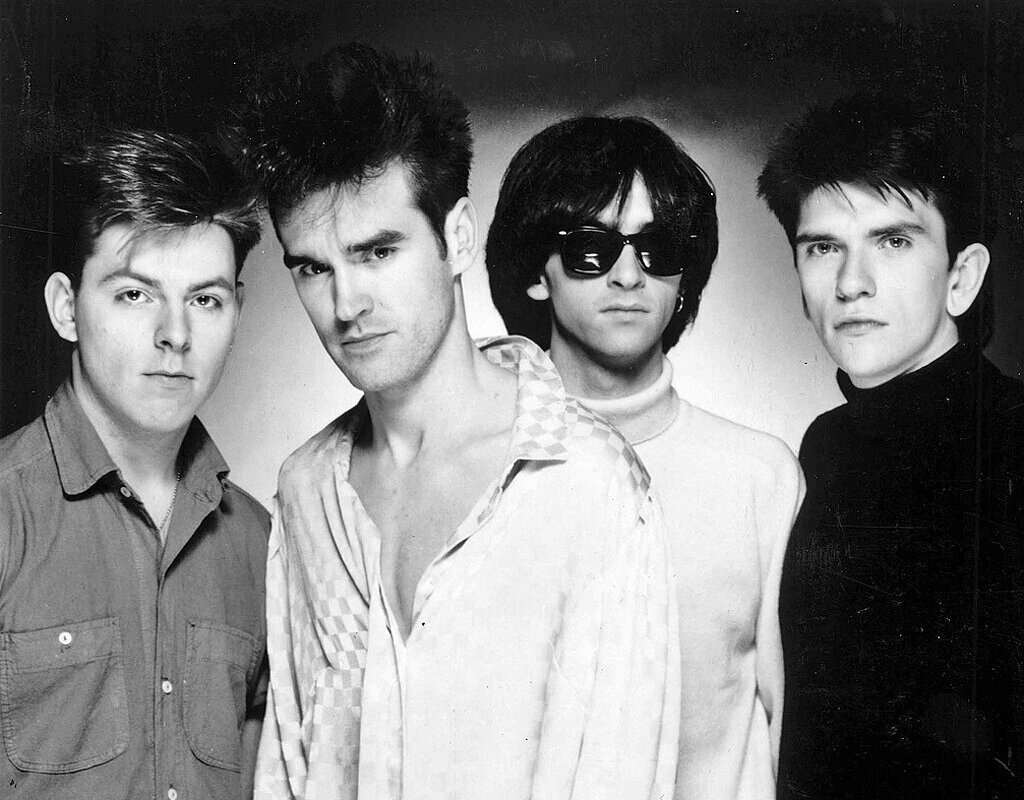
Some partnerships in British music are remembered for the songs, and some for the silence that followed them. Morrissey and Johnny Marr belong to both. Together they wrote four albums in five years that remade British guitar music, and then they stopped speaking in any meaningful way for nearly forty years. The Smiths made only four studio albums, yet their influence runs through almost everything that followed: the jangling guitars of the indie bands of the late 1980s, the swagger of the Britpop groups of the 1990s, and the confessional songwriting of singers who learned that a pop song could be literate, funny, miserable and thrilling at the same time.
Two Manchester boys
Steven Patrick Morrissey was born on 22 May 1959 in Davyhulme, on the edge of Manchester, the son of Irish immigrants. He grew up in Stretford, a bookish, awkward boy who loved Oscar Wilde, the New York Dolls and the kitchen-sink dramas of post-war Britain. He wrote letters to the music papers and ran a fan club for the New York Dolls. He was not an obvious pop star. He was shy, intense, and convinced that the world of pop music was run by people who did not understand it at all.
John Martin Maher, who would become Johnny Marr, was born on 31 October 1963 in Manchester, also to Irish parents. He was four years younger than Morrissey, and the opposite kind of teenager: a prodigy guitarist who had been playing since childhood, obsessed with the sound of a Rickenbacker and the records of the 1960s. He had played in several local bands by sixteen, and he knew he wanted to be in a great band. The two first crossed paths at a Patti Smith concert at the Manchester Apollo on 31 August 1978, but the meeting that mattered came four years later, when Marr knocked on Morrissey’s door in May 1982 and asked him to start a band. Morrissey said yes, and The Smiths were born.
The sound of the Smiths
What Marr brought was the music. His guitar playing was unlike anything else in British pop at the time: bright, chiming arpeggios that owed as much to folk and to the Byrds as to punk, layered with a melodic inventiveness that made even the simplest chord sequence sound like it had been written by someone showing off.
What Morrissey brought was the words, and a voice that nobody else in British music possessed. He sang about shyness and celibacy, about the misery of provincial life and the cruelty of the meat industry, about Oscar Wilde and kitchen sinks and the strange, bruised romance of being young and out of place. He wore NHS glasses, a hearing aid and a bunch of gladioli in his back pocket, and he turned awkwardness into a style. The Smiths signed to Rough Trade in 1983, and their first single, “Hand in Glove”, arrived that May, followed by “This Charming Man”.
Four albums in five years
The Smiths’ self-titled debut album arrived in February 1984 and reached number two in the British charts. It was followed by Meat Is Murder in 1985, which went to number one, and then by the album most fans and critics still regard as their masterpiece, The Queen Is Dead, in June 1986. That record contains “There Is a Light That Never Goes Out” and “Bigmouth Strikes Again”, and it remains one of the most loved British albums ever made. Their final album, Strangeways, Here We Come, was released in September 1987, after the band had already split.
The remarkable thing about those five years is how much they packed into them. The Smiths were prolific in a way that seems impossible now: four albums, a string of singles that charted on their own terms, and songs — “How Soon Is Now?”, “Panic”, “Shoplifters of the World Unite” — that have outlived almost everything else released in the same decade. They played their last concert in Brixton in December 1986, and they never played together again.
The split
The break came in the summer of 1987. Marr, exhausted by the touring and frustrated by the band’s management and by Morrissey’s working methods, left in July of that year. The remaining members tried to carry on, but the band was finished by the end of 1987. The reasons have been argued over ever since, in books, in documentaries and in court, when the band’s drummer, Mike Joyce, successfully sued for a share of the royalties.
The years since have been marked by a long, public estrangement. Morrissey and Marr have traded barbs in interviews and on social media, and the bassist Andy Rourke, who died in 2023, was often the only one of the four who kept in touch with both sides. The story of the split is, in its way, as famous as the music: two brilliant, stubborn men who needed each other and could not stand each other, and a band that burned so brightly it could not last.
The reunion that never happened
Few bands in history have been offered as much money to reunite as The Smiths, and few have refused it so consistently. In August 2024 Morrissey wrote on his website, Morrissey Central, that the concert promoters AEG had made a lucrative offer for a Smiths reunion tour in 2025, that he had said yes, and that Marr had ignored the offer. Marr replied on Instagram the following month with a short, pointed correction: “I didn’t ignore the offer — I said no.”
He said it again in June 2025, on the Stick to Football podcast, explaining that the offer had been “an eye-watering amount of money” but that “the vibe’s not right”. Morrissey, for his part, told the writer Fiona Dodwell in December 2024 that he had agreed to the reunion because it felt like the last time such a thing would be possible, and that he had “absolutely none” of the emotional attachment to Marr that fans assumed. As of November 2026, no reunion has happened, and none is scheduled.
Two solo careers
Morrissey’s solo career began almost immediately, with Viva Hate in March 1988, which went to number one in Britain and produced the singles “Suedehead” and “Everyday Is Like Sunday”. He has released fourteen solo albums since, including Your Arsenal in 1992 and Vauxhall and I in 1994, another number one, and he enjoyed a full commercial comeback with You Are the Quarry in 2004. His fourteenth solo album, Make-Up Is a Lie, was released in March 2026, and he toured the United States and Europe through the summer and autumn of that year. His later public statements have divided opinion, but his concerts still sell out, and his audience remains fiercely loyal.
Marr took a different path. He joined The The, formed Electronic with Bernard Sumner of New Order, scoring a hit with “Getting Away with It”, played with Modest Mouse and The Cribs, and became one of the most in-demand session guitarists in the world, working with everyone from Talking Heads and the Pet Shop Boys to Billie Eilish and Hans Zimmer. His solo career began in earnest with The Messenger in 2013, followed by Playland, Call the Comet and Fever Dreams Pts 1–4. His fifth solo album, The Age of Everything, was released on 2 October 2026 and reached number five in the UK charts. His autobiography, Set the Boy Free, was published in 2016.
What neither of them ever managed, for all their solo success, was to escape the shadow of the band. Morrissey’s concerts still lean heavily on Smiths songs, and Marr still plays them in his own sets, to the delight of audiences who never saw the original band. The songs belong to both of them, and to neither of them alone, which is perhaps why the argument over the reunion has never really ended.
Why they still matter
The Smiths matter because they proved that British pop music could be intelligent without being boring, and emotional without being sentimental. Marr’s guitar work rewrote the rules of what a British guitar band could sound like, and Morrissey’s lyrics gave a voice to a generation of young people who felt like outsiders in their own country. Every British indie band that followed owes them something, and the songs have never gone away: “There Is a Light That Never Goes Out” is still discovered by teenagers who were not born when the band split.
Four albums, five years, and a partnership that ended in silence — and yet the music is still being played and loved, nearly forty years after the last note. For more on two British musicians whose partnership defined an era, read our piece on Robert Plant and Jimmy Page, and Morrissey remains one of British music’s most complicated figures, though the songs he wrote with Johnny Marr are beyond argument.