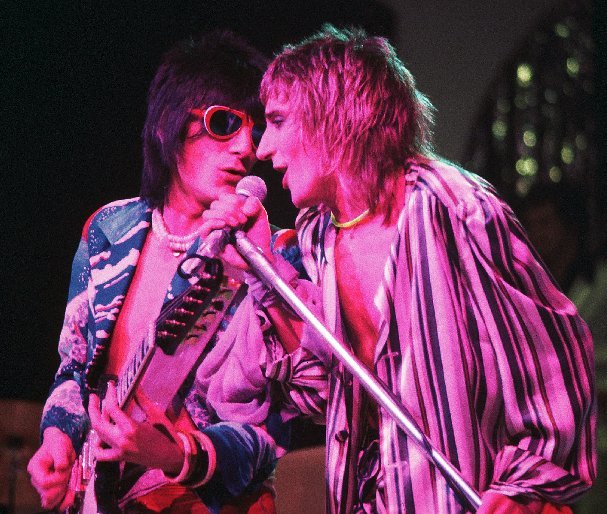
Some partnerships in rock are built on planning, and some on two men who simply could not stop playing together. Rod Stewart and Ronnie Wood belong firmly in the second group. They met in the Jeff Beck Group, walked out of it together in 1969, and spent six years as the singer and guitarist of the Faces. Rod Stewart went on to become one of the best-selling solo artists of all time, and Wood spent half a century as a Rolling Stone. Yet whenever they share a stage, the sound is the Faces all over again.
The singer from Highgate
Roderick David Stewart was born on 10 January 1945 at 507 Archway Road in Highgate, north London, the youngest of five children. His father was a Scot from Leith in Edinburgh who had moved south to work as a master builder. The young Rod spent time as a Brentford Football Club apprentice, but music won in the end.
Stewart’s career began in 1962, when he took up busking with a harmonica in London. The following year he joined the Dimensions as a harmonica player and singer, and in 1964 he moved on to Long John Baldry and the All Stars. These were the hard years of the London rhythm and blues scene, and they taught him his trade.
By 1967 he had joined the Jeff Beck Group, and there he met the guitarist who would shape the rest of his working life. The band made two albums, Truth in 1968 and Beck-Ola in 1969, and toured America, where audiences took to them at once. But in the summer of 1969 it fell apart. Stewart was twenty-four and out of a band, about to make the two decisions that defined his career: he would record on his own, and he would do it with Wood beside him.
The guitarist from Hillingdon
Ronald David Wood was born on 1 June 1947 in Hillingdon, Middlesex, the youngest of three brothers. The Wood family came from Britain’s canal-barge communities, and Ronnie was said to be the first of his family born on dry land. His father led a big band, and his brothers Art and Ted were musicians and graphic artists. Wood took to both crafts, painting from childhood, and went on to study at Ealing College of Art, the art school of Pete Townshend and Freddie Mercury.
Wood began his professional career in 1964, playing lead guitar with the Birds, a rhythm and blues band from west London. He moved on to the Creation, the mod group behind Making Time, and then, in 1967, he joined the Jeff Beck Group, playing bass as well as guitar. Truth and Beck-Ola are still regarded as founding documents of hard rock.
Wood and Stewart got on at once. Close in age, they shared a taste in American blues and soul and a sense of humour about the music business. When Beck sacked Wood in the summer of 1969, Stewart went with him. Neither man had a plan beyond the next gig, but they had each other, and an invitation from three London musicians who needed exactly what they offered.
Joining the Faces
The invitation came from the remains of the Small Faces. Steve Marriott had left to form Humble Pie, leaving bassist Ronnie Lane, keyboard player Ian McLagan and drummer Kenney Jones without a frontman. They recruited Stewart and Wood and shortened the band’s name to Faces.
The Faces never did things neatly, and that was the point. First Step arrived in 1970, followed by Long Player in 1971, and both were modest successes. What made them special was the shows: long, ragged, joyful nights in which the band sounded as though they were having more fun than anyone in the room. They toured relentlessly, and by the early nineteen seventies they were among the top-grossing live acts in the world.
All the while, Stewart was building a solo career in parallel, with Wood and McLagan on his first solo album, An Old Raincoat Won’t Ever Let You Down, in 1969. When his third solo album, Every Picture Tells a Story, and its single Maggie May both reached number one in Britain and America in 1971, Stewart became an international star, and the Faces rode the wave with him.
Stay with Me and the glory years
The high point of the Faces came at the end of 1971. Their third album, A Nod Is As Good As a Wink… to a Blind Horse, was released that November, and its first single, Stay with Me, was written by the two men together. A strutting rocker about a one-night stand, it became the band’s signature song. It reached number six in Britain and number seventeen in America, and the album itself climbed to number two in Britain and number six in America.
The band’s fourth and final studio album, Ooh La La, followed in 1973 and reached number one in Britain. Wood sang and co-wrote its title track, a much-loved song in the Faces catalogue. Lane left the band in 1973, unhappy at being overshadowed by Stewart’s solo fame. In December 1975 the Faces announced that they were splitting up, six years after they had begun.
Two roads after 1975
The split sent the two men in different directions. Wood had already been drifting towards the Rolling Stones. After their guitarist Mick Taylor left at the end of 1974, Wood played on the sessions for Black and Blue and toured North America with them in 1975 while still a member of the Faces. He became an official member on 23 April 1976, and he has been there ever since. He entered the Rock and Roll Hall of Fame with the Stones in 1989, and again with the Faces in 2012.
Wood’s life as a Stone never crowded out his other talents. His first solo album, I’ve Got My Own Album to Do, came in 1974, with contributions from George Harrison and Keith Richards, and he followed it with Now Look, Gimme Some Neck and I Feel Like Playing. And he never stopped painting: the art-school boy from Hillingdon has exhibited internationally.
Stewart, meanwhile, became one of the biggest solo stars on the planet. His first album after the Faces split, Atlantic Crossing in 1975, reached number one in Britain and Australia, and its single Sailing became one of his signature songs. Then came disco: Blondes Have More Fun in 1978, and its single Da Ya Think I’m Sexy?, a number one in Britain, America, Canada and Australia. In the two thousands he reinvented himself with his Great American Songbook albums. He has sold more than 120 million records worldwide, entered the Rock and Roll Hall of Fame twice, been made a CBE in 2007, and been knighted in 2016.
The voice and the guitar, still together
For all their separate success, the two never really left each other alone. A reunion tour in 2010 and 2011 featured Mick Hucknall of Simply Red in Stewart’s place, and Hucknall sang Stay with Me at the 2012 Rock and Roll Hall of Fame induction, when Stewart was ill. It took until 2015 for Stewart to front the band for a full show for the first time in forty years. Then, in February 2020, the three surviving members, Stewart, Wood and Kenney Jones, closed the BRIT Awards with Stay with Me. Lane had died in 1997 and McLagan in 2014, and the performance was a tribute to them as much as a reunion.
Since 2021 the three survivors have been recording what would be the first Faces album since Ooh La La in 1973. Then, on Sunday 29 June 2025, Stewart took the Sunday afternoon legends slot on the Pyramid Stage at Glastonbury. He played a ninety-minute set, ending with Sailing, and midway through he brought out his old bandmate. Wood joined him for Stay with Me, their first public performance together since the 2020 BRIT Awards. Reports after the show said the pair had recorded around eleven tracks for a new album, their first in more than fifty years.
They met as hired hands in somebody else’s band, built a group that defined early-seventies British rock, and went on to two of the longest careers in popular music. One became a knight and a solo superstar, the other a Rolling Stone and a painter. Yet put them on a stage together and they are still the two young men from the Jeff Beck Group. For more on two British stars who built a partnership that defined an era, read our piece on Mick Jagger and Keith Richards.
More than fifty years on, the songs are still everywhere. Stay with Me still opens the encore, and Maggie May still gets the whole room singing. Whenever Rod Stewart and Ronnie Wood stand side by side, the crowd knows what it is watching: not a nostalgia act, but a friendship that happens to have a soundtrack.