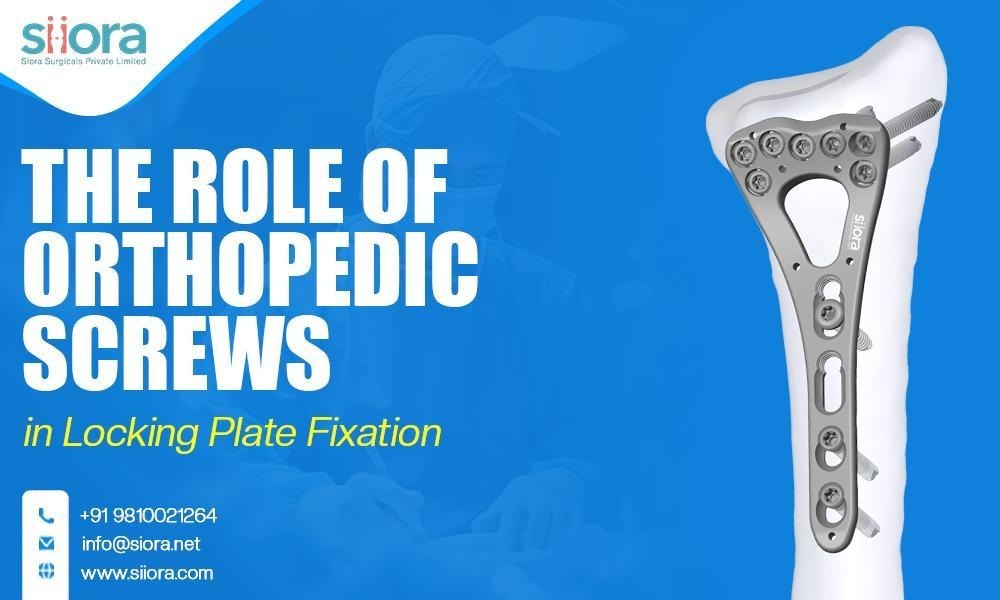
When you have a bad fracture, surgeons often use orthopedic implant plates to fix it. It’s easy to think the locking plate is the hero of the story—it’s the big, obvious piece of hardware. However, the true innovation—the engineering brilliance that underpins the entire system—is found in the screws. A locking screw is much more than a simple fastener; it is an active and crucial component that helps forge a powerful, stable structure, completely rewriting the principles of fracture fixation.
The Old Way: A Friction-Based Hope
To appreciate what a locking screw does, you have to understand how a traditional, non-locking system works. With a non-locking plate, the screw’s only job is to get a bulldog grip in the bone and squeeze the plate down onto it as tightly as possible. The entire stability of the repair relies on the friction between the plate and the bone. It’s a good system, but it has a major weakness: if the bone is soft or the fracture is shattered, the screws can loosen, the friction is lost, and the whole thing can fall apart.
The New Handshake: What Makes a Locking Screw Different?
A locking screw plays a totally different game. The head of a locking screw has threads on it, just like the shaft. The holes in a locking plate also have threads. When the surgeon tightens the screw, the head doesn’t just press against the plate; it physically threads into and locks with the plate.
This “locking handshake” between the screw and the plate creates a single, solid, fixed-angle construct. When the screw and plate are locked together, they create a single, solid unit. This small change makes a huge difference. The system’s stability no longer depends on friction. Instead, it acts like a rigid internal support structure, essentially an “internal fixator”.
What Does the Screw Actually Do?
In this new system, the locking screw is the star player, providing three critical benefits.
It Creates Stability Without Compression
With a non-locking plate, tightening the screw smashes the plate down onto the bone. This can be a problem because it can disrupt the bone’s precious blood supply (the periosteum) that lies directly under the plate. A locking screw, because it locks into the plate, doesn’t need to create this compression. The plate can sit a tiny distance off the bone, preserving that vital blood supply and creating a better biological environment for healing.
It Fights Back Against Failure
The most common failure in older plate systems was the screw “toggling” or backing out over time. In a locking system, this is nearly impossible. Because the screw head is physically locked into the plate, it can’t loosen or back out on its own. Furthermore, the fixed-angle construct distributes the load across all the screws in the plate. No single screw has to bear the entire load, dramatically reducing the risk of failure at any one point.
It Is the Ultimate Solution for Weak Bones
This is where locking screws truly shine. In an elderly patient with soft, osteoporotic bone, a non-locking screw struggles to get a good grip. A locking screw, however, doesn’t depend solely on its grip in the bone. Its stability comes from its rigid connection to the plate. This allows surgeons to get a strong, durable fix even when the bone quality is poor, which is why locking plates have become the standard of care for geriatric fractures.
Above all, variable angle locking plates are also there. Along with the locking mechanism, these plates also offer the flexibility of adjusting the angle of locking screw placement according to the type and fracture pattern.
The Bottom Line
A locking screw is far more than a simple fastener. It’s a piece of precision engineering that transforms a simple plate into a rigid, biomechanically superior scaffold. Creating a fixed-angle construct provides stability without compromising blood supply, drastically reduces the risk of hardware failure, and gives surgeons a reliable way to fix the most challenging fractures. It’s the quiet, unsung hero that makes modern fracture fixation possible.