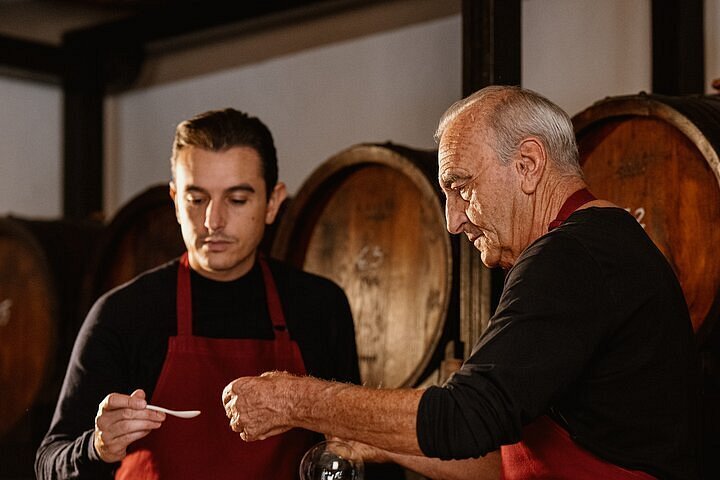
Slow tourism arises from the desire to experience places with greater attention, making room for details, stories, and local rhythms. Experiences in an acetaia respond well to this new sensitivity, because they allow visitors to approach balsamic vinegar of Modena without haste, observing the spaces where the product matures and listening to the story of a tradition made of time and care. It means entering a world where aromas, barrels, and agricultural memory become part of the journey. For many visitors, it is precisely this slowness that represents the most authentic value of the experience.
When travel slows down and taste becomes a story
Those who choose a visit to an acetaia are often looking for something different from a quick stop. They want to pause, understand, and connect a flavor to a specific place. Balsamic vinegar of Modena is particularly well suited to this type of tourism because it is born from long aging times and from work that cannot be rushed.
For those seeking a balsamic vinegar tour in a traditional acetaia in Modena, producers such as Acetaia Leonardi offer an itinerary in which the visit and the tasting become part of a broader discovery of the territory. The interest is not only in the final product, but in everything that surrounds it: the vineyards, the maturation spaces, the aromas of the wood, and the story of gestures repeated over the years. In this way, the journey naturally slows down and taste stops being a simple tasting, becoming a story to understand step by step.
Barrels, aromas, and waiting: the value of a slow visit
The charm of a visit to an acetaia such as Acetaia Leonardi also lies in its ability to make time feel different. Standing before the barrel batteries, visitors understand that balsamic vinegar is born from a patient transformation, made up of almost imperceptible stages. The aromas change from one space to another: wood, cooked must, and sharper notes create an atmosphere that invites calm observation.
This dimension fits perfectly with slow tourism, because it does not impose a fast pace and does not rely only on immediate impact. On the contrary, it requires attention. Each barrel tells of a different time, and every tasting becomes easier to understand after breathing in the environment where the product matures.
Tasting slowly: why the tasting takes on new meaning
In slow tourism, the tasting itself takes on a different value. It is not simply the moment when one “tries” a product, but the point at which all the sensations gathered during the visit take concrete form. After seeing the barrels and perceiving the aromas of the acetaia, balsamic vinegar is tasted with greater attention: its density is observed, the sweet note of the must is recognized, the balance with the acidic component is evaluated, and its persistence on the palate is followed.
This way of tasting requires time, but it gives back much more than a quick tasting. Visitors learn to distinguish nuances that would normally go unnoticed and to connect every sensation to the work that made it possible. In this way, tasting becomes a small experience of knowledge, capable of transforming balsamic vinegar from a familiar condiment into a product to be read with greater awareness.
From souvenir to memory: what remains after the experience
One of the main differences between a quick visit and a slow experience lies in what remains afterward. In the case of a visit to an acetaia, visitors do not take away only a bottle or a typical product, but a collection of images and sensations: the silence of the rooms, the scent of the wood, the sight of the barrels, the story of long aging times, and the final tasting.
All these elements transform balsamic vinegar into something more personal, connected to a place and to a moment experienced calmly. Even once back home, every use in the kitchen can recall that memory, making the product different from a simple gastronomic souvenir. It is this ability to leave a deeper memory that makes experiences in an acetaia so close to the spirit of slow tourism: less rapid consumption, more connection with the territory.