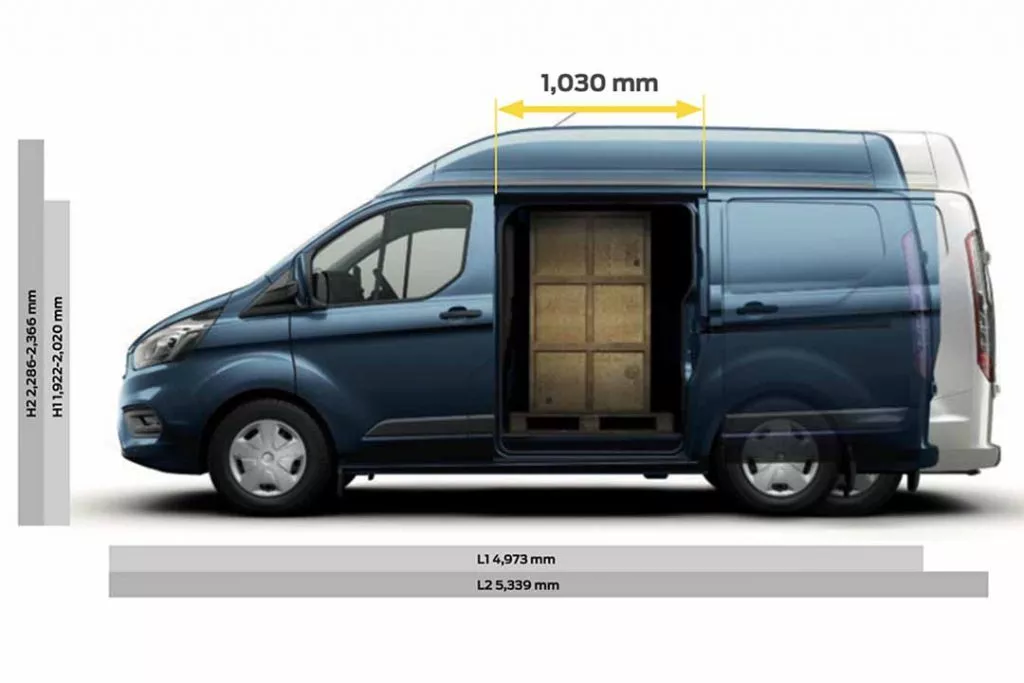
When commercial vehicle buyers search for the exact dimensions of a van, they are looking for precise, real-world data to make a critical business decision. Selecting the right chassis size isn’t just about aesthetics; it directly influences your daily driving experience, fuel efficiency, parking accessibility, garage clearance, and overall payload productivity.
The Ford Transit Custom, which stands as Europe’s and the UK’s best-selling medium van, is highly regarded for its versatile configuration options. It is primarily available in two distinctive body lengths: the L1 (Short Wheelbase / SWB) and the L2 (Long Wheelbase / LWB).
Whether you are navigating tight urban multi-story car parks, loading multiple Euro-pallets via a forklift, or planning a premium lifestyle campervan conversion, understanding the exact technical breakdown of the Ford Transit Custom length options is essential. This comprehensive guide provides accurate technical specifications across generations, evaluates interior and exterior practicalities, explores hidden payload challenges, and delivers expert advice to help you select the ideal van for your operational requirements.
The Generation Shift: Why Model Year Matters
Before diving directly into the core millimeter measurements, it is vital to clarify a major structural change implemented by Ford. Many online guides fail to distinguish between the older and newer models, leading to significant confusion and wrong information for buyers looking at different model years.
- First Generation (Mk1: 2012 – 2023): This generation set the benchmark for modern medium vans. It features a specific footprint that millions of tradespeople rely on today in the used market.
- Second Generation (All-New Mk2: 2024 – Present): Built from the ground up, the newest iteration of the Ford Transit Custom features an entirely re-engineered platform. It features a slightly lower overall height to clear standard 2-meter car parks, an elongated wheelbase across both L1 and L2 variants, and a completely redesigned interior bulkhead structure that alters the usable floor workspace.
To ensure absolute factual accuracy, we will break down the exterior and interior length technical specifications for both generations independently.
Technical Specifications Breakdown (Millimeters & Metres)

1. The All-New Ford Transit Custom (2024 to Present Generation)
The latest generation platform utilizes lightweight high-strength steels and an integrated chassis design that extends the physical outer footprint of the vehicle while optimizing internal load-carrying efficiency.
| Dimension Variable | L1 Variant (Short Wheelbase – SWB) | L2 Variant (Long Wheelbase – LWB) | The Generational Difference |
| Overall Exterior Length | 5,050 mm (5.05 m) | 5,450 mm (5.45 m) | + 400 mm |
| Wheelbase Length | 3,100 mm (3.10 m) | 3,500 mm (3.50 m) | + 400 mm |
| Maximum Internal Load Length | 2,602 mm (2.60 m) | 3,002 mm (3.00 m) | + 400 mm |
| Load Length (With Bulkhead Hatch) | 3,050 mm (3.05 m) | 3,450 mm (3.45 m) | + 400 mm |
| Standard Cargo Volume (H1 Roof) | 5.8 cubic metres ($m^3$) | 6.8 cubic metres ($m^3$) | + 1.0 cubic metre |
2. The Classic Ford Transit Custom (2012 to 2023 Generation)
If you are dealing with vehicles manufactured during the initial long-running production cycle, the footprints are slightly tighter, making them a common search target for used vehicle buyers.
| Dimension Variable | L1 Variant (Short Wheelbase – SWB) | L2 Variant (Long Wheelbase – LWB) | The Generational Difference |
| Overall Exterior Length | 4,973 mm (4.97 m) | 5,340 mm (5.34 m) | + 367 mm |
| Wheelbase Length | 2,933 mm (2.93 m) | 3,300 mm (3.30 m) | + 367 mm |
| Maximum Internal Load Length | 2,554 mm (2.55 m) | 2,921 mm (2.92 m) | + 367 mm |
| Load Length (With Bulkhead Hatch) | 3,080 mm (3.08 m) | 3,440 mm (3.44 m) | + 360 mm |
| Standard Cargo Volume (H1 Roof) | 6.0 cubic metres ($m^3$) | 6.8 cubic metres ($m^3$) | + 0.8 cubic metre |
Exterior Footprint & Urban Maneuverability
The Spatial Reality of the L1 Variant
With an exterior measurement hovering right around the 5-meter mark, the L1 variant offers a highly maneuverable urban footprint. To put this into perspective, a standard mid-sized family estate car or large SUV typically spans between 4.7 to 4.9 meters.
For multi-drop delivery drivers, residential service technicians, and inner-city couriers, the L1 presents minimal friction when searching for curbside parking or reversing into tight driveways. Furthermore, its shorter wheelbase creates a tighter turning circle (approximately 10.9 to 11.6 meters depending on the specific wheels fitted), allowing for effortless U-turns on standard city roads.
The Spatial Reality of the L2 Variant
The additional 367 mm to 400 mm appended to the rear flank of the L2 variant transitions the vehicle out of standard parking bay parameters. At 5.34 to 5.45 meters in total length, the L2 will frequently overhang standard parking spaces.
However, Ford’s engineering team has cleverly positioned the extra length within the wheelbase itself rather than merely stretching the rear overhang. This preserves excellent weight distribution and high-speed stability while towing or carrying max payloads. The turning circle increases slightly to roughly 12.1 to 12.8 meters, requiring drivers to take wider trajectories when maneuvering around narrow street corners, multi-story ramps, or tight industrial yards.
Interior Cargo Capacity & Practical Use Cases
When examining the interior cargo layout, the choice between L1 and L2 directly defines what types of physical goods your business can legally and securely transport without damaging the rear doors or the interior bulkhead.
| Van Variant | Wheelbase Type | Euro-Pallet Capacity | Maximum Flat Floor Length | Best Suited Cargo Items |
|---|---|---|---|---|
| L1 Variant | Short Wheelbase (SWB) | 2 Standard Pallets | Up to 2.60 meters | Standard 8×4 building sheets, toolboxes, component packs, and domestic equipment. |
| L2 Variant | Long Wheelbase (LWB) | 3 Standard Pallets | Up to 3.00 meters | 3-meter copper pipes, conduits, structural timber planks, carpet rolls, and bulk supplies. |
The L1 Interior Capabilities
The short wheelbase cargo bay is optimized to accommodate standard 8×4 sheet materials (2,440 mm x 1,220 mm) flat on the floor or angled against the side panels.
- Pallet Capacity: The L1 floor comfortably fits up to two standard Euro-pallets loaded sideways between the wheel arches.
- Target Trades: Highly suitable for residential electricians, painters, domestic plumbers, and mobile detailing businesses where tools and component boxes take priority over ultra-long raw materials.
The L2 Interior Capabilities
Stepping up to the long wheelbase variation alters the cargo dynamic by ensuring you have a flat load length that securely clears 3 full meters directly on the floor.
- Pallet Capacity: The L2 floor can effortlessly swallow three standard Euro-pallets, maximizing supply runs and reducing transit frequency.
- Material Accommodation: Standard 3-meter copper pipes, conduits, timber planks, and carpet rolls can be placed directly flat on the floor without requiring awkward diagonal positioning that wastes surrounding spatial volume.
- Target Trades: Essential for building contractors, carpenters, scaffolding teams, and commercial installation specialists who frequently stock extensive inventory arrays.
Maximizing Utility: The Ford Load-Through Bulkhead
One of Ford’s most celebrated engineering features across the Transit Custom range is the load-through bulkhead hatch. This functional innovation bridges the gap for tradespeople who only occasionally need to transport excessively long items but prefer the compact footprint of an L1 van.
Located at the bottom corner of the metal partition separating the cabin from the cargo area, this magnetic flip-up door allows long, thin items to slip directly underneath the passenger dual-seat storage compartment.
- In the L1 Variant: Utilizing the bulkhead hatch elevates your usable loading capacity from 2.60 meters to an impressive 3.05 meters. This means an L1 owner can occasionally haul 3-meter structural timbers or drainage pipes completely enclosed and locked inside the vehicle.
- In the L2 Variant: Opening the hatch extends the structural loading length to an immense 3.45 meters, which easily handles long professional ladders, conduits, and architectural trim pieces.
Important Note on the Hatch: While the load-through hatch adds significant length, the vertical opening under the seat is relatively narrow (around 10-15 cm high). It is designed strictly for flat or cylindrical items like pipes, boards, and ladders, rather than bulky boxes.
The Height Factor: How H1 vs H2 Changes Length Perception
A common mistake buyers make when analyzing the Ford Transit Custom length is ignoring the roof height configuration (H1 Standard Roof vs H2 High Roof).
While changing the roof height does not physically alter the exterior bumper-to-bumper length or the wheel base, it fundamentally alters how you load long items. In an H1 van, items over 2.5 meters must sit flat on the floor. In an H2 variant, the added vertical height allows you to secure long, lightweight items (like plasterboard tracks or plastic conduits) onto internal roof racks. This keeps the main floor area completely clear for tools, meaning an H1 L2 van and an H2 L1 van can sometimes solve the same length problem in completely different ways.
Campervan Conversions: Why Length Changes Everything
Over the past decade, the Ford Transit Custom has emerged as a premium alternative to the Volkswagen Transporter in the lifestyle and camper conversion markets. If you are constructing a custom-built home on wheels, vehicle length dictates your entire floor plan layout.
- The L1 Layout Compromise: An L1 chassis is popular for day vans and classic “rock and roll” bed layouts. Because the distance behind the front seats is shorter, installing a full-scale kitchenette cupboard block alongside a slide-out bed will noticeably crowd the front cabin entrance. It remains highly popular for individuals who use their campervan as a daily commuter car due to standard parking compatibility.
- The L2 Layout Luxury: The L2 is widely considered the sweet spot for professional, long-term camper conversions. The extra 400 mm of internal space grants builders the flexibility to install a fixed rear bed layout, a compact dedicated toilet/shower cubicle, or a substantially deeper kitchen workspace without compromising walkway space. The added wheelbase length also dampens road vibrations, ensuring a smooth cruising experience during long cross-country road trips.
Financial Implications & Resale Value Analysis
When looking at fleet acquisition or independent purchasing, the price differential between an L1 and an L2 variant must be weighed against long-term operational efficiency and depreciation curves.
1. Initial Purchase Capital & Fuel Trends
In both the new and used market, an L2 model carries a modest price premium over its equivalent L1 counterpart. Mechanically, both variants share identical EcoBlue diesel or Plug-In Hybrid (PHEV) powertrains. However, due to the minor structural weight increase of the extended chassis frame (approximately 40 to 60 kg depending on trim), the L2 may exhibit a nominal reduction in miles-per-gallon (MPG) when fully laden. In real-world highway driving, this difference is marginal, typically scaling under 1-2%.
2. Market Demand & Resale Trends
On the used market, L2 variants often hold their value slightly better and sell faster than L1 models. This is because buyers in the second-hand market are typically growing businesses or camper conversion enthusiasts who actively search for maximum space. An L1 model is easier to source due to higher initial fleet purchases, but an L2 remains a hot commodity that safeguards your initial investment.
Conclusion
Selecting the definitive Ford Transit Custom length hinges entirely on balancing spatial necessity against urban driving limitations.
The L1 configuration serves as a nimble, car-like tool optimized for tight parking spaces, residential streets, and businesses that prioritize agility and localized transit. It comfortably handles standard everyday equipment while maximizing fuel economy in high-congestion zones. It remains the absolute best choice for multi-drop inner-city operations.
On the other end of the spectrum, the L2 variant is an uncompromised workhorse engineered to eradicate space limitations. By extending the load floor to a true 3-meter operational landscape, it empowers tradespeople to carry larger material quantities, accommodate specialized long-form tools, and design spacious camper layouts without needing to step up to a heavy, hard-to-drive full-size transit van.
By calculating your daily material dimensions, considering your typical parking constraints, and cross-referencing your choice with the generational changes highlighted in this comprehensive breakdown, you can confidently invest in the exact Transit Custom footprint designed to drive your business forward.
Frequently Asked Questions
Can a Ford Transit Custom L1 fit a standard 8×4 sheet flat on the floor?
Yes, in both the classic (2012-2023) and all-new (2024-Present) generations, the internal width between the wheel arches and the maximum load length of the L1 platform are specifically engineered to accommodate standard 8ft x 4ft (2,440 mm x 1,220 mm) building sheets completely flat on the floor area.
How do I visually tell the difference between an L1 and an L2 Transit Custom?
The easiest visual indicator is the distance between the rear edge of the sliding side-loading door and the front curve of the rear wheel arch. On an L1 model, the sliding door frame terminates very close to the rear wheel arch. On an L2 model, there is a visible, wide vertical strip of sheet metal work separating the sliding door edge from the wheel arch archway, marking the extended wheelbase extension.
Will a long-wheelbase L2 Ford Transit Custom fit into a standard UK/European parking space?
Standard supermarket and public roadside parking spaces across the UK and Europe typically measure approximately 4.8 to 5.0 meters in total length. Because the classic L2 measures 5.34 meters and the new Mk2 L2 spans 5.45 meters, the long-wheelbase model will noticeably overhang standard bays. Drivers should seek out end-of-row bays or commercial loading zones to avoid obstructing passing traffic.
Does the longer L2 Ford Transit Custom have a lower payload capacity?
Because the L1 and L2 variants often share the exact same Gross Vehicle Mass (GVM) ratings (such as 3,000 kg or 3,200 kg variants), the additional steel required to construct the longer L2 body increases the van’s unladen curb weight. Consequently, this minor weight penalty means the L2 can sometimes have a slightly reduced legal payload limit (roughly 40 to 60 kg less) compared to an identically specced L1 model. Always verify the specific weight plate on your passenger door pillar.
What is the maximum load length achievable using the front bulkhead flap?
In the newest 2024+ Ford Transit Custom generation, utilizing the load-through bulkhead flap extends the available internal storage channel to 3,050 mm in the L1 model and a massive 3,450 mm in the longer L2 variant, making it perfect for secure pipe or ladder storage.
Does the overall length of the van change if I choose an automatic transmission?
No, choosing between a manual or automatic transmission does not alter the physical exterior length, interior load length, or wheelbase of either the L1 or L2 models. The chassis dimensions remain completely identical regardless of your drivetrain setup.
You may also read: How Oliver Wyman Spring Week Helps Launch Your Consulting Career