Fructul Oprit: What the Romanian Phrase “The Forbidden Fruit” Really Means
Some phrases travel far beyond the language they were born in, and Fructul Oprit is one of them. To an English speaker it may look unfamiliar, but its meaning is instantly recognisable once translated: “the forbidden fruit”. The phrase carries centuries of religious history, a powerful idea about temptation, and a modern life in Romanian television and everyday speech. It is a small group of words that opens a window onto Romanian language, culture and storytelling, and it is worth understanding properly rather than guessing at from the surface.
This article explains the phrase in plain English. It covers what the words literally mean, where the idea comes from in the Garden of Eden story, how the phrase is used in Romanian conversation today, and the well-known Romanian television drama that gave the title a new audience. Whether you came across the phrase in a subtitle, a song, a book or a conversation, this guide will help you understand exactly what it means and why it carries so much weight.
The Meaning of Fructul Oprit
Fructul Oprit is Romanian for “the forbidden fruit”. The phrase is made of two words: “fructul”, meaning “the fruit”, and “oprit”, meaning “forbidden” or “prohibited”. Together they form a direct equivalent of the English expression “forbidden fruit”, and Romanian speakers use it in much the same way that English speakers use the English phrase. It can describe a literal fruit that someone is not allowed to eat, but far more often it is used figuratively, to describe something desirable precisely because it is out of reach.
The Romanian saying translates as “the forbidden fruit is the sweetest”, and it captures the central idea of the phrase in a single line. The saying expresses a familiar human truth: the things we are told we cannot have often become the things we want most. A forbidden love, a banned pleasure, a rule that begs to be broken, all of these can be described as the forbidden fruit in Romanian, just as they can in English. The phrase is not a piece of obscure vocabulary. It is a living idiom that appears in conversation, in journalism, in song lyrics and in the titles of books and television programmes.
The Garden of Eden and the Forbidden Fruit
The idea behind the phrase comes from the Book of Genesis, the first book of the Bible, and the story of Adam and Eve in the Garden of Eden. In the story, God places Adam and Eve in a beautiful garden and tells them they may eat from every tree except one: the tree of the knowledge of good and evil. The fruit of that tree is forbidden to them, and they are warned that eating it will bring death. A serpent persuades Eve to taste the fruit, she shares it with Adam, and the two are expelled from the garden as a consequence of their disobedience.
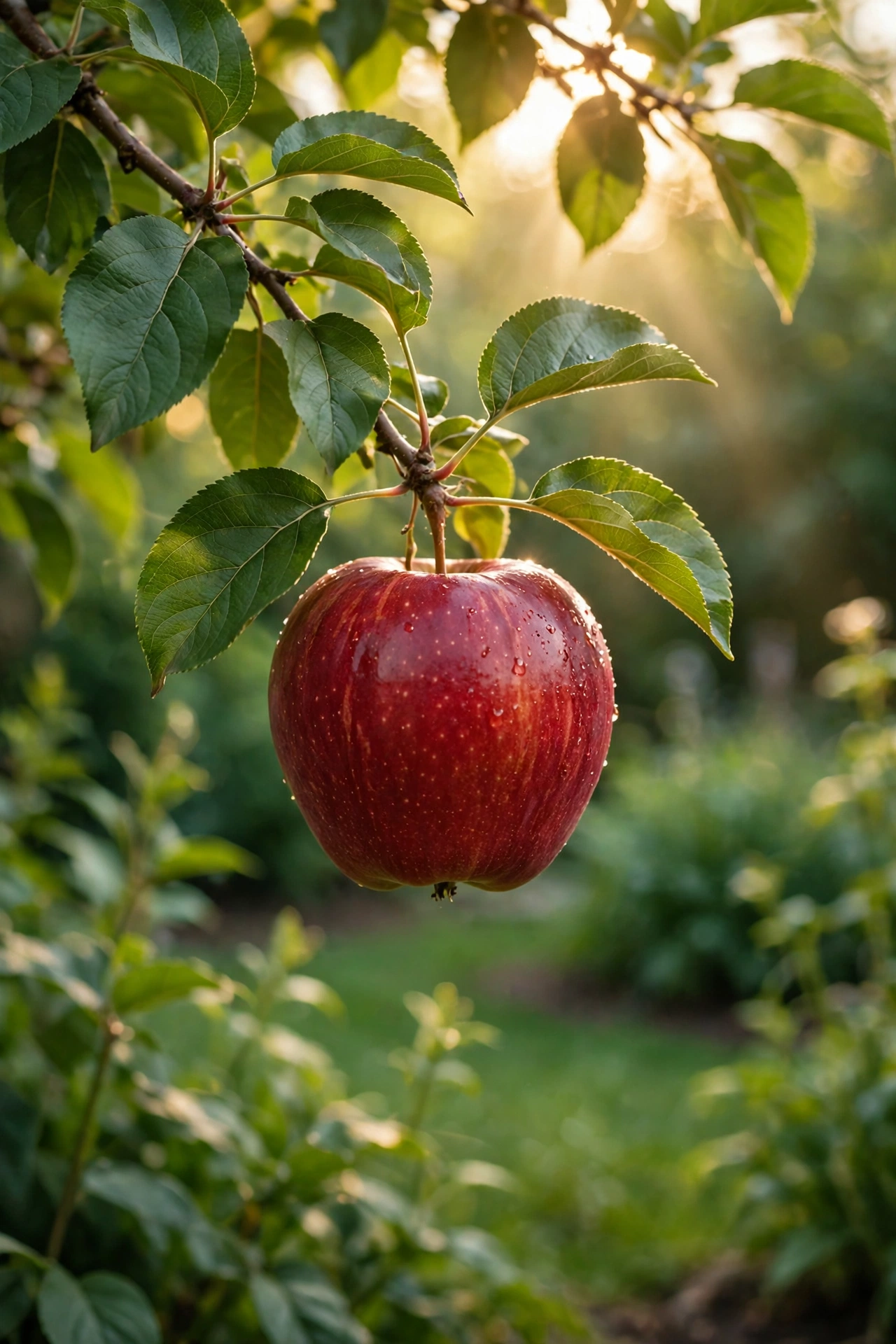
It is worth noting that the Bible itself never names the kind of fruit involved. The text speaks only of the fruit of a particular tree, and it never says that it was an apple. The association with the apple developed later in European tradition, partly through a play on the Latin word “malum”, which can mean both “evil” and “apple”, and partly through centuries of paintings that showed the scene with an apple in Eve’s hand. In Jewish tradition, the fruit has been imagined as a grape, a fig, a citron or wheat, while in Islamic tradition it is often understood as wheat. The identity of the fruit matters far less than what it represents: a boundary set by a higher authority, and the human urge to cross it.
That symbolism is why the phrase has survived for so long and travelled into so many languages. The forbidden fruit stands for temptation itself, for the appeal of the thing we are told to leave alone, and for the consequences that follow when desire wins over obedience. When a Romanian speaker uses the phrase, they are drawing on that whole history, whether they are thinking about it consciously or not. The same is true in English, where “forbidden fruit” has been used figuratively since the seventeenth century, as the Oxford English Dictionary’s records and the research on the phrase’s history confirm. You can read a clear account of the phrase’s history and its biblical roots here: Forbidden fruit on Wikipedia.
How the Phrase Is Used in Romanian Culture
In everyday Romanian, the phrase works exactly as its English cousin does. It describes a person someone is attracted to but cannot have, a pleasure that is off limits, or an opportunity that is tempting because it is forbidden. A journalist might describe a scandal as a case of the forbidden fruit, a songwriter might use it as a metaphor for a love affair that should never have happened, and a friend might use it jokingly about a cake that is supposed to be saved for guests. The tone can be serious, romantic, humorous or moralising, depending on the context, but the core meaning stays the same.
The phrase also appears in one of the most familiar Romanian proverbs about temptation. “The forbidden fruit is the sweetest” is used to explain why people chase after things they know they should avoid. It is the Romanian version of an idea that exists in many languages, and it is often quoted in articles and conversations about relationships, addiction, ambition and rule-breaking. The proverb works because it is true to experience: scarcity and prohibition make things seem more valuable, and the mind fills in the gaps with fantasy. Psychologists call this effect reactance, the tendency to want something more when we feel our freedom to have it has been taken away, but ordinary speakers have known about it for far longer than psychology has had a name for it.
Romanian culture is also deeply shaped by Orthodox Christianity, and the Garden of Eden story is part of the shared religious background that most Romanians grow up with, whether or not they are regular churchgoers. That shared background gives the phrase an extra layer of meaning in Romania. It is not only a figure of speech borrowed from literature, but a reference to a story that many people heard as children in church or at home, and that recognition makes the phrase feel natural and immediate rather than literary or imported.
Fructul Oprit: The Romanian Television Drama
The phrase reached a large new audience in 2018, when the Romanian television channel Antena 1 premiered a drama series called Fructul Oprit. The series was a psychological drama produced by Intact Media Group, and it premiered on 15 January 2018. It was a free adaptation of the Turkish novel “Ask-i Memnu”, published in 1900 by the author Halit Ziya Usakligil, and its action was set in modern Bucharest, Snagov and Istanbul. The title was a natural choice for the story, which centres on forbidden love, betrayal, family tension and the consequences of giving in to temptation.
The series ran for two seasons and 63 episodes, with a cast that included Michaela Prosan, Petru Paun, Cristina Ciobanasu and Carmen Tanase. Its story follows a wealthy family whose comfortable life is disrupted by a forbidden affair, and it uses the title’s symbolism quite deliberately: the characters are drawn towards relationships and choices they know are wrong, and the drama comes from watching the consequences unfold. The series was part of a wider wave of Romanian adaptations of Turkish drama formats, and it found a loyal audience on Antena 1, where it became one of the channel’s recognised drama titles of the late 2010s.
The show’s existence also explains why many people outside Romania encounter the phrase today. Fans of Turkish and Romanian drama share clips, subtitles and discussions online, and a series title in Romanian can travel quickly through streaming platforms and social media. Anyone who has searched for the show’s episodes, cast or soundtrack has come across the phrase in its original language, and many have wondered what it means. The answer is in the story itself: the title is a warning about the very temptation the characters cannot resist.
The Forbidden Fruit in Literature and Art
Long before Romanian television adopted the title, the forbidden fruit had already been one of the most painted and written-about images in European culture. Artists from the Renaissance onwards returned to the Garden of Eden again and again, and the image of Eve holding the fruit became one of the most recognisable scenes in Western art. Writers used it as a metaphor for knowledge, desire and disobedience, from John Milton’s epic poem “Paradise Lost”, which retells the story of the Fall in magnificent detail, to countless novels in which a character’s downfall begins with a single forbidden choice.
The idea also appears in traditions beyond Christianity. In the Islamic telling of the story, Adam and Eve eat from a forbidden tree and are sent down to earth, and the fruit is often understood as wheat. In Jewish commentary, the fruit’s identity has been debated for centuries, with grapes, figs, citrons and wheat all proposed as candidates. The variety of answers shows that the story’s power does not depend on botany. What matters is the pattern: a rule, a temptation, a choice, and a consequence. That pattern is universal, which is why the image appears in so many cultures and why it translates so easily from one language to another.
In modern popular culture, the forbidden fruit has become a shorthand for any desire that is made stronger by being denied. Advertisers use it to sell perfume and chocolate, filmmakers use it as a title for stories about affairs and obsessions, and songwriters use it to describe a love that cannot be openly acknowledged. The phrase works in all of these settings because the audience already knows the story, even if they have never read the Book of Genesis. It is one of the rare biblical images that has become part of everyday language in many countries at once.
Why Forbidden Things Feel More Desirable
There is a real psychological reason why the forbidden fruit tastes sweetest, and it helps explain why the phrase has lasted so long. When something is forbidden, our attention is drawn to it, and our imagination fills in what we are missing. The restriction itself becomes a signal that the thing must be valuable, otherwise why would anyone bother to forbid it? This is the same effect that makes a “do not touch” sign in a museum almost impossible to ignore, and it is the reason why banned books are often the most widely read.
Social scientists have studied this effect under the name of psychological reactance, and their findings match the folk wisdom of the proverb. People who are told they cannot do something often become more determined to do it, and the desire can grow stronger the more forcefully the rule is stated. That does not mean that every rule should be abandoned, because many prohibitions protect people from real harm, but it does explain why temptation is such a durable theme in stories. The best storytellers understand that a rule creates a dramatic question, and the audience stays to find out whether the character will obey it or break it.
The phrase also captures a tension that runs through many cultures, including Romanian culture: the tension between tradition and desire, between what the community expects and what the individual wants. In a society where family, faith and reputation matter deeply, a forbidden love or a forbidden ambition carries real social risk, and that risk makes the story more compelling. The television drama understood this perfectly, which is why its title resonated with its audience. The forbidden fruit is not only a religious image, but a social one, and its meaning changes with the society that uses it.
Learning Romanian Through Phrases Like This One
For anyone learning Romanian, phrases like this one are a gift, because they show how the language works at its most expressive. The grammar is simple, two words and a clear meaning, but the cultural weight is enormous. Learning the phrase teaches the learner not only vocabulary, but also something about Romanian history, religion and popular culture. It is the kind of expression that makes a language feel alive, because it connects a grammar lesson to a story that people actually tell.
If you are studying Romanian, it is worth learning the phrase alongside its proverb, “the forbidden fruit is the sweetest”, and trying it in conversation. Native speakers will recognise it immediately, and using it correctly is a sign that the learner understands more than just the dictionary meaning of the words. The same is true of many Romanian idioms, which often carry a biblical or folk reference that explains why they mean what they mean. Language learning is often presented as a matter of memorising words, but phrases like this one show that it is really a matter of learning stories.
What Does Fructul Oprit Mean in English?
It means “the forbidden fruit” in English. The phrase is made of “fructul”, meaning “the fruit”, and “oprit”, meaning “forbidden” or “prohibited”. It is used in the same figurative way as the English phrase “forbidden fruit”, to describe something desirable that is not allowed, such as a forbidden love or a banned pleasure. The phrase comes from the biblical story of Adam and Eve in the Garden of Eden, and the Romanian proverb about the forbidden fruit means “the forbidden fruit is the sweetest”.
Is Fructul Oprit a TV Show?
Yes, the phrase is also the title of a Romanian television drama that premiered on Antena 1 on 15 January 2018. The psychological drama was produced by Intact Media Group and was a free adaptation of the 1900 Turkish novel “Ask-i Memnu” by Halit Ziya Usakligil, with the action set in modern Bucharest, Snagov and Istanbul. It ran for two seasons and 63 episodes, and its cast included Michaela Prosan, Petru Paun, Cristina Ciobanasu and Carmen Tanase. The title fits the story, which centres on forbidden love and its consequences.
What Is the Story of the Forbidden Fruit in the Bible?
In the Book of Genesis, God tells Adam and Eve they may eat from every tree in the Garden of Eden except the tree of the knowledge of good and evil. A serpent persuades Eve to eat its fruit, she shares it with Adam, and both are expelled from the garden as a consequence. The Bible never names the kind of fruit, and the common idea that it was an apple developed later in European tradition. The story is the origin of the phrase “forbidden fruit” in English and its equivalents in many other languages, including Romanian.
How Do You Pronounce the Phrase?
It is pronounced approximately as “FROOK-tool oh-PREET” in English spelling, with the stress on the first syllable of “fructul” and the second syllable of “oprit”. The letter “u” sounds like the “oo” in “book”, and the letter “i” sounds like the “ee” in “see”. Romanian pronunciation is largely phonetic, so each letter is pronounced, and the phrase is short enough to learn quickly. Listening to a native speaker say it once is the best way to get the sounds exactly right.
Why Is the Forbidden Fruit Often Shown as an Apple?
The forbidden fruit is often shown as an apple because of a Latin wordplay and centuries of artistic tradition, not because the Bible says so. The Latin word “malum” can mean both “evil” and “apple”, and European painters adopted the apple as a convenient visual symbol for the fruit of the tree of knowledge. Over time, the image became so familiar that many people assume the Bible names an apple, when in fact the text never identifies the fruit at all. Other traditions have suggested a grape, a fig, a citron or wheat instead.
What Is the Romanian Proverb About the Forbidden Fruit?
The best-known Romanian proverb on this theme says the forbidden fruit is the sweetest. It expresses the idea that things we are not allowed to have often seem more desirable because they are forbidden. The proverb is used in conversations about relationships, temptation and rule-breaking, and it has an equivalent in English in the saying “forbidden fruit is always the sweetest”. Both versions capture the same human tendency to want what is denied to us.
Conclusion
Fructul Oprit is a small phrase with a very large history. In Romanian it means “the forbidden fruit”, and it carries the whole weight of the Garden of Eden story, the psychology of temptation, and a modern life in proverbs, songs and television. The Romanian drama of the same name gave the phrase a new audience in 2018, but the idea behind it is far older, and it belongs to no single language or country. Whether it describes a forbidden love, a banned pleasure or a choice that should never have been made, the phrase works because everyone understands the feeling it names. The forbidden fruit is the sweetest, and that is exactly why it is forbidden.
For more explainers and cultural guides, take a look at our guide to rugby positions.