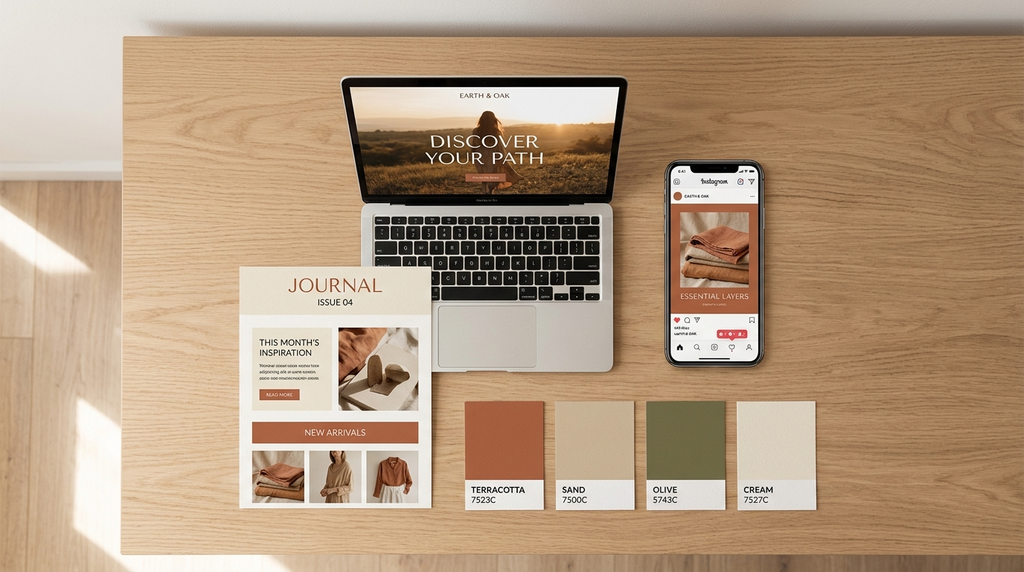
Your logo looks great. Your website is polished. But scroll through your social media posts, product listings, and email campaigns side by side, and something feels off. The colours shift. The lighting changes. The overall mood drifts from one piece to the next. If this sounds familiar, you are not alone — and it is costing you more than you think.
Brand consistency is one of those things every business knows matters but few manage to maintain in practice. Research consistently shows that presenting a brand uniformly across all platforms can increase revenue by up to 23 percent. Customers form impressions in milliseconds, and when your visuals tell a fragmented story, trust erodes before anyone reads a word of your copy.
The challenge has always been execution. Creating a cohesive visual identity across a website, four social media platforms, marketplace listings, email templates, and advertising banners requires either a dedicated design team or a very patient freelancer. For most businesses, neither option scales well.
The Real Problem Is Not Creating Images — It Is Keeping Them Consistent
Most businesses can produce a good image when they need one. The problem shows up at scale. A product photo shot by one photographer in January looks nothing like the lifestyle image taken by a different photographer in March. The Instagram designer uses slightly different brand colours than the email marketing team. The banner ad uses a font weight that exists nowhere else on the website.
These are not careless mistakes. They are the natural result of visual production being spread across multiple people, tools, and timelines. Brand guidelines help in theory, but in practice, a 40-page PDF sitting in a shared drive does not prevent style drift when someone needs an image in 20 minutes.
The traditional solution — running everything through a single creative director — works beautifully until the volume of content exceeds what one person can review. In 2026, with most brands producing dozens of visual assets per week across multiple channels, that bottleneck arrives quickly.
How Conversational AI Changes the Equation
The latest generation of AI image tools uses a conversational interface rather than technical prompt syntax. You describe what you need in plain language, review the output, and refine through follow-up messages. This workflow turns out to be particularly well suited to maintaining brand consistency for a reason that is easy to overlook.
When you describe your brand’s visual language in a conversation — “warm golden-hour lighting, minimal backgrounds with natural textures, muted earth tones, plenty of negative space” — the AI maintains that context across the entire session. Every image you generate within that conversation inherits the same visual DNA. Adjustments are incremental. The style does not reset between images.
This is fundamentally different from working with separate designers or even using traditional prompt-based AI tools, where each generation starts from a blank slate and consistency depends entirely on how precisely you replicate your instructions each time.

A Practical Approach to Building Brand Visuals with AI
If you are starting from scratch or trying to bring consistency to an existing visual library, here is a workflow that works:
Define your visual anchors first. Before generating anything, write down four or five characteristics that define your brand’s look. Lighting direction and warmth. Background style. Colour temperature. Level of detail. Typography mood. These anchors become the foundation of every conversation you have with the tool.
Generate your core assets in a single session. Produce your hero image, key product shots, and primary social media templates within one conversation. Because the AI remembers context, the outputs will share a consistent visual language without you having to repeat your specifications for each one.
Use native multi-format generation. A single visual concept often needs to exist as a landscape website banner, a square social post, a vertical mobile story, and a wide-format advertisement. Tools that generate natively across multiple aspect ratios — rather than cropping from a single output — preserve composition and brand intent across every format.
Iterate within the conversation, not from scratch. When you need seasonal variations or new product additions, continue the existing conversation or describe adjustments relative to your established style. “Same visual language as before, but shift the palette toward cooler tones for winter” keeps your brand coherent while allowing it to evolve.
Putting It Into Practice
Banana AI is one example of how this conversational approach works in practice. Built on Google’s Gemini models, it maintains context across multi-turn conversations, supports 14 native aspect ratios including ultra-wide formats, and renders text accurately within images — which matters when your brand assets include logos, taglines, or annotated product shots. The platform offers multiple model tiers from quick concept drafts to high-fidelity 4K output, with pricing starting at $9.9 per month.
The broader point extends beyond any single tool. The shift from isolated image generation to context-aware conversational workflows makes maintaining a consistent visual brand identity something that a solo entrepreneur or a small marketing team can realistically achieve — without the overhead of a full creative department.
As demonstrated by the Banana AI team, they have perfectly bridged theory and practice in their tutorial, Shopify Product Photography. By translating their hands-on experience with Nano Banana prompts into action, leveraging their core tools, and applying keen insights into product photography, they have mapped out an ultra-low-cost workflow for Shopify merchants to generate commercial-grade product photo sets.

The Bottom Line
Visual brand consistency is not about perfection. It is about recognition. When a customer sees your product on Instagram, lands on your website, and receives your email — the visual experience should feel like it comes from the same place. That sense of coherence builds trust, and trust drives decisions.
AI image tools have not made good design irrelevant. They have made consistent visual production achievable at a scale that was previously reserved for brands with dedicated creative teams. For businesses that take their visual identity seriously, that is a shift worth paying attention to.
The strongest brands are not the ones with the most expensive visuals. They are the ones you recognise instantly, no matter where you encounter them.