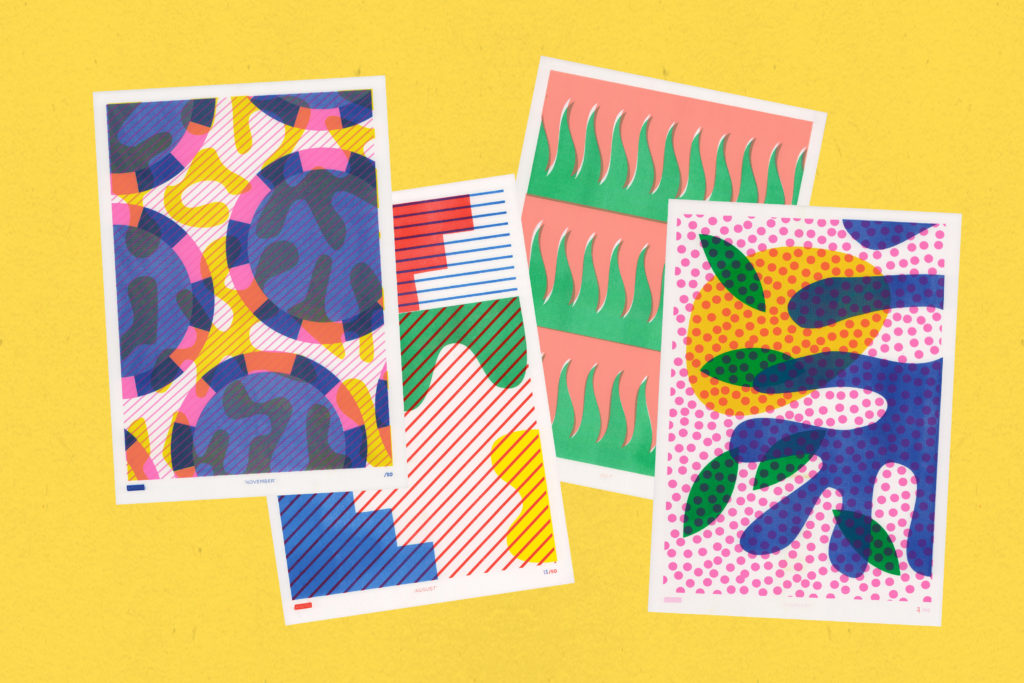
Risograph printing has carved out a unique place in modern print culture by doing something most commercial printing avoids: embracing imperfection. Instead of chasing flawless precision, this process celebrates texture, bold colour, and subtle variation. As a result, risograph printing has become a favourite among artists, designers, photographers, and independent publishers who want their work to feel expressive rather than mass-produced.
At first glance, a risograph machine looks like an ordinary office copier. In reality, it functions more like an automated screen printer, producing layered, ink-rich prints that feel tactile and alive. While the process has existed for decades, its resurgence in creative fields is very much a modern phenomenon. Today, risograph printing is chosen not because it is the most accurate method, but because it produces results no other printing process can truly replicate.
This article explains what risograph printing is, how it actually works in practice, where it excels, where it fails, and how to decide whether it is the right choice for your project.
What Is Risograph Printing?
Risograph printing is a stencil-based printing method that uses real ink and spot colours rather than digitally mixed tones. Each colour in a design is printed separately using its own ink drum, meaning the final image is built layer by layer. Unlike standard digital printing, colours are not blended on a screen and transferred to paper; they are physically overprinted on the page.
This approach gives risograph prints a distinctive appearance. Colours appear unusually vibrant, ink coverage can vary slightly across the page, and overlapping layers often create unexpected new tones. These characteristics are not accidents of poor quality control—they are inherent to the process and widely considered part of its appeal.
Originally designed for fast, economical duplication, risograph machines were widely used in schools, offices, and community organisations. Over time, creatives recognised that the process produced results that felt closer to traditional printmaking than modern digital output. That discovery transformed risograph printing into a respected creative medium rather than just a utilitarian tool.
How the Risograph Printing Process Works
The risograph printing process begins with preparing artwork as separate colour layers. Each layer represents one ink colour and must be printed independently. Once a file is ready, the machine creates a thin stencil—often called a master—for that specific layer.
This stencil is wrapped around a rotating drum filled with ink. As paper passes through the machine, ink is pushed through the tiny openings in the stencil and transferred directly onto the paper. When more than one colour is involved, the paper is run through the machine again with a different drum and stencil.
Because the paper feeds flat and each pass is mechanical, minor shifts in alignment are common. Ink coverage can also vary slightly depending on paper type, humidity, and ink density. Rather than being defects, these variations give risograph prints their characteristic depth and movement.
Once the stencils are created, the machine can print hundreds of copies quickly and efficiently, making risograph printing well suited to repeated designs and medium-sized runs.
What Makes Risograph Printing Visually Different

The most noticeable difference between risograph printing and other methods is how the ink behaves on paper. Risograph ink sits on the surface rather than being fused or absorbed instantly. This creates a soft, tactile finish that feels closer to traditional screen printing than to laser or inkjet output.
Another defining feature is colour interaction. Since risograph printing relies on spot colours, designers must think in layers rather than blends. Overprinting one colour on top of another creates entirely new hues, often with unpredictable results. This unpredictability is a major reason creatives are drawn to the process.
Unlike digital printing, where consistency is the goal, risograph printing produces subtle variation from print to print. No two copies are ever perfectly identical, which adds to the sense that each piece is handmade rather than manufactured.
Advantages of Risograph Printing
One of the strongest advantages of risograph printing is its ability to produce bold, high-impact colour without the cost of traditional screen printing. Once the setup is complete, printing large quantities becomes surprisingly affordable, especially when compared to other spot-colour methods.
The process is also relatively energy-efficient. Risograph machines do not rely on heat to set ink, and the inks themselves are typically vegetable-based. For creators who care about sustainability, this makes risograph printing an appealing alternative to more resource-intensive printing techniques.
Another benefit is speed. After the initial setup, risograph machines can print at very high speeds, making them ideal for posters, zines, flyers, and publications that require hundreds or thousands of copies in a short time.
Limitations You Must Understand Before Choosing Risograph Printing
Despite its strengths, risograph printing is not a universal solution. One of its biggest limitations is precision. Fine detail, tight registration, and photographic realism are difficult to achieve consistently. Projects that require exact colour matching or perfect alignment are usually better suited to digital or offset printing.
Ink drying time is another important consideration. Because the ink sits on the surface of uncoated paper, prints can smudge if handled too soon or too frequently. This makes risograph printing less suitable for items that will be heavily handled, such as menus or packaging.
It is also important to understand that risograph inks are not fully archival. Over long periods, especially when exposed to sunlight, colours may fade. For projects that need long-term colour stability, other printing methods may be more appropriate.
Designing Effectively for Risograph Printing

Designing for risograph printing requires a different mindset than designing for screens or digital printers. Instead of thinking in gradients and blended tones, designers must plan artwork in distinct layers. Limiting the number of colours—often between one and four—helps keep designs clear and costs manageable.
Bold shapes, strong typography, and high-contrast imagery tend to work best. While photographs can be printed using risograph techniques, they usually need to be simplified or converted into halftones to translate well through stencils.
Understanding ink coverage is essential. Heavy ink areas can lead to smudging, while very fine details may not transfer cleanly. Many studios recommend testing small runs before committing to a full print job, as experimentation is a core part of working with this process.
Common Creative Uses of Risograph Printing
Risograph printing is widely used for creative projects that benefit from texture and individuality. Independent publishers often rely on it for zines, booklets, and small-run publications where a handcrafted feel enhances the content.
Artists use risograph printing for limited-edition prints, posters, and illustrations, taking advantage of its bold colours and organic variations. Photographers also experiment with risograph printing to introduce grain, contrast, and colour effects that are difficult to achieve digitally.
Beyond physical printing, the risograph aesthetic has influenced digital design trends. Many designers now emulate risograph textures and overprint effects in software, inspired by the process even when working entirely digitally.
Risograph Printing Compared to Other Methods
Compared to digital printing, risograph printing offers stronger colour presence and texture but sacrifices accuracy and consistency. Digital printing is ideal for short runs and photographic detail, while risograph printing shines when repetition and bold design are priorities.
When compared to screen printing, risograph printing is faster and less labour-intensive, particularly for multi-page projects. Screen printing allows more control over ink thickness and materials but requires significantly more manual setup.
Offset printing remains the best choice for very large runs and precise colour reproduction. However, risograph printing occupies a valuable middle ground, offering creative freedom, affordability, and character for projects that do not require perfection.
Is Risograph Printing the Right Choice for Your Project?
Risograph printing works best when you value expression over uniformity. If your project benefits from texture, bold colour, and slight variation, the process can elevate your work in ways that other methods cannot.
However, if consistency, fine detail, or long-term durability are critical, risograph printing may not be the best option. Understanding these trade-offs is essential before committing to the process.
For many creatives, the appeal of risograph printing lies precisely in what it lacks. Its imperfections make each print feel intentional, personal, and alive—qualities that are increasingly rare in modern production.
Conclusion
Risograph printing is not simply a printing technique; it is a creative philosophy. By prioritising colour, texture, and variation, it offers an alternative to the uniform perfection of modern printing. This is why it continues to attract artists, designers, and independent publishers around the world.
When used thoughtfully, risograph printing delivers results that feel expressive, tactile, and distinctive. It is not suitable for every project, but for the right purpose, it remains one of the most compelling print processes available today.
If you are willing to design with its strengths and respect its limitations, risograph printing can transform simple ideas into memorable physical objects.
You may also read: Jacqueline Fernandez’s Style and Presence at Cannes 2025